“The knowledge of which geometry aims is the knowledge of eternal” — Plato
Omar Khayyam was a Persian mathematician, astronomer and poet. As a poet, his classic work Rubaiyat attained world fame.
Khayyam’s work is an effort to unify Algebra and Geometry. Khayyam’s work can be considered the first systematic study and the first exact method of solving cubic equations. He accomplished this task using Geometry. His efforts in trying to generalize the principles of Geometry provided by Euclid, inspired many European mathematicians to the eventual discovery of non-Euclidean Geometry. Khayyam was a perfect example of being a notable scientist and a great poet, an achievement which many do not possess.
To recall congruent triangles and understand the definition of similar triangles.
To understand the properties and construction of similar triangles and apply them to solve problems.
To prove basic proportionality theorem, angle bisector theorem and study their applications and study the construction of triangles under given conditions.
To prove Pythagoras theorem and study its applications.
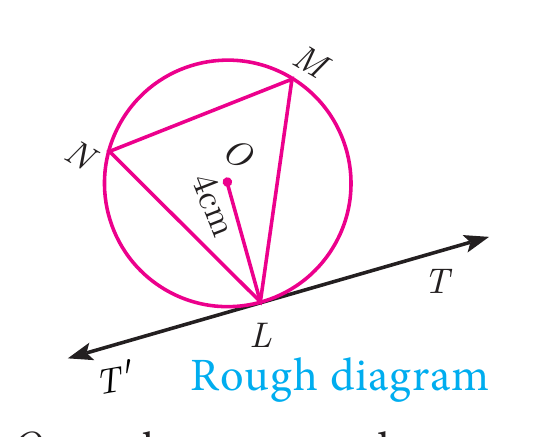
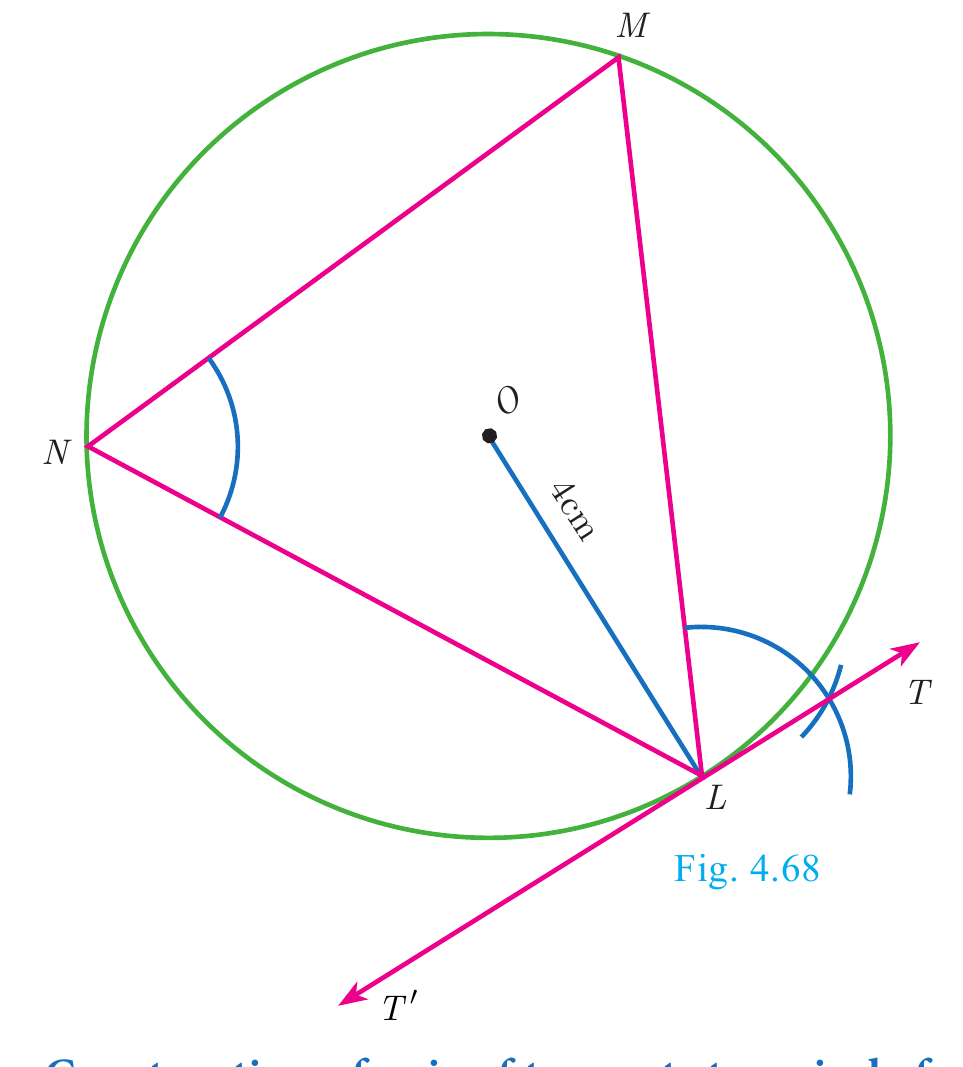
To understand the concept of tangent to a circle and study construction of tangent to circle.
The study of Geometry is concerned with knowing properties of various shapes and structures. Arithmetic and Geometry were considered to be the two oldest branches of mathematics. Greeks held Geometry in high esteem and used its properties to discuss various scientific principles which otherwise would have been impossible. Eratosthenes used the similarity of circle to determine the circumference of the Earth, distances of the moon and the sun from the Earth, to a remarkable accuracy. Apart from these achievements, similarity is used to find width of rivers, height of trees and much more.
In this chapter, we will be discussing the concepts mainly as continuation of previous classes and discuss most important concepts like Similar Triangles, Basic Proportionality Theorem, Angle Bisector Theorem, the most prominent and widely acclaimed Pythagoras Theorem and much more. Ceva’s Theorem and Menelaus Theorem is introduced for the first time. These two new theorems generalize all concurrent theorems that we know. Overall, the study of Geometry will create interest in the deep understanding of objects around us.
Geometry plays vital role in the field of Science, Engineering and Architecture. We see many Geometrical patterns in nature. We are familiar with triangles and many of their properties from earlier classes.
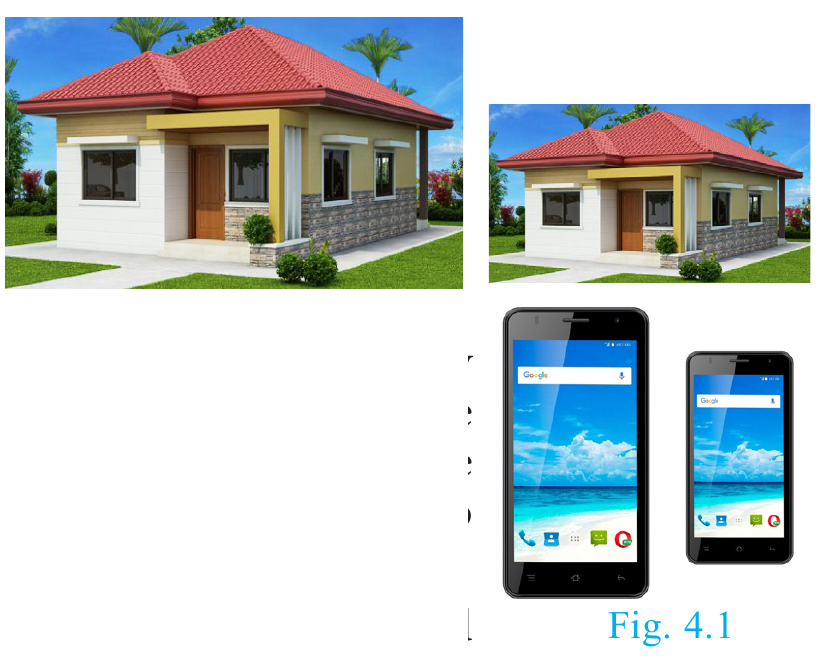
Two figures are said to be similar if every aspect of one figure is proportional to other figure. For example:
The above houses look the same but different in size. Both the mobile phones are the same but they vary in their sizes. Therefore, mathematically we say that two objects are similar if they are of same shape but not necessarily they need to have the same size. The ratio of the corresponding measurements of two similar objects must be proportional.
Fig. 4.1
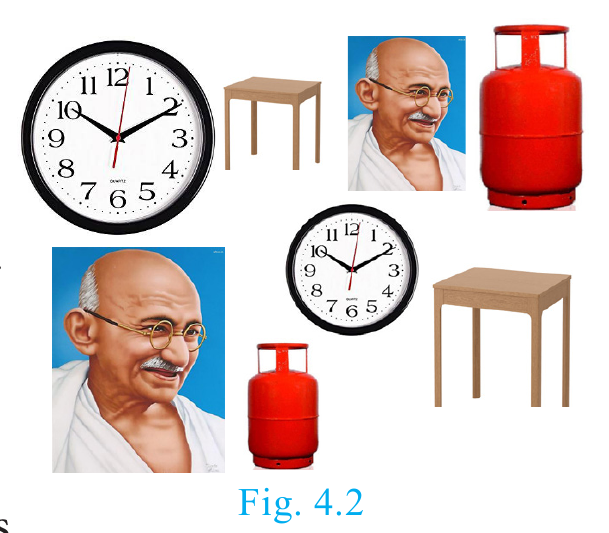
Here is a box of geometrical shapes. Collect the similar objects and list out.
Fig. 4.2
In this chapter, we will be discussing specifically the use of similar triangles which is of utmost importance where if it is beyond our reach to physically measure the distance and height with simple measuring instruments. The concept of similarity is widely used in the fields of engineering, architecture and construction.
Here are few applications of similarity
(i) By analyzing the shadows that make triangles, we can determine the actual height of the objects.
(ii) Used in aerial photography to determine the distance from sky to a particular location on the ground.
(iii) Used in Architecture to aid in design of their work.
In class IX, we have studied congruent triangles. We can say that two geometrical figures are congruent, if they have same size and shape. But, here we shall study about geometrical figures which have same shape but proportional sizes. These figures are called “similar”.
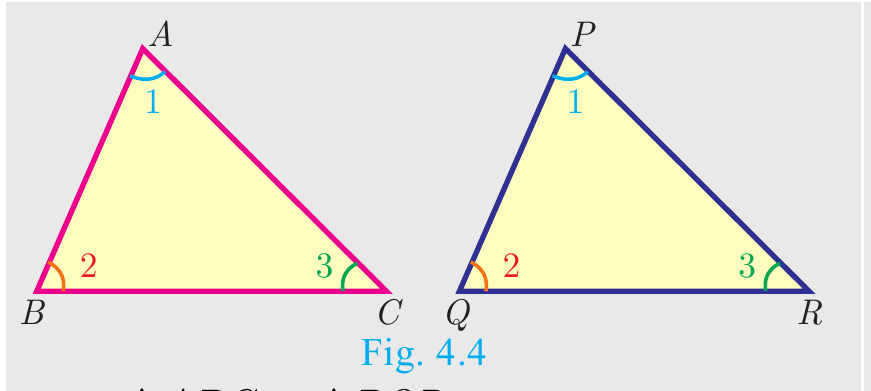
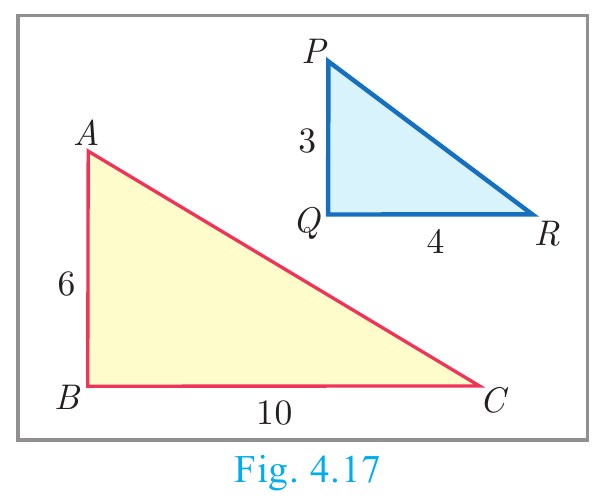
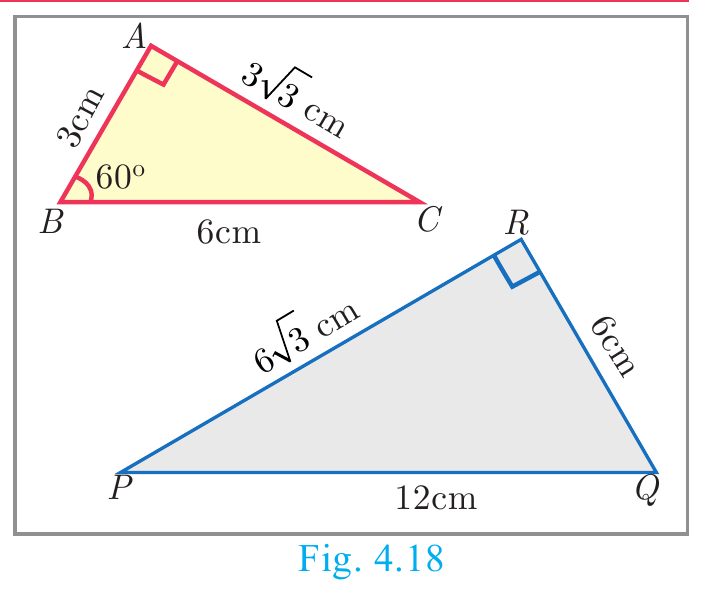
Congruency is a particular case of similarity. In both the cases, three angles of one triangle are equal to the three corresponding angles of the other triangle. But in congruent triangles, the corresponding sides are equal. While in similar triangles, the corresponding sides are proportional.
Note
The traingles $ABC$ and $PQR$ are similar can be written as $\triangle ABC \sim \triangle PQR$
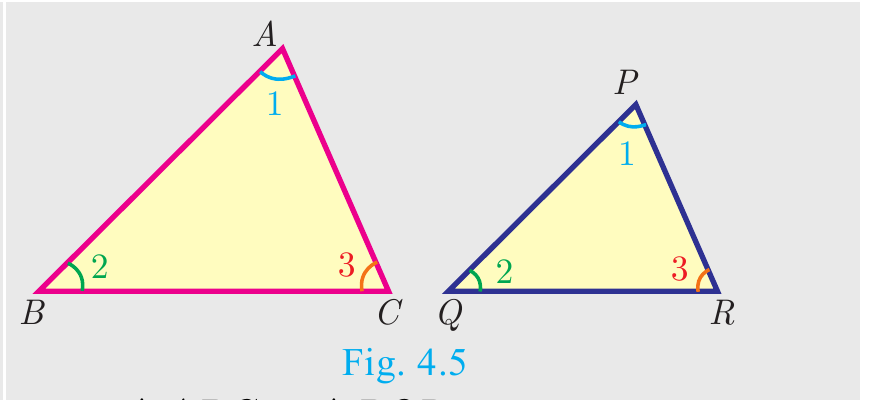
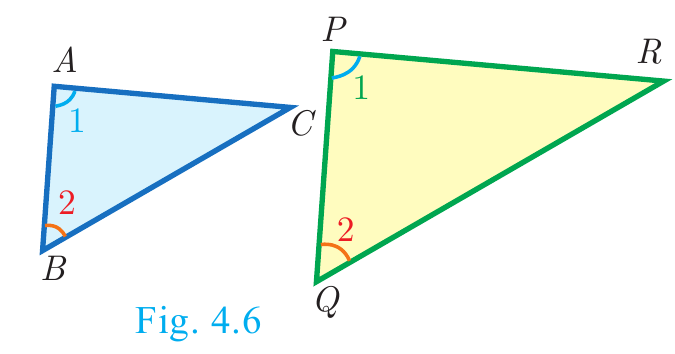
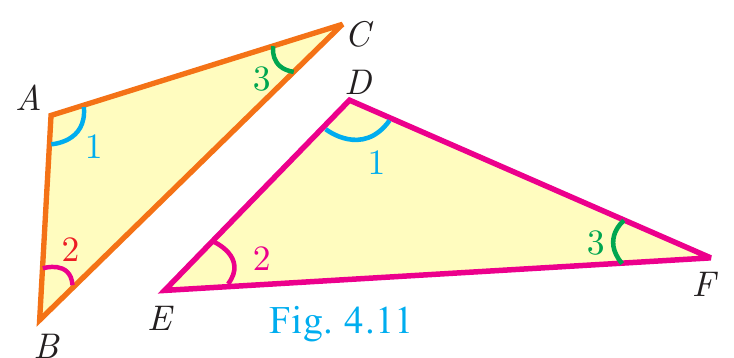
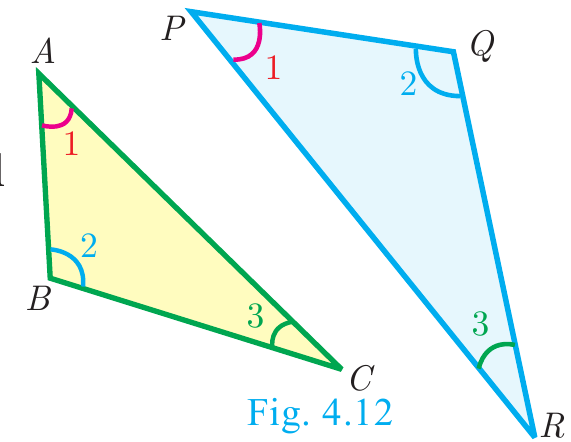
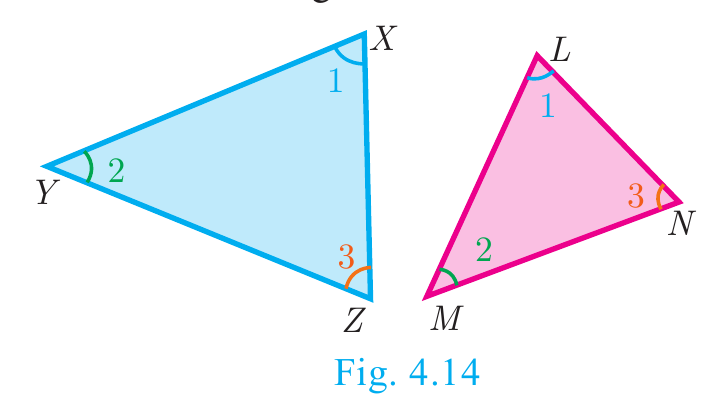
If two angles of one triangle are respectively equal to two angles of another triangle, then the two triangles are similar, because the third angle in both triangles must be equal. Therefore, AA similarity criterion is same as the AAA similarity criterion.
Fig. 4.6
So if $\angle A=\angle P=1$ and $\angle B=\angle Q=2$ then $\triangle ABC\sim\triangle PQR$.
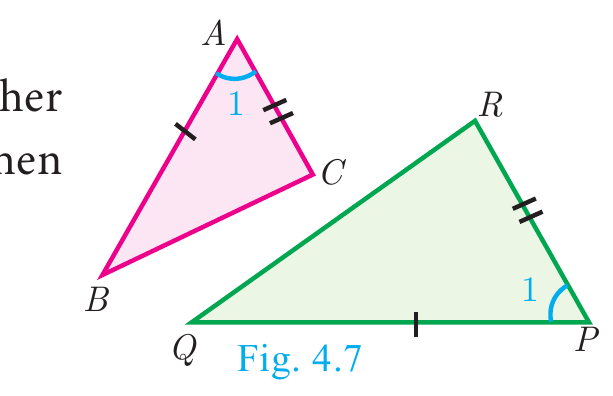
If one angle of a triangle is equal to one angle of another triangle and if the sides including them are proportional then the two triangles are similar.
Thus if $\angle A=\angle P=1$ and $\dfrac{AB}{PQ}=\dfrac{AC}{PR}$ then $\triangle ABC\sim\triangle PQR$
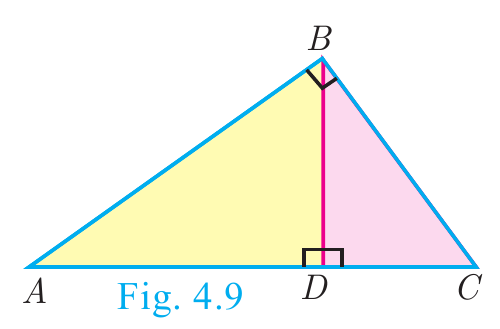
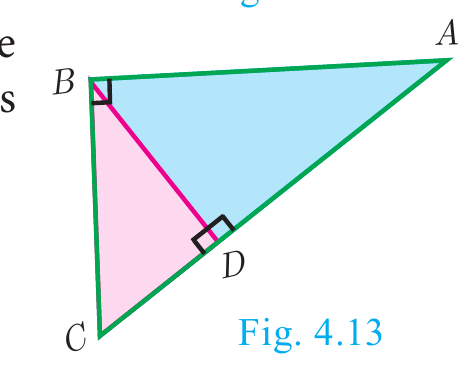
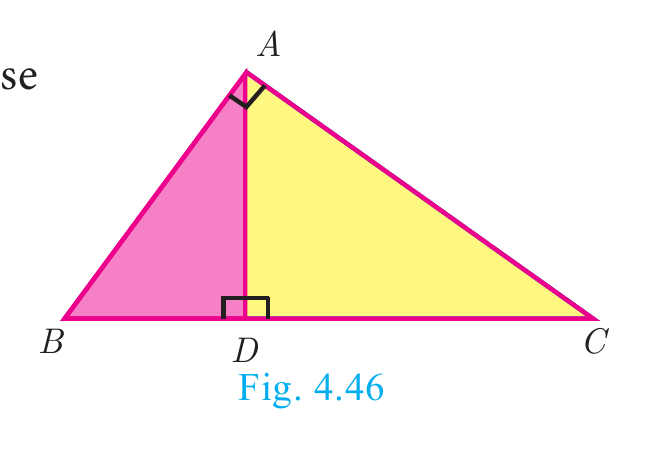
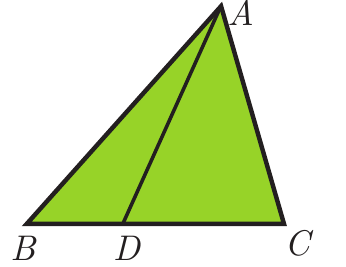
A perpendicular line drawn from the vertex of a right angled triangle divides the triangle into two triangles similar to each other and also to original triangle.
If two triangles have common vertex and their bases are on the same straight line, the ratio between their areas is equal to the ratio between the length of their bases.
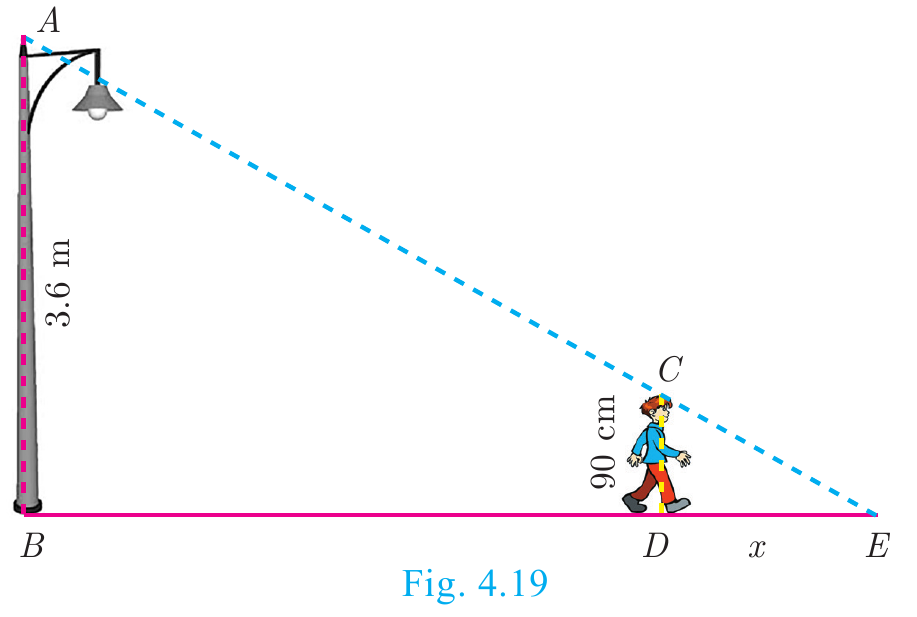
A boy of height 90cm is walking away from the base of a lamp post at a speed of 1.2m/sec. If the lamppost is 3.6m above the ground, find the length of his shadow cast after 4 seconds.
Fig. 4.19
Solution Given, speed $=1.2$ m/s, time $=4$ seconds
If $\triangle ABC$ is similar to $\triangle DEF$ such that $BC=3$ cm, $EF=4$ cm and area of $\triangle ABC=54\text{ cm}^2$. Find the area of $\triangle DEF$.
Solution Since the ratio of area of two similar triangles is equal to the ratio of the squares of any two corresponding sides, we have
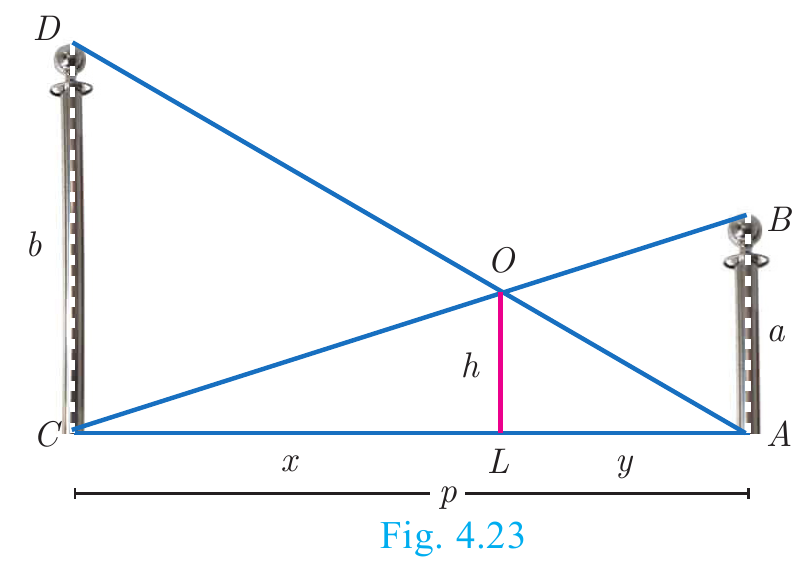
Two poles of height ‘$a$’ metres and ‘$b$’ metres are ‘$p$’ metres apart. Prove that the height of the point of intersection of the lines joining the top of each pole to the foot of the opposite pole is given by $\dfrac{ab}{a+b}$ metres.
Fig. 4.23
Solution Let $AB$ and $CD$ be two poles of height ‘$a$’ metres and ‘$b$’ metres respectively such that the poles are ‘$p$’ metres apart. That is $AC=p$ metres. Suppose the lines $AD$ and $BC$ meet at $O$, such that $OL=h$ metres
Let $CL=x$ and $LA=y$.
Then, $x+y=p$
In $\triangle ABC$ and $\triangle LOC$, we have
$\angle CAB=\angle CLO$ [each equal to $90^\circ$]
So far we have discussed the theoretical approach of similar triangles and their properties. Now we shall discuss the geometrical construction of a triangle similar to a given triangle whose sides are in a given ratio with the corresponding sides of the given triangle.
This construction includes two different cases. In one, the triangle to be constructed is smaller and in the other it is larger than the given triangle. So, we use the following term called “scale factor” which measures the ratio of the sides of the triangle to be constructed with the corresponding sides of the given triangle. Let us take the following examples involving the two cases:
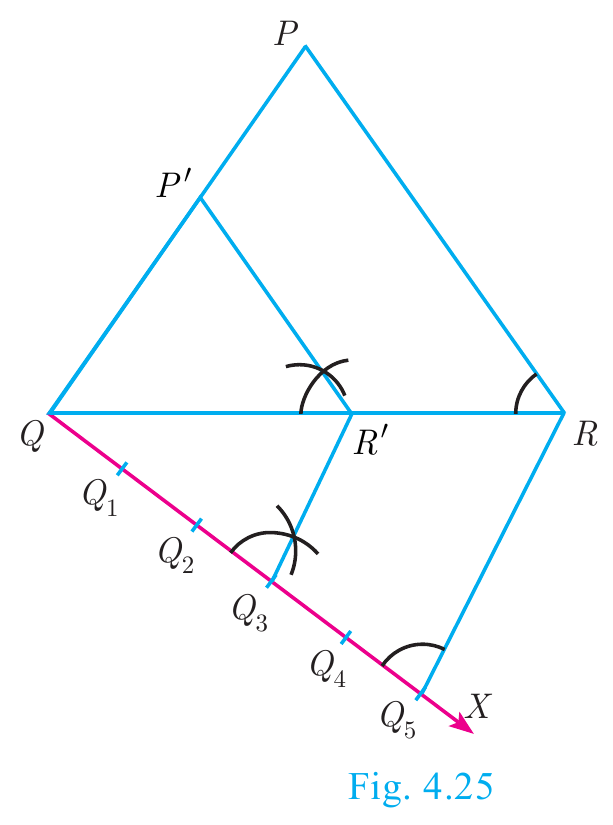
Construct a triangle similar to a given triangle $PQR$ with its sides equal to $\dfrac35$ of the corresponding sides of the triangle $PQR$ (scale factor $\dfrac35<1$)
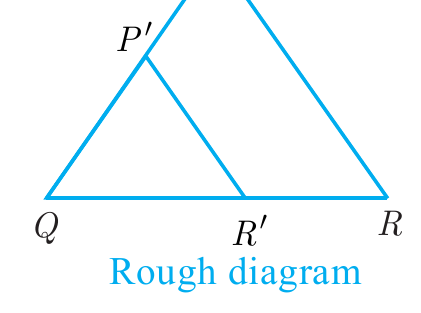
Solution Given a triangle $PQR$ we are required to construct another triangle whose sides are $\dfrac35$ of the corresponding sides of the triangle $PQR$.
Construct a triangle similar to a given triangle $PQR$ with its sides equal to $\dfrac74$ of the corresponding sides of the triangle $PQR$ (scale factor $\dfrac74>1$)
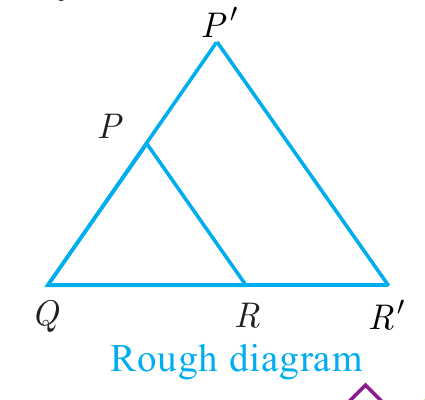
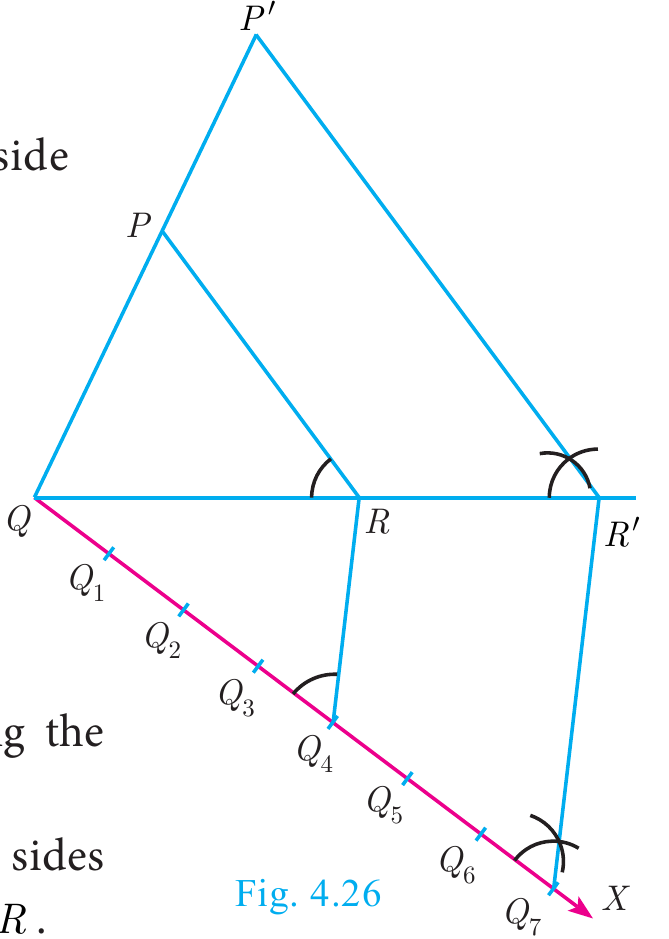
Solution Given a triangle $PQR$, we are required to construct another triangle whose sides are $\dfrac74$ of the corresponding sides of the triangle $PQR$.
Draw a ray $QX$ making an acute angle with $QR$ on the side opposite to vertex $P$.
Locate 7 points (the greater of 7 and 4 in $\frac{7}{4}$) $Q_1,Q_2,Q_3,Q_4,Q_5,Q_6$ and $Q_7$ on $QX$ so that $QQ_1=Q_1Q_2=Q_2Q_3=Q_3Q_4=Q_4Q_5=Q_5Q_6=Q_6Q_7$
Join $Q_4$ (the 4th point, 4 being smaller of 4 and 7 in $\frac{7}{4}$) to $R$ and draw a line through $Q_7$ parallel to $Q_4R$, intersecting the extended line segment $QR$ at $R'$.
Draw a line through $R'$ parallel to $RP$ intersecting the extended line segment $QP$ at $P'$
Then $\triangle P'QR'$ is the required triangle each of whose sides is seven-fourths of the corresponding sides of $\triangle PQR$.
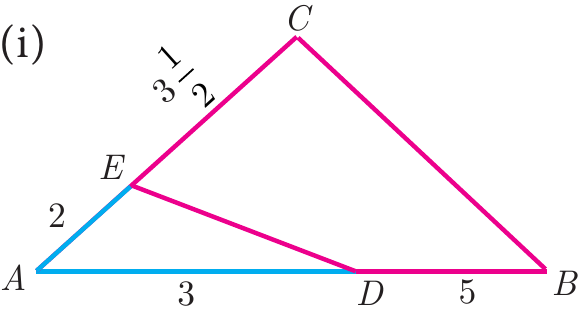
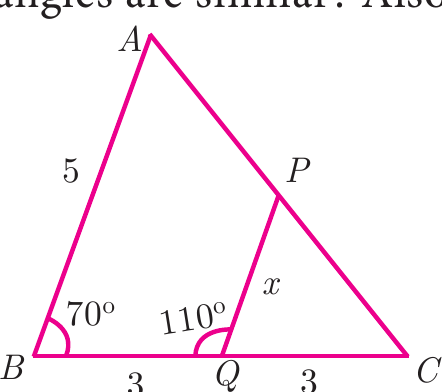
In the given triangles, check which triangles are similar? Also find the value of $x$.
(i)
Exercise 4.1, Q1 (i)
(ii)
Exercise 4.1, Q1 (ii)
A girl looks the reflection of the top of the lamp post on the mirror which is $6.6$ m away from the foot of the lamppost. The girl whose height is $1.25$ m is standing $2.5$ m away from the mirror. Assuming the mirror is placed on the ground facing the sky and the girl, mirror and the lamppost are in a same line, find the height of the lamp post.
A vertical stick of length 6 m casts a shadow $400$ cm long on the ground and at the same time a tower casts a shadow $28$ m long. Using similarity, find the height of the tower.
Two triangles $QPR$ and $QSR$, right angled at $P$ and $S$ respectively are drawn on the same base $QR$ and on the same side of $QR$. If $PR$ and $SQ$ intersect at $T$, prove that $PT\times TR=ST\times TQ$.
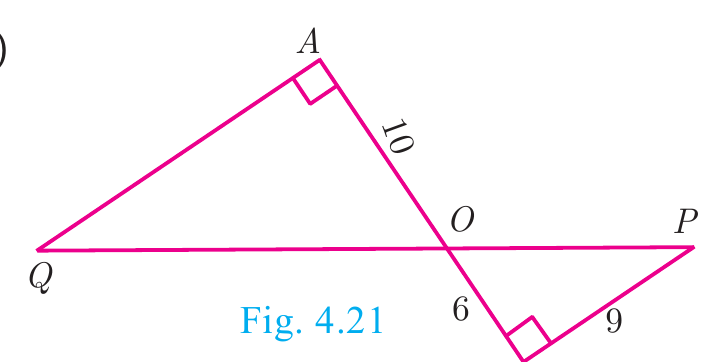
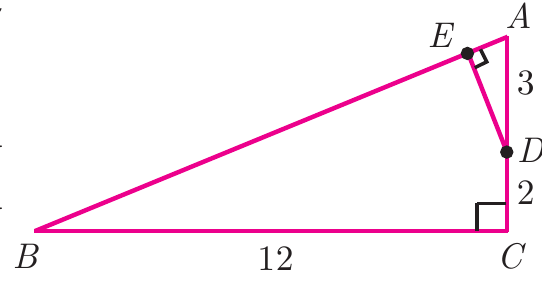
In the adjacent figure, $\triangle ABC$ is right angled at C and $DE\perp AB$. Prove that $\triangle ABC\sim\triangle ADE$ and hence find the lengths of $AE$ and $DE$.
Exercise 4.1, Q5
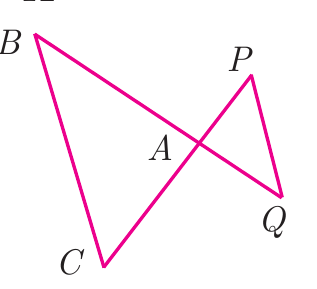
In the adjacent figure, $\triangle ACB\sim\triangle APQ$. If $BC=8$ cm, $PQ=4$ cm, $BA=6.5$ cm and $AP=2.8$ cm, find $CA$ and $AQ$.
Exercise 4.1, Q6
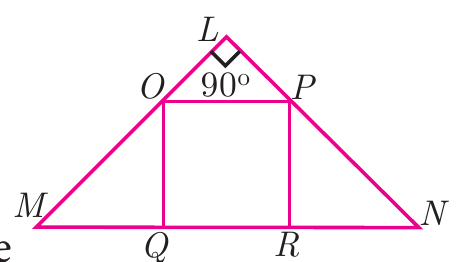
If figure $OPRQ$ is a square and $\angle MLN=90^\circ$. Prove that (i) $\triangle LOP\sim\triangle QMO$ (ii) $\triangle LOP\sim\triangle RPN$ (iii) $\triangle QMO\sim\triangle RPN$ (iv) $QR^2=MQ\times RN$
Exercise 4.1, Q7
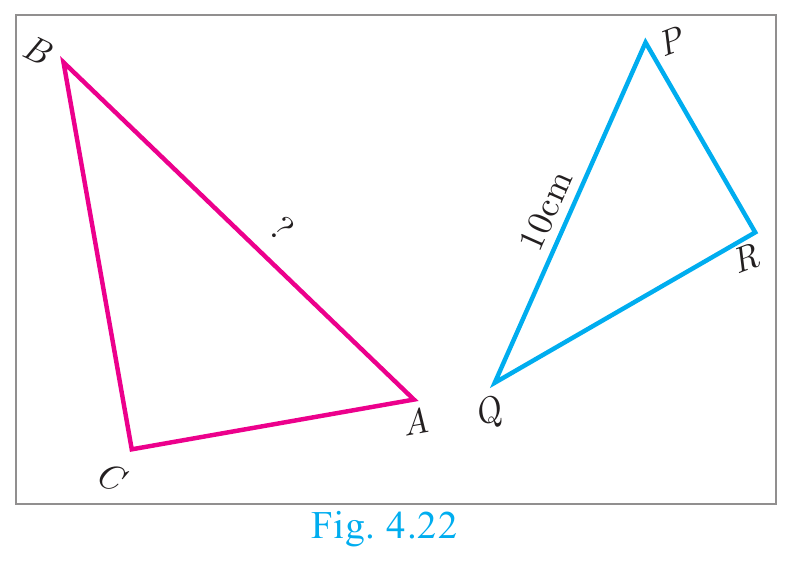
If $\triangle ABC\sim\triangle DEF$ such that area of $\triangle ABC$ is 9cm² and the area of $\triangle DEF$ is 16cm² and $BC=2.1$ cm. Find the length of $EF$.
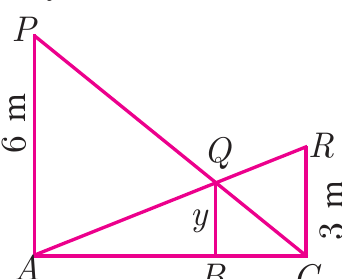
Two vertical poles of heights $6$ m and $3$ m are erected above a horizontal ground $AC$. Find the value of $y$.
Exercise 4.1, Q9
Construct a triangle similar to a given triangle $PQR$ with its sides equal to $\frac{2}{3}$ of the corresponding sides of the triangle $PQR$ (scale factor $\frac{2}{3}<1$).
Construct a triangle similar to a given triangle $LMN$ with its sides equal to $\frac{4}{5}$ of the corresponding sides of the triangle $LMN$ (scale factor $\frac{4}{5}<1$).
Construct a triangle similar to a given triangle $ABC$ with its sides equal to $\frac{6}{5}$ of the corresponding sides of the triangle $ABC$ (scale factor $\frac{6}{5}>1$).
Construct a triangle similar to a given triangle $PQR$ with its sides equal to $\frac{7}{3}$ of the corresponding sides of the triangle $PQR$ (scale factor $\frac{7}{3}>1$).
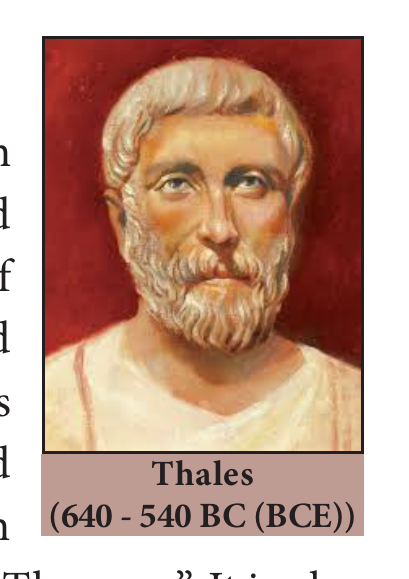
Thales, (640 - 540 BC (BCE)) the most famous Greek mathematician and philosopher lived around seventh century BC (BCE). He possessed knowledge to the extent that he became the first of seven sages of Greece. Thales was the first man to announce that any idea that emerged should be tested scientifically and only then it can be accepted. In this aspect, he did great investigations in mathematics and astronomy and discovered many concepts. He was credited for providing first proof in mathematics, which today is called by the name “Basic Proportionality Theorem”. It is also called “Thales Theorem” named after its discoverer.
Thales (640 - 540 BC (BCE))
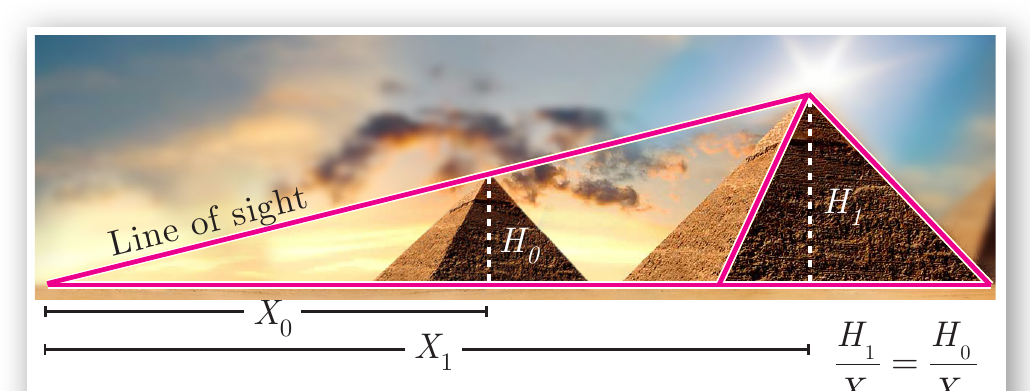
The discovery of the Thales theorem itself is a very interesting story. When Thales travelled to Egypt, he was challenged by Egyptians to determine the height of one of several magnificent pyramids that they had constructed. Thales accepted the challenge and used similarity of triangles to determine the same successfully, another triumphant application of Geometry. Since $X_0$, $X_1$ and $H_0$ are known, we can determine the height $H_1$ of the pyramid.
Fig. 4.27
To understand the basic proportionality theorem or Thales theorem, let us do the following activity.
Activity 2
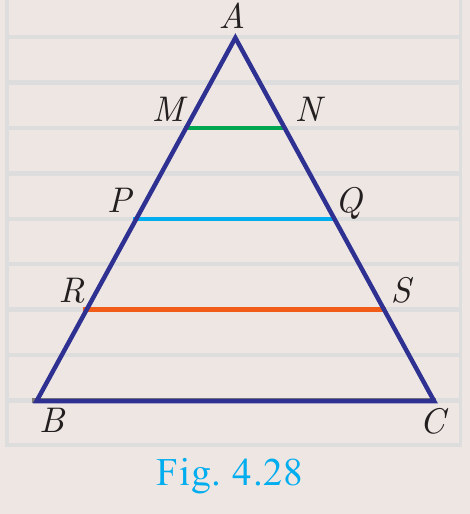
Take any ruled paper and draw a triangle $ABC$ with its base on one of the lines. Several parallel lines will cut the triangle $ABC$.
Select any one line among them and name the points where it meets the sides $AB$ and $AC$ as $P$ and $Q$.
Can we find the ratio of $\frac{AP}{PB}$ and $\frac{AQ}{QC}$. By measuring $AP$, $PB$, $AQ$ and $QC$ through a scale, verify whether the ratios are equal or not? Try for different parallel lines, say $MN$ and $RS$.
Now find the ratios $\frac{AM}{MB},\frac{AN}{NC}$ and $\frac{AR}{RB},\frac{AS}{SC}$.
Fig. 4.28
Check if they are equal? The conclusion will lead us to one of the most important theorem in Geometry, which we will discuss below.
Theorem 1: Basic Proportionality Theorem (BPT) or Thales theorem#
Statement
A straight line drawn parallel to a side of triangle intersecting the other two sides, divides the sides in the same ratio.
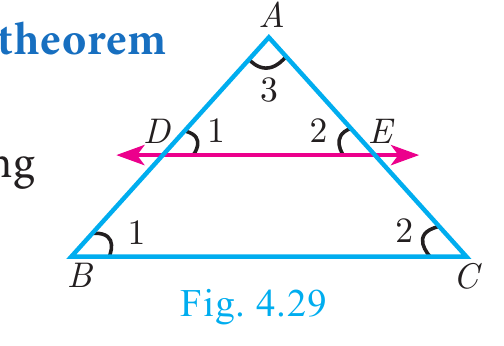
Fig. 4.29
Proof
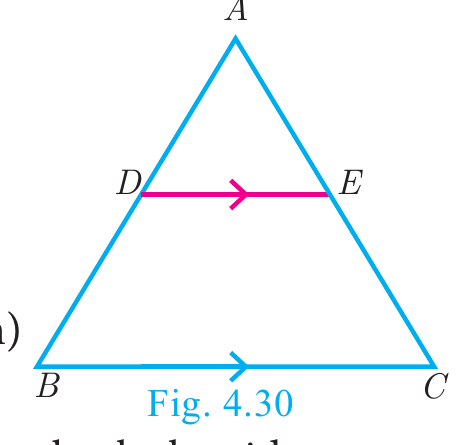
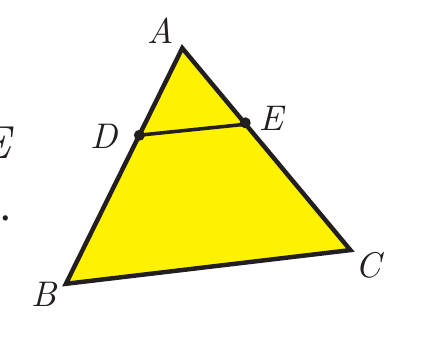
Given: In $\triangle ABC$, $D$ is a point on $AB$ and $E$ is a point on $AC$.
To prove: $\dfrac{AD}{DB}=\dfrac{AE}{EC}$
Construction: Draw a line $DE\parallel BC$
No.
Statement
Reason
1.
$\angle ABC=\angle ADE=\angle 1$
Corresponding angles are equal because $DE\parallel BC$
2.
$\angle ACB=\angle AED=\angle 2$
Corresponding angles are equal because $DE\parallel BC$
3.
$\angle DAE=\angle BAC=\angle 3$
Both triangles have a common angle
4.
$\triangle ABC\sim\triangle ADE$
By $AAA$ similarity
$\dfrac{AB}{AD}=\dfrac{AC}{AE}$
Corresponding sides are proportional
$\dfrac{AD+DB}{AD}=\dfrac{AE+EC}{AE}$
Split $AB$ and $AC$ using the points $D$ and $E$.
$1+\dfrac{DB}{AD}=1+\dfrac{EC}{AE}$
On simplification
$\dfrac{DB}{AD}=\dfrac{EC}{AE}$
Cancelling $1$ on both sides
$\dfrac{AD}{DB}=\dfrac{AE}{EC}$
Taking reciprocals
Hence proved
Corollary
If in $\triangle ABC$, a straight line $DE$ parallel to $BC$, intersects $AB$ at $D$ and $AC$ at $E$, then (i) $\dfrac{AB}{AD}=\dfrac{AC}{AE}$ (ii) $\dfrac{AB}{DB}=\dfrac{AC}{EC}$.
(i) Taking reciprocals, we get $\dfrac{DB}{AD}=\dfrac{EC}{AE}$
Add 1 to both in the sides $\dfrac{DB}{AD}+1=\dfrac{EC}{AE}+1$
$\dfrac{DB+AD}{AD}=\dfrac{EC+AE}{AE}$ so, $\dfrac{AB}{AD}=\dfrac{AC}{AE}$
(ii) Add 1 to both the sides
$\dfrac{AD}{DB}+1=\dfrac{AE}{EC}+1$
Therefore, $\dfrac{AB}{DB}=\dfrac{AC}{EC}$
Is the converse of Basic Proportionality Theorem also true? To examine let us do the following illustration.
Illustration
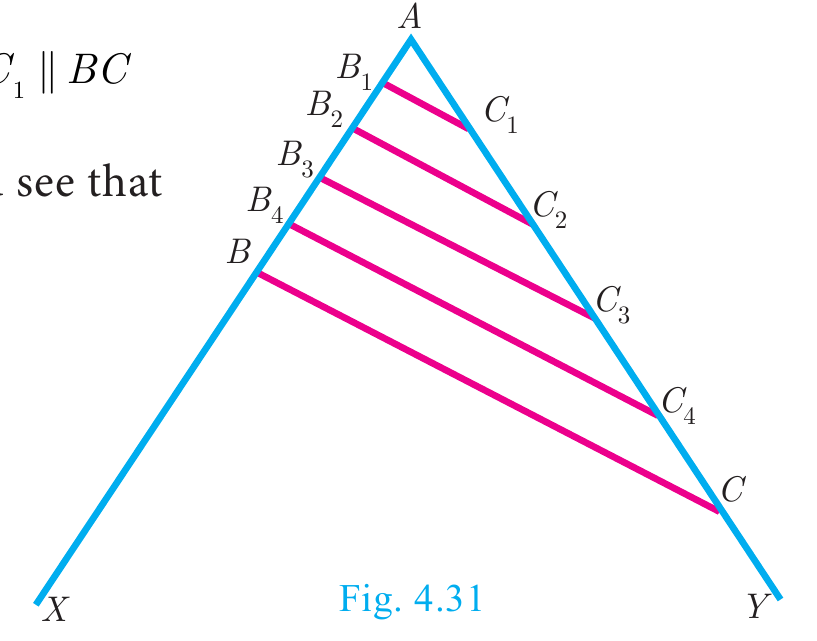
Draw an angle $XAY$ on your notebook as shown in Fig.4.31 and on ray $AX$, mark points $B_1,B_2,B_3,B_4$ and $B$ such that $AB_1=B_1B_2=B_2B_3=B_3B_4=B_4B=1$cm.
Similarly on ray $AY$, mark points $C_1,C_2,C_3,C_4$ and $C$, such that $AC_1=C_1C_2=C_2C_3=C_3C_4=C_4C=2$ cm, Join $B_1C_1$ and $BC$.
Observe that $\dfrac{AB_1}{B_1B}=\dfrac{AC_1}{C_1C}=\dfrac{1}{4}$ and $B_1C_1\parallel BC$
Similarly joining $B_2C_2$, $B_3C_3$ and $B_4C_4$ you see that
$$\frac{AB_2}{B_2B}=\frac{AC_2}{C_2C}=\frac{2}{3}\text{ and }B_2C_2\parallel BC$$$$\frac{AB_3}{B_3B}=\frac{AC_3}{C_3C}=\frac{3}{2}\text{ and }B_3C_3\parallel BC$$$$\frac{AB_4}{B_4B}=\frac{AC_4}{C_4C}=\frac{4}{1}\text{ and }B_4C_4\parallel BC$$
Fig. 4.31
From this we observe that if a line divides two sides of a triangle in the same ratio, then the line is parallel to the third side.
Therefore, we obtain the following theorem called converse of the Thales theorem.
Theorem 2: Converse of Basic Proportionality Theorem#
Statement
If a straight line divides any two sides of a triangle in the same ratio, then the line must be parallel to the third side.
Proof
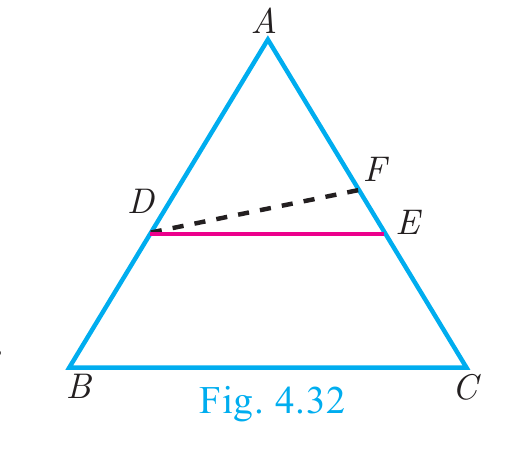
Given: In $\triangle ABC$, $\dfrac{AD}{DB}=\dfrac{AE}{EC}$
To prove: $DE\parallel BC$
Construction: If $DE$ is not parallel to $BC$, draw $DF\parallel BC$.
Fig. 4.32
No.
Statement
Reason
1.
$\dfrac{AD}{DB}=\dfrac{AE}{EC}\quad\cdots(1)$
Given
2.
$\triangle ABC$, $DF\parallel BC$
Construction
3.
$\dfrac{AD}{DB}=\dfrac{AF}{FC}\quad\cdots(2)$
Thales theorem
4.
$\dfrac{AE}{EC}=\dfrac{AF}{FC}$
From (1) and (2)
$\dfrac{AE}{EC}+1=\dfrac{AF}{FC}+1$
Adding 1 to both sides
$\dfrac{AE+EC}{EC}=\dfrac{AF+FC}{FC}$
$\dfrac{AC}{EC}=\dfrac{AC}{FC}$
$EC=FC$
Cancelling $AC$ on both sides
Therefore, $E=F$
Our assumption that $DE$ is not parallel to $BC$ is wrong.
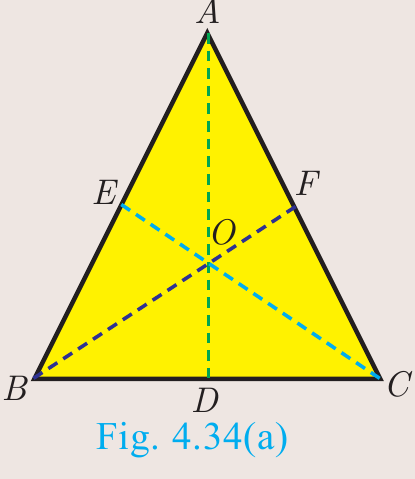
Step 1: Take a chart and cut it like a triangle as shown in Fig.4.34(a).
Step 2: Then fold it along the symmetric line $AD$. Then C and B will be one upon the other.
Step 3: Similarly fold it along CE, then $B$ and $A$ will be one upon the other.
Step 4: Similarly fold it along BF, then $A$ and $C$ will be one upon the other.
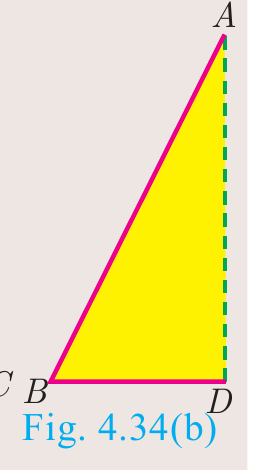
Find $AB$, $AC$, $BD$, $DC$ using a scale.
Find $\frac{AB}{AC},\frac{BD}{DC}$ check if they are equal?
Fig. 4.34(a)
Fig. 4.34(b)
In the three cases, the internal bisector of an angle of a triangle divides the opposite side internally in the ratio of the corresponding sides containing the angle.
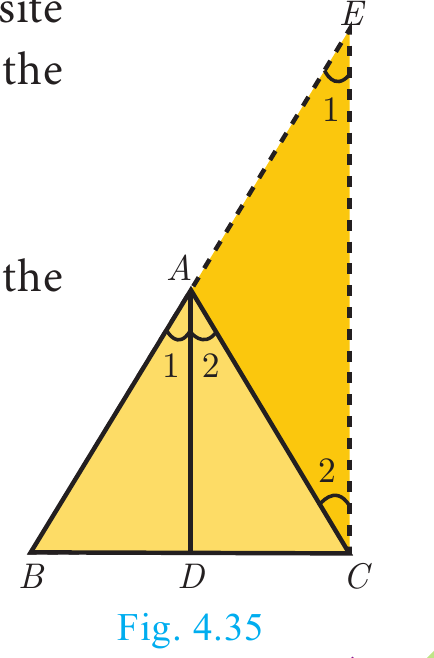
If a straight line through one vertex of a triangle divides the opposite side internally in the ratio of the other two sides, then the line bisects the angle internally at the vertex.
Proof
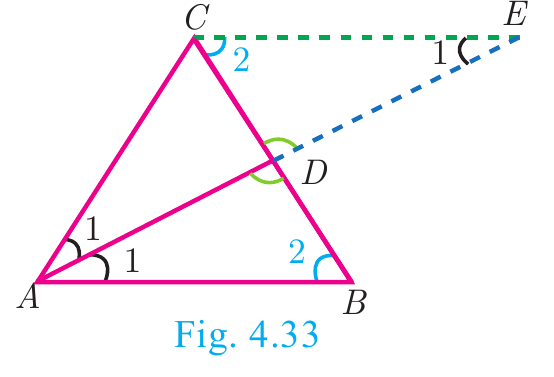
Given: $ABC$ is a triangle. $AD$ divides $BC$ in the ratio of the sides containing the angles $\angle A$ to meet $BC$ at $D$.
That is $\dfrac{AB}{AC}=\dfrac{BD}{DC}\quad\cdots(1)$
To prove: $AD$ bisects $\angle A$ i.e. $\angle 1=\angle 2$
Construction: Draw $CE\parallel DA$. Extend $BA$ to meet at $E$.
Fig. 4.35
No.
Statement
Reason
1.
Let $\angle BAD=\angle 1$ and $\angle DAC=\angle 2$
Assumption
2.
$\angle BAD=\angle AEC=\angle 1$
Since $DA\parallel CE$ and $AC$ is transversal, corresponding angles are equal
3.
$\angle DAC=\angle ACE=\angle 2$
Since $DA\parallel CE$ and $AC$ is transversal, Alternate angles are equal
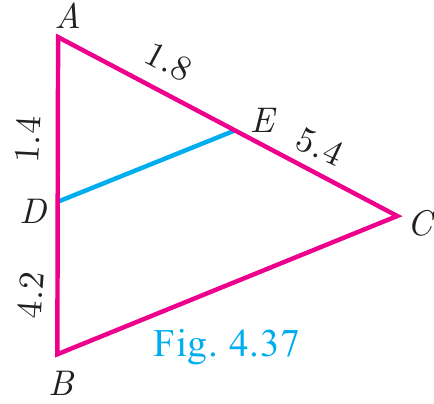
$D$ and $E$ are respectively the points on the sides $AB$ and $AC$ of a $\triangle ABC$ such that $AB=5.6$ cm, $AD=1.4$ cm, $AC=7.2$ cm and $AE=1.8$ cm, show that $DE\parallel BC$.
Fig. 4.37
Solution We have $AB=5.6$ cm, $AD=1.4$ cm, $AC=7.2$ cm and $AE=1.8$ cm.
$$BD=AB-AD=5.6-1.4=4.2\text{ cm}$$
and $EC=AC-AE=7.2-1.8=5.4$ cm.
$$\frac{AD}{DB}=\frac{1.4}{4.2}=\frac{1}{3}\text{ and }\frac{AE}{EC}=\frac{1.8}{5.4}=\frac{1}{3}$$$$\frac{AD}{DB}=\frac{AE}{EC}$$
Therefore, by converse of Basic Proportionality Theorem, we have $DE$ is parallel to $BC$. Hence proved.
A straight line drawn _______ to a side of a triangle divides the other two sides proportionally.
Basic Proportionality Theorem is also known as _______.
Let $\triangle ABC$ be equilateral. If $D$ is a point on $BC$ and $AD$ is the internal bisector of $\angle A$. Using Angle Bisector Theorem, $\dfrac{BD}{DC}$ is ________.
The ________ of an angle of a triangle divides the opposite side internally in the ratio of the corresponding sides containing the angle.
If the median $AD$ to the side $BC$ of a $\triangle ABC$ is also an angle bisector of $\angle A$ then $\dfrac{AB}{AC}$ is ________.
We have already learnt in previous class how to construct triangles when sides and angles are given.
In this section, let us construct a triangle when the following are given :
(i) the base, vertical angle and the median on the base
(ii) the base, vertical angle and the altitude on the base
(iii) the base, vertical angle and the point on the base where the bisector of the vertical angle meets the base.
First, we consider the following construction,
Construction of a segment of a circle on a given line segment containing an angle $\theta$#
Construction
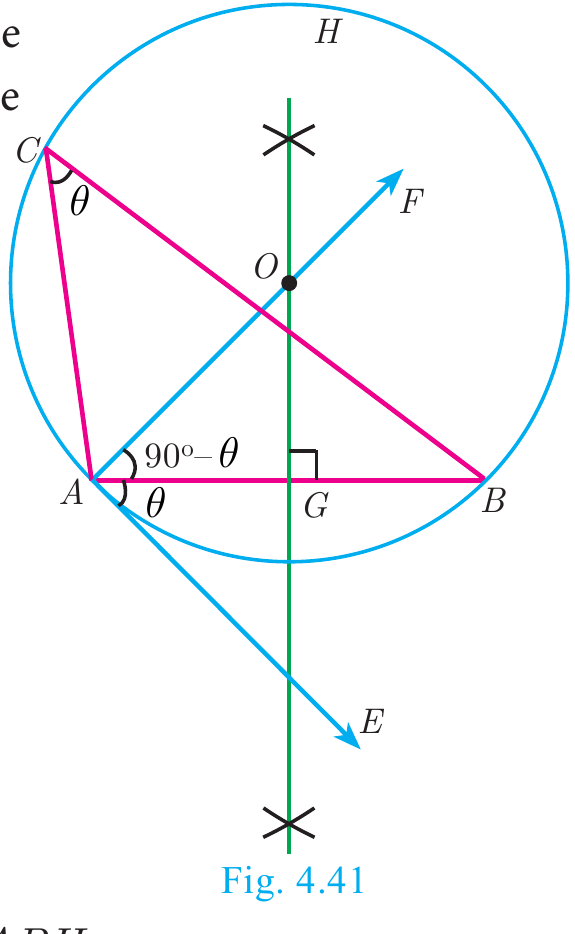
Step 1: Draw a line segment $\overline{AB}$.
Step 2: At $A$, take $\angle BAE=\theta$. Draw $AE$.
Step 3: Draw, $AF\perp AE$.
Step 4: Draw the perpendicular bisector of $AB$ meeting $AF$ at $O$.
Step 5: With $O$ as centre and $OA$ as radius draw a circle $ABH$.
Step 6: Take any point $C$ on the circle, By the alternate segments theorem, the major arc $ACB$ is the required segment of the circle containing the angle $\theta$.
Fig. 4.41
Note
If $C_1, C_2, \ldots$ are points on the circle, then all the triangles $\triangle BAC_1$, $\triangle BAC_2, \ldots$ are with same base and the same vertical angle.
Construction of a triangle when its base, the vertical angle and the median from the vertex of the base are given.#
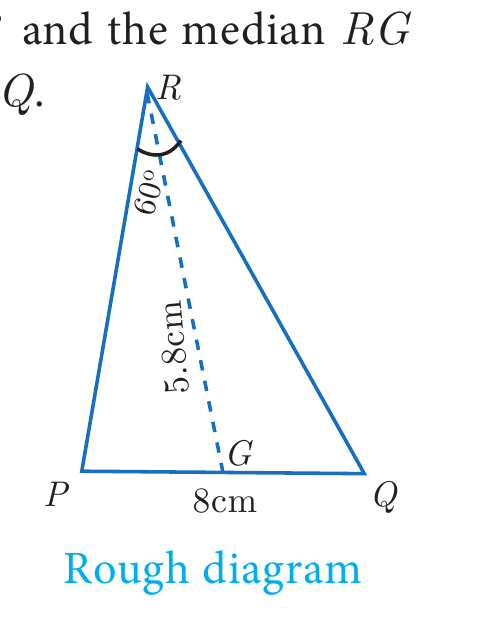
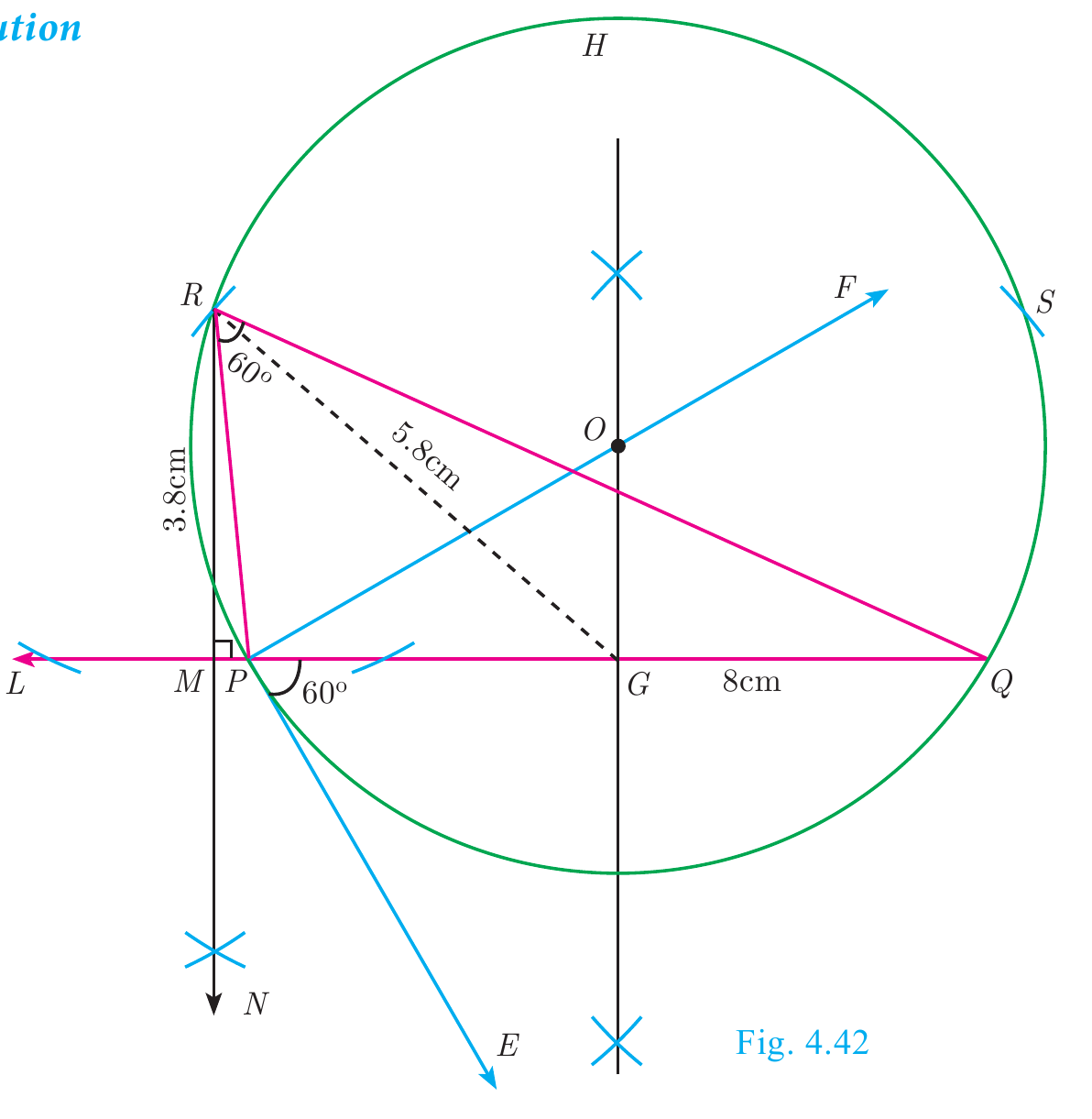
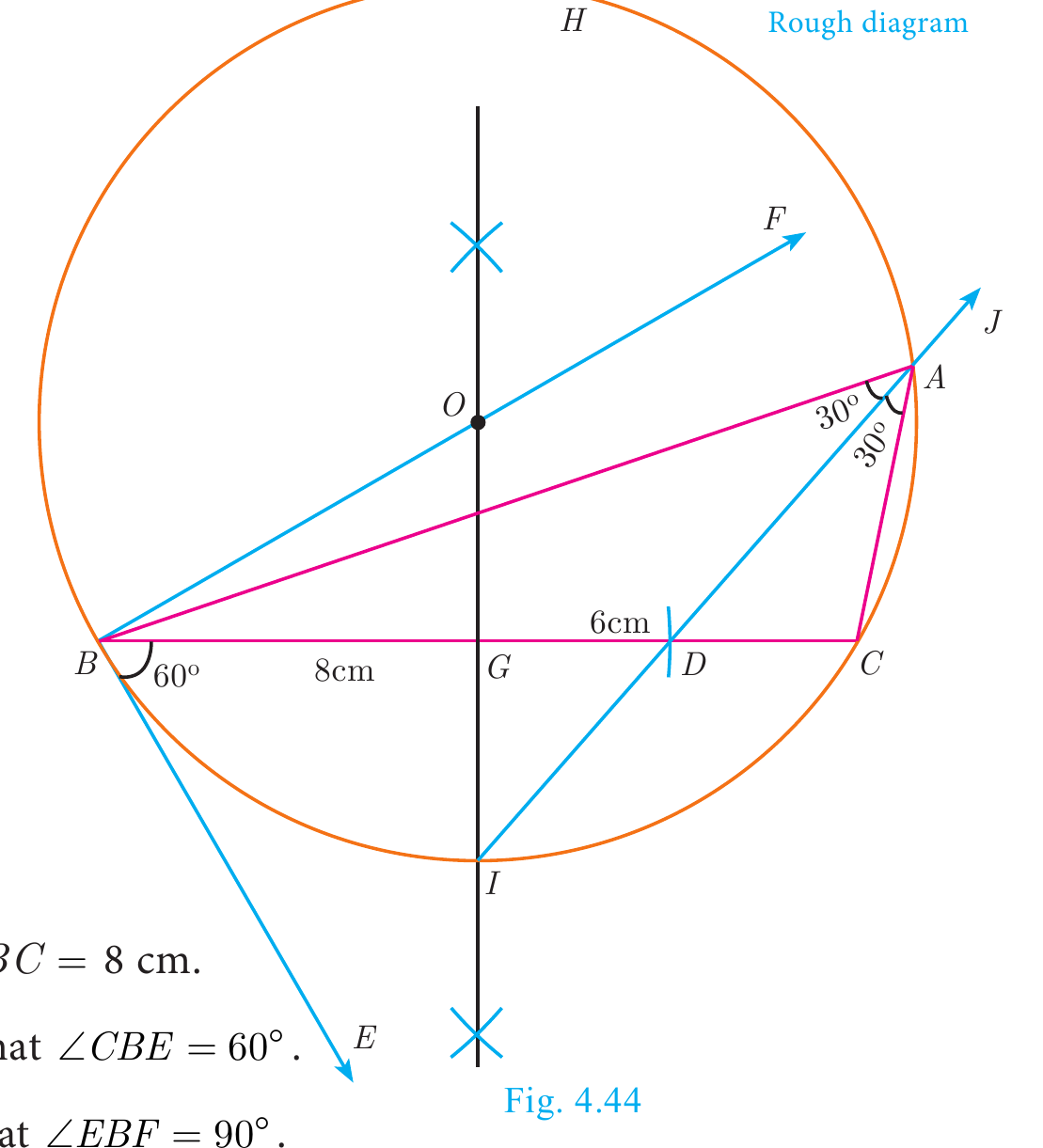
Construct a $\triangle PQR$ in which $PQ=8$ cm, $\angle R=60^\circ$ and the median $RG$ from $R$ to $PQ$ is 5.8 cm. Find the length of the altitude from $R$ to $PQ$.
Solution
Rough diagram
Fig. 4.42
Construction
Step 1: Draw a line segment $PQ=8$ cm.
Step 2: At $P$, draw $PE$ such that $\angle QPE=60^\circ$.
Step 3: At $P$, draw $PF$ such that $\angle EPF=90^\circ$.
Step 4: Draw the perpendicular bisector to $PQ$, which intersects $PF$ at $O$ and $PQ$ at $G$.
Step 5: With $O$ as centre and $OP$ as radius draw a circle.
Step 6: From $G$ mark arcs of radius 5.8 cm on the circle. Mark them as $R$ and $S$.
Step 7: Join $PR$ and $RQ$. Then $\triangle PQR$ is the required triangle.
Step 8: From $R$ draw a line $RN$ perpendicular to $LQ$. $LQ$ meets $RN$ at $M$.
Step 9: The length of the altitude is $RM=3.8$ cm.
Note
We can get another $\triangle PQS$ for the given measurements.
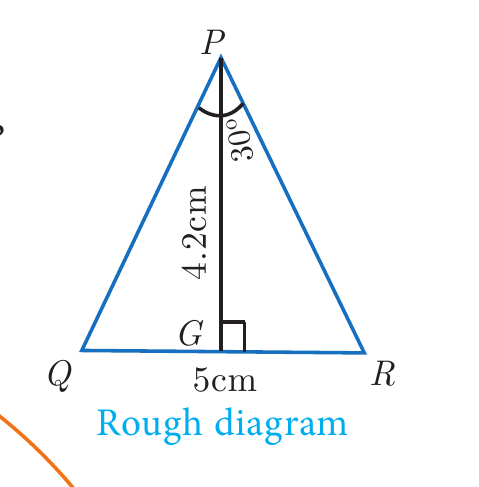
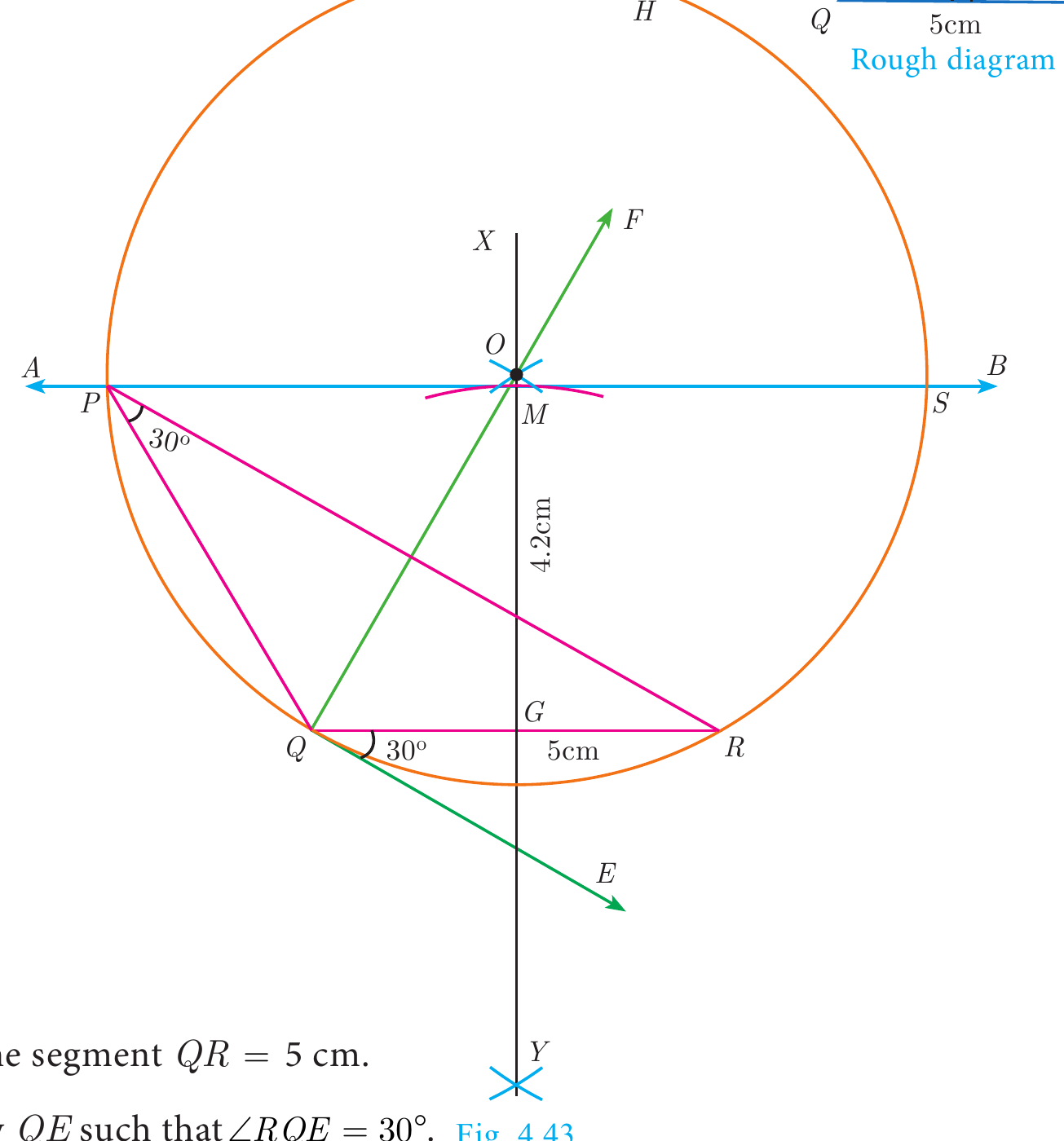
Construct a triangle when its base, the vertical angle and the altitude from the vertex to the base are given.#
In $\triangle ABC$, $D$ and $E$ are points on the sides $AB$ and $AC$ respectively such that $DE\parallel BC$
(i) If $\dfrac{AD}{DB}=\dfrac34$ and $AC=15$ cm find $AE$.
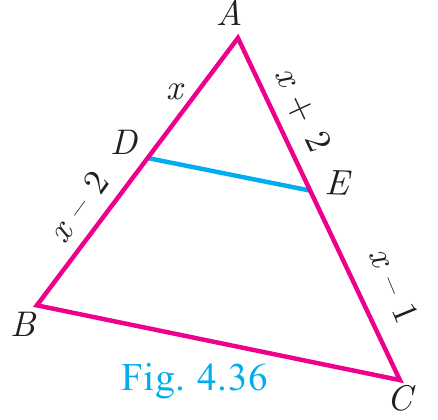
(ii) If $AD=8x-7$, $DB=5x-3$, $AE=4x-3$ and $EC=3x-1$, find the value of $x$.
ABCD is a trapezium in which $AB\parallel DC$ and $P,Q$ are points on $AD$ and $BC$ respectively, such that $PQ\parallel DC$ if $PD=18$ cm, $BQ=35$ cm and $QC=15$ cm, find $AD$.
In $\triangle ABC$, $D$ and $E$ are points on the sides $AB$ and $AC$ respectively. Show that $DE\parallel BC$ if $AB=12$ cm, $AD=8$ cm, $AE=12$ cm and $AC=18$ cm.
In fig. if $PQ\parallel BC$ and $PR\parallel CD$ prove that
(i) $\dfrac{AR}{AD}=\dfrac{AQ}{AB}$ (ii) $\dfrac{QB}{AQ}=\dfrac{DR}{AR}$.
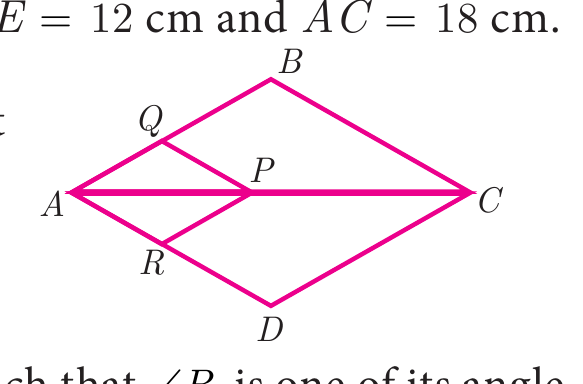
Rhombus PQRB is inscribed in $\triangle ABC$ such that $\angle B$ is one of its angle. $P$, $Q$ and $R$ lie on $AB$, $AC$ and $BC$ respectively. If $AB=12$ cm and $BC=6$ cm, find the sides $PQ$, $RB$ of the rhombus.
In trapezium $ABCD$, $AB\parallel DC$, $E$ and $F$ are points on non-parallel sides $AD$ and $BC$ respectively, such that $EF\parallel AB$. Show that $\dfrac{AE}{ED}=\dfrac{BF}{FC}$.
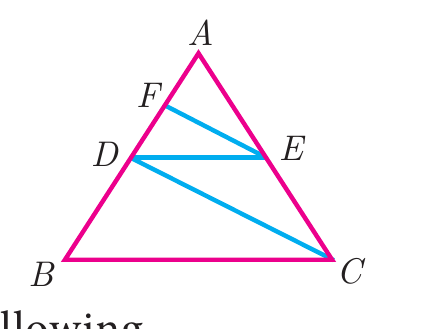
In figure $DE\parallel BC$ and $CD\parallel EF$. Prove that $AD^2=AB\times AF$.
Check whether $AD$ is bisector of $\angle A$ of $\triangle ABC$ in each of the following
(i) $AB=5$ cm, $AC=10$ cm, $BD=1.5$ cm and $CD=3.5$ cm.
(ii) $AB=4$ cm, $AC=6$ cm, $BD=1.6$ cm and $CD=2.4$ cm.
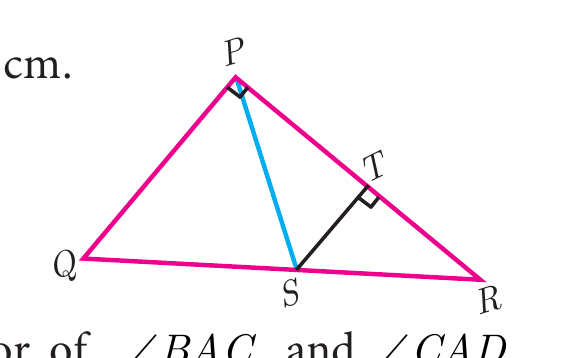
In figure $\angle QPR=90^\circ$, PS is its bisector. If $ST\perp PR$, prove that $ST\times(PQ+PR)=PQ\times PR$.
$ABCD$ is a quadrilateral in which $AB=AD$, the bisector of $\angle BAC$ and $\angle CAD$ intersect the sides $BC$ and $CD$ at the points $E$ and $F$ respectively. Prove that $EF\parallel BD$.
Construct a $\triangle PQR$ which the base $PQ=4.5$ cm, $\angle R=35^\circ$ and the median $RG$ from $R$ to $PQ$ is 6 cm.
Construct a $\triangle PQR$ in which $QR=5$ cm, $\angle P=40^\circ$ and the median $PG$ from $P$ to $QR$ is 4.4 cm. Find the length of the altitude from $P$ to $QR$.
Construct a $\triangle PQR$ such that $QR=6.5$ cm, $\angle P=60^\circ$ and the altitude from $P$ to $QR$ is of length 4.5 cm.
Construct a $\triangle ABC$ such that $AB=5.5$ cm, $\angle C=25^\circ$ and the altitude from $C$ to $AB$ is 4 cm.
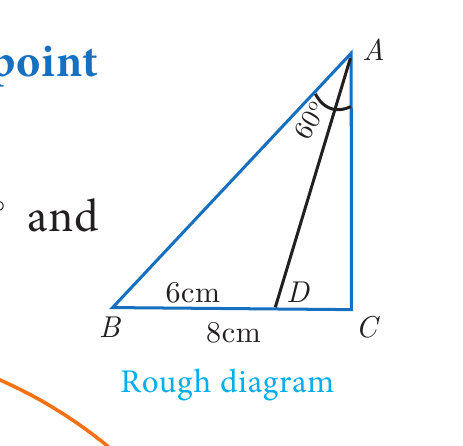
Draw a triangle $ABC$ of base $BC=5.6$ cm, $\angle A=40^\circ$ and the bisector of $\angle A$ meets $BC$ at $D$ such that $CD=4$ cm.
Draw $\triangle PQR$ such that $PQ=6.8$ cm, vertical angle is $50^\circ$ and the bisector of the vertical angle meets the base at $D$ where $PD=5.2$ cm.
Among all existing theorems in mathematics, Pythagoras theorem is considered to be the most important because it has maximum number of proofs. There are more than 350 ways of proving Pythagoras theorem through different methods. Each of these proofs was discovered by eminent mathematicians, scholars, engineers and math enthusiasts, including one by the 20th American president James Garfield. The book titled “The Pythagorean Proposition” written by Elisha Scott Loomis, published by the National Council of Teaching of Mathematics (NCTM) in America contains 367 proofs of Pythagoras Theorem.
Three natural numbers $(a,b,c)$ are said to form Pythagorean Triplet, if they form sides of a right triangle. Thus $(a,b,c)$ is a Pythagorean Triplet if and only if $c^2=a^2+b^2$.
Now we are in a position to study this most famous and important theorem not only in Geometry but in whole of mathematics.
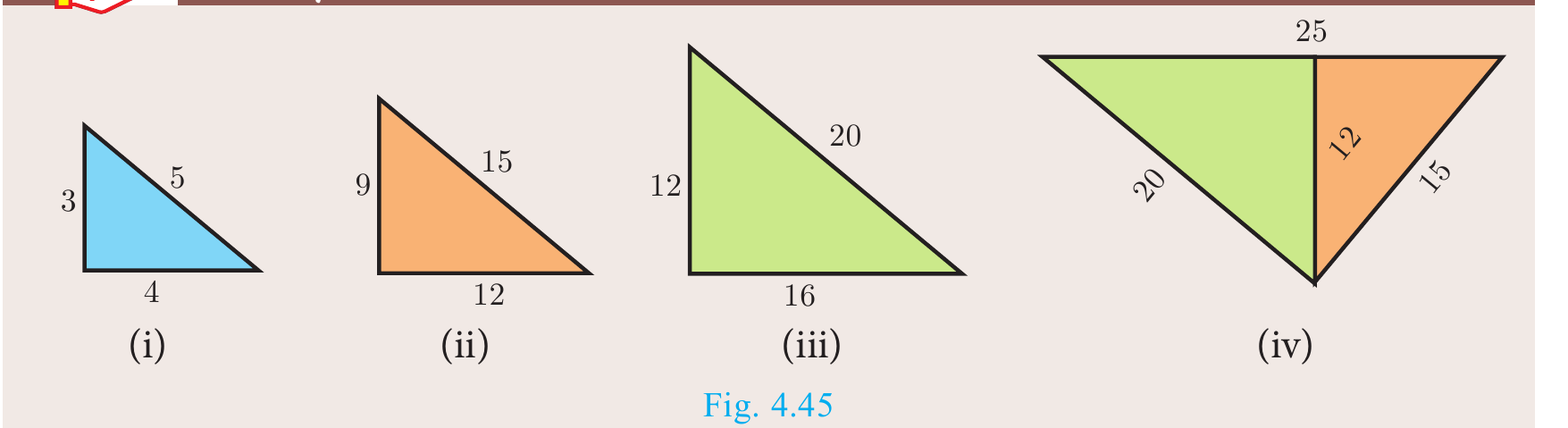
Activity 4
Fig. 4.45
Step 1: Take a chart paper, cut out a right angled triangle of measurement as given in triangle (i).
Step 2: Take three more different colour chart papers and cut out three triangles such that the sides of triangle (ii) is three times of the triangle (i), the sides of triangle (iii) is four times of the triangle (i), the sides of triangle (iv) is five times of triangle (i).
Step 3: Now keeping the common side length 12 place the triangle (ii) and (iii) over the triangle (iv) such that the sides of these two triangles [(ii) and (iii)] coincide with the triangle (iv).
Observe the hypotenuse side and write down the equation. What do you conclude?
Note
In a right angled triangle, the side opposite to $90^\circ$ (the right angle) is called the hypotenuse.
The other two sides are called legs of the right angled triangle.
The hypotenuse will be the longest side of the triangle.
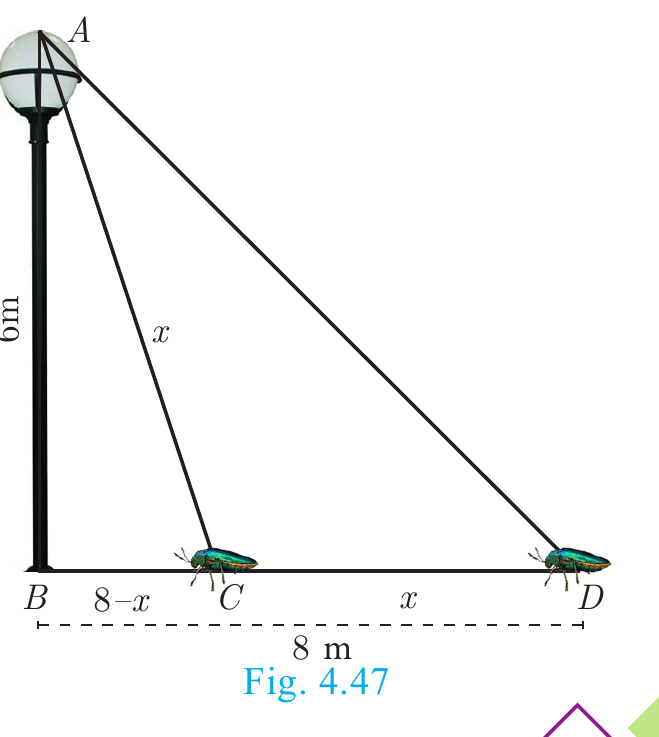
An insect 8 m away initially from the foot of a lamp post which is 6 m tall, crawls towards it moving through a distance. If its distance from the top of the lamp post is equal to the distance it has moved, how far is the insect away from the foot of the lamp post?
Solution Distance between the insect and the foot of the lamp post $BD=8$ m
The height of the lamp post, $AB=6$ m
After moving a distance of $x$ m, let the insect be at $C$
Let, $AC=CD=x$. Then $BC=BD-CD=8-x$
In $\triangle ABC$, $\angle B=90^\circ$
$$AC^2=AB^2+BC^2 \text{ gives } x^2=6^2+(8-x)^2$$$$x^2=36+64-16x+x^2$$$$16x=100 \text{ then } x=6.25$$
Then, $BC=8-x=8-6.25=1.75$ m
Therefore the insect is 1.75 m away from the foot of the lamp post.
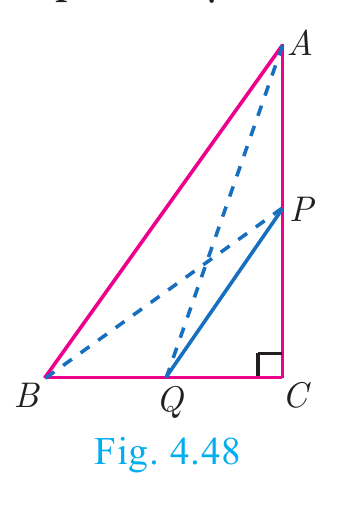
$P$ and $Q$ are the mid-points of the sides $CA$ and $CB$ respectively of a $\triangle ABC$, right angled at $C$. Prove that $4(AQ^2+BP^2)=5AB^2$.
Fig. 4.48
Solution
$\triangle AQC$ is a right triangle at $C$, $AQ^2=AC^2+QC^2 \qquad\cdots(1)$
$\triangle BPC$ is a right triangle at $C$, $BP^2=BC^2+CP^2 \qquad\cdots(2)$
$\triangle ABC$ is a right triangle at $C$, $AB^2=AC^2+BC^2 \qquad\cdots(3)$
From (1) and (2), $AQ^2+BP^2=AC^2+QC^2+BC^2+CP^2$
$$\begin{aligned}4(AQ^2+BP^2)&=4AC^2+4QC^2+4BC^2+4CP^2\\&=4AC^2+(2QC)^2+4BC^2+(2CP)^2\\&=4AC^2+BC^2+4BC^2+AC^2 &&\text{(Since } P \text{ and } Q \text{ are mid points)}\\&=5(AC^2+BC^2) &&\text{(From equation (3))}\end{aligned}$$$$4(AQ^2+BP^2)=5AB^2$$
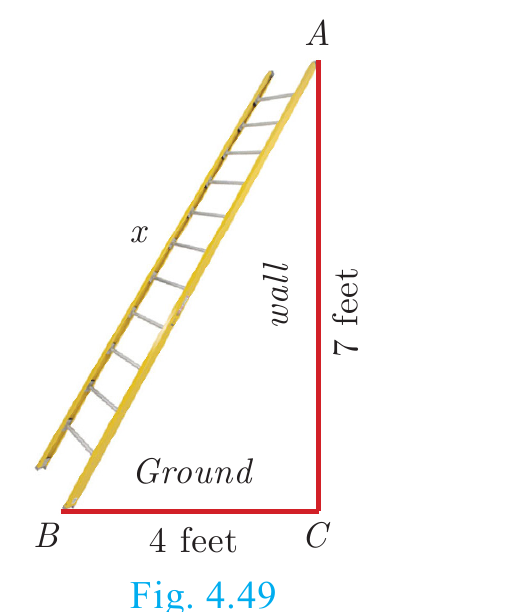
What length of ladder is needed to reach a height of 7 ft along the wall when the base of the ladder is 4 ft from the wall? Round off your answer to the next tenth place.
Fig. 4.49
Solution Let $x$ be the length of the ladder. $BC=4$ ft, $AC=7$ ft.
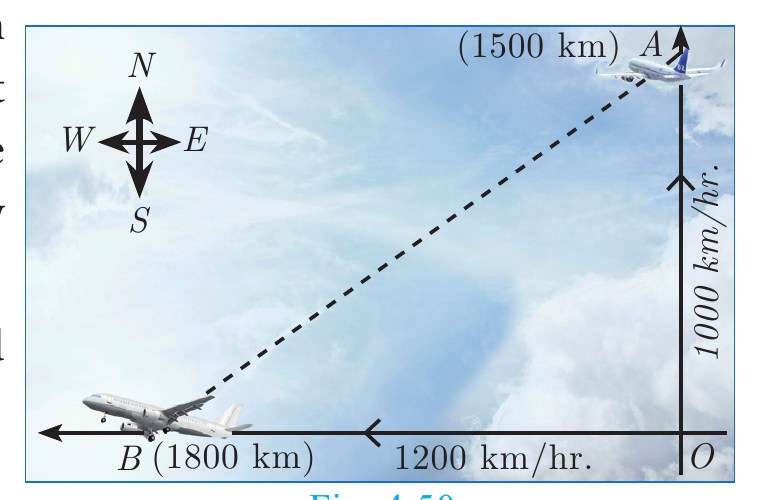
An Aeroplane after take off from an airport and flies due north at a speed of 1000 km/hr. At the same time, another aeroplane take off from the same airport and flies due west at a speed of 1200 km/hr. How far apart will be the two planes after $1\frac{1}{2}$ hours?
Fig. 4.50
Solution Let the first aeroplane starts from $O$ and goes upto $A$ towards north, (Distance = Speed $\times$ time)
where $OA=\left(1000\times\dfrac{3}{2}\right)\text{ km}=1500$ km
Let the second aeroplane starts from $O$ at the same time and goes upto $B$ towards west,
where $OB=\left(1200\times\dfrac{3}{2}\right)=1800$ km
A man goes 18 m due east and then 24 m due north. Find the distance of his current position from the starting point?
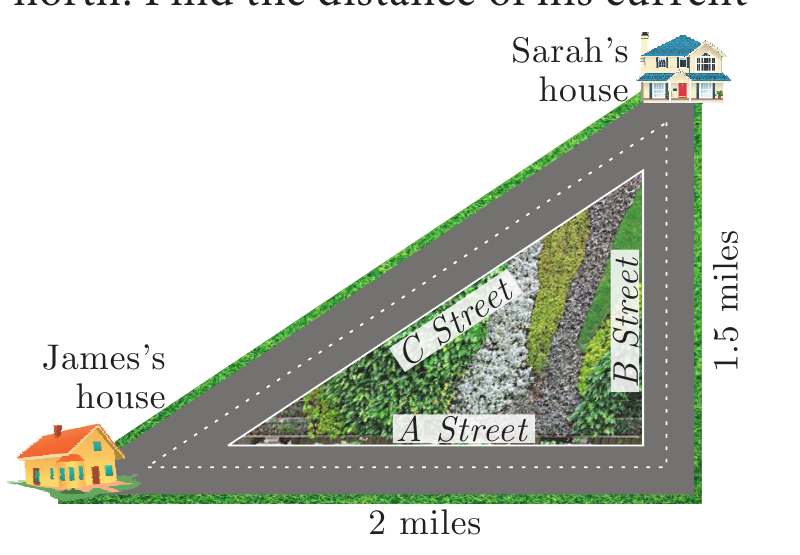
There are two paths that one can choose to go from Sarah’s house to James house. One way is to take $C$ street, and the other way requires to take $B$ street and then $A$ street. How much shorter is the direct path along $C$ street? (Using figure).
Sarah’s house and James house
To get from point $A$ to point $B$ you must avoid walking through a pond. You must walk $34$ m south and $41$ m east. To the nearest meter, how many meters would be saved if it were possible to make a way through the pond?
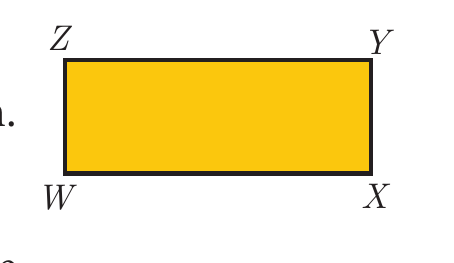
In the rectangle $WXYZ$, $XY+YZ=17$ cm, and $XZ+YW=26$ cm. Calculate the length and breadth of the rectangle?
Rectangle WXYZ
The hypotenuse of a right triangle is 6 m more than twice of the shortest side. If the third side is $2$ m less than the hypotenuse, find the sides of the triangle.
$5$ m long ladder is placed leaning towards a vertical wall such that it reaches the wall at a point 4m high. If the foot of the ladder is moved $1.6$ m towards the wall, then find the distance by which the top of the ladder would slide upwards on the wall.
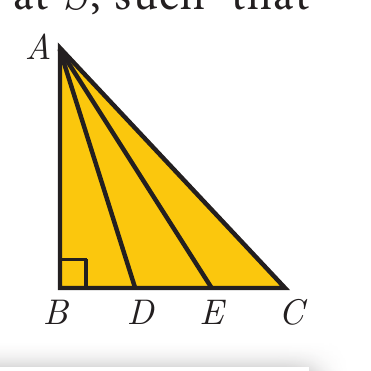
The perpendicular $PS$ on the base $QR$ of a $\triangle PQR$ intersects $QR$ at $S$, such that $QS=3\,SR$. Prove that $2PQ^2=2PR^2+QR^2$
In the adjacent figure, $ABC$ is a right angled triangle with right angle at $B$ and points $D$, $E$ trisect $BC$. Prove that $8AE^2=3AC^2+5AD^2$
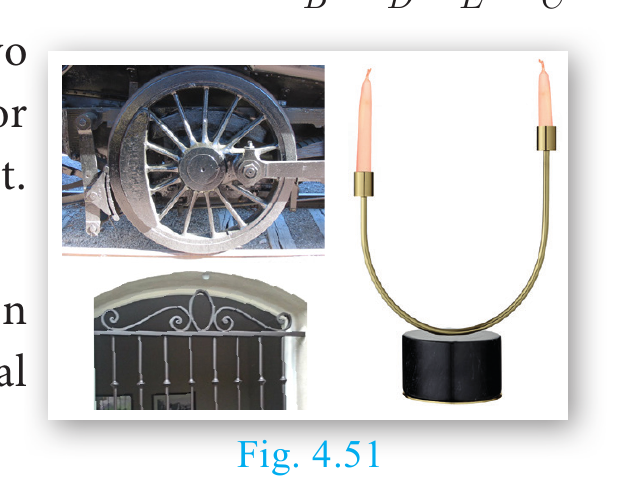
In our day-to-day real life situations, we have seen two lines intersect at a point or do not intersect in a plane. For example, two parallel lines in a railway track, do not intersect. Whereas, grills in a window intersect.
Similarly what happens when a curve and a line is given in a plane? The curve may be parabola, circle or any general curve.
Fig. 4.51
Similarly, what happens when we consider intersection of a line and a circle?
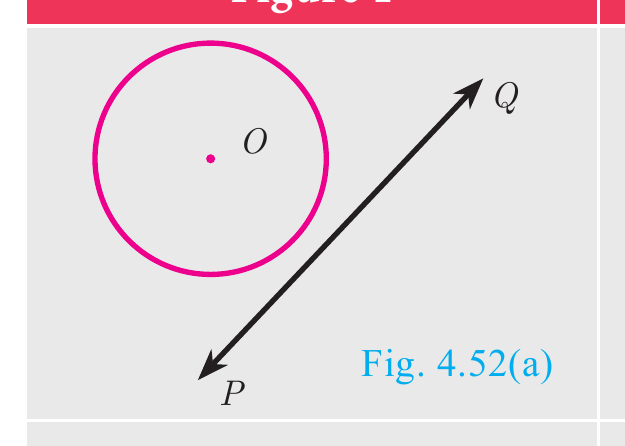
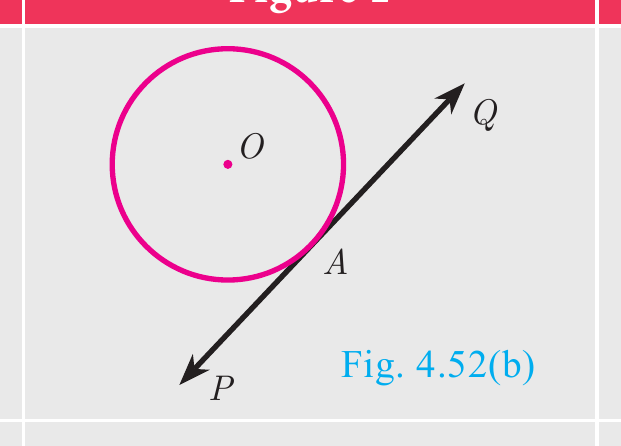
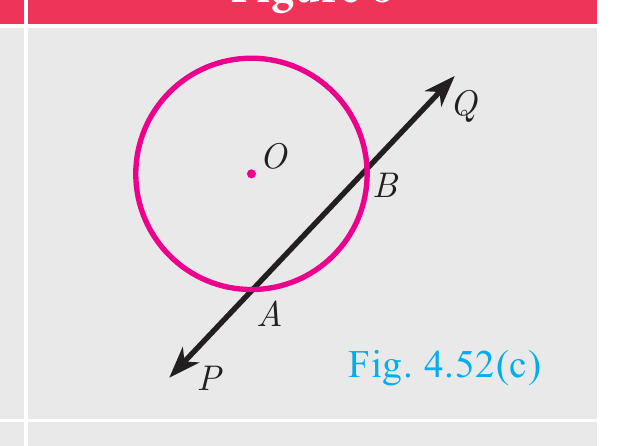
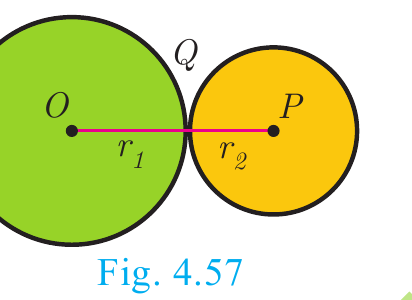
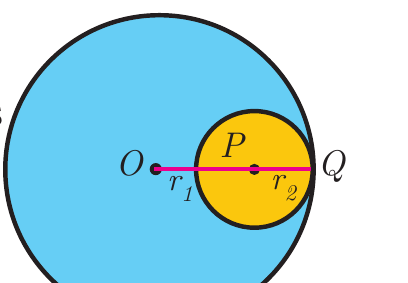
We may get three situations as given in the following diagram
Figure 1
Figure 2
Figure 3
Fig. 4.52(a)
Fig. 4.52(b)
Fig. 4.52(c)
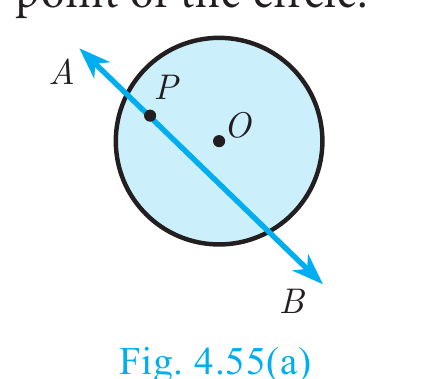
(i) Straight line $PQ$ does not touch the circle.
(i) Straight line $PQ$ touches the circle at a common point $A$.
(i) Straight line $PQ$ intersects the circle at two points $A$ and $B$.
(ii) There is no common point between the straight line and circle.
(ii) $PQ$ is called the tangent to the circle at $A$.
(ii) The line $PQ$ is called a secant of the circle.
(iii) Thus the number of points of intersection of a line and circle is zero.
(iii) Thus the number of points of intersection of a line and circle is one.
(iii) Thus the number of points of intersection of a line and circle is two.
Note
The line segment $AB$ inscribed in the circle in Fig. 4.52(c) is called chord of the circle. Thus a chord is a sub-section of a secant.
Do You Know?
The word “tangent” comes from the latin word “tangere” which means “to touch” and was introduced by Danish mathematician, ‘Thomas Fineko’ in 1583.
Definition
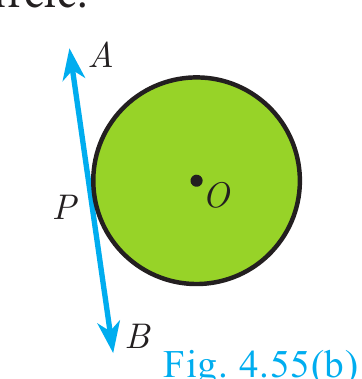
If a line touches the given circle at only one point, then it is called tangent to the circle.
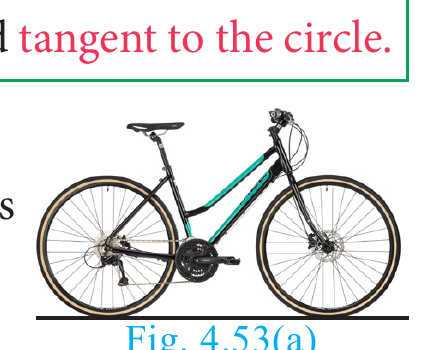
(i) When a cycle moves along a road, then the road becomes the tangent at each point when the wheels rolls on it.
Fig. 4.53(a)
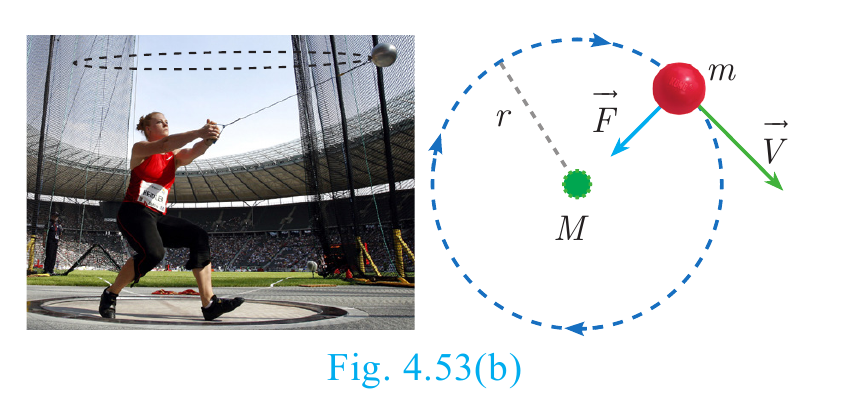
(ii) When a stone is tied at one end of a string and is rotated from the other end, then the stone will describe a circle. If we suddenly stop the motion, the stone will go in a direction tangential to the circular motion.
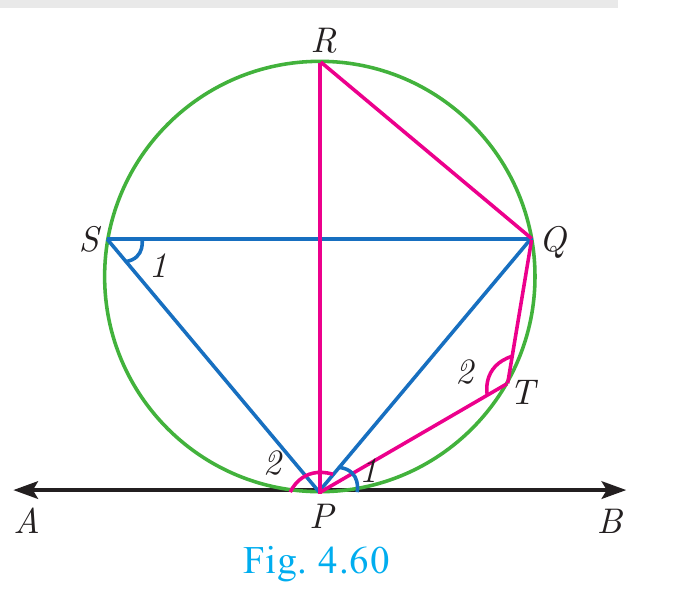
In the Fig. 4.60, the chord PQ divides the circle into two segments. The tangent AB is drawn such that it touches the circle at $P$.
Fig. 4.60
The angle in the alternate segment for $\angle QPB$ $(\angle 1)$ is $\angle QSP$ $(\angle 1)$ and that for $\angle QPA$ $(\angle 2)$ is $\angle PTQ$ $(\angle 2)$.
If a line touches a circle and from the point of contact a chord is drawn, the angles between the tangent and the chord are respectively equal to the angles in the corresponding alternate segments.
Proof
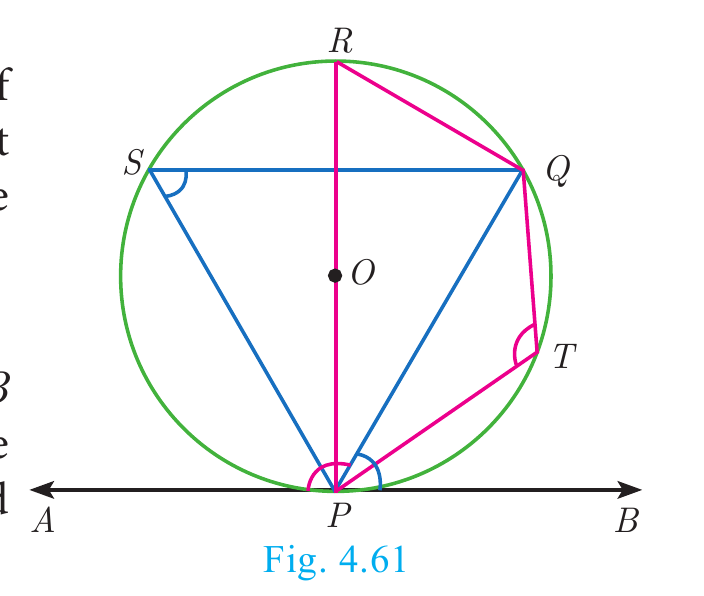
Fig. 4.61
Given : A circle with centre at $O$, tangent $AB$ touches the circle at $P$ and $PQ$ is a chord. $S$ and $T$ are two points on the circle in the opposite sides of chord $PQ$.
To prove : (i) $\angle QPB=\angle PSQ$ and (ii) $\angle QPA=\angle PTQ$
Construction: Draw the diameter $POR$. Draw $QR$, $QS$ and $PS$.
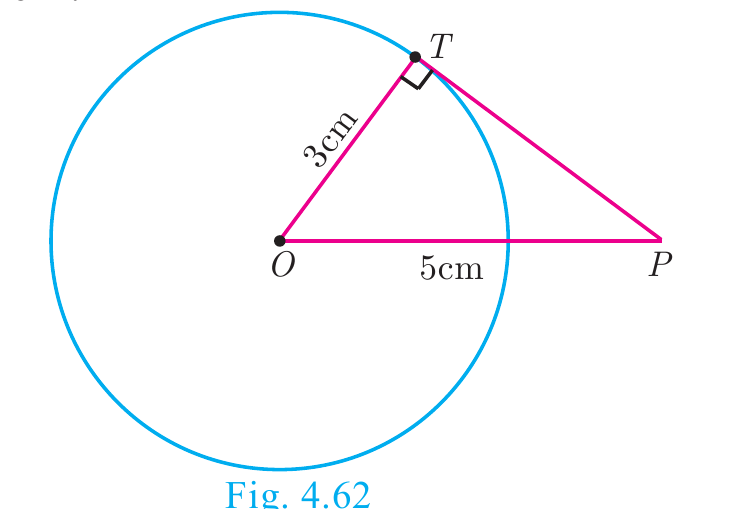
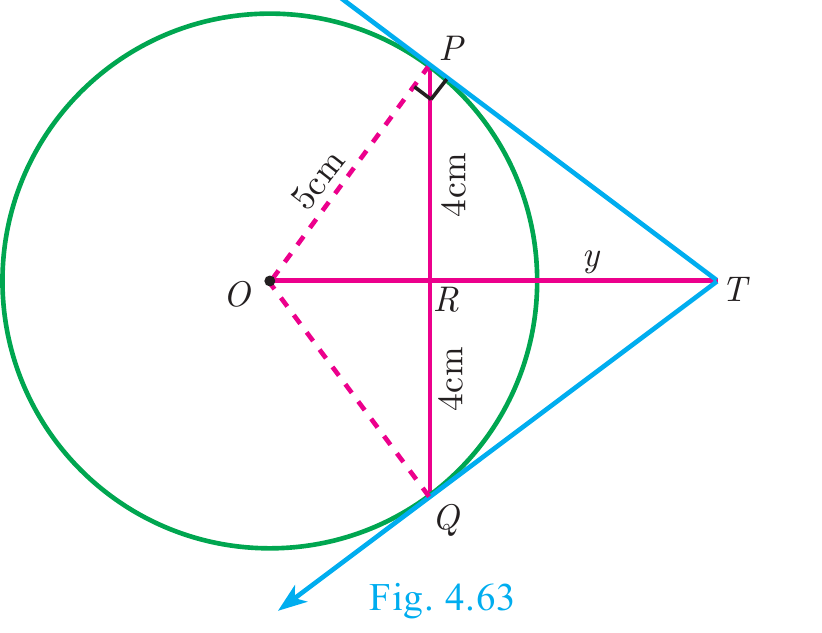
In $\triangle PRT$, $TP^2=TR^2+PR^2 \qquad\cdots(2)$
and $\triangle OPT$ we have, $OT^2=TP^2+OP^2$
$$\begin{aligned}OT^2&=(TR^2+PR^2)+OP^2 &&\text{(substitute for } TP^2 \text{ from (2))}\\(3+y)^2&=y^2+4^2+5^2 &&\text{(substitute for } OT \text{ from (1))}\\9+6y+y^2&=y^2+16+25\\6y&=41-9 \text{ we get } y=\frac{16}{3}\end{aligned}$$
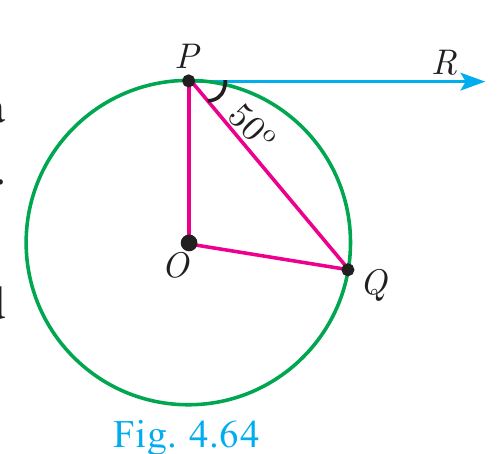
In Fig. 4.64, $O$ is the centre of a circle. $PQ$ is a chord and the tangent $PR$ at $P$ makes an angle of $50^\circ$ with $PQ$. Find $\angle POQ$.
Fig. 4.64
Solution $\angle OPQ=90^\circ-50^\circ=40^\circ$ (angle between the radius and tangent is $90^\circ$)
$$\begin{aligned}OP&=OQ &&\text{(Radii of a circle are equal)}\\\angle OPQ&=\angle OQP=40^\circ &&(\triangle OPQ \text{ is isosceles})\\\angle POQ&=180^\circ-\angle OPQ-\angle OQP\\\angle POQ&=180^\circ-40^\circ-40^\circ=100^\circ\end{aligned}$$
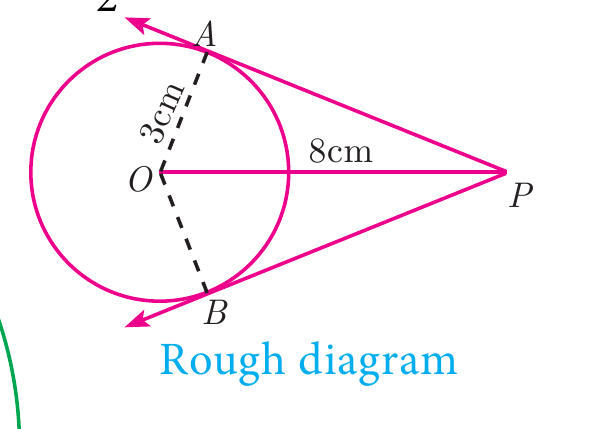
Draw a circle of diameter $6$ cm from a point $P$, which is $8$ cm away from its centre. Draw the two tangents $PA$ and $PB$ to the circle and measure their lengths.
Solution Given, diameter $(d)=6$ cm, we find radius $(r)=\dfrac{6}{2}=3$ cm
Rough diagram
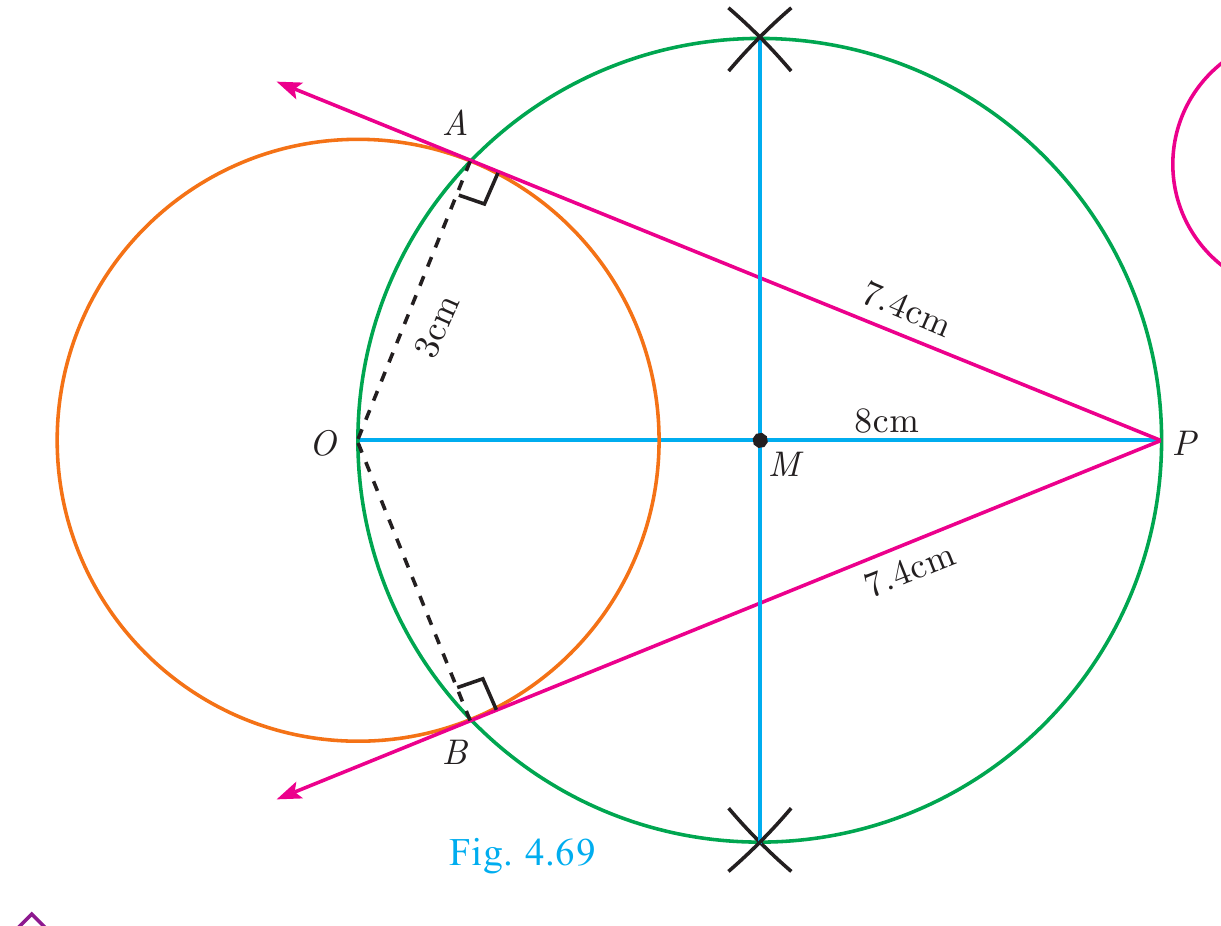
Fig. 4.69
Construction
Step 1: With centre at $O$, draw a circle of radius $3$ cm.
Step 2: Draw a line $OP$ of length $8$ cm.
Step 3: Draw a perpendicular bisector of $OP$, which cuts $OP$ at $M$.
Step 4: With $M$ as centre and $MO$ as radius, draw a circle which cuts previous circle at $A$ and $B$.
Step 5: Join $AP$ and $BP$. $AP$ and $BP$ are the required tangents. Thus length of the tangents are $PA=PB=7.4$ cm.
Verification: In the right angle triangle $OAP$, $PA^2=OP^2-OA^2=8^2-3^2=64-9=55$
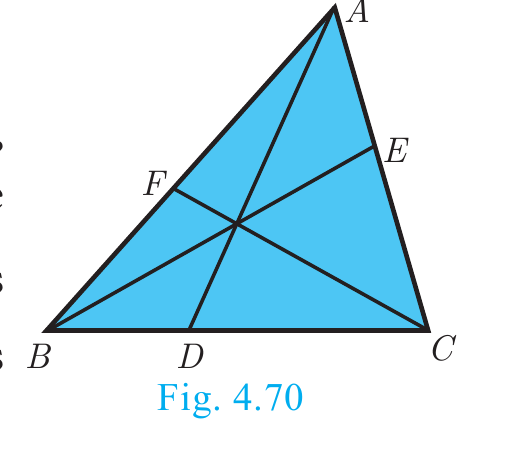
Let ABC be a triangle and let $D,E,F$ be points on lines $BC$, $CA$, $AB$ respectively. Then the cevians $AD$, $BE$, $CF$ are concurrent if and only if $\dfrac{BD}{DC}\times\dfrac{CE}{EA}\times\dfrac{AF}{FB}=1$ where the lengths are directed. This also works for the reciprocal of each of the ratios as the reciprocal of $1$ is $1$.
Fig. 4.70
Do You Know? — Giovanni Ceva (Dec 7, 1647 – June 15, 1734)
In 1686, Ceva was designated as the professor of Mathematics, University of Mantua and worked there for the rest of the life. In 1678, he published an important theorem on synthetic geometry for a triangle called Ceva’s theorem.
Ceva also rediscovered and published in the Journal Opuscula mathematica and Geometria motus in 1692. He applied these ideas in mechanics and hydraulics.
Note
The cevians do not necessarily lie within the triangle, although they do in the diagram.
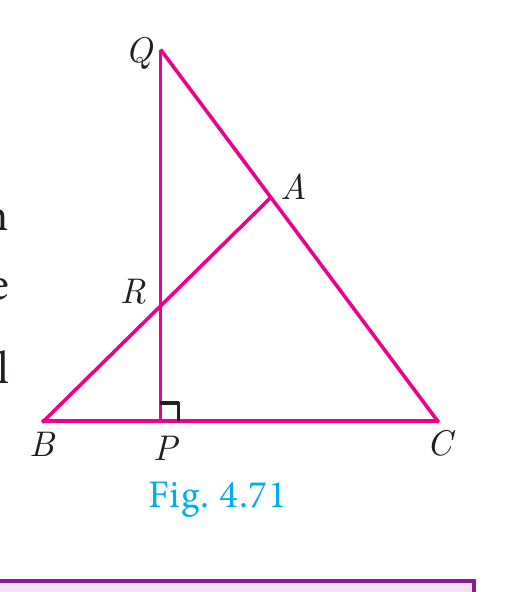
A necessary and sufficient condition for points $P$, $Q$, $R$ on the respective sides BC, $CA$, $AB$ (or their extension) of a triangle $ABC$ to be collinear is that $\dfrac{BP}{PC}\times\dfrac{CQ}{QA}\times\dfrac{AR}{RB}=-1$ where all segments in the formula are directed segments.
Fig. 4.71
Do You Know? — Menelaus
Menelaus was a Greek mathematician who lived during the Roman empire in both Alexandria and Rome during first century (CE). His work was largely on the geometry of spheres.
Menelaus theorem was first discussed in his book, sphaerica and later mentioned by Ptolemy in his work Almagest.
Menelaus theorem proves that spheres are made up of spherical triangles.
Note
Menelaus theorem can also be given as $BP\times CQ\times AR=-PC\times QA\times RB$.
If BP is replaced by $PB$ (or) $CQ$ by $QC$ (or) $AR$ by $RA$, or if any one of the six directed line segments $BP$, $PC$, $CQ$, $QA$, $AR$, $RB$ is interchanged, then the product will be $1$.
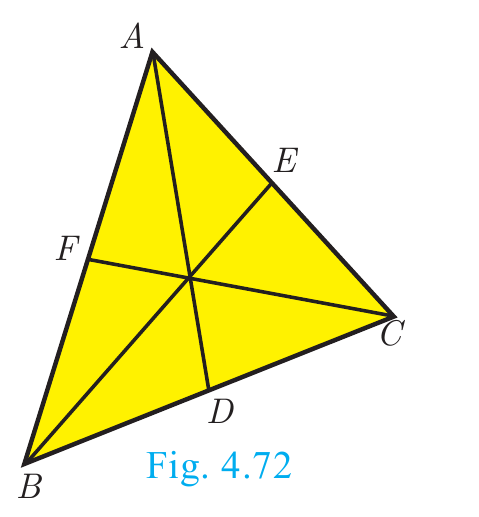
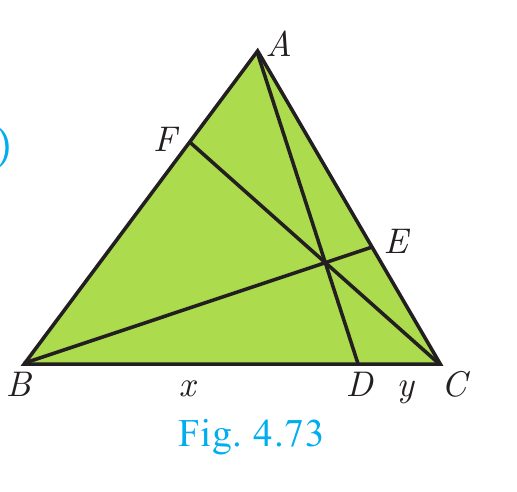
In $\triangle ABC$, points D,E,F lies on BC, CA, AB respectively. Suppose $AB$, $AC$ and $BC$ have lengths $13$, $14$ and $15$ respectively. If $\dfrac{AF}{FB}=\dfrac{2}{5}$ and $\dfrac{CE}{EA}=\dfrac{5}{8}$. Find $BD$ and $DC$.
Solution Given that $AB=13$, $AC=14$ and $BC=15$.
Fig. 4.73
Let $BD=x$ and $DC=y$
Using Ceva’s theorem, we have, $\dfrac{BD}{DC}\times\dfrac{CE}{EA}\times\dfrac{AF}{FB}=1 \quad\ldots(1)$
Substitute the values of $\dfrac{AF}{FB}$ and $\dfrac{CE}{EA}$ in (1),
we have $\dfrac{BD}{DC}\times\dfrac{5}{8}\times\dfrac{2}{5}=1$
$\dfrac{x}{y}\times\dfrac{10}{40}=1$ we get, $\dfrac{x}{y}\times\dfrac{1}{4}=1$. Hence, $x=4y \quad\ldots(2)$
$BC=BD+DC=15$ so, $x+y=15 \quad\ldots(3)$
From (2), using $x=4y$ in (3) we get, $4y+y=15$ gives $5y=15$ then $y=3$
Substitute $y=3$ in (3) we get, $x=12$. Hence $BD=12$, $DC=3$.
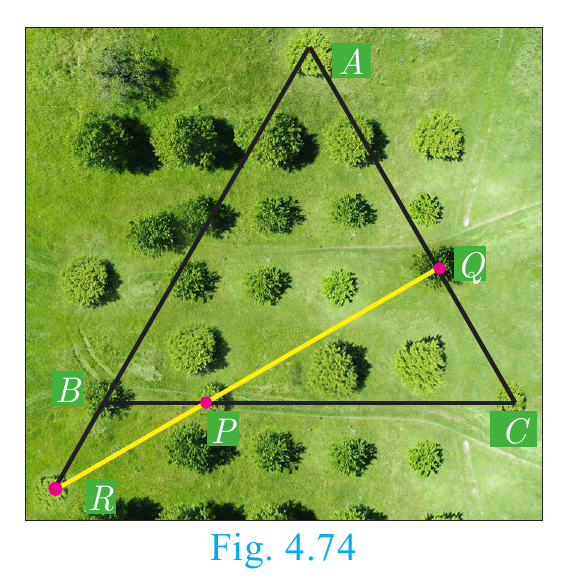
In a garden containing several trees, three particular trees $P$, $Q$, $R$ are located in the following way, $BP=2$ m, $CQ=3$ m, $RA=10$ m, $PC=6$ m, $QA=5$ m, $RB=2$ m, where $A$, $B$, $C$ are points such that $P$ lies on $BC$, $Q$ lies on $AC$ and $R$ lies on $AB$. Check whether the trees P, Q, R lie on a same straight line.
Fig. 4.74
Solution By Meanlau’s theorem, the trees $P$, $Q$, $R$ will be collinear (lie on same straight line)
if $\dfrac{BP}{PC}\times\dfrac{CQ}{QA}\times\dfrac{RA}{RB}=1 \quad\ldots(1)$
Given $BP=2$ m, $CQ=3$ m, $RA=10$ m, $PC=6$ m, $QA=5$ m and $RB=2$ m
Substituting these values in (1) we get, $\dfrac{BP}{PC}\times\dfrac{CQ}{QA}\times\dfrac{RA}{RB}=\dfrac{2}{6}\times\dfrac{3}{5}\times\dfrac{10}{2}=\dfrac{60}{60}=1$
Hence the trees P, Q, R lie on a same straight line.
Progress Check
A straight line that touches a circle at a common point is called a _______.
A chord is a subsection of _______.
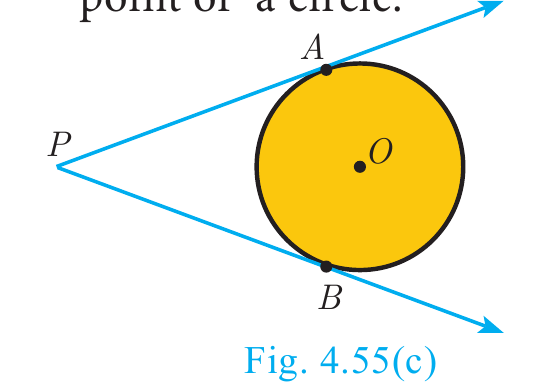
The lengths of the two tangents drawn from _______ point to a circle are equal.
No tangent can be drawn from _______ of the circle.
_______ is a cevian that divides the angle, into two equal halves.
The length of the tangent to a circle from a point $P$, which is $25$ cm away from the centre is $24$ cm. What is the radius of the circle?
$\triangle LMN$ is a right angled triangle with $\angle L=90^\circ$. A circle is inscribed in it. The lengths of the sides containing the right angle are $6$ cm and $8$ cm. Find the radius of the circle.
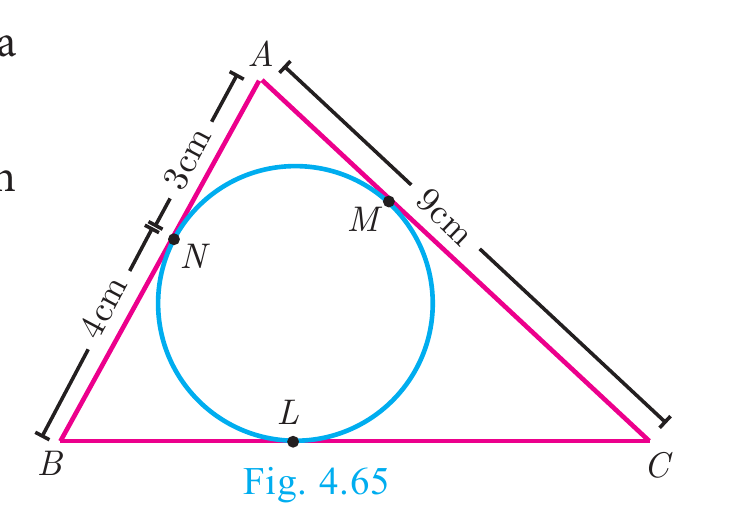
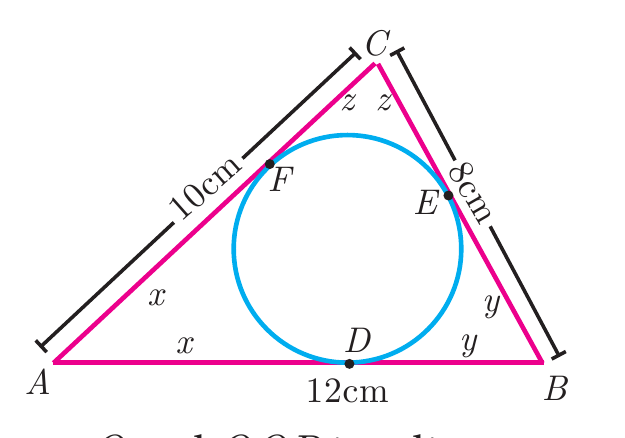
A circle is inscribed in $\triangle ABC$ having sides $8$ cm, $10$ cm and $12$ cm as shown in figure, Find $AD$, $BE$ and $CF$.
Exercise 4.4, Q3
$PQ$ is a tangent drawn from a point $P$ to a circle with centre $O$ and $QOR$ is a diameter of the circle such that $\angle POR=120^\circ$. Find $\angle OPQ$.
A tangent $ST$ to a circle touches it at $B$. $AB$ is a chord such that $\angle ABT=65^\circ$. Find $\angle AOB$, where “$O$” is the centre of the circle.
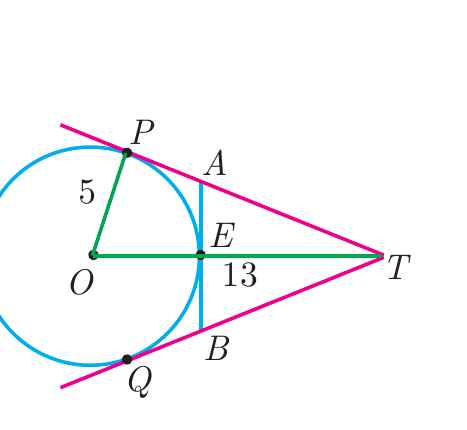
In figure, $O$ is the centre of the circle with radius $5$ cm. $T$ is a point such that $OT=13$ cm and $OT$ intersects the circle $E$, if $AB$ is the tangent to the circle at $E$, find the lenght of $AB$.
Exercise 4.4, Q6
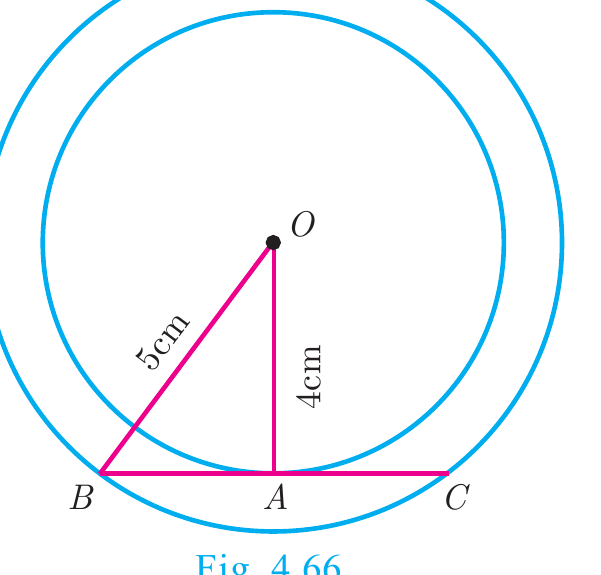
In two concentric circles, a chord of length $16$ cm of larger circle becomes a tangent to the smaller circle whose radius is $6$ cm. Find the radius of the larger circle.
Two circles with centres $O$ and $O'$ of radii $3$ cm and $4$ cm, respectively intersect at two points $P$ and $Q$, such that $OP$ and $O'P$ are tangents to the two circles. Find the length of the common chord $PQ$.
Show that the angle bisectors of a triangle are concurrent.
An artist has created a triangular stained glass window and has one strip of small length left before completing the window. She needs to figure out the length of left out portion based on the lengths of the other sides as shown in the figure.
Exercise 4.4, Q10
Draw a tangent at any point $R$ on the circle of radius $3.4$ cm and centre at $P$?
Draw a circle of radius $4.5$ cm. Take a point on the circle. Draw the tangent at that point using the alternate segment theorem.
Draw the two tangents from a point which is $10$ cm away from the centre of a circle of radius $5$ cm. Also, measure the lengths of the tangents.
Take a point which is $11$ cm away from the centre of a circle of radius $4$ cm and draw the two tangents to the circle from that point.
Draw the two tangents from a point which is $5$ cm away from the centre of a circle of diameter $6$ cm. Also, measure the lengths of the tangents.
Draw a tangent to the circle from the point $P$ having radius $3.6$ cm, and centre at $O$. Point $P$ is at a distance $7.2$ cm from the centre.
If $\triangle ABC$ is an isosceles triangle with $\angle C=90^\circ$ and $AC=5$ cm, then $AB$ is
(A) $2.5$ cm (B) $5$ cm (C) $10$ cm (D) $5\sqrt{2}$ cm
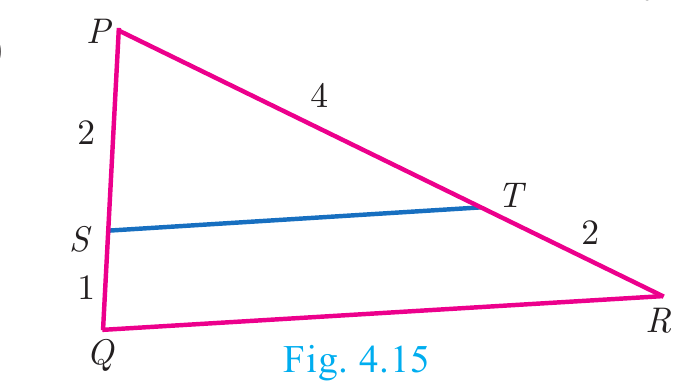
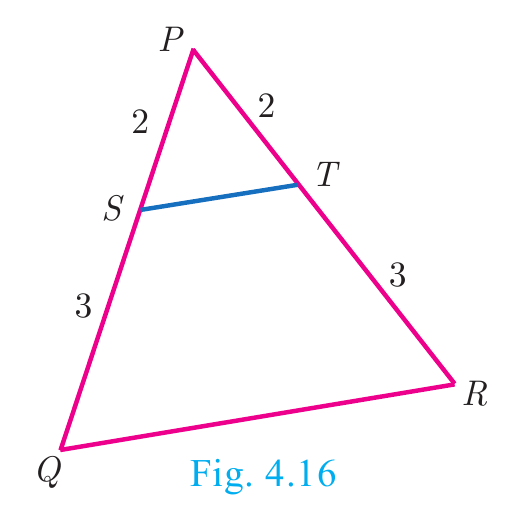
In a given figure $ST\parallel QR$, $PS=2$ cm and $SQ=3$ cm. Then the ratio of the area of $\triangle PQR$ to the area of $\triangle PST$ is
Exercise 4.5, Q4
(A) $25:4$ (B) $25:7$ (C) $25:11$ (D) $25:13$
The perimeters of two similar triangles $\triangle ABC$ and $\triangle PQR$ are $36$ cm and $24$ cm respectively. If $PQ=10$ cm, then the length of $AB$ is
(A) $6\frac{2}{3}$ cm (B) $\dfrac{10\sqrt{6}}{3}$ cm (C) $66\frac{2}{3}$ cm (D) $15$ cm
If in $\triangle ABC$, $DE\parallel BC$. $AB=3.6$ cm, $AC=2.4$ cm and $AD=2.1$ cm then the length of AE is
(A) $1.4$ cm (B) $1.8$ cm (C) $1.2$ cm (D) $1.05$ cm
In a $\triangle ABC$, $AD$ is the bisector of $\angle BAC$. If $AB=8$ cm, $BD=6$ cm and $DC=3$ cm. The length of the side $AC$ is
(A) $6$ cm (B) $4$ cm (C) $3$ cm (D) $8$ cm
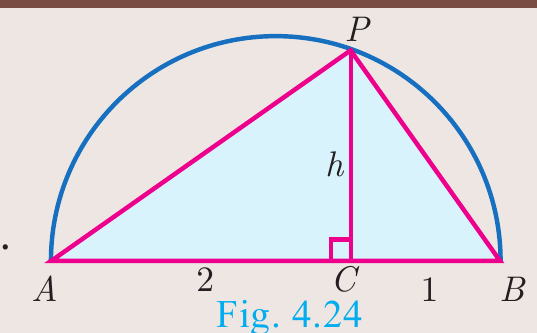
In the adjacent figure $\angle BAC=90^\circ$ and $AD\perp BC$ then
Two poles of heights $6$ m and $11$ m stand vertically on a plane ground. If the distance between their feet is $12$ m, what is the distance between their tops?
(A) $13$ m (B) $14$ m (C) $15$ m (D) $12.8$ m
In the given figure, $PR=26$ cm, $QR=24$ cm, $\angle PAQ=90^\circ$, $PA=6$ cm and $QA=8$ cm. Find $\angle PQR$
(A) centre (B) point of contact (C) infinity (D) chord
How many tangents can be drawn to the circle from an exterior point?
(A) one (B) two (C) infinite (D) zero
The two tangents from an external points $P$ to a circle with centre at $O$ are $PA$ and $PB$. If $\angle APB=70^\circ$ then the value of $\angle AOB$ is
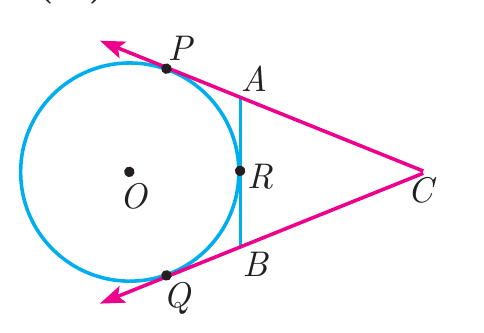
In figure $CP$ and $CQ$ are tangents to a circle with centre at $O$. $ARB$ is another tangent touching the circle at $R$. If $CP=11$ cm and $BC=7$ cm, then the length of $BR$ is
Exercise 4.5, Q14
(A) $6$ cm (B) $5$ cm (C) $8$ cm (D) $4$ cm
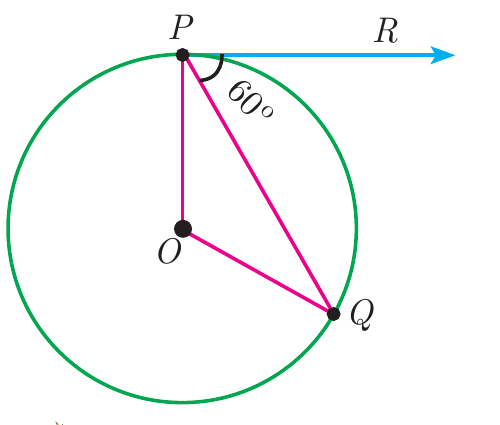
In figure if $PR$ is tangent to the circle at $P$ and $O$ is the centre of the circle, then $\angle POQ$ is
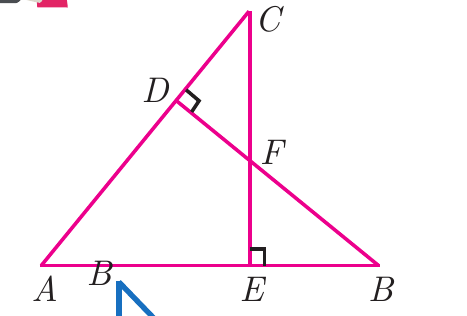
In the figure, if $BD\perp AC$ and $CE\perp AB$, prove that
Unit Exercise 4, Q1
(i) $\triangle AEC\sim\triangle ADB$ (ii) $\dfrac{CA}{AB}=\dfrac{CE}{DB}$
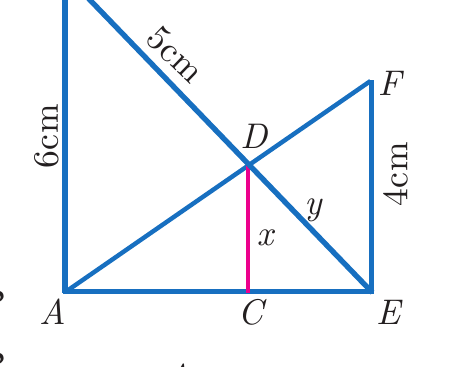
In the given figure $AB\parallel CD\parallel EF$.
Unit Exercise 4, Q2
If $AB=6$ cm, $CD=x$ cm, $EF=4$ cm, $BD=5$ cm and $DE=y$ cm. Find $x$ and $y$.
O is any point inside a triangle $ABC$. The bisector of $\angle AOB$, $\angle BOC$ and $\angle COA$ meet the sides $AB$, $BC$ and $CA$ in point $D$, $E$ and $F$ respectively. Show that $AD\times BE\times CF=DB\times EC\times FA$
In the figure, $ABC$ is a triangle in which $AB=AC$. Points $D$ and $E$ are points on the side $AB$ and $AC$ respectively such that $AD=AE$. Show that the points $B$, $C$, $E$ and $D$ lie on a same circle.
Unit Exercise 4, Q4
Two trains leave a railway station at the same time. The first train travels due west and the second train due north. The first train travels at a speed of $20$ km/hr and the second train travels at $30$ km/hr. After $2$ hours, what is the distance between them?
$D$ is the mid point of side $BC$ and $AE\perp BC$. If $BC=a$, $AC=b$, $AB=c$, $ED=x$, $AD=p$ and $AE=h$, prove that
(i) $b^2=p^2+ax+\dfrac{a^2}{4}$ (ii) $c^2=p^2-ax+\dfrac{a^2}{4}$ (iii) $b^2+c^2=2p^2+\dfrac{a^2}{2}$
A man whose eye-level is $2$ m above the ground wishes to find the height of a tree. He places a mirror horizontally on the ground $20$ m from the tree and finds that if he stands at a point $C$ which is $4$ m from the mirror $B$, he can see the reflection of the top of the tree. How height is the tree?
An Emu which is $8$ feet tall is standing at the foot of a pillar which is $30$ feet high. It walks away from the pillar. The shadow of the Emu falls beyond Emu. What is the relation between the length of the shadow and the distance from the Emu to the pillar?
Two circles intersect at $A$ and $B$. From a point $P$ on one of the circles lines $PAC$ and $PBD$ are drawn intersecting the second circle at $C$ and $D$. Prove that $CD$ is parallel to the tangent at $P$.
Let $ABC$ be a triangle and D,E,F are points on the respective sides $AB$, $BC$, $AC$ (or their extensions). Let $AD:DB=5:3$, $BE:EC=3:2$ and $AC=21$. Find the length of the line segment $CF$.
(ii) their corresponding sides are in the same ratio or prvoportional.
Any congruent triangles are similar but the converse is not true
$AA$ similarity criterion is same as the $AAA$ similarity criterion.
If one angle of a triangle is equal to one angle of another triangle and the sides including these angles are in the same ratio then the triangles are similar. (SAS)
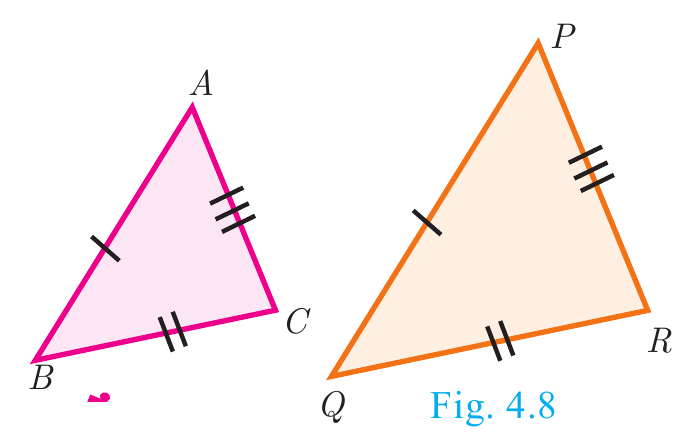
If three sides of a triangle are proportional to the corresponding sides of another triangle, then the two triangles are similar (SSS)
If two triangles are similar then the ratio of the corresponding sides is equal to the ratio of the corresponding perimeters.
The ratio of the area of two similar triangles are equal to the ratio of the squares of their corresponding sides.
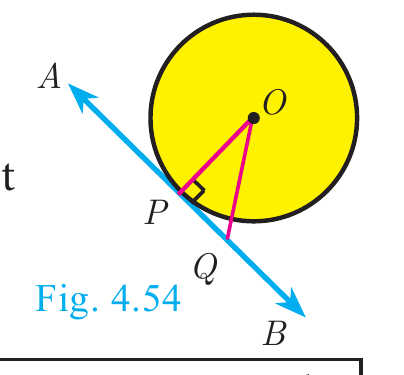
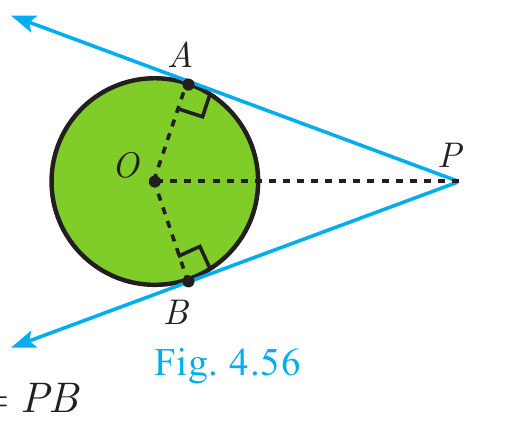
A tangent to a circle will be perpendicular to the radius at the point of contact.
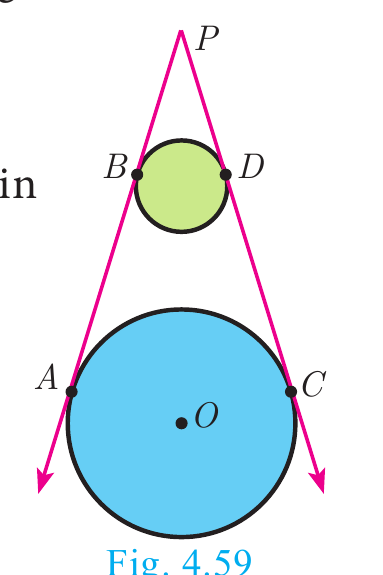
Two tangents can be drawn from any exterior point of a circle.
The lengths of the two tangents drawn from an exterior point to a circle are equal.
Two direct common tangents drawn to two circles are equal in length.
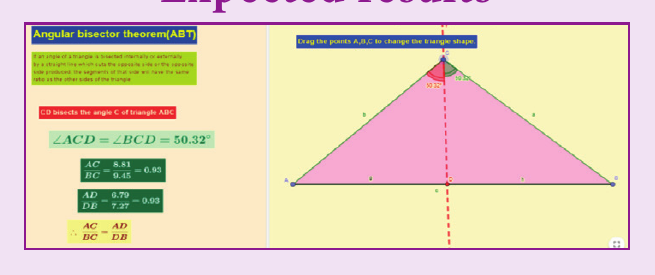
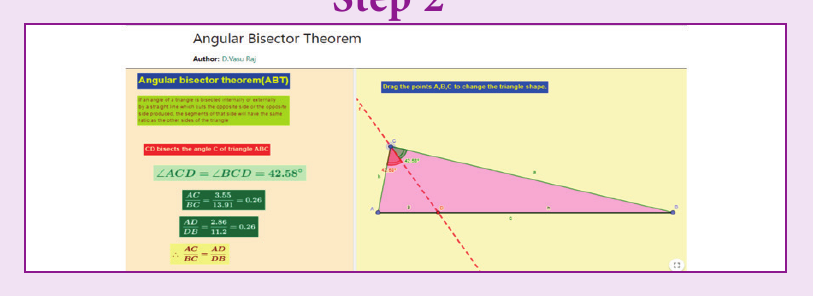
Step 1: Open the Browser type the URL Link given below (or) Scan the QR Code. 10th Standard Mathematics Chapter named “Geometry” will open. Select the work sheet “Angular Bisector theorem”
Step 2: In the given worksheet you can see Triangle ABC and its Angular Bisector CD. and you can change the triangle by dragging the Vertices. Observe the ratios given on Left hand side and learn the theorem.
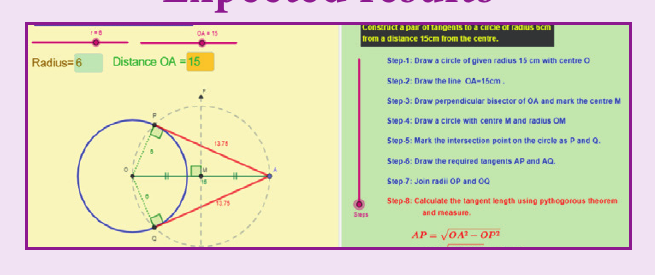
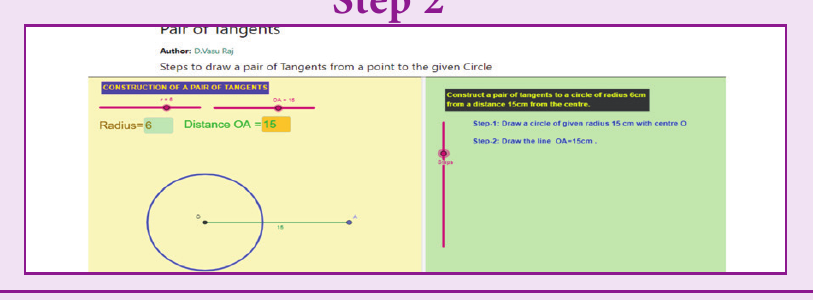
Step 1: Open the Browser type the URL Link given below (or) Scan the QR Code. 10th Standard Mathematics Chapter named “Geometry” will open. Select the work sheet “Pair of Tangents”.
Step 2: In the given worksheet you can change the radius and Distance by moving the sliders given on Left hand side. Move the Slider in the middle to see the steps for construction.
ICT 4.2: Expected results
ICT 4.2: Step 1
ICT 4.2: Step 2
You can repeat the same steps for other activities