Chapter 7#
MENSURATION#
“Nature is an infinite sphere of which the centre is everywhere and the circumference nowhere”. – Blaise Pascal
Pappus, born at Alexandria, Egypt is the last of the great Greek geometers. Pappus major work ‘Synagoge’ or ‘The Mathematical Collection’ is a collection of mathematical writings in eight books.
He described the principles of levers, pulleys, wedges, axles and screws. These concepts are widely applied in Physics and modern Engineering Science.
Learning Outcomes#
- To determine the surface area and volume of cylinder, cone, sphere, hemisphere and frustum.
- To compute volume and surface area of combined solids.
- To solve problems involving conversion of solids from one shape to another with no change in volume.
7.1 Introduction#
The ancient cultures throughout the world sought the idea of measurements for satisfying their daily needs. For example, they had to know how much area of crops needed to be grown in a given region; how much could a container hold? etc. These questions were very important for making decisions in agriculture and trade. They needed efficient and compact way of doing this. It is for this reason, mathematicians thought of applying geometry to real life situations to attain useful results. This was the reason for the origin of mensuration. Thus, mensuration can be thought as applied geometry.
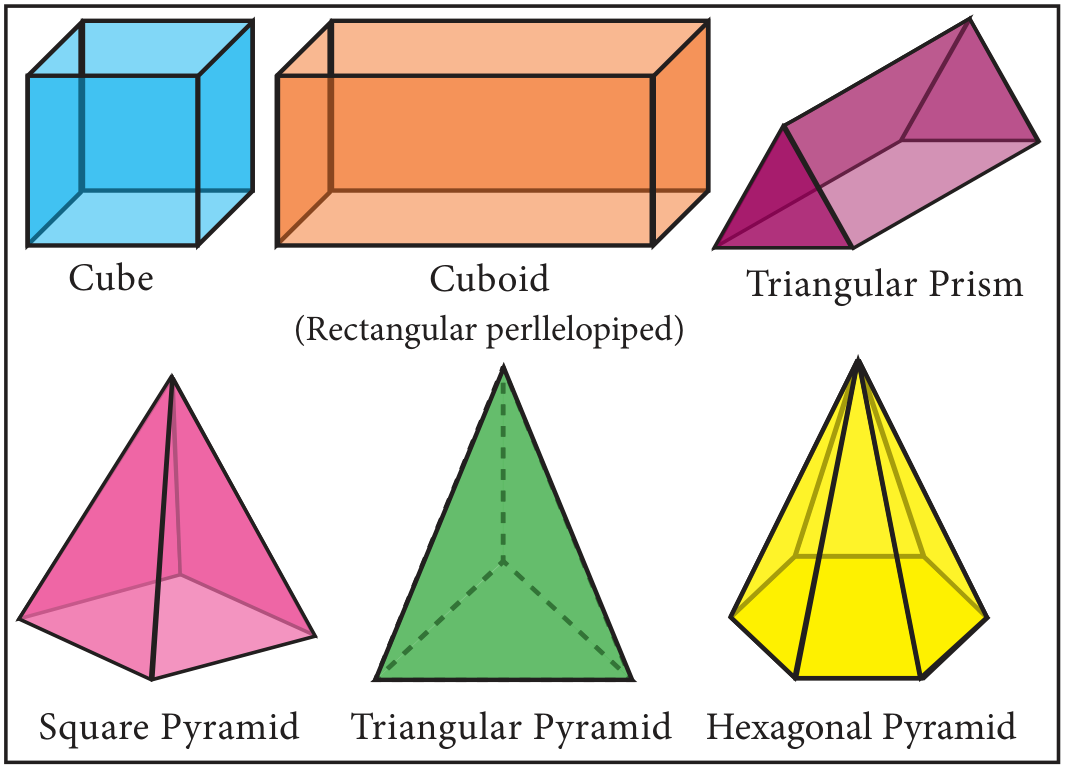
We are already familiar with the areas of plane figures like square, rectangle, triangle, circle etc. These figures are called $2$-dimensional shapes as they can be drawn in a plane. But most of the objects which we come across in our daily life cannot be represented in a plane. For example, tubes, water tanks, bricks, ice-cream cones, football etc. These objects are called solid shapes or $3$-dimensional shapes.
We often see solids like cube, cuboid, prism and pyramid. For three dimensional objects measurements like surface area and volume exist.
In this chapter, we shall study about the surface area and volume of some of the standard solid shapes such as cylinder, cone, sphere, hemisphere and frustum.
7.2 Surface Area#
Surface area is the measurement of all exposed area of a solid object.
7.2.1 Right Circular Cylinder#
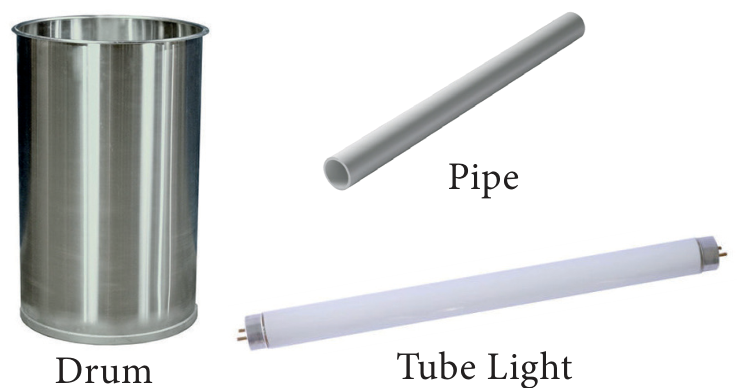
Observe the given figures in Fig.7.2 and identify the shape.
These objects resemble the shape of a cylinder.
Definition
A right circular cylinder is a solid generated by the revolution of a rectangle about one of its sides as axis.
If the axis is perpendicular to the radius then the cylinder is called a right circular cylinder. In the Fig.7.3, AB $= h$ represent the height and $AD = r$ represent the radius of the cylinder.
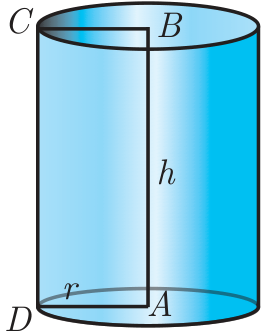
A solid cylinder is an object bounded by two circular plane surfaces and a curved surface. The area between the two circular bases is called its ‘Lateral Surface Area’ (L.S.A.) or ‘Curved Surface Area’ (C.S.A.).
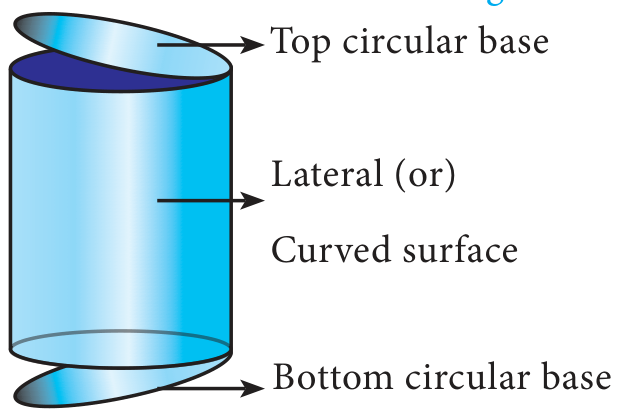
Formation of a Right Circular Cylinder – Demonstration
(i) Take a rectangle sheet of a paper of length $l$ and breadth $b$.
(ii) Revolve the paper about one of its sides, say $b$ to complete a full rotation (without overlapping).
(iii) The shape thus formed will be a right circular cylinder whose circumference of the base is $l$ and the height is $b$.
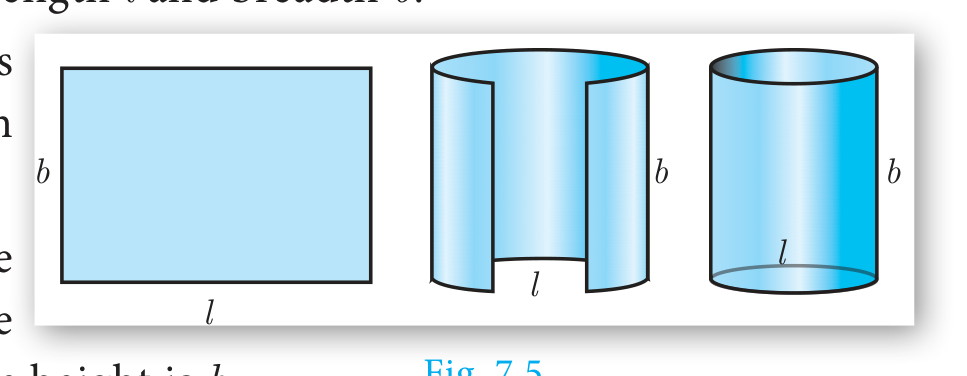
Surface Area of a Right Circular Cylinder
(i) Curved surface area
Curved surface area (C.S.A.) of a right circular cylinder
$$= \text{Area of the corresponding rectangle}$$$$= l \times b$$$$= 2\pi r \times h \quad (\because l \text{ is the circumference of the base, } b \text{ is the height}) \text{ [see Fig. 7.5]}$$$$= 2\pi rh$$$$\boxed{\text{C.S.A. of a right circular cylinder} = 2\pi rh \text{ sq. units.}}$$(ii) Total surface area
Total surface area refers to the sum of areas of the curved surface area and the two circular regions at the top and bottom.
That is, total surface area (T.S.A.) of right circular cylinder
$$= \text{C.S.A + Area of top circular region + Area of bottom circular region.}$$$$= 2\pi rh + \pi r^2 + \pi r^2 \quad \text{(Refer Fig.7.4)}$$$$= 2\pi rh + 2\pi r^2$$$$= 2\pi r(h + r)$$$$\boxed{\text{T.S.A. of a right circular cylinder} = 2\pi r(h + r) \text{ sq. units}}$$Note
- We always consider $\pi = \dfrac{22}{7}$, unless otherwise stated.
- The term ‘surface area’ refers to ’total surface area’.
Example 7.1 A cylindrical drum has a height of $20$ cm and base radius of $14$ cm. Find its curved surface area and the total surface area.
Solution Given that, height of the cylinder $h = 20$ cm ; radius $r = 14$ cm
Now, C.S.A. of the cylinder $= 2\pi rh$ sq. units
$$\text{C.S.A. of the cylinder} = 2 \times \dfrac{22}{7} \times 14 \times 20 = 2 \times 22 \times 2 \times 20 = 1760 \text{ cm}^2$$$$\text{T.S.A. of the cylinder} = 2\pi r(h + r) \text{ sq. units}$$$$= 2 \times \dfrac{22}{7} \times 14 \times (20 + 14) = 2 \times \dfrac{22}{7} \times 14 \times 34$$$$= 2992 \text{ cm}^2$$Therefore, C.S.A. $= 1760$ cm$^2$ and T.S.A. $= 2992$ cm$^2$
Example 7.2 The curved surface area of a right circular cylinder of height $14$ cm is $88$ cm$^2$. Find the diameter of the cylinder.
Solution Given that, C.S.A. of the cylinder $= 88$ sq. cm
$$2\pi rh = 88$$$$2 \times \dfrac{22}{7} \times r \times 14 = 88 \qquad (h = 14 \text{ cm})$$$$2r = \dfrac{88 \times 7}{22 \times 14} = 2$$Therefore, diameter $= 2$ cm
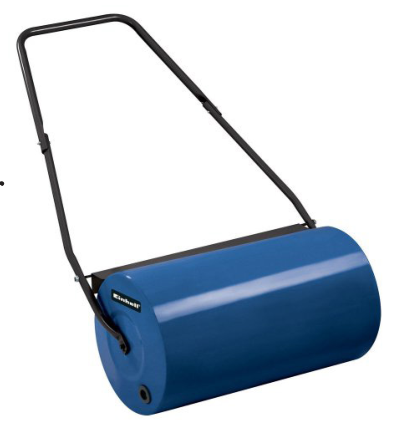
Example 7.3 A garden roller whose length is $3$ m long and whose diameter is $2.8$ m is rolled to level a garden. How much area will it cover in $8$ revolutions?
Solution Given that, diameter $d = 2.8$ m and height $= 3$ m
radius $r = 1.4$ m
$$\text{Area covered in one revolution} = \text{curved surface area of the cylinder}$$$$= 2\pi rh \text{ sq. units}$$$$= 2 \times \dfrac{22}{7} \times 1.4 \times 3 = 26.4$$Area covered in $1$ revolution $= 26.4$ m$^2$
Area covered in $8$ revolutions $= 8 \times 26.4 = 211.2$
Therefore, area covered is $211.2$ m$^2$
Thinking Corner
- When ‘$h$’ coins each of radius ‘$r$’ units and thickness $1$ unit is stacked one upon the other, what would be the solid object you get? Also find its C.S.A.
- When the radius of a cylinder is double its height, find the relation between its C.S.A. and base area.
- Two circular cylinders are formed by rolling two rectangular aluminum sheets each of dimensions $12$ m length and $5$ m breadth, one by rolling along its length and the other along its width. Find the ratio of their curved surface areas.
7.2.2 Hollow Cylinder#
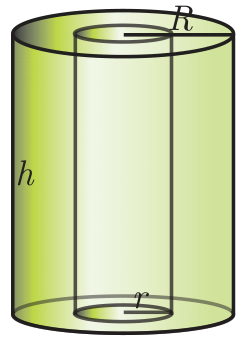
An object bounded by two co-axial cylinders of the same height and different radii is called a ‘hollow cylinder’.
Let $R$ and $r$ be the outer and inner radii of the cylinder. Let $h$ be its height.
Example 7.4 If one litre of paint covers $10$ m$^2$, how many litres of paint is required to paint the internal and external surface areas of a cylindrical tunnel whose thickness is $2$ m, internal radius is $6$ m and height is $25$ m.
Solution Given that, height $h = 25$ m; thickness $= 2$ m
internal radius $r = 6$ m
Now, external radius $R = 6 + 2 = 8$ m
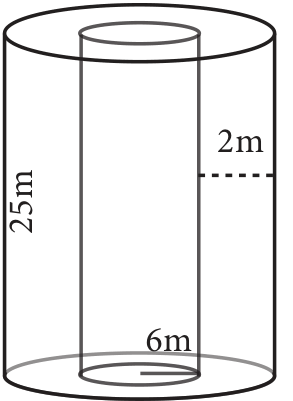
Hence, C.S.A. of the cylindrical tunnel $= 2200$ m$^2$
Area covered by one litre of paint $= 10$ m$^2$
$$\text{Number of litres required to paint the tunnel} = \dfrac{2200}{10} = 220$$Therefore, $220$ litres of paint is needed to paint the tunnel.
Progress Check
- Right circular cylinder is a solid obtained by revolving ____ about ____.
- In a right circular cylinder the axis is ____ to the diameter.
- The difference between the C.S.A. and T.S.A. of a right circular cylinder is ____.
- The C.S.A. of a right circular cylinder of equal radius and height is ____ the area of its base.
7.2.3 Right Circular Cone#
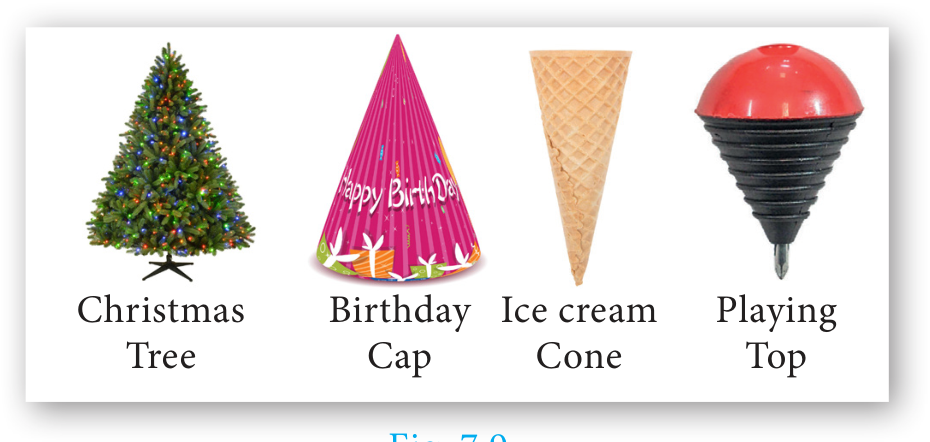
Observe the given figures in Fig.7.9 and identify which solid shape they represent?
These objects resemble the shape of a cone.
Definition
A right circular cone is a solid generated by the revolution of a right angled triangle about one of the sides containing the right angle as axis.
Formation of a Right Circular Cone - Demonstration
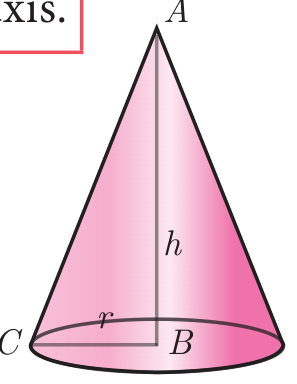
In Fig. 7.10, if the right triangle $ABC$ revolves about $AB$ as axis, the hypotenuse $AC$ generates the curved surface of the cone represented in the diagram. The height of the cone is the length of the axis $AB$, and the slant height is the length of the hypotenuse $AC$.
Surface area of a right circular cone
Suppose the surface area of the cone is cut along the hypotenuse $AC$ and then unrolled on a plane, the surface area will take the form of a sector $ACD$, of which the radius AC and the arc $CD$ are respectively the slant height and the circumference of the base of the cone.
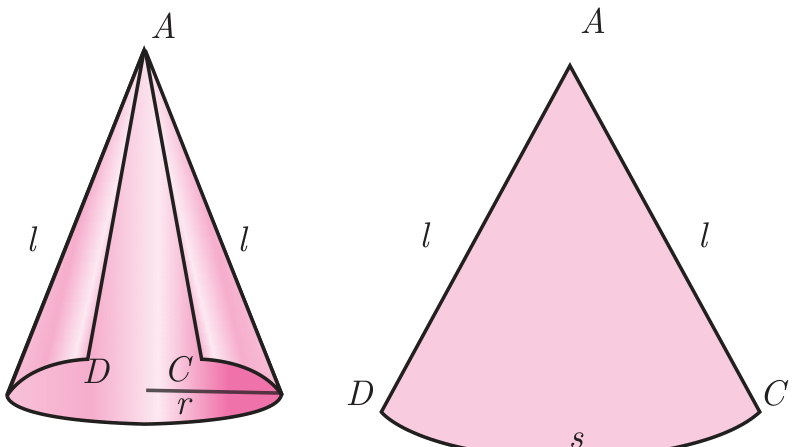
Here the sector of radius ‘$l$’ and arc length ‘$s$’ will be similar to a circle of radius $l$.
(i) Curved surface area
$$\dfrac{\text{Area of the sector}}{\text{Area of the circle}} = \dfrac{\text{Arc length of the sector}}{\text{Circumference of the circle}}$$$$\text{Area of the sector} = \dfrac{\text{Arc length of the sector}}{\text{Circumference of the circle}} \times \text{Area of the circle}$$$$= \dfrac{s}{2\pi l} \times \pi l^2 = \dfrac{s}{2} \times l = \dfrac{2\pi r}{2} \times l \qquad (\because s = 2\pi r)$$$\therefore$ Curved Surface Area of the cone $=$ Area of the Sector $= \pi rl$ sq. units.
$$\boxed{\text{C.S.A. of a right circular cone} = \pi rl \text{ sq. units.}}$$Thinking Corner
- Give practical example of solid cone.
- Find surface area of a cone in terms of its radius when height is equal to radius.
- Compare the above surface area with the area of the base of the cone.
Activity 1
(i) Take a semi-circular paper with radius $7$ cm and make it a cone. Find the C.S.A. of the cone.
(ii) Take a quarter circular paper with radius $3.5$ cm and make it a cone. Find the C.S.A. of the cone.
Derivation of slant height ‘$l$’
$ABC$ is a right angled triangle, right angled at $B$. The hypotenuse, base and height of the triangle are represented by $l$, $r$ and $h$ respectively.
Now, using Pythagoras theorem in $\Delta ABC$,
$$AC^2 = AB^2 + BC^2$$$$l^2 = h^2 + r^2$$$$l = \sqrt{h^2 + r^2} \text{ units}$$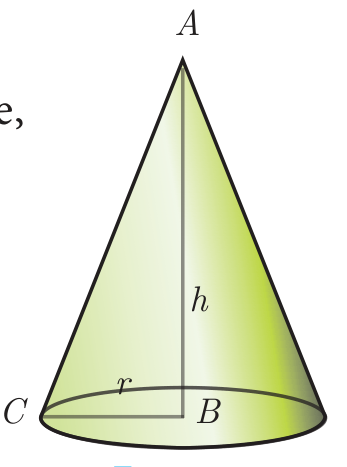
(ii) Total surface area
$$\text{Total surface area of a cone} = \text{C.S.A. + base area of the cone}$$$$= \pi rl + \pi r^2 \quad (\because \text{the base is a circle})$$$$\boxed{\text{T.S.A. of a right circular cone} = \pi r(l + r) \text{ sq. units.}}$$Example 7.5 The radius of a conical tent is $7$ m and the height is $24$ m. Calculate the length of the canvas used to make the tent if the width of the rectangular canvas is $4$ m?
Solution Let $r$ and $h$ be the radius and height of the cone respectively.
Given that, radius $r = 7$ m and height $h = 24$ m
$$\text{Hence, } l = \sqrt{r^2 + h^2}$$$$= \sqrt{49 + 576}$$$$l = \sqrt{625} = 25 \text{ m}$$$$\text{C.S.A. of the conical tent} = \pi rl \text{ sq. units}$$$$\text{Area of the canvas} = \dfrac{22}{7} \times 7 \times 25 = 550 \text{ m}^2$$$$\text{Now, length of the canvas} = \dfrac{\text{Area of the canvas}}{\text{width}} = \dfrac{550}{4} = 137.5 \text{ m}$$Therefore, the length of the canvas is$137.5$ m
Example 7.6 If the total surface area of a cone of radius $7$cm is $704$ cm$^2$, then find its slant height.
Solution Given that, radius $r = 7$ cm
$$\text{Now, total surface area of the cone} = \pi r(l + r) \text{ sq. units}$$$$\text{T.S.A.} = 704 \text{ cm}^2$$$$704 = \dfrac{22}{7} \times 7(l + 7)$$$$32 = l + 7 \Rightarrow l = 25 \text{ cm}$$Therefore, slant height of the cone is $25$ cm.
Example 7.7 From a solid cylinder whose height is $2.4$ cm and diameter $1.4$ cm, a conical cavity of the same height and base is hollowed out (Fig.7.13). Find the total surface area of the remaining solid.
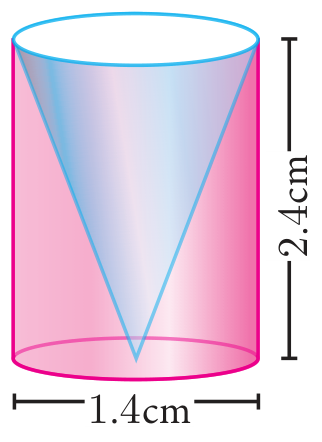
Solution Let $h$ and $r$ be the height and radius of the cone and cylinder.
Let $l$ be the slant height of the cone.
Given that, $h = 2.4$ cm and $d = 1.4$ cm ; $r = 0.7$ cm
$$\left.\begin{matrix}\text{Total surface area of the} \\ \text{remaining solid}\end{matrix}\right\} = \text{C.S.A. of the cylinder + C.S.A. of the cone + area of the bottom}$$$$= 2\pi rh + \pi rl + \pi r^2 \text{ sq. units}$$$$= \pi r(2h + l + r) \text{ sq. units}$$$$\text{Now, } l = \sqrt{r^2 + h^2} = \sqrt{0.49 + 5.76} = \sqrt{6.25} = 2.5 \text{ cm}$$$$l = 2.5 \text{ cm}$$$$\text{Area of the remaining solid} = \pi r(2h + l + r) \text{ sq. units}$$$$= \dfrac{22}{7} \times 0.7 \times [(2 \times 2.4) + 2.5 + 0.7]$$$$= 17.6$$Therefore, total surface area of the remaining solid is $17.6$ cm$^2$
Progress Check
- Right circular cone is a solid obtained by revolving ____ about ____.
- In a right circular cone the axis is ____ to the diameter.
- The difference between the C.S.A. and T.S.A. of a cone is ____.
- When a sector of a circle is transformed to form a cone, then match the conversions taking place between the sector and the cone.
| Sector | Cone |
|---|---|
| Radius | Circumference of the base |
| Area | Slant height |
| Arc length | Curved surface area |
7.2.4 The Sphere#
Definition
A sphere is a solid generated by the revolution of a semicircle about its diameter as axis.
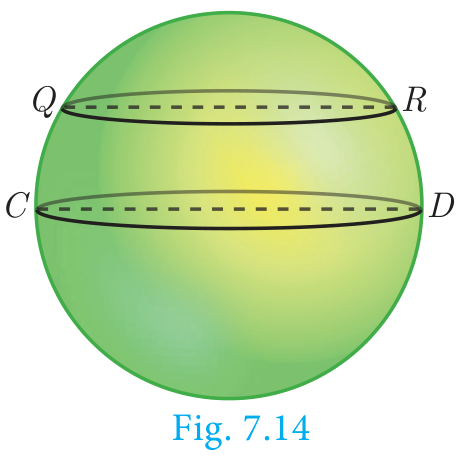
Every plane section of a sphere is a circle. The line of section of a sphere by a plane passing through the centre of the sphere is called a great circle all other plane sections are called small circles.
As shown in the diagram, circle with $CD$ as diameter is a great circle, whereas, the circle with $QR$ as diameter is a small circle.
Surface area of a sphere
Archimedes Proof
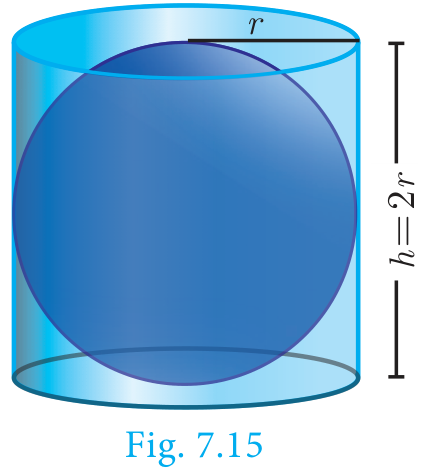
Place a sphere inside a right circular cylinder of equal diameter and height. Then the height of the cylinder will be the diameter of the sphere. In this case, Archimedes proved that the outer area of the sphere is same as curved surface area of the cylinder.
Activity 2
(i) Take a sphere of radius ‘r’.
(ii) Take a cylinder whose base diameter and height are equal to the diameter of the sphere.
(iii) Now, roll thread around the surface of the sphere and the cylinder without overlapping and leaving space between the threads.
(iv) Now compare the length of the two threads in both the cases.
(v) Use this information to find surface area of sphere.
7.2.5 Hemisphere#
A section of the sphere cut by a plane through any of its great circle is a hemisphere.
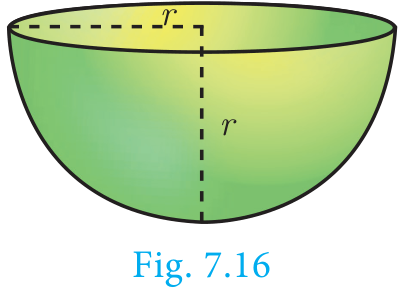
By doing this, we observe that a hemisphere is exactly half the portion of the sphere.
$$\text{Curved surface area of hemisphere} = \dfrac{\text{C.S.A. of the sphere}}{2} = \dfrac{4\pi r^2}{2}$$$$\boxed{\text{C.S.A. of a hemisphere} = 2\pi r^2 \text{ sq.units}}$$$$\text{Total surface area of hemisphere} = \text{C.S.A.} + \text{Area of top circular region}$$$$= 2\pi r^2 + \pi r^2$$$$\boxed{\text{T.S.A. of a hemisphere} = 3\pi r^2 \text{ sq.units}}$$7.2.6 Hollow Hemisphere#
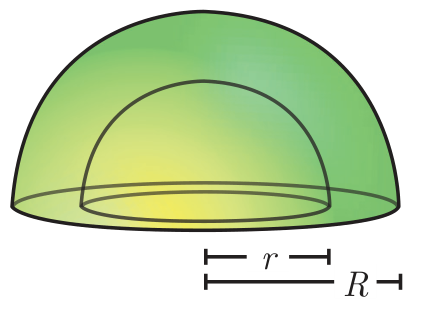
Let the inner radius be $r$ and outer radius be $R$, then thickness $= R\text{-}r$
Therefore,
$$\text{C.S.A.} = \text{Area of external hemisphere} + \text{Area of internal hemisphere}$$$$= 2\pi R^2 + 2\pi r^2$$$$\boxed{\text{C.S.A. of a hollow hemisphere} = 2\pi(R^2 + r^2) \text{ sq. units}}$$$$\text{T.S.A.} = \text{C.S.A.} + \text{Area of annulus region}$$$$= 2\pi(R^2 + r^2) + \pi(R^2 - r^2)$$$$= \pi\left[2R^2 + 2r^2 + R^2 - r^2\right]$$$$\boxed{\text{T.S.A. of a hollow hemisphere} = \pi(3R^2 + r^2) \text{ sq. units}}$$Example 7.8 Find the diameter of a sphere whose surface area is $154$ m².
Solution Let $r$ be the radius of the sphere.
Given that, surface area of sphere $= 154$ m²
$$4\pi r^2 = 154$$$$4 \times \dfrac{22}{7} \times r^2 = 154$$$$\Rightarrow r^2 = 154 \times \dfrac{1}{4} \times \dfrac{7}{22}$$$$r^2 = \dfrac{49}{4} \text{ we get } r = \dfrac{7}{2}$$Therefore, diameter is $7$ m
Activity 3
Using a globe, list any two countries in the northern and southern hemispheres.
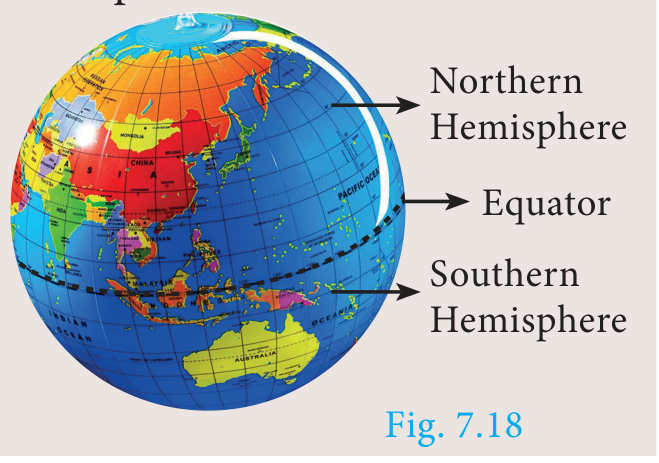
Example 7.9 The radius of a spherical balloon increases from $12$ cm to $16$ cm as air being pumped into it. Find the ratio of the surface area of the balloons in the two cases.
Solution Let $r_1$ and $r_2$ be the radii of the balloons.
$$\text{Given that, } \dfrac{r_1}{r_2} = \dfrac{12}{16} = \dfrac{3}{4}$$$$\text{Now, ratio of C.S.A. of balloons} = \dfrac{4\pi r_1^2}{4\pi r_2^2} = \dfrac{r_1^2}{r_2^2} = \left(\dfrac{r_1}{r_2}\right)^2 = \left(\dfrac{3}{4}\right)^2 = \dfrac{9}{16}$$Therefore, ratio of C.S.A. of balloons is $9:16$.
Thinking Corner
- Find the value of the radius of a sphere whose surface area is $36\pi$ sq. units.
- How many great circles can a sphere have?
- Find the surface area of the earth whose diameter is $12756$ kms.
Progress Check
- Every section of a sphere by a plane is a ____.
- The centre of a great circle is at the ____ of the sphere.
- The difference between the T.S.A. and C.S.A. of hemisphere is ____.
- The ratio of surface area of a sphere and C.S.A. of hemisphere is ____.
- A section of the sphere by a plane through any of its great circle is ____.
Example 7.10 If the base area of a hemispherical solid is $1386$ sq. metres, then find its total surface area?
Solution Let $r$ be the radius of the hemisphere.
$$\text{Given that, base area} = \pi r^2 = 1386 \text{ sq. m}$$$$\text{T.S.A.} = 3\pi r^2 \text{ sq.m}$$$$= 3 \times 1386 = 4158$$Therefore, T.S.A. of the hemispherical solid is $4158$ m².
Note
For finding the C.S.A. and T.S.A. of a hollow sphere, the formula for finding the surface area of a sphere can be used.
Thinking Corner
- Shall we get a hemisphere when a sphere is cut along the small circle?
- T.S.A of a hemisphere is equal to how many times the area of its base?
- How many hemispheres can be obtained from a given sphere?
Example 7.11 The internal and external radii of a hollow hemispherical shell are $3$ m and $5$ m respectively. Find the T.S.A. and C.S.A. of the shell.
Solution Let the internal and external radii of the hemispherical shell be $r$ and $R$ respectively.
Given that, $R = 5$ m, $r = 3$ m
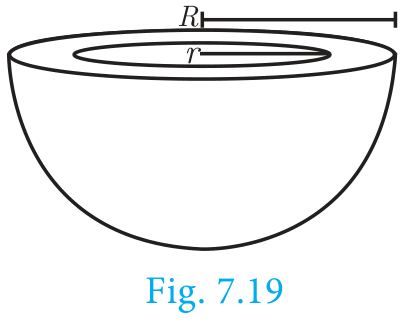
Therefore, C.S.A. $= 213.71$ $m^2$ and T.S.A. $= 264$ m².
Example 7.12 A sphere, a cylinder and a cone are of the same height which is equal to its radius, where as cone and cylinder are of same height. Find the ratio of their curved surface areas.
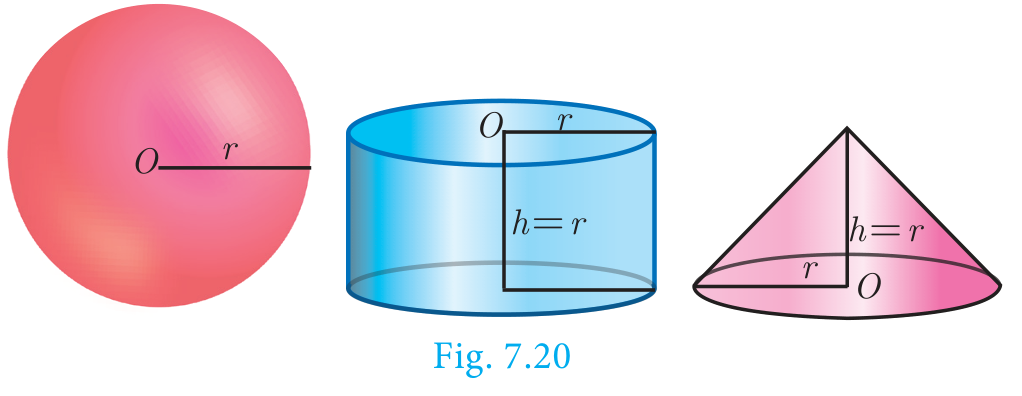
Solution Required Ratio $=$ C.S.A. of the sphere: C.S.A. of the cylinder : C.S.A. of the cone
$$= 4\pi r^2 : 2\pi rh : \pi rl \qquad \left(l = \sqrt{r^2 + h^2} = \sqrt{2r^2} = \sqrt{2}r\right)$$$$= 4\pi r^2 : 2\pi r^2 : \pi r\sqrt{2}\,r$$$$= 4\pi r^2 : 2\pi r^2 : \sqrt{2}\pi r^2$$$$= 4 : 2 : \sqrt{2} = 2\sqrt{2} : \sqrt{2} : 1$$7.2.7 Frustum of a right circular cone#
In olden days a cone shaped buckets [Fig.7.21(a)] filled with sand / water were used to extinguish fire during fire accidents. Later, it was reshaped to a round shaped bottom [Fig.7.21(b)] to increase its volume.
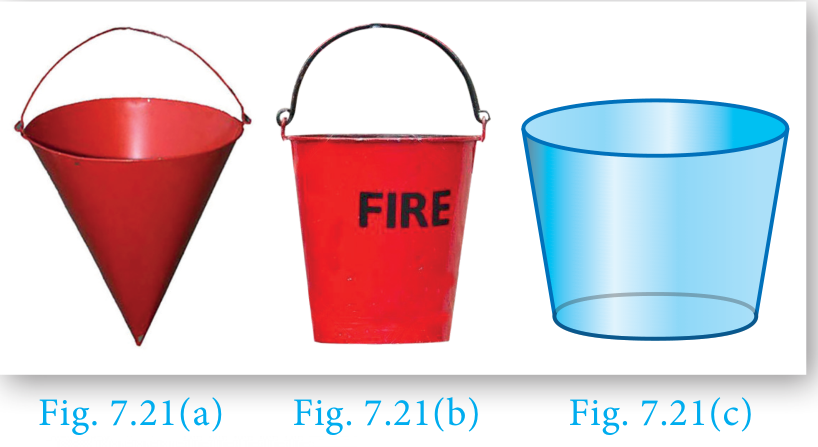
The shape in [Fig.7.21(c)] resembling a inverted bucket is called as a frustrum of a cone.
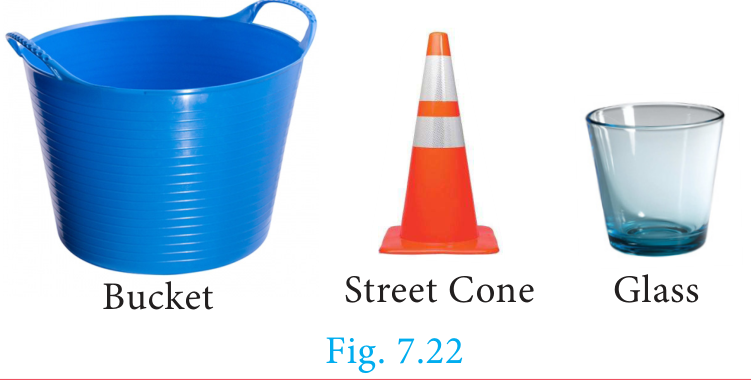
The objects which we use in our daily life such as glass, bucket, street cone are examples of frustum of a cone. (Fig.7.22)
Definition
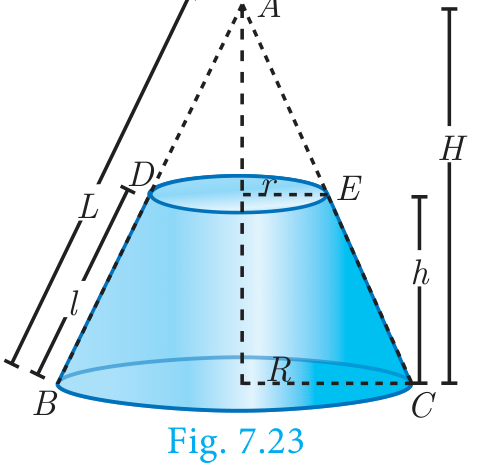
When a cone ABC is cut through by a plane parallel to its base, the portion of the cone DECB between the cutting plane and the base is called a frustum of the cone.
Surface area of a frustum
Let $R$ and $r$ be radii of the base and top region of the frustum $DECB$ respectively, $h$ is the height and $l$ is the slant height of the same.
$$\text{Therefore, C.S.A.} = \dfrac{1}{2}\,(\text{sum of the perimeters of base and top region}) \times \text{slant height}$$$$= \dfrac{1}{2}(2\pi R + 2\pi r)l$$$$\boxed{\text{C.S.A. of a frustum} = \pi(R + r)l \text{ sq. units}} \qquad \text{where, } l = \sqrt{h^2 + (R - r)^2}$$$$\text{T.S.A.} = \text{C.S.A.} + \text{Area of the bottom circular region} + \text{Area of the top circular region.}$$$$\boxed{\text{T.S.A. of a frustum} = \pi(R + r)l + \pi R^2 + \pi r^2 \text{ sq. units}} \qquad \text{where, } l = \sqrt{h^2 + (R - r)^2}$$Example 7.13 The slant height of a frustum of a cone is $5$ cm and the radii of its ends are $4$ cm and $1$ cm. Find its curved surface area.
Solution Let $l$, $R$ and $r$ be the slant height, top radius and bottom radius of the frustum.
Given that, $l = 5$ cm, $R = 4$ cm, $r = 1$ cm
$$\text{Now, C.S.A. of the frustum} = \pi\left(R + r\right)l \text{ sq. units}$$$$= \dfrac{22}{7} \times \left(4 + 1\right) \times 5$$$$= \dfrac{550}{7}$$Therefore, C.S.A. $= 78.57$ cm²
Thinking Corner
- Give two real life examples for a frustum of a cone.
- Can a hemisphere be considered as a frustum of a sphere.
Example 7.14 An industrial metallic bucket is in the shape of the frustum of a right circular cone whose top and bottom diameters are $10$ m and $4$ m and whose height is $4$ m. Find the curved and total surface area of the bucket.
Solution Let $h$, $l$, $R$ and $r$ be the height, slant height, top radius and bottom radius of the frustum.
Given that, diameter of the top $= 10$ m; radius of the top $R = 5$ m.
diameter of the bottom $= 4$ m; radius of the bottom $r = 2$ m, height $h = 4$ m
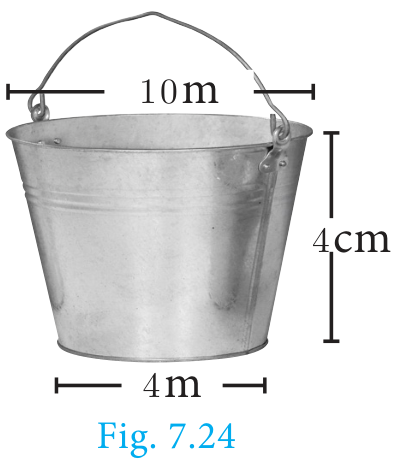
Therefore, C.S.A. $= 110$ m² and T.S.A. $= 122.57$ m²
Progress Check
- The portion of a right circular cone intersected between two parallel planes is ____.
- How many frustums can a right circular cone have?
Exercise 7.1#
- The radius and height of a cylinder are in the ratio $5:7$ and its curved surface area is $5500$ sq.cm. Find its radius and height.
- A solid iron cylinder has total surface area of $1848$ sq.cm. Its curved surface area is five – sixth of its total surface area. Find the radius and height of the iron cylinder.
- The external radius and the length of a hollow wooden log are $16$ cm and $13$ cm respectively. If its thickness is $4$ cm then find its T.S.A.
- A right angled triangle $PQR$ where $\angle Q = 90^\circ$ is rotated about $QR$ and $PQ$ as central axes. If $QR = 16$ cm and $PR = 20$ cm, compare the curved surface areas of the right circular cones so formed by the triangle.
- $4$ persons live in a conical tent whose slant height is $19$ m. If each person require $22$ m² of the floor area, then find the height of the tent.
- A girl wishes to prepare birthday caps in the form of right circular cones for her birthday party, using a sheet of paper whose area is $5720$ cm², how many caps can be made with radius $5$ cm and height $12$ cm.
- The ratio of the radii of two right circular cones of same height is $1:3$. Find the ratio of their curved surface area when the height of each cone is $3$ times the radius of the smaller cone.
- The radius of a sphere increases by $25\%$. Find the percentage increase in its surface area.
- The internal and external diameters of a hollow hemispherical vessel are $20$ cm and $28$ cm respectively. Find the cost to paint the vessel all over at ₹ $0.14$ per cm².
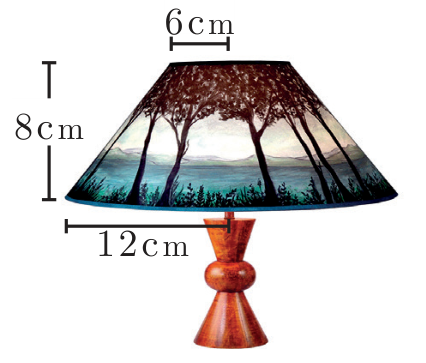
- The frustum shaped outer portion of the table lamp has to be painted including the top part. Find the total cost of painting the lamp if the cost of painting $1$ sq.cm is ₹ $2$.
7.3 Volume#
Having discussed about the surface areas of cylinder, cone, sphere, hemisphere and frustum, we shall now discuss about the volumes of these solids.
Volume refers to the amount of space occupied by an object. The volume is measured in cubic units.
7.3.1 Volume of a solid right circular cylinder#
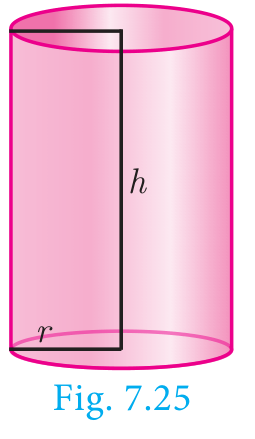
The volume of a right circular cylinder of base radius ‘$r$’ and height ‘$h$’ is given by $V = (\text{Base Area}) \times (\text{Height}) = \pi r^2 \times h = \pi r^2 h$ cubic units.
Therefore, $\boxed{\text{Volume of a cylinder} = \pi r^2 h \text{ cu. units.}}$
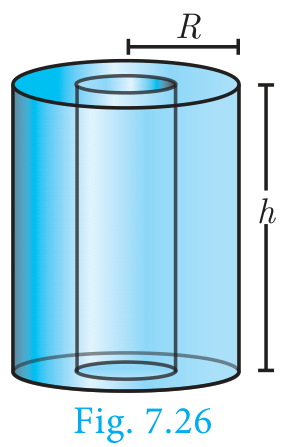
7.3.2 Volume of a hollow cylinder (volume of the material used)#
Let the internal and external radii of a hollow cylinder be $r$ and $R$ units respectively. If the height of the cylinder is $h$ units then
Example 7.15 Find the volume of a cylinder whose height is $2$ m and whose base area is $250$ m².
Solution Let $r$ and $h$ be the radius and height of the cylinder respectively.
Given that, height $h = 2$ m, base area $= 250$ m²
$$\text{Now, volume of a cylinder} = \pi r^2 h \text{ cu. units}$$$$= \textit{base area} \times h$$$$= 250 \times 2 = 500 \text{ m}^3$$$$\text{Therefore, volume of the cylinder} = 500 \text{ m}^3$$Thinking Corner
- If the height is inversely proportional to the square of its radius, the volume of the cylinder is ____.
- What happens to the volume of the cylinder with radius $r$ and height $h$, when its (a) radius is halved (b) height is halved.
Example 7.16 The volume of a cylindrical water tank is $1.078 \times 10^6$ litres. If the diameter of the tank is $7$ m, find its height.
Solution Let $r$ and $h$ be the radius and height of the cylinder respectively.
$$\text{Given that, volume of the tank} = 1.078 \times 10^6 = 1078000 \text{ litre}$$$$= 1078 \text{ m}^3 \qquad \left(\because 1l = \dfrac{1}{1000}\text{ m}^3\right)$$$$\text{diameter} = 7m \Rightarrow \text{radius} = \dfrac{7}{2} \text{ m}$$$$\text{volume of the tank} = \pi r^2 h \text{ cu. units}$$$$1078 = \dfrac{22}{7} \times \dfrac{7}{2} \times \dfrac{7}{2} \times h$$Therefore, height of the tank is $28$ m
Example 7.17 Find the volume of the iron used to make a hollow cylinder of height $9$ cm and whose internal and external radii are $21$ cm and $28$ cm respectively.
Solution Let $r$, $R$ and $h$ be the internal radius, external radius and height of the hollow cylinder respectively.
Given that, $r = 21$cm, $R = 28$ cm, $h = 9$ cm
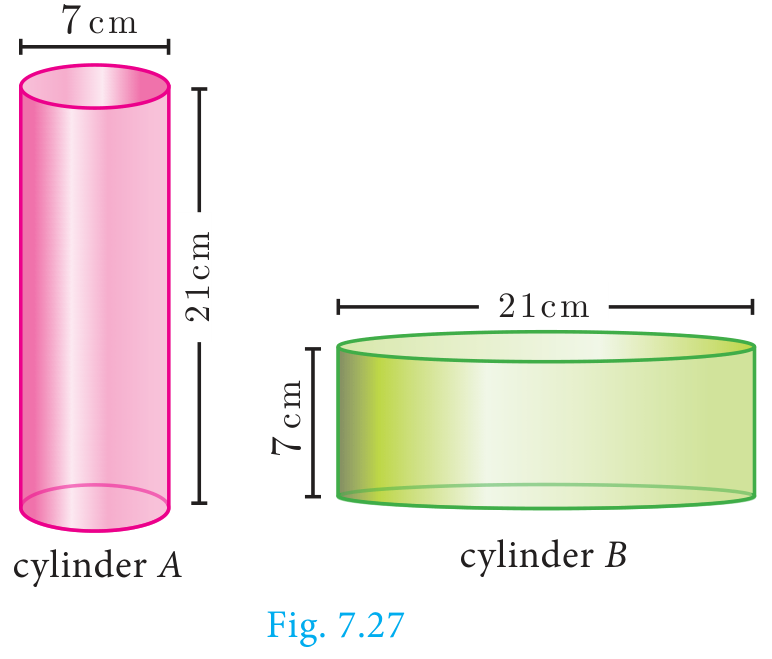
$$\text{Now, volume of hollow cylinder} = \pi(R^2 - r^2)h \text{ cu. units}$$$$= \dfrac{22}{7}\left(28^2 - 21^2\right) \times 9$$$$= \dfrac{22}{7}\left(784 - 441\right) \times 9 = 9702$$$$\text{Therefore, volume of iron used} = 9702 \text{ cm}^3$$Example 7.18 For the cylinders $A$ and $B$ (Fig. 7.27), (i) find out the cylinder whose volume is greater. (ii) verify whether the cylinder with greater volume has greater total surface area. (iii) find the ratios of the volumes of the cylinders $A$ and $B$.
Solution
(i)
$$\text{Volume of cylinder} = \pi r^2 h \text{ cu. units}$$$$\text{Volume of cylinder } A = \dfrac{22}{7} \times \dfrac{7}{2} \times \dfrac{7}{2} \times 21$$$$= 808.5 \text{ cm}^3$$$$\text{Volume of cylinder } B = \dfrac{22}{7} \times \dfrac{21}{2} \times \dfrac{21}{2} \times 7$$$$= 2425.5 \text{ cm}^3$$Therefore, volume of cylinder $B$ is greater than volume of cylinder $A$.
(ii) T.S.A. of cylinder $= 2\pi r(h + r)$ sq. units
$$\text{T.S.A. of cylinder } A = 2 \times \dfrac{22}{7} \times \dfrac{7}{2} \times (21 + 3.5) = 539 \text{ cm}^2$$$$\text{T.S.A. of cylinder } B = 2 \times \dfrac{22}{7} \times \dfrac{21}{2} \times (7 + 10.5) = 1155 \text{ cm}^2$$Hence verified that cylinder $B$ with greater volume has a greater surface area.
(iii)
$$\dfrac{\text{Volume of cylinder A}}{\text{Volume of cylinder B}} = \dfrac{808.5}{2425.5} = \dfrac{1}{3}$$Therefore, ratio of the volumes of cylinders $A$ and $B$ is $1:3$.
7.3.3 Volume of a right circular cone#
Let $r$ and $h$ be the radius and height of a cone then its volume
$$V = \dfrac{1}{3}\pi r^2 h \text{ cu. units.}$$Demonstration
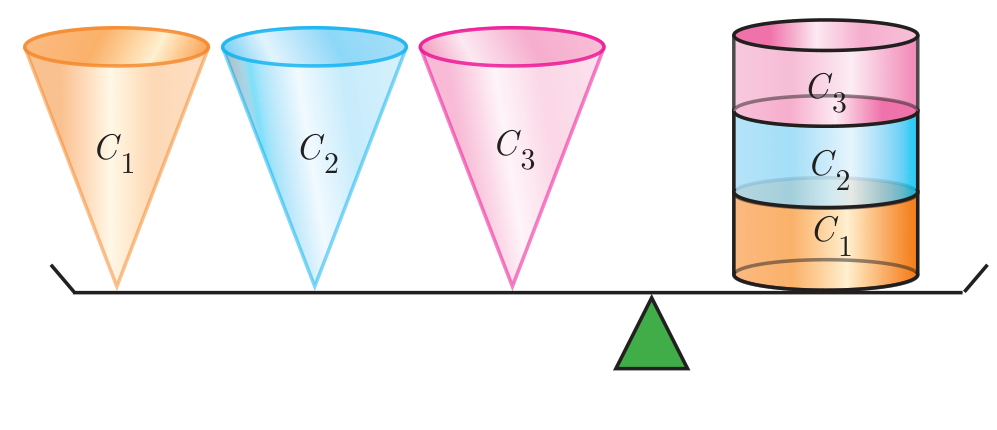
- Consider a right circular cylinder and three right circular cones of same base radius and height as that of the cylinder.
- The contents of three cones will exactly occupy the cylinder.
From, Fig.7.28 we see that,
$$3 \times (\text{Volume of a cone}) = \text{Volume of cylinder}$$$$= \pi r^2 h \text{ cu. units}$$$$\boxed{\text{Volume of a cone} = \dfrac{1}{3}\pi r^2 h \text{ cu. units}}$$Example 7.19 The volume of a solid right circular cone is $11088$ cm$^3$. If its height is $24$ cm then find the radius of the cone.
Solution Let $r$ and $h$ be the radius and height of the cone respectively.
Given that, volume of the cone $= 11088$ cm$^3$
$$\dfrac{1}{3}\pi r^2 h = 11088$$$$\dfrac{1}{3} \times \dfrac{22}{7} \times r^2 \times 24 = 11088$$$$r^2 = 441$$Therefore, radius of the cone $r = 21$ cm
Thinking Corner
- Is it possible to find a right circular cone with equal (a) height and slant height (b) radius and slant height (c) height and radius.
- There are two cones with equal volumes. What will be the ratio of their radius and height?
Example 7.20 The ratio of the volumes of two cones is $2:3$. Find the ratio of their radii if the height of second cone is double the height of the first.
Solution Let $r_1$ and $h_1$ be the radius and height of the cone-I and let $r_2$ and $h_2$ be the radius and height of the cone-II.
$$\text{Given that, } h_2 = 2h_1 \text{ and } \dfrac{\text{Volume of the cone I}}{\text{Volume of the cone II}} = \dfrac{2}{3}$$$$\dfrac{\dfrac{1}{3}\pi r_1^2 h_1}{\dfrac{1}{3}\pi r_2^2 h_2} = \dfrac{2}{3} \Rightarrow \dfrac{r_1^2}{r_2^2} \times \dfrac{h_1}{2h_1} = \dfrac{2}{3}$$$$\dfrac{r_1^2}{r_2^2} = \dfrac{4}{3} \Rightarrow \dfrac{r_1}{r_2} = \dfrac{2}{\sqrt{3}}$$Therefore, ratio of their radii $= 2 : \sqrt{3}$
Progress Check
- Volume of a cone is the product of its base area and ____.
- If the radius of the cone is doubled, the new volume will be ____ times the original volume.
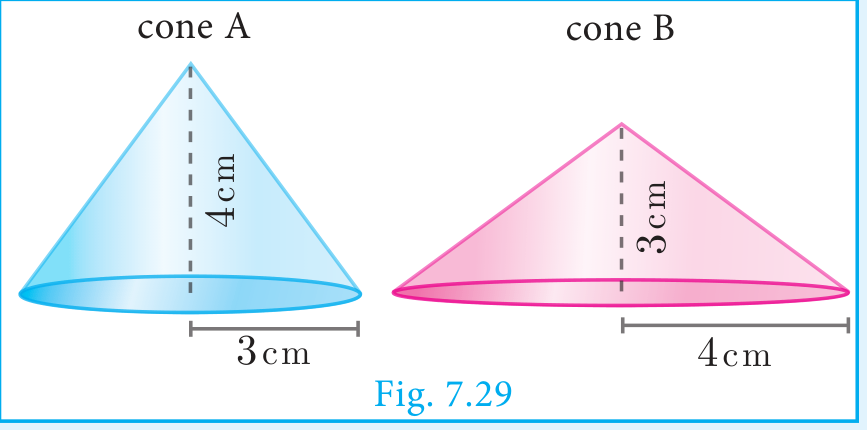
- Consider the cones given in Fig.7.29 (i) Without doing any calculation, find out whose volume is greater? (ii) Verify whether the cone with greater volume has greater surface area. (iii) Volume of cone A : Volume of cone B $= ?$
7.3.4 Volume of sphere#
Let $r$ be the radius of a sphere then its volume is given by $V = \dfrac{4}{3}\pi r^3$ cu. units.
Demonstration
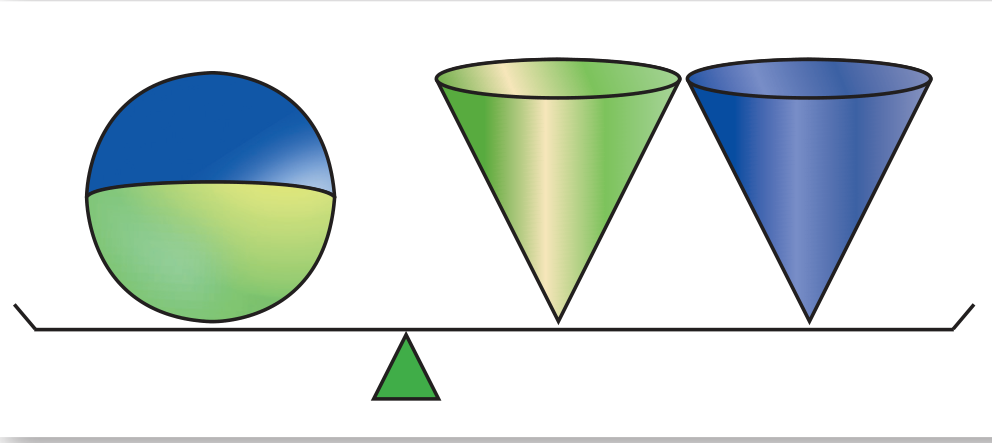
- Consider a sphere and two right circular cones of same base radius and height such that twice the radius of the sphere is equal to the height of the cones.
- Then we can observe that the contents of two cones will exactly occupy the sphere.
From the Fig.7.30, we see that
$$\text{Volume of a sphere} = 2 \times (\text{Volume of a cone})$$where the diameters of sphere and cone are equal to the height of the cone.
$$= 2\left(\dfrac{1}{3}\pi r^2 h\right)$$$$= \dfrac{2}{3}\pi r^2 (2r), \quad (\because h = 2r)$$$$\boxed{\text{Volume of a sphere} = \dfrac{4}{3}\pi r^3 \text{ cu. units}}$$7.3.5 Volume of a hollow sphere / spherical shell (volume of the material used)#
Let $r$ and $R$ be the inner and outer radius of the hollow sphere.
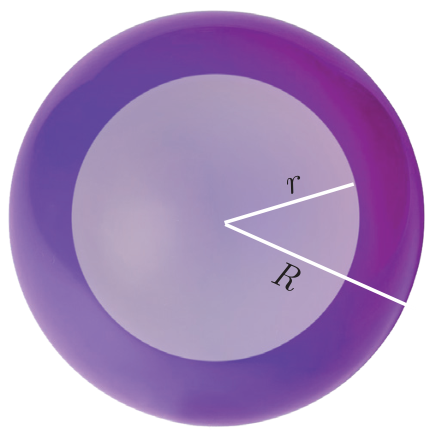
Volume enclosed between the outer and inner spheres
$$= \dfrac{4}{3}\pi R^3 - \dfrac{4}{3}\pi r^3$$$$\boxed{\text{Volume of a hollow sphere} = \dfrac{4}{3}\pi(R^3 - r^3) \text{ cu. units}}$$7.3.6 Volume of solid hemisphere#
Let $r$ be the radius of the solid hemisphere.
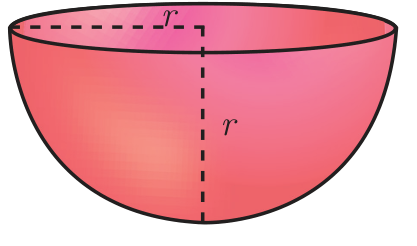
7.3.7 Volume of hollow hemisphere (volume of the material used)#
Let $r$ and $R$ be the inner and outer radius of the hollow hemisphere.
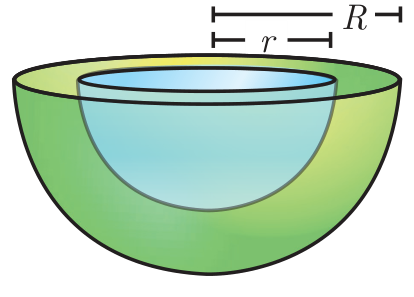
Thinking Corner
A cone, a hemisphere and a cylinder have equal bases. The heights of the cone and cylinder are equal and are same as the common radius. Are they equal in volume?
Example 7.21 The volume of a solid hemisphere is $29106$ cm$^3$. Another hemisphere whose volume is two-third of the above is carved out. Find the radius of the new hemisphere.
Solution Let $r$ be the radius of the hemisphere.
Given that, volume of the hemisphere $= 29106$ cm$^3$
$$\text{Now, volume of new hemisphere} = \dfrac{2}{3}(\text{Volume of original sphere})$$$$= \dfrac{2}{3} \times 29106$$$$\text{Volume of new hemisphere} = 19404 \text{ cm}^3$$$$\dfrac{2}{3}\pi r^3 = 19404$$$$r^3 = \dfrac{19404 \times 3 \times 7}{2 \times 22} = 9261$$$$r = \sqrt[3]{9261} = 21 \text{ cm}$$Therefore, $r = 21$ cm
Thinking Corner
- Give any two real life examples of sphere and hemisphere.
- A plane along a great circle will split the sphere into ____ parts.
- If the volume and surface area of a sphere are numerically equal, then the radius of the sphere is ____.
Example 7.22 Calculate the mass of a hollow brass sphere if the inner diameter is $14$ cm and thickness is $1$mm, and whose density is $17.3$ g/ cm$^3$. (Hint: mass = density × volume)
Solution Let $r$ and $R$ be the inner and outer radii of the hollow sphere.
Given that, inner diameter $d = 14$ cm; inner radius $r = 7$ cm; thickness $= 1$ mm $= \dfrac{1}{10}$ cm
$$\text{Outer radius } R = 7 + \dfrac{1}{10} = \dfrac{71}{10} = 7.1 \text{ cm}$$$$\text{Volume of hollow sphere} = \dfrac{4}{3}\pi(R^3 - r^3) \text{ cu. units}$$$$= \dfrac{4}{3} \times \dfrac{22}{7}(357.91 - 343) = 62.48 \text{ cm}^3$$But, density of brass in $1$ cm$^3$ $= 17.3$ gm
$$\text{Total mass} = 17.3 \times 62.48 = 1080.90 \text{ gm}$$Therefore, total mass is $1080.90$ grams.
Progress Check
- What is the ratio of volume to surface area of a sphere?
- The relationship between the height and radius of the hemisphere is ____.
- The volume of a sphere is the product of its surface area and ____.
7.3.8 Volume of frustum of a cone#
Let $H$ and $h$ be the height of cone and frustum respectively, $L$ and $l$ be the slant height of the same.
If $R$, $r$ are the radii of the circular bases of the frustum, then volume of the frustum of the cone is the difference of the volumes of the two cones.
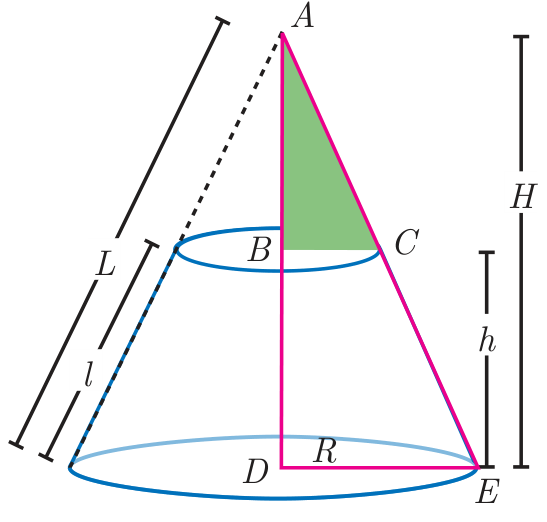
Since the triangles $ABC$ and $ADE$ are similar, the ratio of their corresponding sides are proportional.
$$\text{Therefore, } \dfrac{H - h}{H} = \dfrac{r}{R} \Rightarrow H = \dfrac{hR}{R - r} \qquad \ldots(1)$$$$V = \dfrac{1}{3}\pi R^2 H - \dfrac{1}{3}\pi r^2 (H - h)$$$$= \dfrac{\pi}{3}H(R^2 - r^2) + \dfrac{1}{3}\pi r^2 h$$$$= \dfrac{\pi}{3}\dfrac{hR}{R - r}(R^2 - r^2) + \dfrac{\pi}{3}r^2 h \quad [\text{using } (1)]$$$$= \dfrac{\pi}{3}hR(R + r) + \dfrac{\pi}{3}r^2 h$$$$\boxed{\text{Volume of a frustum} = \dfrac{\pi h}{3}(R^2 + Rr + r^2) \text{ cu. units}}$$Thinking Corner
Is it possible to obtain the volume of the full cone when the volume of the frustum is known?
Example 7.23 If the radii of the circular ends of a frustum which is $45$ cm high are $28$ cm and $7$ cm, find the volume of the frustum.
Solution Let $h$, $r$ and $R$ be the height, top and bottom radii of the frustum.
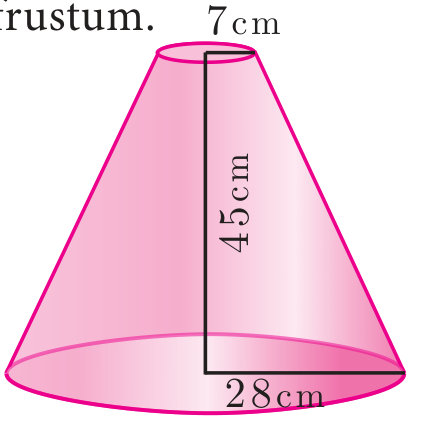
Given that, $h = 45$ cm, $R = 28$ cm, $r = 7$ cm
$$\text{Volume} = \dfrac{1}{3}\pi\left[R^2 + Rr + r^2\right]h \text{ cu. units}$$$$= \dfrac{1}{3} \times \dfrac{22}{7} \times \left[28^2 + (28 \times 7) + 7^2\right] \times 45$$$$= \dfrac{1}{3} \times \dfrac{22}{7} \times 1029 \times 45 = 48510$$Therefore, volume of the frustum is $48510$ cm$^3$
Do You Know
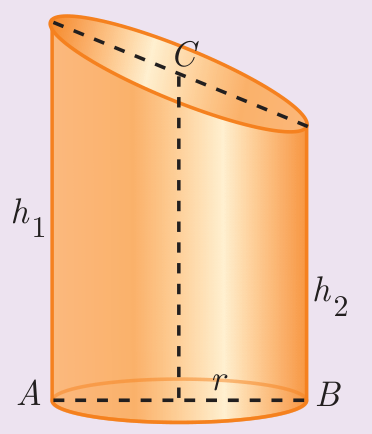
The adjacent figure represents an oblique frustum of a cylinder. Suppose this solid is cut by a plane through $C$, not parallel to the base $AB$, then
$$CSA = 2\pi r \times \dfrac{h_1 + h_2}{2} \text{ sq. units}$$where $h_1$ and $h_2$ denote the greatest and least height of the frustum.
$$\text{Then its volume} = \pi r^2 \times \dfrac{h_1 + h_2}{2} \text{ cu. units}$$
Exercise 7.2#
- A $14$ m deep well with inner diameter $10$ m is dug and the earth taken out is evenly spread all around the well to form an embankment of width $5$ m. Find the height of the embankment.
- A cylindrical glass with diameter $20$ cm has water to a height of $9$ cm. A small cylindrical metal of radius $5$ cm and height $4$ cm is immersed completely. Calculate the raise of the water in the glass?
- If the circumference of a conical wooden piece is $484$ cm then find its volume when its height is $105$ cm.
- A conical container is fully filled with petrol. The radius is $10$m and the height is $15$ m. If the container can release the petrol through its bottom at the rate of $25$ cu. meter per minute, in how many minutes the container will be emptied. Round off your answer to the nearest minute.
- A right angled triangle whose sides are $6$ cm, $8$ cm and $10$ cm is revolved about the sides containing the right angle in two ways. Find the difference in volumes of the two solids so formed.
- The volumes of two cones of same base radius are $3600$ cm$^3$ and $5040$ cm$^3$. Find the ratio of heights.
- If the ratio of radii of two spheres is $4:7$, find the ratio of their volumes.
- A solid sphere and a solid hemisphere have equal total surface area. Prove that the ratio of their volume is $3\sqrt{3} : 4$.
- The outer and the inner surface areas of a spherical copper shell are $576\pi$ cm$^2$ and $324\pi$ cm$^2$ respectively. Find the volume of the material required to make the shell.
- A container open at the top is in the form of a frustum of a cone of height $16$ cm with radii of its lower and upper ends are $8$ cm and $20$ cm respectively. Find the cost of milk which can completely fill a container at the rate of ₹$40$ per litre.
7.4 Volume and Surface Area of Combined Solids#
Observe the shapes given (Fig.7.37).
The shapes provided lead to the following definitions of ‘Combined Solid’.
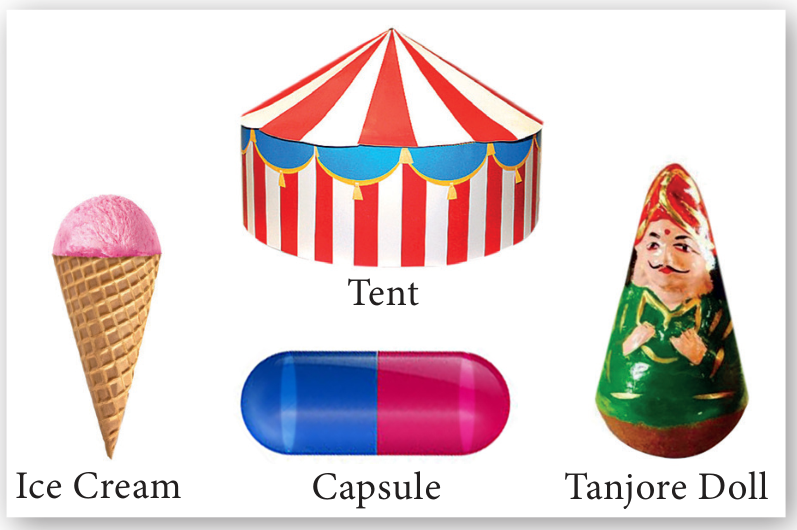
A combined solid is said to be a solid formed by combining two or more solids.
The concept of combined solids is useful in the fields like doll making, building construction, carpentry, etc.
To calculate the surface area of the combined solid, we should only calculate the areas that are visible to our eyes. For example, if a cone is surmounted by a hemisphere, we need to just find out the C.S.A. of the hemisphere and C.S.A. of the cone separately and add them together. Note that we are leaving the base area of both the cone and the hemisphere since both the bases are attached together and are not visible.
But, the volume of the solid formed by joining two basic solids will be the sum of the volumes of the individual solids.
Example 7.24 A toy is in the shape of a cylinder surmounted by a hemisphere. The height of the toy is $25$ cm. Find the total surface area of the toy if its common diameter is $12$ cm.
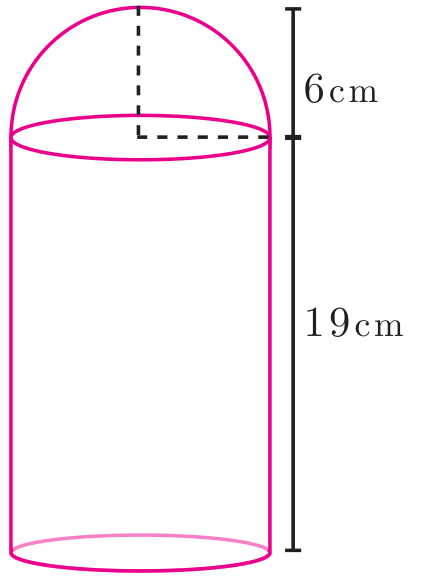
Solution Let $r$ and $h$ be the radius and height of the cylinder respectively.
Given that, diameter $d = 12$ cm, radius $r = 6$ cm
Total height of the toy is $25$ cm
Therefore, height of the cylindrical portion $= 25 - 6 = 19$ cm
$$\text{T.S.A. of the toy} = \text{C.S.A. of the cylinder + C.S.A. of the hemisphere + Base Area of the cylinder}$$$$= 2\pi rh + 2\pi r^2 + \pi r^2$$$$= \pi r(2h + 3r) \text{ sq. units}$$$$= \dfrac{22}{7} \times 6 \times (38 + 18)$$$$= \dfrac{22}{7} \times 6 \times 56 = 1056$$Therefore, T.S.A. of the toy is $1056$ cm$^2$
Example 7.25 A jewel box (Fig. 7.39) is in the shape of a cuboid of dimensions $30$ cm $\times$ $15$ cm $\times$ $10$ cm surmounted by a half part of a cylinder as shown in the figure. Find the volume of the box.
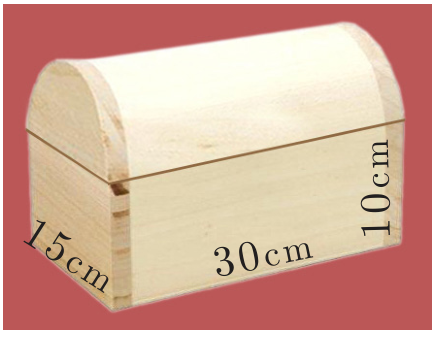
Solution Let $l$, $b$ and $h_1$ be the length, breadth and height of the cuboid. Also let us take $r$ and $h_2$ be the radius and height of the cylinder.
$$\text{Now, Volume of the box} = \text{Volume of the cuboid} + \dfrac{1}{2}(\text{Volume of cylinder})$$$$= (l \times b \times h_1) + \dfrac{1}{2}(\pi r^2 h_2) \text{ cu. units}$$$$= (30 \times 15 \times 10) + \dfrac{1}{2}\left(\dfrac{22}{7} \times \dfrac{15}{2} \times \dfrac{15}{2} \times 30\right)$$$$= 4500 + 2651.79 = 7151.79$$Therefore, Volume of the box $= 7151.79$ cm$^3$
Example 7.26 Arul has to make arrangements for the accommodation of $150$ persons for his family function. For this purpose, he plans to build a tent which is in the shape of cylinder surmounted by a cone. Each person occupies $4$ sq. m of the space on ground and $40$ cu. meter of air to breathe. What should be the height of the conical part of the tent if the height of cylindrical part is $8$ m?
Solution Let $h_1$ and $h_2$ be the height of cylinder and cone respectively.
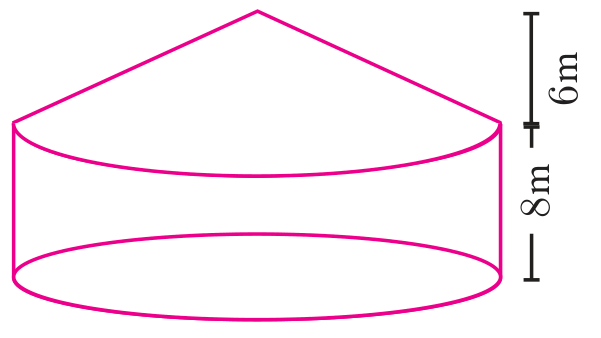
Volume of air required for $1$ person $= 40$ m$^3$
Total Volume of air required for $150$ persons $= 150 \times 40 = 6000$ m$^3$
$$\pi r^2 h_1 + \dfrac{1}{3}\pi r^2 h_2 = 6000$$$$\pi r^2\left(h_1 + \dfrac{1}{3}h_2\right) = 6000$$$$600\left(8 + \dfrac{1}{3}h_2\right) = 6000 \qquad [\text{using } (1)]$$$$8 + \dfrac{1}{3}h_2 = \dfrac{6000}{600}$$$$\dfrac{1}{3}h_2 = 10 - 8 = 2$$$$h_2 = 6 \text{ m}$$Therefore, the height of the conical tent $h_2$ is $6$ m
Example 7.27 A funnel consists of a frustum of a cone attached to a cylindrical portion $12$ cm long attached at the bottom. If the total height be $20$ cm, diameter of the cylindrical portion be $12$ cm and the diameter of the top of the funnel be $24$ cm. Find the outer surface area of the funnel.
Solution Let $R$, $r$ be the top and bottom radii of the frustum.
Let $h_1$, $h_2$ be the heights of the frustum and cylinder respectively.
Given that, $R = 12$ cm, $r = 6$ cm, $h_2 = 12$ cm
Now, $h_1 = 20 - 12 = 8$ cm
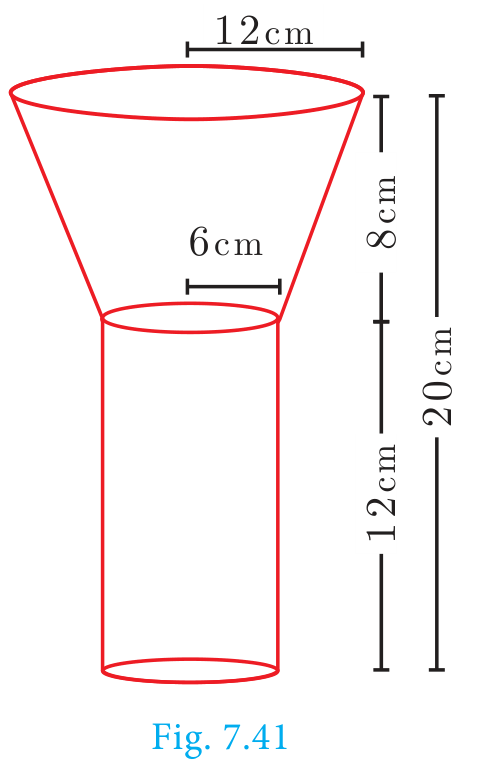
Therefore, outer surface area of the funnel is $1018.28$ cm$^2$
Example 7.28 A hemispherical section is cut out from one face of a cubical block (Fig.7.42) such that the diameter $l$ of the hemisphere is equal to side length of the cube. Determine the surface area of the remaining solid.
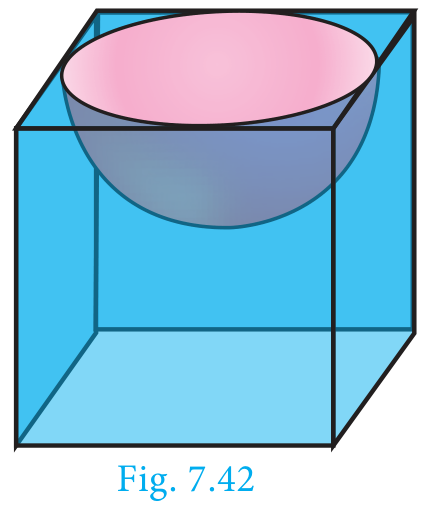
Solution Let $r$ be the radius of the hemisphere.
Given that, diameter of the hemisphere $=$ side of the cube $= l$
Radius of the hemisphere $= \dfrac{l}{2}$
TSA of the remaining solid $=$ Surface area of the cubical part $+$ C.S.A. of the hemispherical part $-$ Area of the base of the hemispherical part
$$= 6 \times (Edge)^2 + 2\pi r^2 - \pi r^2$$$$= 6 \times (Edge)^2 + \pi r^2$$$$= 6 \times (l)^2 + \pi\left(\dfrac{l}{2}\right)^2 = \dfrac{1}{4}(24 + \pi)l^2$$Total surface area of the remaining solid $= \dfrac{1}{4}(24 + \pi)l^2$ sq. units
Activity 4
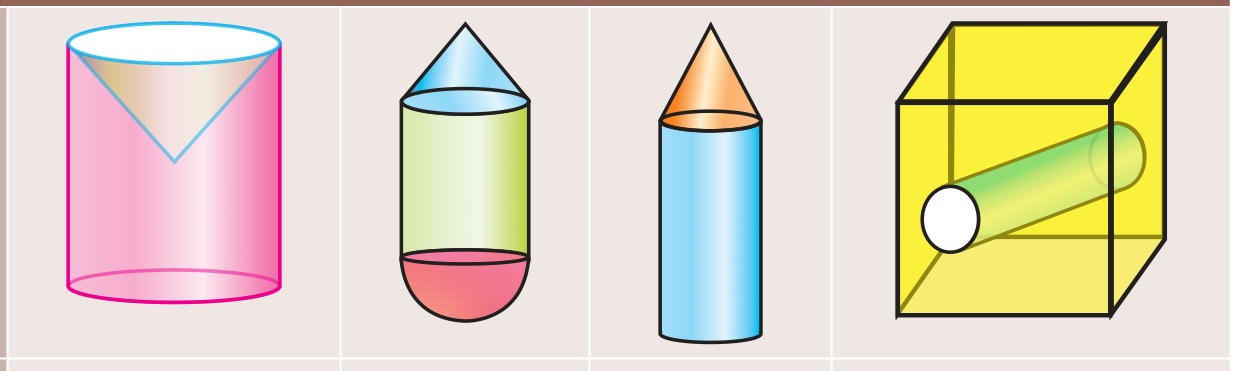
| Combined solids | (1) | (2) | (3) | (4) |
|---|---|---|---|---|
| List out the solids in each combined solid | ||||
| Total Surface Area of the combined solid |
Exercise 7.3#
A vessel is in the form of a hemispherical bowl mounted by a hollow cylinder. The diameter is $14$ cm and the height of the vessel is $13$ cm. Find the capacity of the vessel.
Nathan, an engineering student was asked to make a model shaped like a cylinder with two cones attached at its two ends. The diameter of the model is $3$ cm and its length is $12$ cm. If each cone has a height of $2$ cm, find the volume of the model that Nathan made.
From a solid cylinder whose height is $2.4$ cm and the diameter $1.4$ cm, a cone of the same height and same diameter is carved out. Find the volume of the remaining solid to the nearest $cm^3$.
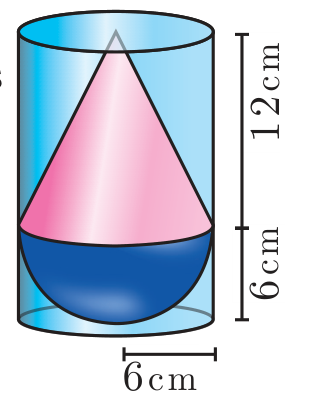
A solid consisting of a right circular cone of height $12$ cm and radius $6$ cm standing on a hemisphere of radius $6$ cm is placed upright in a right circular cylinder full of water such that it touches the bottom. Find the volume of the water displaced out of the cylinder, if the radius of the cylinder is $6$ cm and height is $18$ cm.
Exercise 7.3 Q4 A capsule is in the shape of a cylinder with two hemisphere stuck to each of its ends. If the length of the entire capsule is $12$ mm and the diameter of the capsule is $3$ mm, how much medicine it can hold?
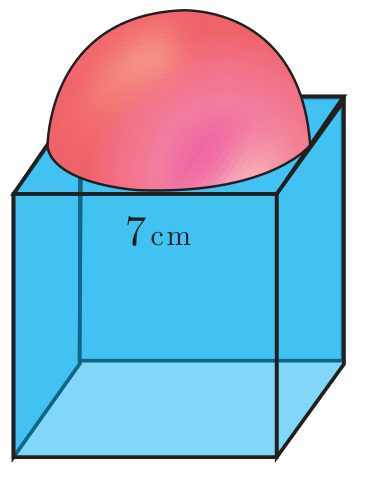
As shown in figure a cubical block of side $7$ cm is surmounted by a hemisphere. Find the surface area of the solid.
Exercise 7.3 Q6 A right circular cylinder just enclose a sphere of radius $r$ units. Calculate (i) the surface area of the sphere (ii) the curved surface area of the cylinder (iii) the ratio of the areas obtained in (i) and (ii).
7.5 Conversion of Solids from one shape to another with no change in Volume#
Conversions or Transformations becomes a common part of our daily life. For example, a gold smith melts a bar of gold to transform it to a jewel. Similarly, a kid playing with clay shapes it into different toys, a carpenter uses the wooden logs to form different house hold articles/furniture. Likewise, the conversion of solids from one shape to another is required for various purposes.
In this section we will be learning problems involving conversions of solids from one shape to another with no change in volume.
Example 7.29 A metallic sphere of radius $16$ cm is melted and recast into small spheres each of radius $2$ cm. How many small spheres can be obtained?
Solution Let the number of small spheres obtained be $n$.
Let $r$ be the radius of each small sphere and $R$ be the radius of metallic sphere.
Here, $R = 16$ cm, $r = 2$ cm
Now, $n \times$ (Volume of a small sphere) $=$ Volume of big metallic sphere
$$n\left(\dfrac{4}{3}\pi r^3\right) = \dfrac{4}{3}\pi R^3$$$$n\left(\dfrac{4}{3}\pi \times 2^3\right) = \dfrac{4}{3}\pi \times 16^3$$$$8n = 4096 \Rightarrow n = 512$$Therefore, there will be $512$ small spheres.
Example 7.30 A cone of height $24$ cm is made up of modeling clay. A child reshapes it in the form of a cylinder of same radius as cone. Find the height of the cylinder.
Solution Let $h_1$ and $h_2$ be the heights of a cone and cylinder respectively.
Also, let $r$ be the raius of the cone.
Given that, height of the cone $h_1 = 24$ cm; radius of the cone and cylinder $r = 6$ cm
Since, Volume of cylinder $=$ Volume of cone
$$\pi r^2 h_2 = \dfrac{1}{3}\pi r^2 h_1$$$$h_2 = \dfrac{1}{3} \times h_1 \Rightarrow h_2 = \dfrac{1}{3} \times 24 = 8$$Therefore, height of cylinder is $8$ cm
Example 7.31 A right circular cylindrical container of base radius $6$ cm and height $15$ cm is full of ice cream. The ice cream is to be filled in cones of height $9$ cm and base radius $3$ cm, having a hemispherical cap. Find the number of cones needed to empty the container.
Solution Let $h$ and $r$ be the height and radius of the cylinder respectively.
Given that, $h = 15$ cm, $r = 6$ cm
$$\text{Volume of the container } V = \pi r^2 h \text{ cubic units.}$$$$= \dfrac{22}{7} \times 6 \times 6 \times 15$$Let, $r_1 = 3$ cm, $h_1 = 9$ cm be the radius and height of the cone.
Also, $r_1 = 3$ cm is the radius of the hemispherical cap.
Volume of one ice cream cone $=$ (Volume of the cone $+$ Volume of the hemispherical cap)
$$= \dfrac{1}{3}\pi r_1^2 h_1 + \dfrac{2}{3}\pi r_1^3$$$$= \dfrac{1}{3} \times \dfrac{22}{7} \times 3 \times 3 \times 9 + \dfrac{2}{3} \times \dfrac{22}{7} \times 3 \times 3 \times 3$$$$= \dfrac{22}{7} \times 9(3 + 2) = \dfrac{22}{7} \times 45$$$$\text{Number of cones} = \dfrac{\text{volume of the cylinder}}{\text{volume of one ice cream cone}}$$$$\text{Number of ice cream cones needed} = \dfrac{\dfrac{22}{7} \times 6 \times 6 \times 15}{\dfrac{22}{7} \times 45} = 12$$Thus $12$ ice cream cones are required to empty the cylindrical container.
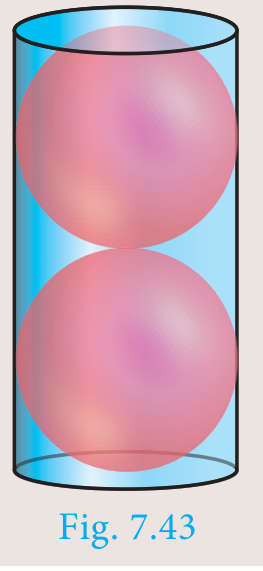
Activity 5
The adjacent figure shows a cylindrical can with two balls. The can is just large enough so that two balls will fit inside with the lid on. The radius of each tennis ball is $3$ cm. Calculate the following
(i) height of the cylinder.
(ii) radius of the cylinder.
(iii) volume of the cylinder.
(iv) volume of two balls.
(v) volume of the cylinder not occupied by the balls.
(vi) percentage of the volume occupied by the balls.
Exercise 7.4#
- An aluminium sphere of radius $12$ cm is melted to make a cylinder of radius $8$ cm. Find the height of the cylinder.
- Water is flowing at the rate of $15$ km per hour through a pipe of diameter $14$ cm into a rectangular tank which is $50$ m long and $44$ m wide. Find the time in which the level of water in the tanks will rise by $21$ cm.
- A conical flask is full of water. The flask has base radius $r$ units and height $h$ units, the water is poured into a cylindrical flask of base radius $xr$ units. Find the height of water in the cylindrical flask.
- A solid right circular cone of diameter $14$ cm and height $8$ cm is melted to form a hollow sphere. If the external diameter of the sphere is $10$ cm, find the internal diameter.
- Seenu’s house has an overhead tank in the shape of a cylinder. This is filled by pumping water from a sump (underground tank) which is in the shape of a cuboid. The sump has dimensions $2$ m $\times 1.5$ m $\times 1$ m. The overhead tank has its radius of $60$ cm and height $105$ cm. Find the volume of the water left in the sump after the overhead tank has been completely filled with water from the sump which has been full, initially.
- The internal and external diameter of a hollow hemispherical shell are $6$ cm and $10$ cm respectively. If it is melted and recast into a solid cylinder of diameter $14$ cm, then find the height of the cylinder.
- A solid sphere of radius $6$ cm is melted into a hollow cylinder of uniform thickness. If the external radius of the base of the cylinder is $5$ cm and its height is $32$ cm, then find the thickness of the cylinder.
- A hemispherical bowl is filled to the brim with juice. The juice is poured into a cylindrical vessel whose radius is $50\%$ more than its height. If the diameter is same for both the bowl and the cylinder then find the percentage of juice that can be transferred from the bowl into the cylindrical vessel.
Exercise 7.5#
Multiple choice questions
- The curved surface area of a right circular cone of height $15$ cm and base diameter $16$ cm is (A) $60\pi$ cm$^2$ (B) $68\pi$ cm$^2$ (C) $120\pi$ cm$^2$ (D) $136\pi$ cm$^2$
- If two solid hemispheres of same base radius r units are joined together along their bases, then curved surface area of this new solid is (A) $4\pi r^2$ sq. units (B) $6\pi r^2$ sq. units (C) $3\pi r^2$ sq. units (D) $8\pi r^2$ sq. units
- The height of a right circular cone whose radius is $5$ cm and slant height is $13$ cm will be (A) $12$ cm (B) $10$ cm (C) $13$ cm (D) $5$ cm
- If the radius of the base of a right circular cylinder is halved keeping the same height, then the ratio of the volume of the cylinder thus obtained to the volume of original cylinder is (A) $1:2$ (B) $1:4$ (C) $1:6$ (D) $1:8$
- The total surface area of a cylinder whose radius is $\dfrac{1}{3}$ of its height is (A) $\dfrac{9\pi h^2}{8}$ sq.units (B) $24\pi h^2$ sq.units (C) $\dfrac{8\pi h^2}{9}$ sq.units (D) $\dfrac{56\pi h^2}{9}$ sq.units
- In a hollow cylinder, the sum of the external and internal radii is $14$ cm and the width is $4$ cm. If its height is $20$ cm, the volume of the material in it is (A) $5600\pi$ cm$^3$ (B) $1120\pi$ cm$^3$ (C) $56\pi$ cm$^3$ (D) $3600\pi$ cm$^3$
- If the radius of the base of a cone is tripled and the height is doubled then the volume is (A) made $6$ times (B) made $18$ times (C) made $12$ times (D) unchanged
- The total surface area of a hemi-sphere is how much times the square of its radius. (A) $\pi$ (B) $4\pi$ (C) $3\pi$ (D) $2\pi$
- A solid sphere of radius $x$ cm is melted and cast into a shape of a solid cone of same radius. The height of the cone is (A) $3x$ cm (B) $x$ cm (C) $4x$ cm (D) $2x$ cm
- A frustum of a right circular cone is of height $16$cm with radii of its ends as $8$cm and $20$cm. Then, the volume of the frustum is (A) $3328\pi$ cm$^3$ (B) $3228\pi$ cm$^3$ (C) $3240\pi$ cm$^3$ (D) $3340\pi$ cm$^3$
- A shuttle cock used for playing badminton has the shape of the combination of (A) a cylinder and a sphere (B) a hemisphere and a cone (C) a sphere and a cone (D) frustum of a cone and a hemisphere
- A spherical ball of radius $r_1$ units is melted to make $8$ new identical balls each of radius $r_2$ units. Then $r_1 : r_2$ is (A) $2:1$ (B) $1:2$ (C) $4:1$ (D) $1:4$
- The volume (in cm$^3$) of the greatest sphere that can be cut off from a cylindrical log of wood of base radius $1$ cm and height $5$ cm is (A) $\dfrac{4}{3}\pi$ (B) $\dfrac{10}{3}\pi$ (C) $5\pi$ (D) $\dfrac{20}{3}\pi$
- The height and radius of the cone of which the frustum is a part are $h_1$ units and $r_1$ units respectively. Height of the frustum is $h_2$ units and radius of the smaller base is $r_2$ units. If $h_2 : h_1 = 1:2$ then $r_2 : r_1$ is (A) $1:3$ (B) $1:2$ (C) $2:1$ (D) $3:1$
- The ratio of the volumes of a cylinder, a cone and a sphere, if each has the same diameter and same height is (A) $1:2:3$ (B) $2:1:3$ (C) $1:3:2$ (D) $3:1:2$
Unit Exercise - 7#
- The barrel of a fountain-pen cylindrical in shape, is $7$ cm long and $5$ mm in diameter. A full barrel of ink in the pen will be used for writing $330$ words on an average. How many words can be written using a bottle of ink containing one fifth of a litre?
- A hemi-spherical tank of radius $1.75$ m is full of water. It is connected with a pipe which empties the tank at the rate of $7$ litre per second. How much time will it take to empty the tank completely?
- Find the maximum volume of a cone that can be carved out of a solid hemisphere of radius $r$ units.
- An oil funnel of tin sheet consists of a cylindrical portion $10$ cm long attached to a frustum of a cone. If the total height is $22$ cm, the diameter of the cylindrical portion be $8$ cm and the diameter of the top of the funnel be $18$ cm, then find the area of the tin sheet required to make the funnel.
- Find the number of coins, $1.5$ cm in diameter and $2$ mm thick, to be melted to form a right circular cylinder of height $10$ cm and diameter $4.5$ cm.
- A hollow metallic cylinder whose external radius is $4.3$ cm and internal radius is $1.1$ cm and whole length is $4$ cm is melted and recast into a solid cylinder of $12$ cm long. Find the diameter of solid cylinder.
- The slant height of a frustum of a cone is $4$ m and the perimeter of circular ends are $18$ m and $16$ m. Find the cost of painting its curved surface area at ₹$100$ per sq. m.
- A hemi-spherical hollow bowl has material of volume $\dfrac{436\pi}{3}$ cubic cm. Its external diameter is $14$ cm. Find its thickness.
- The volume of a cone is $1005\dfrac{5}{7}$ cu. cm. The area of its base is $201\dfrac{1}{7}$ sq. cm. Find the slant height of the cone.
- A metallic sheet in the form of a sector of a circle of radius $21$ cm has central angle of $216°$. The sector is made into a cone by bringing the bounding radii together. Find the volume of the cone formed.
Points to Remember#
| Solid | Figure | Curved surface Area / Lateral surface Area (in sq. units) | Total surface Area (in sq. units) | Volume (in cubic units) |
|---|---|---|---|---|
| Cuboid | 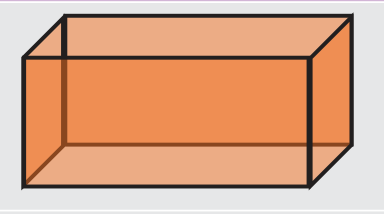 | $2h(l+b)$ | $2(lb+bh+lh)$ | $l \times b \times h$ |
| Cube | 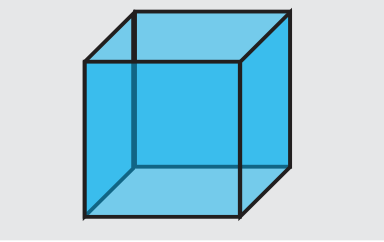 | $4a^2$ | $6a^2$ | $a^3$ |
| Right Circular Cylinder | 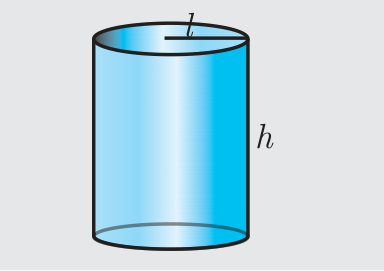 | $2\pi rh$ | $2\pi r(h+r)$ | $\pi r^2 h$ |
| Right Circular Cone | 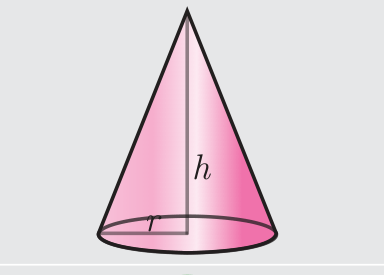 | $\pi rl$, $l = \sqrt{r^2+h^2}$, $l =$ slant height | $\pi rl + \pi r^2 = \pi r(l+r)$ | $\dfrac{1}{3}\pi r^2 h$ |
| Sphere | 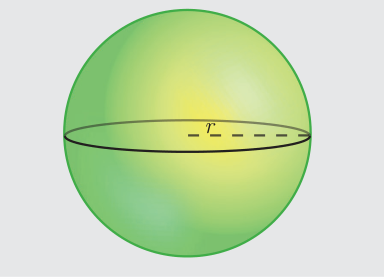 | $4\pi r^2$ | $4\pi r^2$ | $\dfrac{4}{3}\pi r^3$ |
| Hemisphere | 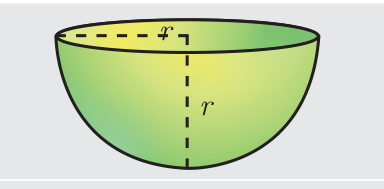 | $2\pi r^2$ | $3\pi r^2$ | $\dfrac{2}{3}\pi r^3$ |
| Hollow cylinder | 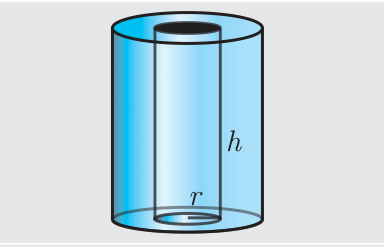 | $2\pi(R+r)h$ | $2\pi(R+r)(R-r+h)$ | $\pi(R^2-r^2)h$ |
| Hollow sphere | 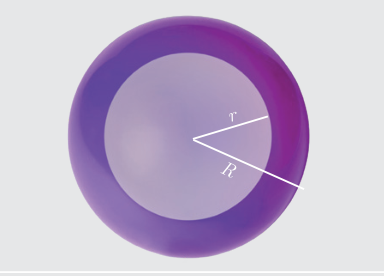 | $4\pi R^2 =$ outer surface area | $4\pi(R^2+r^2)$ | $\dfrac{4}{3}\pi(R^3-r^3)$ |
| Hollow hemisphere | 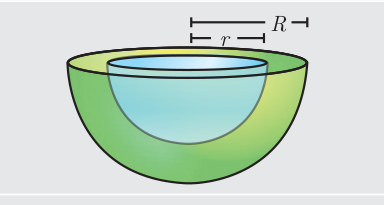 | $2\pi(R^2+r^2)$ | $\pi(3R^2+r^2)$ | $\dfrac{2}{3}\pi(R^3-r^3)$ |
| Frustum of right circular cone | 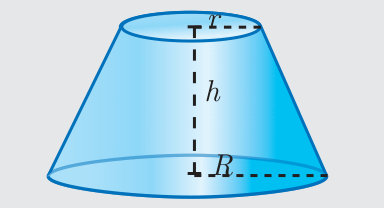 | $\pi(R+r)l$ where $l = \sqrt{h^2+(R-r)^2}$ | $\pi(R+r)l + \pi R^2 + \pi r^2$ | $\dfrac{1}{3}\pi h\left[R^2+r^2+Rr\right]$ |
ICT CORNER#
ICT 7.1
Step 1: Open the Browser type the URL Link given below (or) Scan the QR Code. GeoGebra work book named “Mensuration _X” will open. Select the work sheet “Cone-Cylinder relation”
Step 2: In the given worksheet you can change the radius and height of the cone-Cylinder by moving the sliders on the left-hand side. Move the vertical slider, to view cone filled in the cylinder and this proves 3 times cone equal to one cylinder of same radius and same height.
(Screenshots for Step 1, Step 2, and Expected results of the “Cone-Cylinder relation” GeoGebra worksheet appear here in the source — not reproduced as these are illustrative app-navigation screenshots rather than content figures.)
ICT 7.2
Step 1: Open the Browser type the URL Link given below (or) Scan the QR Code. GeoGebra work book named “Mensuration _X” will open. Select the work sheet “Cylinder Hemispheres”
Step 2: In the given worksheet you can change the radius of the Hemisphere-Cylinder by moving the sliders on the left-hand side. Move the slider Attach/Detach to see how combined solid is formed. You can rotate 3-D picture to see the faces. Working is given on the left-hand side. Work out and verify your answer.
(Screenshots for Step 1, Step 2, and Expected results of the “Cylinder Hemispheres” GeoGebra worksheet appear here in the source — not reproduced as these are illustrative app-navigation screenshots rather than content figures.)
You can repeat the same steps for other activities
https://www.geogebra.org/m/jfr2zzgy#chapter/356197 or Scan the QR Code.
(A QR code linking to the GeoGebra activity appears here in the source; code label: UTONL.)