You have learnt, in your lower classes that matter is around us everywhere. Matter is made of atoms. Curiously the idea of atom was first proposed by the Greek philosophers in the fifth century BC (BCE). But, their theory was more philosophical than scientific.
The first scientific theory of the atom was proposed by John Dalton. Few of the postulates of Dalton’s theory about an atom were found incorrect by the later on studies made by J.J. Thomson, Rutherford, Neils Bohr and Schrodinger. In the light of the result of the researches most of the limitations of the Dalton’s theory were removed and a new theory known as the modern atomic theory was put forward.
The main postulates of modern atomic theory are as follows:#
- An atom is no longer indivisible (after the discovery of the electron, proton, and neutron).
- Atoms of the same element may have different atomic mass. (discovery of isotopes ).
- Atoms of different elements may have same atomic masses (discovery of Isobars $$ _{18}Ar^{40}, _{20}Ca^{40} $$).
- Atoms of one element can be transmuted into atoms of other elements. In other words, atom is no longer indestructible (discovery of artificial transmutation).
- Atoms may not always combine in a simple whole number ratio (E.g. Glucose C₆H₁₂O₆ C:H:O = 6:12:6 or 1:2:1 and Sucrose C₁₂H₂₂O₁₁ C:H:O = 12:22:11).
- Atom is the smallest particle that takes part in a chemical reaction.
- The mass of an atom can be converted into energy ($$ E = mc^2 $$).
The modern atomic theory is the basis for all the studies of chemical and physical processes that involve atoms. You have studied the most fundamental ideas about an atom in your lower classes. Let us discuss some more concepts about atoms in this lesson.
ATOM AND ATOMIC MASS#
As you know, anything that has mass and occupies space is called matter. Atoms are the building blocks of matter. Since matter has mass, it must be due to its atoms. According to the modern atomic theory, an atom contains subatomic particles such as protons, neutrons and electrons. Protons and neutrons have considerable mass, but electrons don’t have such a considerable mass. Thus, the mass of an atom is mainly contributed by its protons and neutrons and hence the sum of the number of protons and neutrons of an atom is called its mass number.
Individual atoms are very small and it is difficult to measure their masses. You can measure the mass of macroscopic materials in gram or kilogram. The mass of an atom is measured in atomic mass unit (amu).
Atomic mass unit is one-twelfth of the mass of a carbon-12 atom; an isotope of carbon, which contains 6 protons and 6 neutrons.
Note: The symbol ‘amu’ is no longer used in the modern system and instead, it uses the symbol ‘u’ to denote unified atomic mass. The mass of a proton or neutron is approximately 1 amu.
Relative Atomic Mass (RAM)#
As an atom is very small, its absolute mass cannot be determined directly. The early pioneers of chemistry used to measure the atomic mass of an atom relative to an atom of another element. They measured the masses of equal number of atoms of two or more elements at a time, to determine their relative masses. They established one element as a standard, gave it an arbitrary value of atomic mass and using this value they measured the relative mass of other elements. The mass obtained by this way is called relative atomic mass. In the beginning, the mass of hydrogen atom was chosen as a standard and masses of other atoms were compared with it, because of the existence of isotopic character of hydrogen (
$$ ^1H^1, ^1H^2, ^1H^3 $$). Later hydrogen atom was replaced by oxygen atom as the standard. Now, the stable isotope of carbon (C-12) with atomic mass 12 is used as the standard for measuring the relative atomic mass of an element.
Relative atomic mass of an element is the ratio between the average mass of its isotopes to
$$ \frac{1}{12} $$part of the mass of a carbon-12 atom. It is denoted as Aᵣ. It is otherwise called “Standard Atomic Weight”.
$$ \text{Relative Atomic Mass (A}_r\text{)} = \frac{\text{Average mass of the isotopes of the element}}{\frac{1}{12} \text{ of the mass of one Carbon-12 atom}} $$Modern methods of determination of atomic mass by Mass Spectrometry uses C-12 as standard. For most of the elements, the relative atomic mass is very closer to a whole number and it is rounded off to a whole number, to make calculations easier. Table 7.1 lists some of the elements of periodic table and their Aᵣ values.
Table 7.1: Relative atomic mass of elements (C-12 Scale)
| Element | Symbol | Aᵣ |
|---|---|---|
| Hydrogen | H | 1 |
| Carbon | C | 12 |
| Nitrogen | N | 14 |
| Oxygen | O | 16 |
| Sodium | Na | 23 |
| Magnesium | Mg | 24 |
| Sulphur | S | 32 |
Relative Atomic Mass is only a ratio, so it has no unit. If the atomic mass of an element is expressed in grams, it is called as Gram Atomic Mass.
Do You Know?
- Gram Atomic Mass of hydrogen = 1 g
- Gram Atomic Mass of carbon = 12 g
- Gram Atomic Mass of nitrogen = 14 g
- Gram Atomic Mass of oxygen = 16 g
Average Atomic Mass (AAM)#
How can one measure the atomic mass of an element? It is somewhat more complicated because most of the naturally occurring elements exist as a mixture of isotopes, each of which has its own mass. Thus, it is essential to consider this isotopic mixture while calculating the atomic mass of an element.
The average atomic mass of an element is the weighted average of the masses of its naturally occurring isotopes.
But, the abundance of isotopes of each element may differ. So, the abundancy of all these isotopes are taken into consideration while calculating the atomic mass. Then, what do we mean by a weighted average? Let us consider an element which exists as a mixture of 50% of an isotope having a mass of 9 amu, and 50% of another isotope having a mass of 10 amu. Then, its average atomic mass is calculated by the following equation:
$$ \text{Average atomic mass} = (\text{Mass of 1st isotope} \times \%\text{ abundance of 1st isotope}) + (\text{Mass of 2nd isotope} \times \%\text{ abundance of 2nd isotope}) $$Thus, for the given element the average atomic mass:
$$ = \left(9 \times \frac{50}{100}\right) + \left(10 \times \frac{50}{100}\right) = 4.5 + 5 = 9.5 \text{ amu} $$Note: In the calculations involving percentages, you need to convert percentage abundance into fractional abundance. For example, 50 percent is converted into 50/100 or 0.50 as shown in the aforesaid calculation.
The atomic masses of elements, given in the periodic table, are average atomic masses. Sometimes, the term atomic weight is used to mean average atomic mass. It is observed, from the periodic table that atomic masses of most of the elements are not whole numbers. For instance, the atomic mass of carbon given in the periodic table is 12.01 amu, not 12.00 amu. The reason is that while calculating the atomic mass of carbon, both of its natural isotopes such as carbon-12 and carbon-13 are considered. The natural abundance of C-12 and C-13 are 98.90% and 1.10% respectively. The average of the atomic mass of carbon is calculated as follows:
$$ \text{Average atomic mass of carbon} = \left(12 \times \frac{98.9}{100}\right) + \left(13 \times \frac{1.1}{100}\right) $$$$ = (12 \times 0.989) + (13 \times 0.011) $$$$ = 11.868 + 0.143 = 12.011 \text{ amu} $$So it is important to understand that if it is mentioned that the atomic mass of carbon is 12 amu, it refers to the average atomic mass of the carbon isotopes, not the mass of the individual atoms of carbon.
Table 7.2: Atomic mass of some elements
| Atomic Number | Name | Symbol | Atomic Mass (amu) |
|---|---|---|---|
| 1 | Hydrogen | H | 1.008 |
| 2 | Helium | He | 4.003 |
| 3 | Lithium | Li | 6.941 |
| 4 | Beryllium | Be | 9.012 |
| 5 | Boron | B | 10.811 |
Calculation of average atomic mass – Solved Examples#
Example 1: Oxygen is the most abundant element in both the Earth’s crust and the human body. It exists as a mixture of three stable isotopes in nature as shown in Table 7.3:
Table 7.3: Isotopes of oxygen
| Isotope | Mass (amu) | % abundance |
|---|---|---|
| ₈O¹⁶ | 15.9949 | 99.757 |
| ₈O¹⁷ | 16.9991 | 0.038 |
| ₈O¹⁸ | 17.9992 | 0.205 |
Example 2: Boron naturally occurs as a mixture of boron-10 (5 protons + 5 neutrons) and boron-11 (5 protons + 6 neutrons) isotopes. The percentage abundance of B-10 is 20 and that of B-11 is 80. Then, the atomic mass of boron is calculated as follows:
$$ \text{Atomic mass of boron} = \left(10 \times \frac{20}{100}\right) + \left(11 \times \frac{80}{100}\right) $$$$ = (10 \times 0.20) + (11 \times 0.80) = 2 + 8.8 = 10.8 \text{ amu} $$MOLECULE AND MOLECULAR MASS#
Except noble gases, atoms of most of the elements are found in the combined form with itself or atoms of other elements. It is called as a molecule. A molecule is a combination of two or more atoms held together by strong chemical forces of attraction, i.e. chemical bonds.
Conceptual Thoughts: All compounds are molecules; but, all molecules are not compounds. Why?
Classification of molecules#
A molecule may contain atoms of the same element or may contain atoms of two or more elements joined in a fixed ratio, in accordance with the law of definite proportions. Thus, a molecule may be an element or a compound. If the molecule is made of similar kind of atoms, then it is called homoatomic molecule. The molecule that consist of atoms of different elements is called heteroatomic molecule. A compound is a heteroatomic molecule. The number of atoms present in the molecule is called its ‘atomicity’.
Table 7.4: Classification of molecules
| Atomicity | No. of atoms present | Name |
|---|---|---|
| 1 | 1 | Monoatomic |
| 2 | 2 | Diatomic |
| 3 | 3 | Triatomic |
| > 3 | > 3 | Polyatomic |
Let us consider oxygen. Oxygen gas exists in two allotropic forms: Oxygen (O₂) and Ozone (O₃). In oxygen molecule, there are two oxygen atoms. So its atomicity is two. Since both the atoms are similar, oxygen (O₂) is a homodiatomic molecule. Other elements that exist as diatomic molecules are hydrogen (H₂), nitrogen (N₂) and halogens: fluorine (F₂), chlorine (Cl₂), bromine (Br₂) and iodine (I₂).
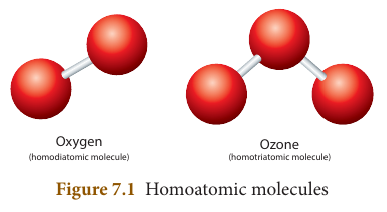
Ozone (O₃) contains three oxygen atoms and hence it is called homotriatomic molecule. If a molecule contains more than three atoms, then it is called polyatomic molecule.
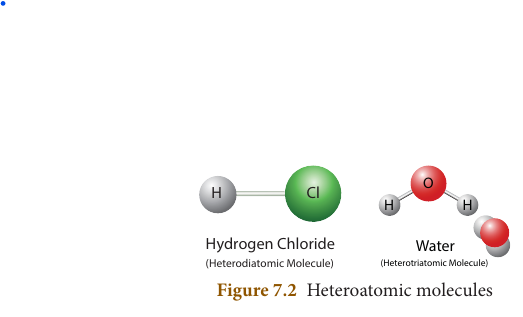
Consider hydrogen chloride. It consists of two atoms, but of different elements, i.e. hydrogen and chlorine. So, its atomicity is two. It is a heterodiatomic molecule. Similarly, the water molecule contains two hydrogen atoms and one oxygen atom. So its atomicity is three. It is a heterotriatomic molecule.
Activity 7.1#
Complete the following table by filling the appropriate values/terms
| Element | No. of Protons | No. of Neutrons | Mass Number | Stable Isotopes (abundance) | Atomic Mass (amu) |
|---|---|---|---|---|---|
| Nitrogen | 7 | 7 | 14 | N-14 (99.6 %) | 14.007 |
| 7 | 8 | 15 | N-15 (0.4 %) | ||
| Silicon | 14 | 14 | 28 | Si-28 (92.2 %) | 28.086 |
| 14 | 15 | 29 | Si-29 (4.7 %) | ||
| 14 | 16 | 30 | Si-30 (3.1 %) | ||
| Chlorine | 17 | 18 | 35 | Cl-35 (75%) | 35.45 |
| 17 | 20 | 37 | Cl-37 (25 %) |
Activity 7.2#
Classify the following molecules based on their atomicity and fill in the table: Fluorine (F₂), Carbon dioxide (CO₂), Phosphorous (P₄), Sulphur (S₈), Ammonia (NH₃), Hydrogen iodide (HI), Sulphuric Acid (H₂SO₄), Methane (CH₄), Glucose (C₆H₁₂O₆), Carbon monoxide (CO)
| Molecule | Di-atomic | Tri atomic | Poly atomic |
|---|---|---|---|
| Homo | F₂ | O₃ | P₄, S₈ |
| Hetero | HI, CO | CO₂, H₂O | NH₃, H₂SO₄, CH₄, C₆H₁₂O₆ |
Relative Molecular Mass (RMM)#
As the molecules are made of atoms, they also have their own mass. The mass of the molecule of an element or compound is measured in the C-12 scale and hence called relative molecular mass.
The Relative Molecular Mass of a molecule is the ratio between the mass of one molecule of the substance to
$$ \frac{1}{12} $$mass of an atom of Carbon-12.
Do You Know? Relative Molecular Mass is only a ratio. So, it has no unit. If the molecular mass of a compound is expressed in grams, it is called Gram Molecular Mass.
- Gram Molecular Mass of water = 18 g
- Gram Molecular Mass of carbon dioxide = 44 g
- Gram Molecular Mass of ammonia = 17 g
- Gram Molecular Mass of HCl = 36.5 g
The relative molecular mass is obtained by adding together the relative atomic masses of all the atoms present in a molecule.
Calculation of relative molecular mass – Solved examples:#
Example 1: Relative molecular mass of sulphuric acid (H₂SO₄) is calculated as follows: Sulphuric acid contains 2 atoms of hydrogen, 1 atom of sulphur and 4 atoms of oxygen.
Therefore, Relative molecular mass of sulphuric acid:
$$ = (2 \times \text{mass of hydrogen}) + (1 \times \text{mass of sulphur}) + (4 \times \text{mass of oxygen}) $$$$ = (2 \times 1) + (1 \times 32) + (4 \times 16) = 98 $$i.e., one molecule of H₂SO₄ is 98 times as heavy as
$$ \frac{1}{12} $$of the mass of a carbon –12.
Example 2: Relative molecular mass of water (H₂O) is calculated as follows: A water molecule is made of 2 atoms of hydrogen and one atom of oxygen.
So, the relative molecular mass of water:
$$ = (2 \times \text{mass of hydrogen}) + (1 \times \text{mass of oxygen}) $$$$ = (2 \times 1) + (1 \times 16) = 18 $$i.e., one molecule of H₂O is 18 times as heavy as
$$ \frac{1}{12} $$of the mass of a carbon –12.
DIFFERENCE BETWEEN ATOMS AND MOLECULES#
Even though atoms are the basic components of molecules, they differ in many aspects when compared to the molecules. Table 7.5 consolidates the major difference between atoms and molecules.
Table 7.5: Difference between atoms and molecules
| Atom | Molecule |
|---|---|
| An atom is the smallest particle of an element | A molecule is the smallest particle of an element or compound. |
| Atom does not exist in free state except in noble gas | Molecule exists in a free state |
| Except some of noble gas, other atoms are highly reactive | Molecules are less reactive |
| Atom does not have a chemical bond | Atoms in a molecule are held by chemical bonds |
MOLE CONCEPT#
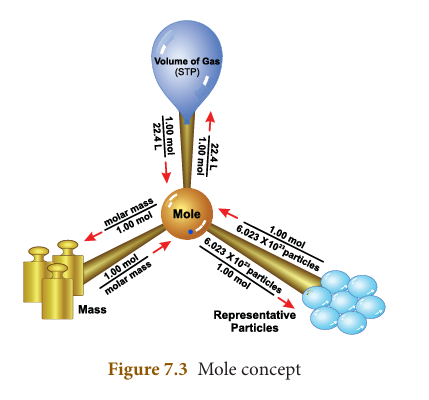
So far we discussed about matters in terms of individual atoms and molecules. Atomic mass units provide a relative scale for the masses of the elements. Since the atoms have such small masses, no usable scale can be devised to weigh them in the calibrated units of atomic mass units. In any real situation, we deal with macroscopic samples containing enormous number of atoms. Therefore, it is convenient to have a special unit to describe a very large number of atoms. The idea of a ‘unit’ to denote a particular number of objects is not new. For example, the pair (2 items) and the dozen (12 items), are all familiar units. Chemists measure atoms and molecules in ‘moles’. So, you can now understand that ‘mole’ denotes a number of particles.
In the SI system, the mole (mol) is the amount of a substance that contains as many elementary entities (atoms, molecules, or other particles) as there are atoms in exactly 12 g (or 0.012 kg) of the carbon-12 isotope. The actual number of atoms in 12 g of carbon-12 is determined experimentally. This is called Avogadro’s Number (Nₐ), named after an Italian scientist Amedeo Avogadro who proposed its significance. Its value is 6.023 × 10²³. So one mole of a substance contains 6.023 × 10²³ entities. Thus, 5 moles of oxygen molecules contain 5 × 6.023 × 10²³ molecules.
Mole Concept: The study of the collection of particles by using mole as the counting unit, in order to express the mass and volume of such unit particles in a bulk of matter is known as mole concept.
The number of moles of a substance can be calculated by various means depending on the data available, as follows:
- Number of moles of molecules.
- Number of moles of atoms.
- Number of moles of a gas (Standard molar volume at STP = 22.4 litre).
- Number of moles of ions.
Note: STP - Standard Temperature and Pressure (273.15 K, 1 atm)
Mole of atoms:#
One mole of an element contains 6.023 × 10²³ atoms and it is equal to its gram atomic mass.
i.e., one mole of oxygen atom contains 6.023 × 10²³ atoms of oxygen and its gram atomic mass is 16 g.
Mole of molecules:#
One mole of matter contains 6.023 × 10²³ molecules and it is equal to its gram molecular mass.
i.e., one mole of oxygen molecule contains 6.023 × 10²³ molecules of oxygen and its gram molecular mass is 32 g.
Molar volume:#
One mole of any gas occupies 22.4 litre or 22400 ml at S.T.P. This volume is called as molar volume.
Calculation of number of moles by Different modes#
$$ \text{Number of moles} = \frac{\text{Mass}}{\text{Atomic Mass}} $$$$ = \frac{\text{Mass}}{\text{Molecular mass}} $$$$
= \frac{\text{Number of Atoms}}{6.023 \times 10^{23}}
$$ $$= \frac{\text{Number of Molecules}}{6.023 \times 10^{23}} $$
PERCENT COMPOSITION#
So far, we were dealing with the number of entities present in a given substance. But many times, the information regarding the percentage of a particular element present in a compound is required.
The percentage composition of a compound represents the mass of each element present in 100 g of the compound.
Let us understand the percentage composition of oxygen and hydrogen by taking the example of H₂O. It can be calculated using the formula:
$$ \text{Mass \% of an element} = \frac{\text{mass of that element in the compound}}{\text{molecular mass of the compound}} \times 100 $$Now,
- Molecular mass of H₂O = 2(1) + 16 = 18 g
- Mass % of hydrogen = $$ \frac{2}{18} \times 100 = 11.11\% $$
- Mass % of oxygen = $$ \frac{16}{18} \times 100 = 88.89\% $$
This percentage composition is useful to determine the empirical formula and molecular formula.
Example 1: Find the mass percentage composition of methane (CH₄).
- Molecular mass of CH₄ = 12 + 4 = 16 g
- Mass % of carbon = $$ \frac{12}{16} \times 100 = 75\% $$
- Mass % of hydrogen = $$ \frac{4}{16} \times 100 = 25\% $$
AVOGADRO HYPOTHESIS#
In 1811 Avogadro framed a hypothesis based on the relationship between the number of molecules present in equal volumes of gases in different conditions.
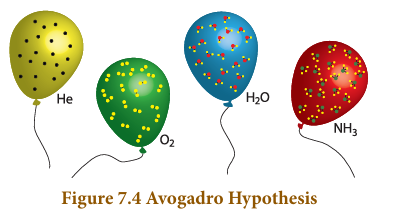
The Avogadro’s law states that “equal volumes of all gases under similar conditions of temperature and pressure contain equal number of molecules”
It follows that the volume of any given gas must be proportional to the number of molecules in it. If ‘V’ is the volume and ’n’ is the number of molecules of a gas, then Avogadro law is represented, mathematically, as follows:
$$ V \propto n $$$$ V = \text{constant} \times n $$Thus, one litre (1 dm³) of hydrogen contains the same number of molecules as in one litre of oxygen, i.e. the volume of the gas is directly proportional to the number of molecules of the gas.
Explanation#
Let us consider the reaction between hydrogen and chlorine to form hydrogen chloride gas:
$$ \text{H}_{2(g)} + \text{Cl}_{2(g)} \rightarrow 2\text{HCl}_{(g)} $$$$ 1 \text{ vol} + 1 \text{ vol} \rightarrow 2 \text{ volumes} $$According to Avogadro’s law 1 volume of any gas is occupied by ’n’ number of molecules.
$$ n \text{ molecules} + n \text{ molecules} \rightarrow 2n \text{ molecules} $$If n = 1 then:
$$ 1 \text{ molecule} + 1 \text{ molecule} \rightarrow 2 \text{ molecules} $$$$ \frac{1}{2} \text{ molecule} + \frac{1}{2} \text{ molecule} \rightarrow 1 \text{ molecule} $$1 molecule of hydrogen chloride gas is made up of ½ molecule of hydrogen and ½ molecule of chlorine. Hence, the molecules can be subdivided. This law is in agreement with Dalton’s atomic theory.
Activity 7.3#
Under same conditions of temperature and pressure if you collect 3 litre of O₂, 5 litre of Cl₂ and 6 litre of H₂,
i. Which has the highest number of molecules? ii. Which has the lowest number of molecules?
APPLICATIONS OF AVOGADRO’S LAW#
i. It explains Gay-Lussac’s law. ii. It helps in the determination of atomicity of gases. iii. Molecular formula of gases can be derived using Avogadro’s law iv. It determines the relation between molecular mass and vapour density. v. It helps to determine gram molar volume of all gases (i.e., 22.4 litre at STP)
RELATIONSHIP BETWEEN VAPOUR DENSITY AND RELATIVE MOLECULAR MASS#
i. Relative molecular mass: (Hydrogen scale)#
The Relative Molecular Mass of a gas or vapour is the ratio between the mass of one molecule of the gas or vapour to mass of one atom of hydrogen.
ii. Vapour Density:#
Vapour density is the ratio of the mass of a certain volume of a gas or vapour, to the mass of an equal volume of hydrogen, measured under the same conditions of temperature and pressure.
$$ \text{Vapour Density} = \frac{\text{Mass of a given volume of gas or vapour at S.T.P}}{\text{Mass of the same volume of hydrogen}} $$According to Avogadro’s law, equal volumes of all gases contain equal number of molecules.
Thus, let the number of molecules in one volume = n, then:
$$ \text{V.D.} = \frac{\text{Mass of 'n' molecules of a gas or vapour at S.T.P}}{\text{Mass of 'n' molecules of hydrogen}} $$Cancelling ’n’ which is common, you get:
$$ \text{V.D.} = \frac{\text{Mass of 1 molecule of a gas or vapour at S.T.P}}{\text{Mass of 1 molecule of hydrogen}} $$However, since hydrogen is diatomic:
$$ \text{V.D.} = \frac{\text{Mass of 1 molecule of a gas or vapour at S.T.P}}{2 \times \text{Mass of 1 atom of hydrogen}} $$When you compare the formula of vapour density with relative molecular mass, they can be represented as:
$$ \text{V.D.} = \frac{\text{Relative molecular mass}}{2} $$Now on cross multiplication, you have:
$$ 2 \times \text{vapour density} = \text{Relative molecular mass of a gas} $$(Or)
$$ \text{Relative molecular mass} = 2 \times \text{Vapour density} $$SOLVED PROBLEMS#
I. Calculation of molecular mass#
Calculate the gram molecular mass of the:
- H₂O 2) CO₂ 3) Ca₃(PO₄)₂
Solution:
1) H₂O
- Atomic masses of H = 1, O = 16
- Gram molecular mass of H₂O = (1 × 2) + (16 × 1) = 2 + 16
- Gram molecular mass of H₂O = 18 g
2) CO₂
- Atomic masses of C = 12, O = 16
- Gram molecular mass of CO₂ = (12 × 1) + (16 × 2) = 12 + 32
- Gram molecular mass of CO₂ = 44 g
3) Ca₃(PO₄)₂
- Atomic masses of Ca = 40, P = 30, O = 16
- Gram molecular mass of Ca₃(PO₄)₂ = (40 × 3) + [(30 + (16 × 4)) × 2]
- = 120 + (94 × 2) = 120 + 188
- Gram molecular mass of Ca₃(PO₄)₂ = 308 g
II. Calculation based on number of moles from mass and volume#
1) Calculate the number of moles in 46 g of sodium?
$$ \text{Number of moles} = \frac{\text{Mass of the element}}{\text{Atomic mass of the element}} = \frac{46}{23} = \textbf{2 moles of sodium} $$2) 5.6 litre of oxygen at S.T.P
$$ \text{Number of moles} = \frac{\text{Given volume of O}_2 \text{ at S.T.P}}{\text{Molar volume at S.T.P}} = \frac{5.6}{22.4} = \textbf{0.25 mole of oxygen} $$3) Calculate the number of moles of a sample that contains 12.046 × 10²³ atoms of iron?
$$ \text{Number of moles} = \frac{\text{Number of atoms of iron}}{\text{Avogadro's number}} = \frac{12.046 \times 10^{23}}{6.023 \times 10^{23}} = \textbf{2 moles of iron} $$III. Calculation of mass from mole#
1) 0.3 mole of aluminium (Atomic mass of Al = 27)
$$ \text{Mass} = \text{No. of moles} \times \text{atomic mass} $$$$ \text{Mass of Al} = 0.3 \times 27 = \textbf{8.1 g} $$2) 2.24 litre of SO₂ gas at S.T.P
- Molecular mass of SO₂ = 32 + (16 × 2) = 32 + 32 = 64
- Number of moles of SO₂ = $$ \frac{2.24}{22.4} $$ = 0.1 mole
- Mass = 0.1 × 64 = 6.4 g
3) 1.51 × 10²³ molecules of water
- Molecular mass of H₂O = 18
- Number of moles = $$ \frac{1.51 \times 10^{23}}{6.023 \times 10^{23}} $$ = 0.25 mole
- Mass = 0.25 × 18 = 4.5 g
4) 5 × 10²³ molecules of glucose?
- Molecular mass of glucose = 180
- Mass of glucose = $$ \frac{180 \times 5 \times 10^{23}}{6.023 \times 10^{23}} $$ = 149.43 g
IV. Calculation based on number of atoms/molecules#
1) Calculate the number of molecules in 11.2 litre of CO₂ at S.T.P
- Number of moles of CO₂ = $$ \frac{11.2}{22.4} $$ = 0.5 mole
- Number of molecules of CO₂ = 0.5 × 6.023 × 10²³ = 3.011 × 10²³ molecules of CO₂
2) Calculate the number of atoms present in 1 gram of gold (Atomic mass of Au = 198)
$$ \text{Number of atoms of Au} = \frac{\text{Mass of Au} \times \text{Avogadro's number}}{\text{Atomic mass of Au}} $$$$ = \frac{1}{198} \times 6.023 \times 10^{23} = \textbf{3.042 × 10²¹ atoms} $$3) Calculate the number of molecules in 54 g of H₂O?
$$ \text{Number of molecules} = \frac{\text{Avogadro number} \times \text{Given mass}}{\text{Gram molecular mass of water}} $$$$ = \frac{6.023 \times 10^{23} \times 54}{18} = \textbf{18.069 × 10²³ molecules} $$4) Calculate the number of atoms of oxygen and carbon in 5 moles of CO₂.
1 mole of CO₂ contains 2 moles of oxygen
5 moles of CO₂ contain 10 moles of oxygen
Number of atoms of oxygen = 10 × 6.023 × 10²³ = 6.023 × 10²⁴ atoms of Oxygen
1 mole of CO₂ contains 1 mole of carbon
5 moles of CO₂ contains 5 moles of carbon
No. of atoms of carbon = 5 × 6.023 × 10²³ = 3.011 × 10²⁴ atoms of Carbon
V. Calculation based on molar volume#
Calculate the volume occupied by:
1) 2.5 mole of CO₂ at S.T.P
$$ \text{Volume of CO}_2 \text{ at S.T.P} = 22.4 \times 2.5 = \textbf{56 litres} $$2) 12.046 × 10²³ of ammonia gas molecules
- Number of moles = $$ \frac{12.046 \times 10^{23}}{6.023 \times 10^{23}} $$ = 2 moles
- Volume occupied by NH₃ = 2 × 22.4 = 44.8 litres at S.T.P
3) 14 g nitrogen gas
- Number of moles = $$ \frac{14}{28} $$ = 0.5 mole
- Volume occupied by N₂ at S.T.P = 0.5 × 22.4 = 11.2 litres
VI. Calculation based on % composition#
Calculate % of S in H₂SO₄
- Molecular mass of H₂SO₄ = (1 × 2) + (32 × 1) + (16 × 4) = 2 + 32 + 64 = 98 g
- % of S in H₂SO₄ = $$ \frac{32}{98} \times 100 $$ = 32.65%
Points to Remember#
- Two or more forms of an element having the same atomic number, but different mass number are called Isotopes ($$ _{17}Cl^{35}, _{17}Cl^{37} $$).
- Atoms of different elements having the same mass number, but different atomic numbers are called Isobars ($$ _{18}Ar^{40}, _{20}Ca^{40} $$).
- Atoms of different elements having the same number of neutrons, but different atomic number and different mass number are called Isotones ($$ _{6}C^{13}, _{7}N^{14} $$).
- Relative atomic mass of an element is the ratio between the mass of one atom of the element to 1/12th of the mass of the atom of carbon-12.
- Average atomic mass of an element is calculated by adding the masses of its isotopes, each multiplied by their natural abundance on the Earth.
- Relative molecular mass of a molecule is the ratio between the mass of one molecule of the substance to 1/12th of the mass of the atom of carbon –12.
- The Avogadro’s law states that “equal volumes of all gases under similar conditions of temperature and pressure contain equal number of molecules”.
- The vapour density is defined as “the ratio between the masses of equal volumes of a gas (or a vapour) and hydrogen under the same condition”.
- Atomicity of a monoatomic element = Molecular mass / Atomic Mass.
- Molecular mass = 2 × Vapour density.
REFERENCE BOOKS#
- Petrucci, Ralph H et.al. General Chemistry: Principles & Modern Applications (9th Edition). Upper Saddle River, NJ: Pearson Prentice Hall, 2007. Print.
- Raymond Chang. (2010). Chemistry. New York, NY: The Tata McGraw Hill Companies. Inc.
- Julia Burdge. (2011). Chemistry. New York, NY: The Tata McGraw Hill Companies. Inc.