EVALUATION#
Choose the correct answer:
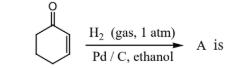
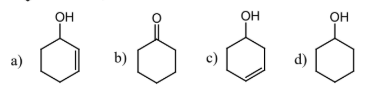
- The correct structure of the product ‘A’ formed in the reaction (NEET)
- The formation of cyanohydrin from acetone is an example of
a) nucleophilic substitution
b) electrophilic substitution
c) electrophilic addition
d) Nucleophilic addition
- Reaction of acetone with one of the following reagents involves nucleophilic addition followed by elimination of water. The reagent is
a) Grignard reagent
b) $\text{Sn / HCl}$
c) hydrazine in presence of slightly acidic solution
d) hydrocyanic acid
- In the following reaction, $$\text{HC}\equiv\text{CH} \xrightarrow[\text{HgSO}_4]{\text{H}_2\text{SO}_4} \text{X Product 'X' will not give}$$
a) Tollen’s test
b) Victor meyer test
c) Iodoform test
d) Fehling solution test
- $\text{CH}_2\text{=CH}_2 \xrightarrow[\text{ii) Zn / H}_2\text{O}]{\text{i) O}_3} \text{X} \xrightarrow{\text{NH}_3} \text{Y ‘Y’ is}$
a) Formaldehyde
b) di acetone ammonia
c) hexamethylene tetraamine
d) oxime
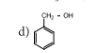
- Predict the product Z in the following series of reactions $$\text{Ethanoic acid} \xrightarrow{\text{PCl}_5} \text{X} \xrightarrow[\text{Anhydrous AlCl}_3]{\text{C}_6\text{H}_6} \text{Y} \xrightarrow[\text{ii) H}_3\text{O}^+]{\text{i) CH}_3\text{MgBr}} \text{Z}$$
a) $(\text{CH}_3)_2\text{C(OH)C}_6\text{H}_5$
b) $\text{CH}_3\text{CH(OH)C}_6\text{H}_5$
c) $\text{CH}_3\text{CH(OH)CH}_2\text{ - CH}_3$
- Assertion: 2,2 – dimethyl propanoic acid does not give HVZ reaction.Reason: 2 – 2, dimethyl propanoic acid does not have $\alpha\text{ - hydrogen}$ atom
a) if both assertion and reason are true and reason is the correct explanation of assertion.
b) if both assertion and reason are true but reason is not the correct explanation of assertion.
c) assertion is true but reason is false
d) both assertion and reason are false.
- Which of the following represents the correct order of acidity in the given compounds
a) $\text{FCH}_2\text{COOH} > \text{CH}_3\text{COOH} > \text{BrCH}_2\text{COOH} > \text{ClCH}_2\text{COOH}$
b) $\text{FCH}_2\text{COOH} > \text{ClCH}_2\text{COOH} > \text{BrCH}_2\text{COOH} > \text{CH}_3\text{COOH}$
c) $\text{CH}_3\text{COOH} > \text{ClCH}_2\text{COOH} > \text{FCH}_2\text{COOH} > \text{Br-CH}_2\text{COOH}$
d) $\text{ClCH}_2\text{COOH} > \text{CH}_3\text{COOH} > \text{BrCH}_2\text{COOH} > \text{ICH}_2\text{COOH}$
- $\text{Benzoic acid} \xrightarrow[\text{ii) }\Delta]{\text{i) NH}_3} \text{A} \xrightarrow{\text{NaOBr}} \text{B} \xrightarrow{\text{NaNO}_2\text{ / HCl}} \text{C \quad ‘C’ is}$
a) anilinium chloride
b) o - nitro aniline
c) benzene diazonium chloride
d) m - nitro benzoic acid
- $\text{Ethanoic acid} \xrightarrow{\text{P/Br}_2} \text{2 – bromoethanoic acid. This reaction is called}$
a) Finkelstein reaction
b) Haloform reaction
c) Hell – Volhard – Zelinsky reaction
d) none of these
- $\text{CH}_3\text{Br} \xrightarrow{\text{KCN}} \text{(A)} \xrightarrow{\text{H}_3\text{O}^+} \text{(B)} \xrightarrow{\text{PCl}_5} \text{(C) \quad product (C) is}$
a) acetylchloride
b) chloro acetic acid
c) $\alpha$-chlorocyano ethanoic acid
d) none of these
- Which one of the following reduces tollens reagent
a) formic acid
b) acetic acid
c) benzophenone
d) none of these
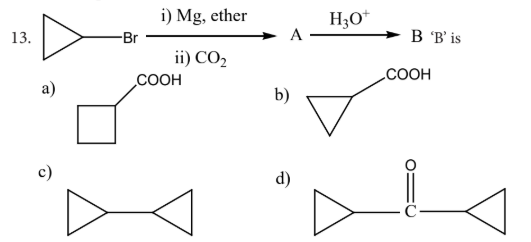
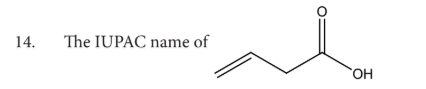
b) but – 1- ene-4-oicacid
c) but – 2- ene-1-oic acid
d) but -3-ene-1-oicacid
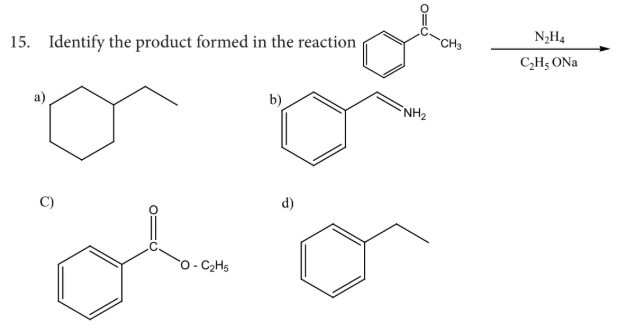
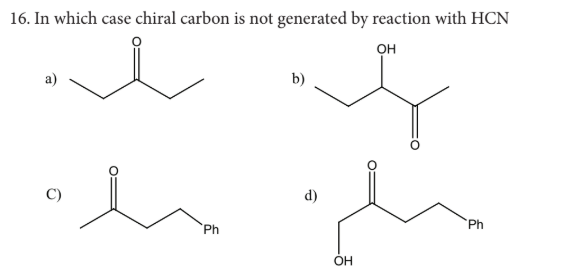
- Assertion: $\text{p - N, N -}$ dimethyl aminobenzaldehyde undergoes benzoin condensation
Reason: The aldehydic ($\text{-CHO}$) group is meta directing
a) if both assertion and reason are true and reason is the correct explanation of assertion.
b) if both assertion and reason are true but reason is not the correct explanation of assertion.
c) assertion is true but reason is false
d) both assertion and reason are false.
- Which one of the following reaction is an example of disproportionation reaction
a) Aldol condensation
b) cannizaro reaction
c) Benzoin condensation
d) none of these
- Which one of the following undergoes reaction with 50% sodium hydroxide solution to give the corresponding alcohol and acid
a) Phenylmethanal
b) ethanal
c) ethanol
d) methanol
- The reagent used to distinguish between acetaldehyde and benzaldehyde i
a) Tollens reagent
b) Fehling’s solution
c) 2,4 – dinitrophenyl hydrazine
d) semicarbazide
- Phenyl methanal is reacted with concentrated $\text{NaOH}$ to give two products $\text{X}$ and $\text{Y}$. $\text{X}$ reacts with metallic sodium to liberate hydrogen $\text{X}$ and $\text{Y}$ are
a) sodiumbenzoate and phenol
b) Sodium benzoate and phenyl methanol
c) phenyl methanol and sodium benzoate
d) none of these
- In which of the following reactions new carbon – carbon bond is not formed?
a) Aldol condensation
b) Friedel craft reaction
c) Kolbe’s reaction
d) Wolf kishner reduction
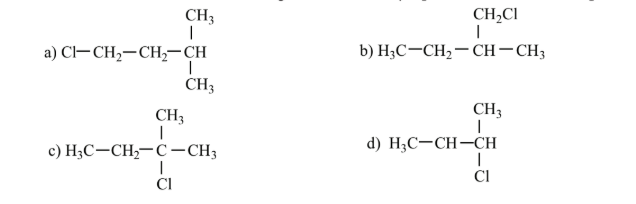
- An alkene “A” on reaction with $\text{O}_3$ and $\text{Zn - H}_2\text{O}$ gives propanone and ethanal in equimolar ratio. Addition of $\text{HCl}$ to alkene “A” gives “B” as the major product. The structure of product “B” is
- Carboxylic acids have higher boiling points than aldehydes, ketones and even alcohols of comparable molecular mass. It is due to their (NEET)
a) more extensive association of carboxylic acid via van der Waals force of attraction
b) formation of carboxylate ion
c) formation of intramolecular H-bonding
d) formation of intermolecular H – bonding
Short Answer Questions
- How is propanoic acid is prepared starting from
(a) an alcohol
(b) an alkylhalide
(c) an alkene
A Compound (A) with molecular formula $\text{C}_2\text{H}_3\text{N}$ on acid hydrolysis gives (B) which reacts with thionylchloride to give compound (C). Benzene reacts with compound (C) in presence of anhydrous $\text{AlCl}_3$ to give compound (D). Compound (D) on reduction with $\text{Zn/Hg}$ and $\text{Conc. HCl}$ gives (E). Identify (A), (B), (C), (D) and (E). Write the equations.
Identify X and Y.
$$\text{CH}_3\text{COCH}_2\text{CH}_2\text{COOC}_2\text{H}_5 \xrightarrow{\text{CH}_3\text{MgBr}} \text{X} \xrightarrow{\text{H}_3\text{O}^+} \text{Y}$$
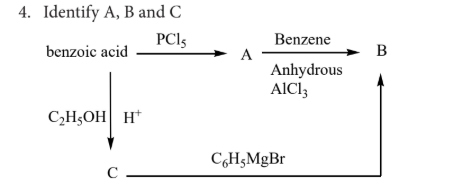
Identify A, B, C and D
$$\text{ethanoic acid} \xrightarrow{\text{SOCl}_2} \text{A} \xrightarrow{\text{Pd/BaSO}_4} \text{B} \xrightarrow[\Delta]{\text{NaOH}} \text{C} \longrightarrow \text{D}$$An alkene (A) on ozonolysis gives propanone and aldehyde (B). When (B) is oxidised (C) is obtained. (C) is treated with $\text{Br}_2\text{/P}$ gives (D) which on hydrolysis gives (E). When propanone is treated with $\text{HCN}$ followed by hydrolysis gives (E). Identify A, B, C, D and E.
How will you convert benzaldehyde into the following compounds?(i) benzophenone(ii) benzoic acid(iii) $\alpha\text{-hydroxyphenylaceticacid}$.
What is the action of HCN on
(i) propanone
(ii) 2,4-dichlorobenzaldehyde.
(iii) ethanal
A carbonyl compound A having molecular formula C_5 H_10 O forms crystalline precipitate with sodium bisulphite and gives positive iodoform test. A does not reduce Fehling solution. Identify A.
Write the structure of the major product of the aldol condensation of benzaldehyde with acetone.
How are the following conversions effected
(a) propanal into butanone
(b) $\text{Hex-3-yne into hexan-3-one}$.
(c) phenylmethanal into benzoic acid
(d) phenylmethanal into benzoin
- Complete the following reaction. $$\text{CH}_3\text{-CH}_2\text{-CH}_2\text{-C(=O)-CH}_3 \xrightarrow[\text{dry HCl}]{\text{HO-CH}_2\text{-CH}_2\text{-CH}_2\text{-OH}} \text{?}$$
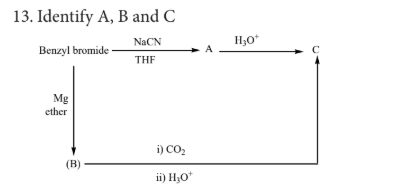
Oxidation of ketones involves carbon – carbon bond cleavage. Name the product (s) is / are formed on oxidising 2,5 – dimethylhexan – 3- one using strong oxidising agent.
How will you prepare
i. Acetic anhydride from acetic acid
ii. Ethylacetate from methylacetate
iii. Acetamide from methylcyanide
iv. Lactic acid from ethanal
v. Acetophenone from acetylchloride
vi. Ethane from sodium acetate
vii. Benzoic acid from toluene
viii. Malachitegreen from benzaldehyde
ix. Cinnamic acid from benzaldehyde
x. Acetaldehyde from ethyne