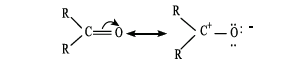
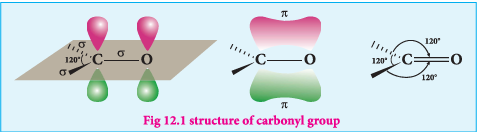
is \(sp^2\) hybridised and the carbon - oxygen bond is similar to carbon - carbon double bond in alkenes. The carbonyl carbon forms three \(\sigma\) bonds using their three \(sp^2\) hybridised orbital. One of the sigma bond is formed with oxygen and the other two with hydrogen and carbon (in aldehydes) or with two carbons (in ketones). All the three \(\sigma\) bonded atoms are lying on the same plane as shown in the fig (12.1). The fourth valence electron of carbon remains in its unhybridised \(2p\) orbital which lies perpendicular to the plane and it overlaps with \(2p\) orbital of oxygen to form a carbon - oxygen \(\pi\) bond. The oxygen atom has two nonbonding pairs of electrons, which occupy its remaining two p-orbitals. Oxygen, the second most electro negative atom attracts the shared pair of electron between the carbon and oxygen towards itself and hence the bond is polar. This polarisation contributes to the reactivity of aldehydes and ketones.