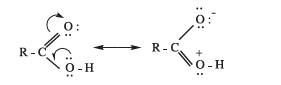
12.9 Structure of carboxyl group#
The carboxyl group represent a planar arrangement of atoms. In -COOH group, the centre carbon atom and both the oxygen atoms are in \(sp^2\) hybridisation. The three \(sp^2\) hybrid orbitals of the carbon atom overlap.
The two \(sp^2\)-hybridised orbitals of the carboxyl carbon overlap with one \(sp^2\) hybridised orbital of each oxygen atom while the third \(sp^2\) hybridised orbital of carbon overlaps with either a s-orbital of H-atom or a \(sp^3\)-hybridised orbital of C-atom of the alkyl group to form three \(\sigma\)-bonds. Each of the two oxygen atoms and the carbon atom are left with one unhybridised p-orbital which is perpendicular to the \(\sigma\)-bonding skeleton.
All these three p-orbitals being parallel overlap to form a \(\pi\)-bond which is partly delocalized between carbon and oxygen atom on one side, and carbon and oxygen of the OH group on the other side. In other words, RCOOH may be represented as a resonance hybrid of the following two canonical structures.