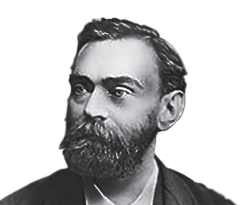
Alfred Bernhard Nobel was a
Swedish chemist, engineer, inventor,
and philanthropist. Nobel found
that when nitroglycerine was
incorporated in an inert absorbent
like kieselguhr (diatomaceous
earth) it became safer and more
convenient to handle. He patented
this mixture in 1867 as “dynamite”.
Nobel prizes were established in
accordance with his will. The Nobel
prizes is considered as one of the
precious awards in the fields of
chemistry, literature, peace activism,
physics, economics and physiology
or medicine.
We have already learnt in eleventh standard that the hydrolysis of an alkyl halide gives an
alcohol, an organic compound containing hydroxyl (-OH) functional group. Many organic
compounds containing –OH group play an important role in our body. For example, cholesteryl
alcohol commonly known as cholesterol is an important component in our cell membrane. Retinol,
the storage form of vitamin A, finds application in proper functioning of our eyes. Alcohols also
find application in many areas like medicine, industry, etc., For example, methanol is used as
an industrial solvent, ethyl alcohol an additive to petrol, isopropyl alcohol as a skin cleanser for
injection, etc., The hydroxyl group of alcohol can be converted to many other functional groups.
Hence, alcohols are important resource in synthetic organic chemistry. In this unit, we will learn
the preparation, properties and uses of alcohols, phenols and ethers.
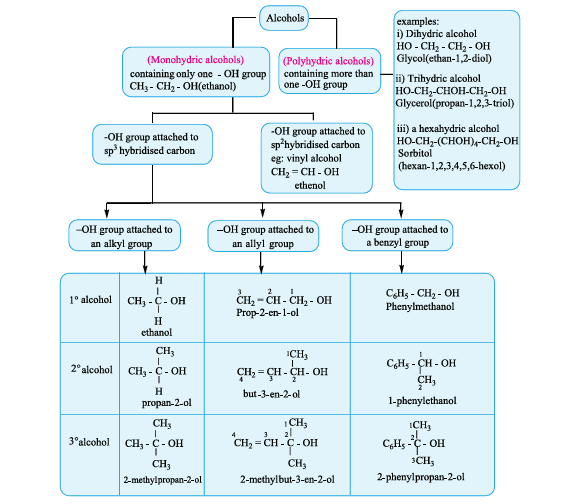
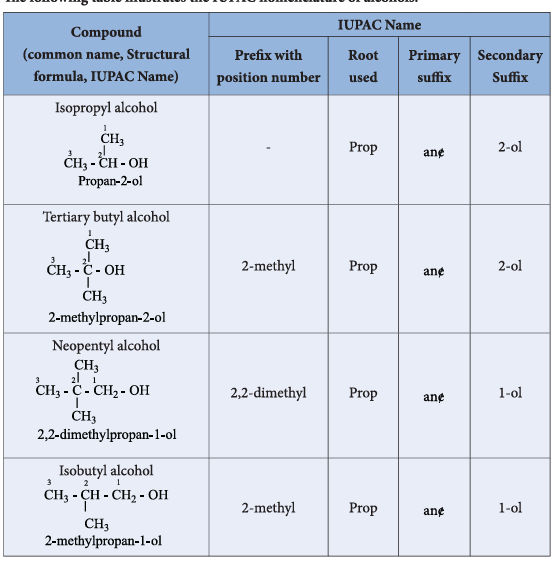
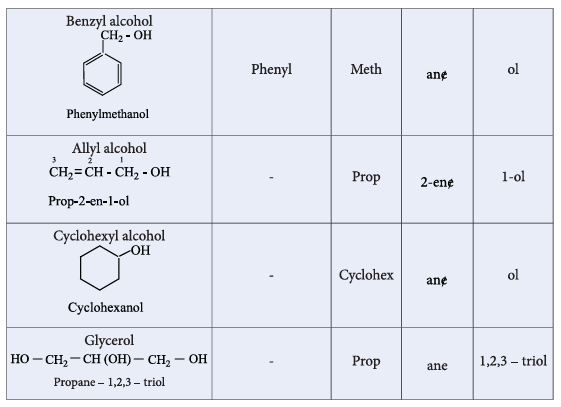
We have already learnt about naming the organic compounds according to IUPAC guidelines in XI standard. Let us recall the basic rules to name the alcohols.
Select the longest continuous chain of carbon atoms (root word) containing the functional group (-OH).
Number the carbon atoms in the chain so that the carbon bearing the -OH group has the lowest possible number.
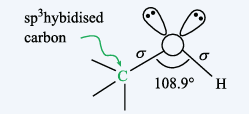
The structure of -O-H group which is attached to a \( \mathrm{sp^3} \) hybridised carbon is similar to the structure of -O-H group attached to a hydrogen in water. i.e., ‘V’ shaped. In such alcohols, one of the \( \mathrm{sp^3} \) hybridised orbital of oxygen linearly overlaps with the \( \mathrm{sp^3} \) hybridised orbital of carbon to form the C-O, ‘$\sigma$’ bond and the another \( \mathrm{sp^3} \) hybridised orbital overlaps with the 1s orbital of hydrogen to form O-H ‘$\sigma$’ bond. The remaining two sp3 hybridised orbitals of oxygen are occupied by two lone pairs of electrons. Due to the lone pair – lone pair repulsion, the C-O-H bond angle in methanol is
reduced to 108.9° from the regular tetrahedral bond angle of 109.5°.
We have already learnt that the nucleophilic substitution reactions of alkyl halides with
dilute alkali, conversion of alkenes to alcohols by hydration and the preparation of alcohols
using Grignard reagent in XI standard. These reactions are summarised below.
1. From Alkyl halides: Alkyl halides on heating with dilute aqueous NaOH gives alcohols. Primary alkyl halides undergo substitution by \( \mathrm{SN^2} \) reaction. Secondary and tertiary alkyl halides usually undergo nucleophilic substitution by \( \mathrm{SN^1} \) mechanism.
If \( \mathrm{R} = \mathrm{t} \)-butyl, the reaction proceeds through the formation of t-butyl carbocation.
2. From alkenes: Addition of water across the double bond of an alkene in presence of concentrated sulphuric acid gives alcohols. This addition reaction follows Markownikoff’s rule.
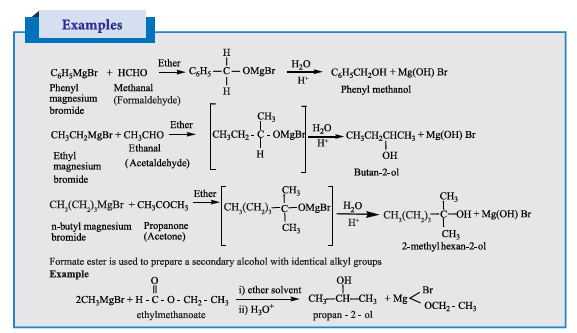
3. From Grignard reagent: Nucleophilic addition of Grignard reagent to aldehydes/ketones in presence of dry ether followed by the acid hydrolysis gives alcohols. Formaldehyde gives primary alcohol and other aldehydes give secondary alcohols. Ketones give tertiary alcohols.
4. Hydroboration:
Diborane reacts with an alkene to form trialkyl borane which on treatment with \( \mathrm{H_2O_2} \) in presence of NaOH gives an alcohol. (Refer reactions of diborane) The overall reaction is hydration of an alkene. This reaction yields an anti-Markownikoff’s product.
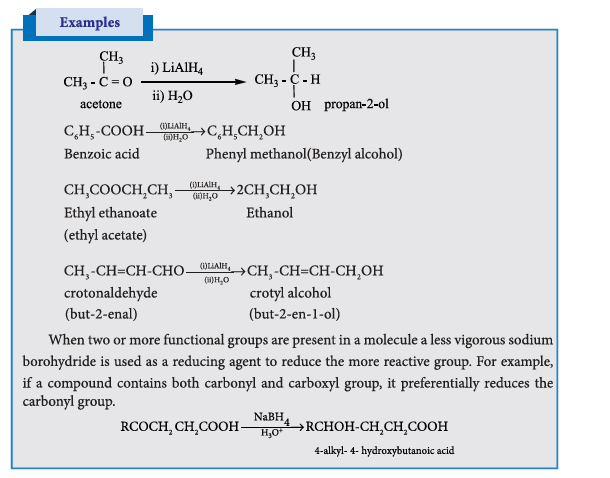
Reduction of aldehydes/ketones with \( \mathrm{LiAlH_4} \) in the presence of solvents like THF (Tetrahydrofuran) followed by hydrolysis gives alcohols. Unlike other reducing agents such as Raney Ni, Na-Hg/H\(_2\)O, the lithium aluminium hydride does not reduce the carbon-carbon double bond present in unsaturated carbonyl compound and hence it is a best reagent to prepare unsaturated alcohols.
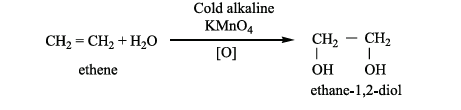
We have already learnt that the hydroxylation of ethylene using cold alkaline solution of potassium permanganate (Baeyer’s reagent) gives ethylene glycol.
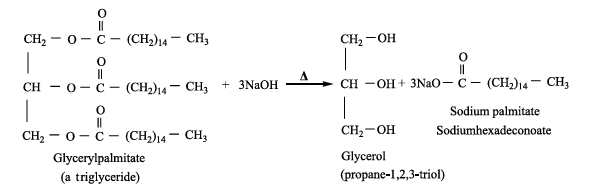
Glycerol occurs in many natural fats and it is also found in long chain fatty acids in the form of glyceryl esters (Triglycerides). The alkaline hydrolysis of these fats gives glycerol and the reaction is known as saponification.
Evaluate Yourself
1.Suggest a suitable carbonyl compound for the preparation of pent-2-en-1-ol using \( \mathrm{LiAlH_4} \).
3.How will you prepare the following using Grignard reagent.
i) t-butyl alcohol
ii) allyl alcohol
Methods to differentiate primary, secondary and tertiary alcohols#
The following tests are used to distinguish between \( 1^{\circ} \), \( 2^{\circ} \) and \( 3^{\circ} \) alcohols.
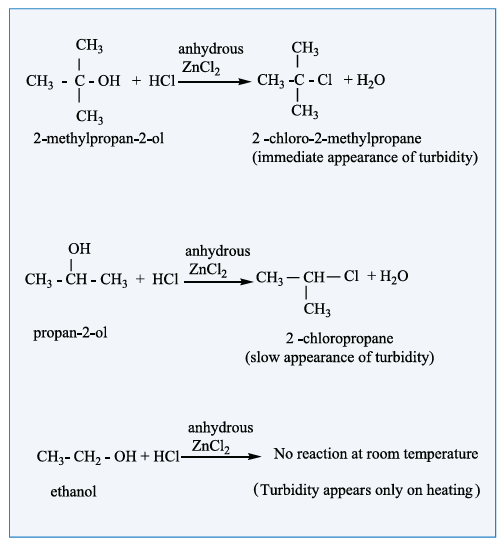
a) Lucas test:
When alcohols are treated with Lucas agent (a mixture of concentrated HCl and anhydrous \( \mathrm{ZnCl_2} \)) at room temperature, tertiary alcohols react immediately to form a turbidity due to the formation of alkyl chloride which is insoluble in the medium. Secondary alcohols react within 10 minutes to form a turbidity of alkyl chloride where primary alcohols do not react at room temperature.
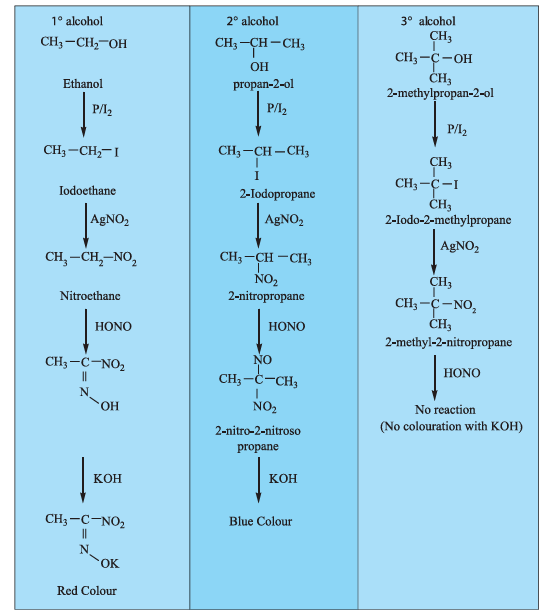
b) Victor Meyer’s test:
This test is based on the behaviour of the different nitro alkanes formed by the three types of alcohols with nitrous acid and it consists of the following steps.
i) Alcohols are converted into alkyl iodide by treating it with \( \mathrm{I_2/P} \).
ii) Alkyl iodide so formed is then treated with \( \mathrm{AgNO_2} \) to form nitro alkanes.
iii) Nitro alkanes are finally treated with \( \mathrm{HNO_2} \) (mixture of \( \mathrm{NaNO_2/HCl} \)) and the resultant solution is made alkaline with \( \mathrm{KOH} \).
Result:
Primary alcohol gives red colour
Secondary alcohol gives blue colour.
No colouration will be observed in case of tertiary alcohol.
i. Lower alcohols are colourless liquids and the higher members are waxy solids.
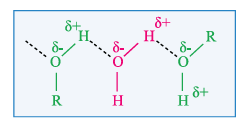
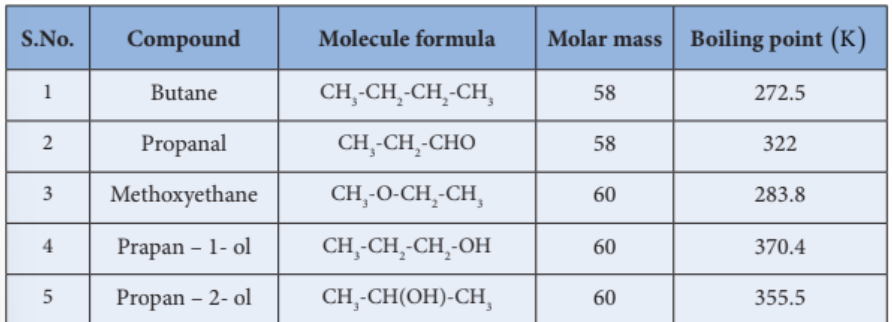
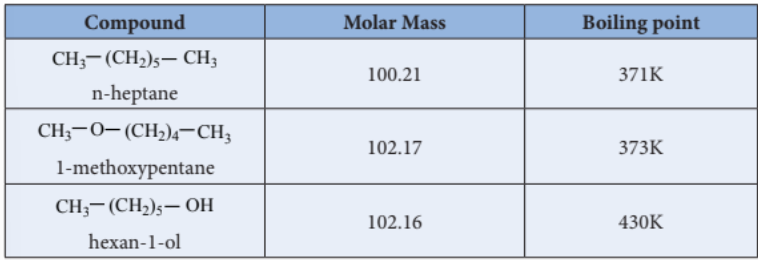
ii. They have higher boiling points than the corresponding other organic compounds such as alkanes, aldehydes, ethers etc., this is due to the presence of intermolecular hydrogen bonding present in alcohols.
iii. Among isomeric alcohols primary alcohols have higher boiling point and the tertiary alcohols have lower boiling points.
iv. The lower members are highly soluble in water due to the formation of intermolecular hydrogen bonding with water.
Table: Boiling point of alcohols in comparison with other organic compounds.
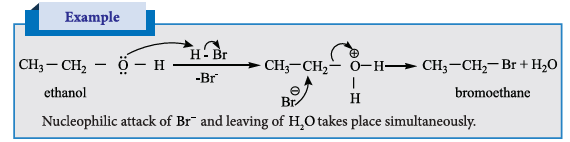
Alcohol has a strong basic leaving group \( (\mathrm{OH}^-) \). So, \( -\mathrm{OH} \) group is first converted into \( -\mathrm{OH}_2^+ \) group by adding an acid. The \( -\mathrm{OH}_2^+ \) group in the protonated alcohol can be easily displaced by a nucleophile such as \( \mathrm{Br}^- \) to give alkyl halides.
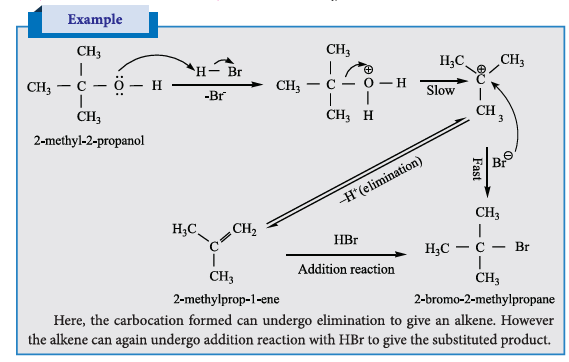
Example: Alcohols undergo nucleophilic substitution reaction with hydrohalic acids to form alkyl halides. In case of tertiary alcohols heating is required.
Conversion of alcohol into alkyl halides: Other methods
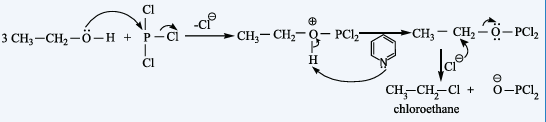
Alcohols can also be converted into alkyl halides using \( \mathrm{PCl_3} \), \( \mathrm{PBr_3} \).
This reaction also follows the \( \mathrm{S_Ni} \) mechanism in the presence of pyridine.
2.Elimination reactions of alcohols
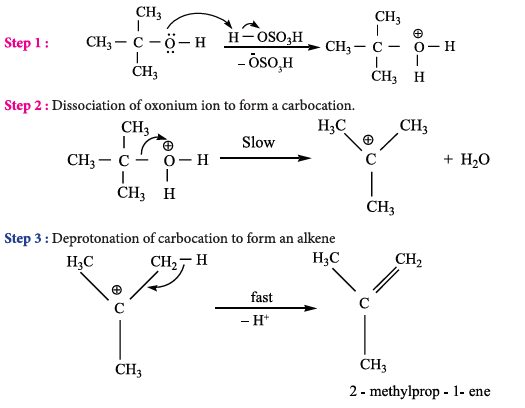
When alcohols are heated with a suitable dehydrating agents like sulphuric acid, the H and OH present in the adjacent carbons of alcohols are lost, and it results in the formation of a carbon-carbon double bond. Phosphoric acid, anhydrous \( \mathrm{ZnCl_2} \), alumina etc., can also be used as dehydrating agents.
Primary alcohols undergo dehydration by \( \mathrm{E_2} \) mechanism.
Tertiary alcohols undergo dehydration by \( \mathrm{E_1} \) mechanism. It involves the formation of a carbocation.
Protonation of alcohol
Order of reactivity:
The relative reactivities of alcohols in the dehydration reaction follows the order
primary < secondary < tertiary
Saytzeff’s rule
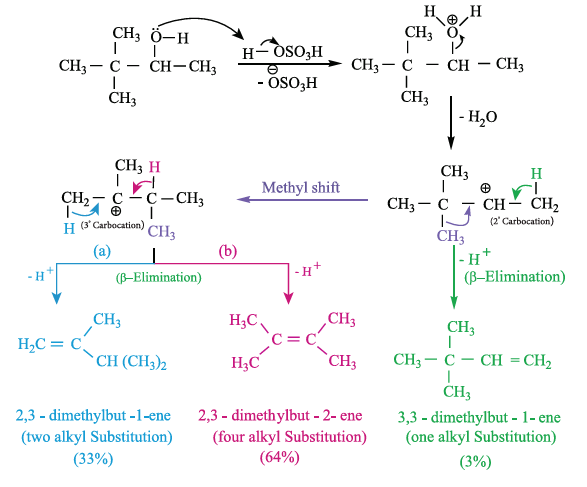
During intramolecular dehydration, if there is a possibility to form a carbon-carbon double bond at different locations, the preferred location is the one that gives the more (highly) substituted alkene i.e., the stable alkene.
For example, the dehydration of 3,3-dimethyl-2-butanol gives a mixture of alkenes. The secondary carbocation formed in this reaction undergoes rearrangement to form a more stable tertiary carbocation.
Evaluate yourself: What is the major product obtained when 2,3-dimethylpentan-3-ol is heated in the presence of \( \mathrm{H_2SO_4} \).
Oxidation of alcohols
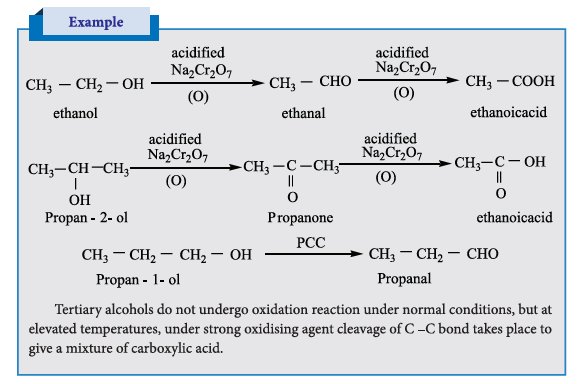
The important reactions of alcohols are their oxidation to give carbonyl compounds. The commonly used oxidising agent is acidified sodium dichromate. Oxidation of primary alcohols give an aldehyde which on further oxidation gives the carboxylic acids. To stop the oxidation reaction at the aldehyde/ketone stage, pyridinium chlorochromate (PCC) is used as an oxidising agent.
Swern oxidation
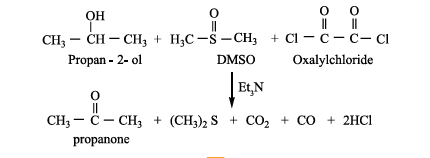
In this method, dimethyl sulfoxide (DMSO) is used as the oxidising agent, which converts alcohols to ketones/aldehydes.
In this method an alcohol is treated with DMSO and oxalyl chloride followed by the addition of triethylamine.
Biological oxidation
The fermentation of the food consumed by an animal produces alcohol. To detoxify the alcohol, the liver produces an enzyme called alcohol dehydrogenase (ADH). Nicotinamide adenine dinucleotide (NAD) present in the animals act as an oxidising agent and ADH catalyses the oxidation of toxic alcohols into non-toxic aldehyde.
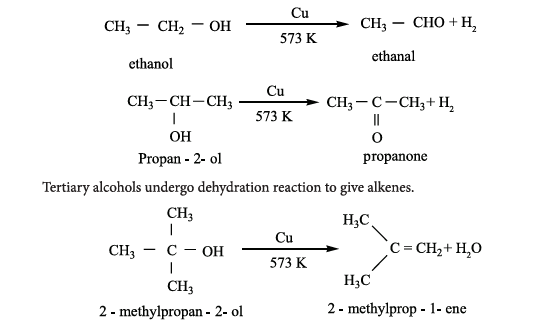
When the vapours of a primary or a secondary alcohol are passed over heated copper at \( 573\mathrm{K} \), dehydrogenation takes place to form aldehyde or ketone.
Esterification
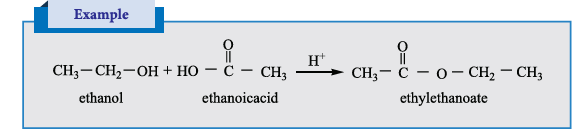
Alcohols react with carboxylic acids in the presence of an acid to give esters.
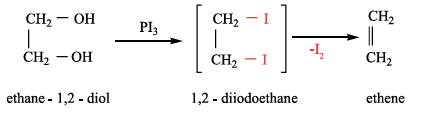
Ethylene glycol contains two primary alcoholic groups and it exhibits the usual reactions of hydroxyl group. Like other primary alcohols, it reacts with metallic sodium to form monosodium glycolate and disodium glycolate. The hydroxyl groups can be converted to the halide groups by treating glycol with halic acid (or with \( \mathrm{PCl_5/PCl_3/SOCl_2} \)).
When ethylene glycol is treated with HI or \( \mathrm{P/I_2} \), 1,2-diiodoethane is first formed which decomposes to give ethene.
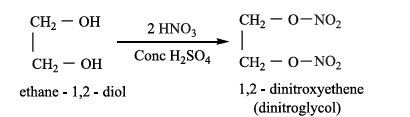
On heating with conc \( \mathrm{HNO_3} \) in the presence of conc. \( \mathrm{H_2SO_4} \), ethylene glycol forms dinitroglycol.
Dehydration reaction
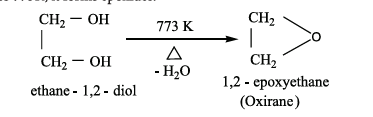
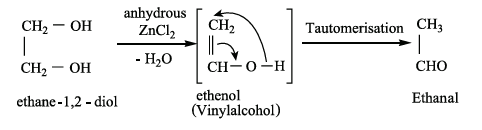
Ethyleneglycol undergoes dehydration reaction under different conditions to form different products.
When heated to 773K, it forms epoxides.
When heated with dilute sulphuric acid (or) anhydrous \( \mathrm{ZnCl_2} \) under pressure in a sealed tube, it gives acetaldehyde.
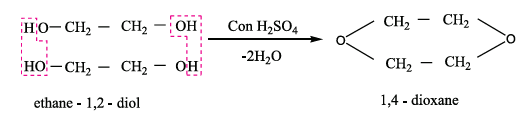
When distilled with conc. \( \mathrm{H_2SO_4} \), glycol forms dioxane.
Oxidation of glycol
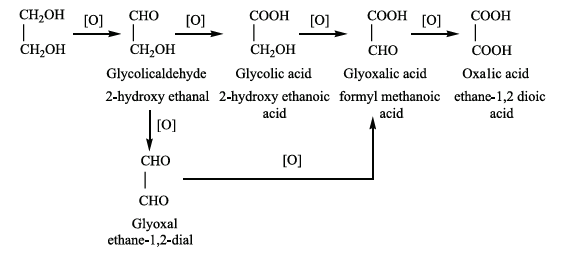
On oxidation, glycol gives a variety of products depending on the nature of oxidizing agent and other reaction conditions.
i) When nitric acid (or) alkaline potassium permanganate is used as the oxidizing agent, the following products are obtained.
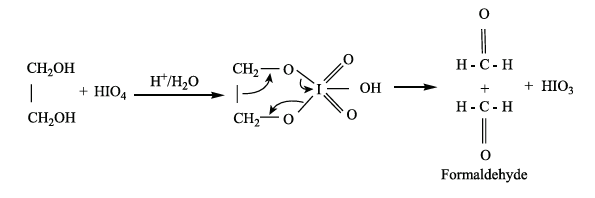
ii) Oxidation of glycol with periodic acid
Ethylene glycol on treatment with periodic acid gives formaldehyde. This reaction is selective for vicinal 1,2-diols and it proceeds through a cyclic periodate ester intermediate.
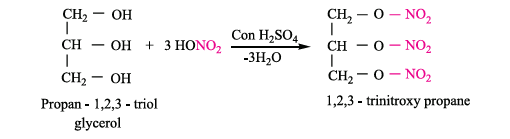
Nitration: Glycerol reacts with concentrated nitric acid in the presence of concentrated sulphuric acid to form TNG (nitroglycerine).
Dehydration
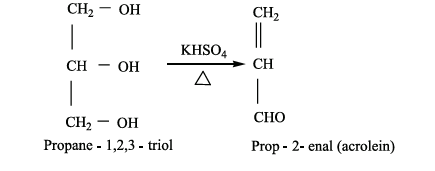
When glycerol is heated with dehydrating agents such as con \( \mathrm{H_2SO_4} \), \( \mathrm{KHSO_4} \) etc…, it undergoes dehydration to form acrolein.
Oxidation
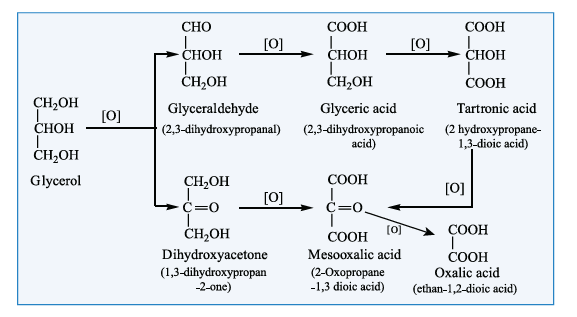
Glycerol can give rise to a variety of oxidation products depending on the nature of the oxidising agent used for oxidation.
a) Oxidation of glycerol with dil. \( \mathrm{HNO_3} \) gives glyceric acid and tartronic acid.
b) Oxidation of glycerol with conc. \( \mathrm{HNO_3} \) gives mainly glyceric acid.
c) Oxidation of glycerol with bismuth nitrate gives meso oxalic acid.
d) Oxidation of glycerol with \( \mathrm{Br_2/H_2O} \) (or) \( \mathrm{NaOBr} \) (or) Fenton’s reagent \( \mathrm{(FeSO_4 + H_2O_2)} \) gives a mixture of glyceraldehyde and dihydroxy acetone (This mixture is named as glycerose).
e) On oxidation with \( \mathrm{HIO_4} \) or Lead tetra acetate (LTA) it gives formaldehyde and formic acid.
f) Acidified \( \mathrm{KMnO_4} \) oxidises glycerol into oxalic acid.
Methanol is used as a solvent for paints, varnishes, shellac, gums, cement, etc.
In the manufacture of dyes, drugs, perfumes and formaldehyde.
Uses of ethanol:
It is also used in the preparation of
a) Paints and varnishes.
b) Organic compounds like ether, chloroform, iodoform, etc.,
c) Dyes, transparent soaps.
As a substitute for petrol under the name power alcohol used as fuel for aeroplane.
It is used as a preservative for biological specimens.
Uses of ethylene glycol:
Ethylene glycol is used as an antifreeze in automobile radiator.
Its dinitrate is used as an explosive with TNG.
Uses of glycerol
Glycerol is used as a sweetening agent in confectionary and beverages.
It is used in the manufacture of cosmetics and transparent soaps.
It is used in making printing inks and stamp pad ink and lubricant for watches and clocks.
It is used in the manufacture of explosive like dynamite and cordite by mixing it with china clay.
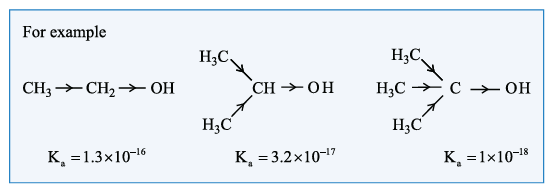
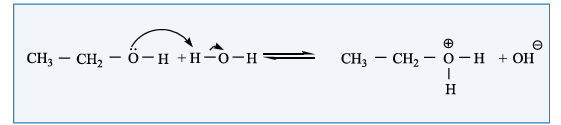
According to Bronsted theory, an acid is defined as a proton donor and the acid strength is the tendency to give up a proton. Alcohols are weakly acidic and their acidity is comparable with water. Except methanol, all other alcohols are weaker acid than water. The \( K_a \) value for water is \( 1.8 \times 10^{-16} \) whereas for alcohols, the \( K_a \) value in the order \( 10^{-18} \) to \( 10^{-16} \).
Alcohols react with active metals such as sodium, aluminium etc. to form the corresponding alkoxides with the liberation of hydrogen gas and similar reaction to give alkoxide is not observed in the reaction of alcohol with NaOH.
The above reaction explains the acidic nature of alcohols.
Comparison of acidity of \( 1^{\circ} \), \( 2^{\circ} \) and \( 3^{\circ} \) alcohols
The acidic nature of the alcohol is due to the polar nature of O-H bond. When an electron withdrawing -I groups such as -Cl, -F etc. is attached to the carbon bearing the OH group, it withdraws the electron density towards itself and thereby facilitating the proton donation. In contrast, the electron releasing group such as alkyl group increases the electron density on oxygen and decreases the polar nature of O-H bond, Hence it results in the decrease in acidity. On moving from primary to secondary and tertiary alcohols, the number of alkyl groups attached to the carbon bearing -OH group increases, which results in the following order of acidity.
Phenol is more acidic than aliphatic alcohols. Unlike alcohols it reacts with bases like sodium hydroxide to form sodium phenoxide. This explains the acidic behaviour of phenol. Let us consider the aqueous solution of phenol in which the following equilibrium exists.
\( K_a \) value for the above equilibrium is \( 1 \times 10^{-10} \) at \( 25^{\circ}\mathrm{C} \). This \( K_a \) value indicates that it is more acidic than aliphatic alcohols. This increased acidic behaviour can be explained on the basis of the stability of phenoxide ion. We have already learnt in XI standard that the phenoxide is more stabilised by resonance than phenol.
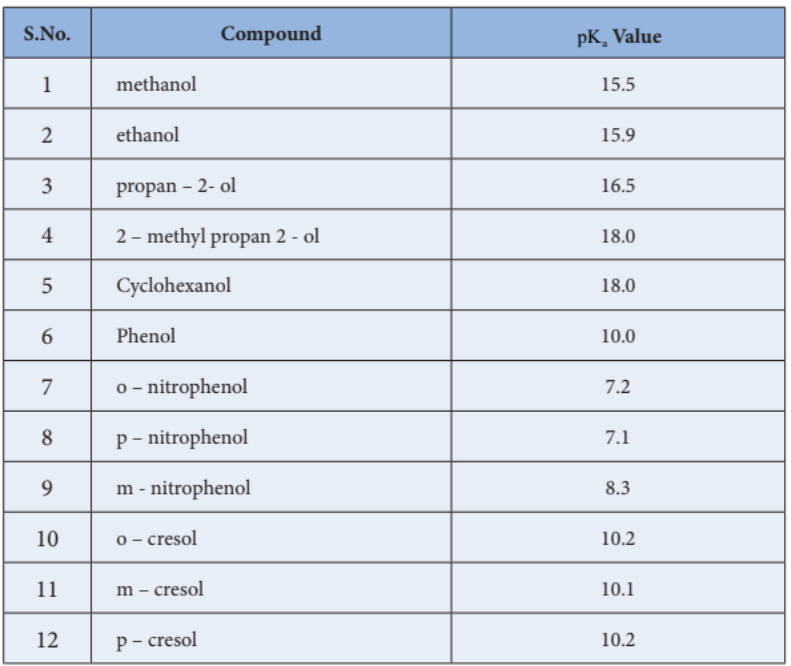
In substituted phenols, the electron withdrawing groups such as \( -\mathrm{NO_2} \), -Cl enhances the acidic nature of phenol especially when they are present at ortho and para positions. In such cases, there is a possibility for the extended delocalisation of negative charge on the phenoxide ion. On the other hand the alkyl substituted phenols show a decreased acidity due to the electron releasing \( +I \) effect of alkyl group.
Table: pK\(_a\) Values of some alcohols and phenols
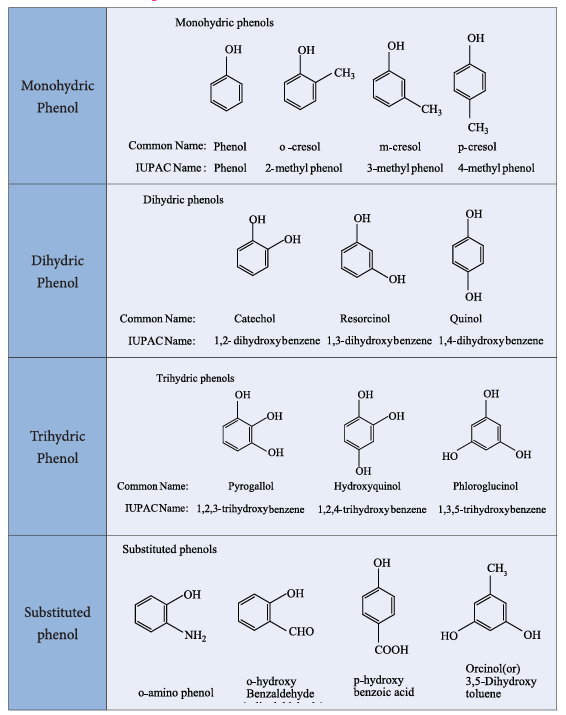
Phenols are organic compounds in which a -OH group is directly attached to a benzene ring. The carbon bearing the -OH group is \( \mathrm{sp^2} \) hybridized.
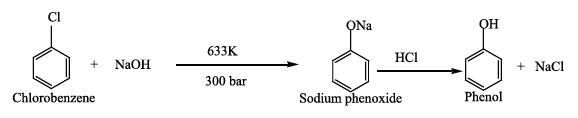
When chlorobenzene is hydrolysed with \( 6-8\% \) \( \mathrm{NaOH} \) at 300 bar and 633K in a closed vessel, sodium phenoxide is formed which on treatment with dilute HCl gives phenol.
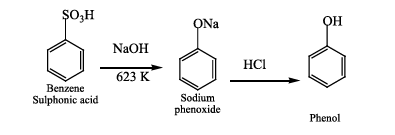
b) From benzene sulphonic acid
Benzene is sulphonated with oleum and the benzene sulphonic acid so formed is heated with molten NaOH at 623K gives sodium phenoxide which on acidification gives phenol.
c) From aniline
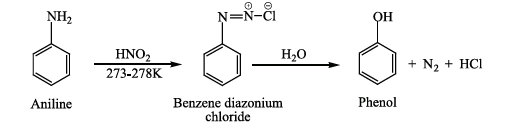
Aniline is diazotized with nitrous acid \( \mathrm{(NaNO_2 + HCl)} \) at \( 273-278\mathrm{K} \) to give benzene diazonium chloride which on further treatment with hot water in the presence of mineral acid gives phenol.
d) From cumene
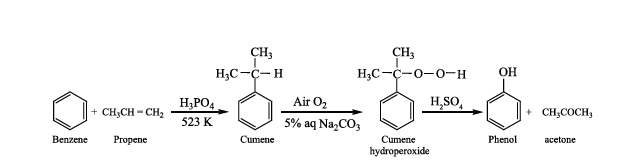
A mixture of benzene and propene is heated at 523K in a closed vessel in presence of \( \mathrm{H_3PO_4} \) catalyst gives cumene (isopropylbenzene). On passing air to a mixture of cumene and \( 5\% \) aqueous sodium carbonate solution, cumene hydroperoxide is formed by oxidation. It is treated with dilute acid to get phenol and acetone. Acetone is also an important byproduct in this reaction.
Phenol is colourless, needle shaped crystal, hygroscopic, corrosive and poisonous. It turns pink on exposure to air and light. The simplest phenols are liquids or low melting solids, they have quite high boiling points. Phenol is slightly soluble in water because of hydrogen bonding. However other substituted phenols are essentially insoluble in water.
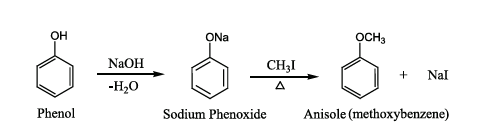
An alkaline solution of phenol reacts with alkyl halide to form phenyl ethers. The alkyl halide undergoes nucleophilic substitution by the phenoxide ion in the presence of alkali.
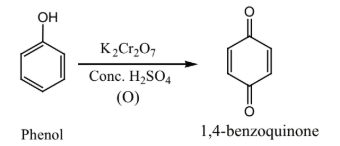
d) Oxidation:
Phenol undergoes oxidation with air or acidified $\text{K}_2\text{Cr}_2\text{O}_7$ with conc. $\text{H}_2\text{SO}_4$ to form 1,4-benzoquinone.
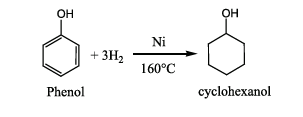
e) Reduction:
Phenol on catalytic hydrogenation gives cyclohexanol.
Reactions of benzene ring:
Electrophilic aromatic substitution:
We have already learnt in XI standard that the groups like - \( \ddot{O}H \), -\( \ddot{N}H_2 \), etc., etc., which when directly attached to the benzene ring, activate the ring towards electrophilic substitution reaction and direct the incoming electrophile to occupy either the ortho or para position.
Common electrophilic aromatic substitutions are as follows:
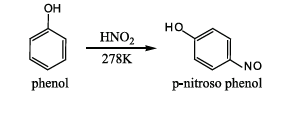
i) Nitrosation: Phenol can be readily nitrosoated at low temperature with \( \mathrm{HNO_2} \).
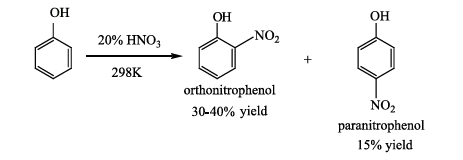
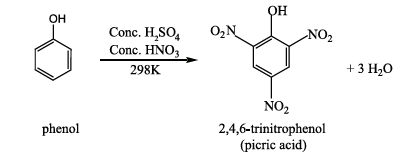
ii) Nitration: Phenol can be nitrated using \( 20\% \) nitric acid even at room temperature, a mixture of ortho and para nitrophenols are formed.
The ortho and para isomers are separated by steam distillation, as o-nitrophenol is slightly soluble in water and more volatile due to intra molecular hydrogen bonding, whereas p-nitrophenol is more soluble in water and less volatile due to intermolecular hydrogen bonding.
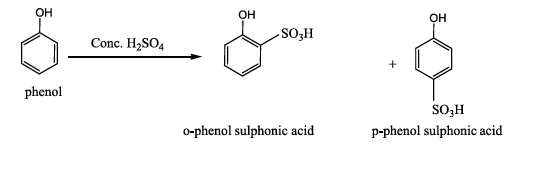
iii) Sulphonation: Phenol reacts with conc. \( \mathrm{H_2SO_4} \) at 280K to form o-phenolsulphonic acid as the major product. When the reaction is carried out at 373K the major product is p-phenolsulphonic acid.
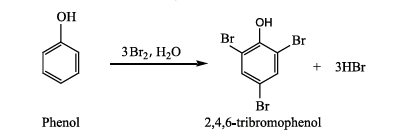
iv) Halogenation: Phenol reacts with bromine water to give a white precipitate of 2,4,6-tribromophenol.
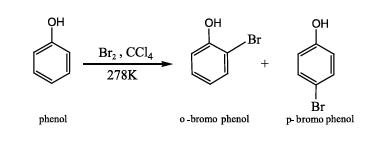
If the reaction is carried out in \( \mathrm{CS_2} \) or \( \mathrm{CCl_4} \) at 278K, a mixture of ortho and para bromophenols are formed.
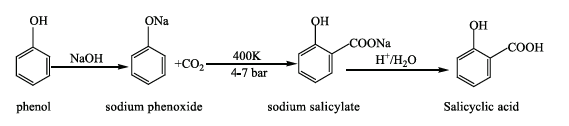
v) Kolbe’s (or Kolbe-Schmitt) reaction: In this reaction, phenol is first converted into sodium phenoxide which is more reactive than phenol towards electrophilic substitution reaction with \( \mathrm{CO_2} \). Treatment of sodium phenoxide with \( \mathrm{CO_2} \) at 400K, 4-7 bar pressure followed by acid hydrolysis gives salicylic acid.
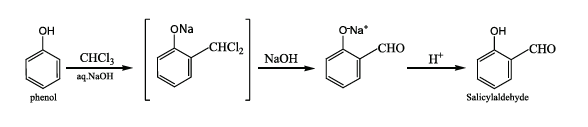
vi) Reimer-Tiemann Reaction: On treating phenol with \( \mathrm{CHCl_3/NaOH} \), a -CHO group is introduced at ortho position. This reaction proceeds through the formation of substituted benzal chloride intermediate.
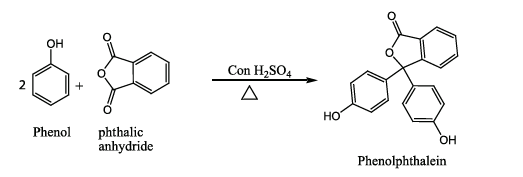
vii) Phthalein reaction: On heating phenol with phthalic anhydride in presence of conc. \( \mathrm{H_2SO_4} \), phenolphthalein is obtained.
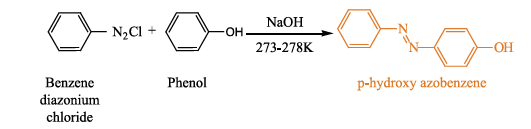
viii) Coupling reaction: Phenol couples with benzene diazonium chloride in an alkaline solution to form p-hydroxyazobenzene (a red orange dye).
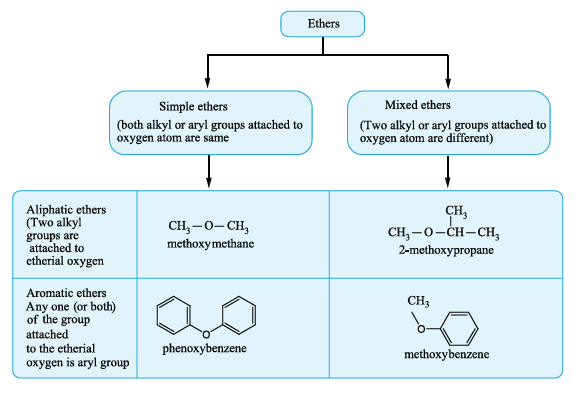
Ethers are a class of organic compound in which an oxygen atom is connected to two alkyl/aryl groups $(\text{R}-\ddot{\text{O}}-\text{R})$. Ethers can be considered as the derivatives of hydrocarbon in which one hydrogen atom is replaced by an alkoxy (-OR) or an aryloxy (-OAr) group. The general formula of aliphatic ether is \( \mathrm{C_nH_{2n+2}O} \).
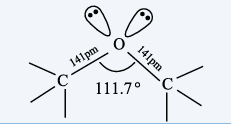
The structure of ethereal oxygen which is attached to two alkyl groups is similar to the structure of -O-H group of alcohol. The oxygen atom is \( \mathrm{sp^3} \) hybridized. Two \( \mathrm{sp^3} \) hybridized orbitals of oxygen linearly overlap with two \( \mathrm{sp^3} \) hybrid orbitals of the carbon which are directly attached to the oxygen forming two C-O \( \sigma \) bonds. The C-O-C bond angle is slightly greater than the tetrahedral bond angle due to the repulsive interaction between the two bulkier alkyl groups.
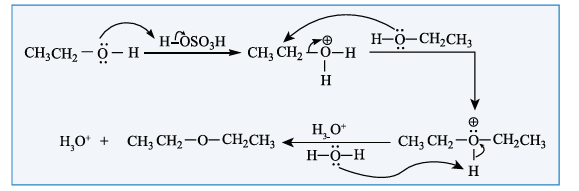
We have already learnt that when ethanol is treated with conc. \( \mathrm{H_2SO_4} \) at 443K, elimination takes place to form ethene. If the same reaction is carried out at 413K, substitution competes over elimination to form ethers.
This method is useful for the preparation of simple ethers and not suitable for preparing mixed ethers. If a mixture of two different alcohols is used, mixture of different ethers will be formed and they are difficult to separate.
2. Williamson synthesis
When an alkyl halide is heated with an alcoholic solution of sodium alkoxide, the corresponding ethers are obtained. The reaction involves \( \mathrm{SN^2} \) mechanism.
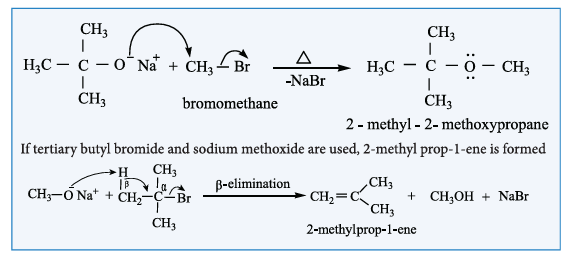
We know that primary alkyl halides are more susceptible for \( \mathrm{SN^2} \) reaction. Hence for the preparation of mixed ether having primary and tertiary alkyl group, primary alkyl halide and tertiary alkoxide are used. On the other hand, if we use tertiary alkyl halide and primary alkoxide, elimination dominates and succeeds over substitution to form an alkene.
Methylation of alcohol
Methyl ethers can be prepared by treating an alcohol with diazomethane in presence of catalyst, fluoroboric acid.
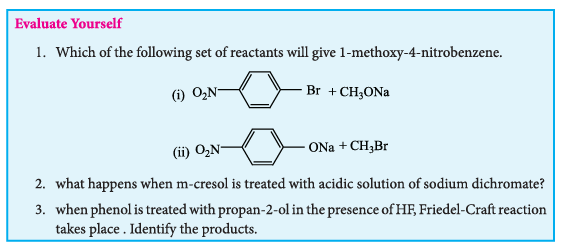
Which of the following reaction will give 1-methoxy-4-nitrobenzene.
a) 4-nitro-1-bromobenzene + sodium methoxide
b) 4-nitrosodium phenoxide + bromomethane
Arrange the following compounds in the increasing order of their acid strength: propan-1-ol, 2,4,6-trinitrophenol, 3-nitrophenol, 3,5-dinitrophenol, phenol, 4-methylphenol.
Ethers are polar in nature. The dipole moment of ether is the vector sum of two polar C-O bonds with significant contribution from two lone pairs of electrons. For example, the dipole moment of diethyl ether is 1.18D. Boiling point of ethers are slightly higher than that of alkanes and lower than that of alcohols of comparable masses.
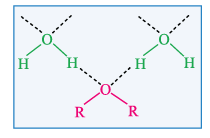
Oxygen of ether can also form hydrogen bond with water and hence they are miscible with water. Ethers dissolve wide range of polar and non-polar substances.
Mechanism: Ethers having primary alkyl group undergo \( \mathrm{SN^2} \) reaction while tertiary alkyl ether undergo \( \mathrm{SN^1} \) reaction. Protonation of ether is followed by the attack of halide ion. The halide ion preferentially attacks the less sterically hindered of the two alkyl groups which are attached to etherial oxygen.
When excess HBr or HI is used, the alcohol formed will further react with HBr or HI to form alkyl halides.
Evaluate Yourself: 1 mole of HI is allowed to react with t-butyl methyl ether. Identify the product and write down the mechanism of the reaction.
Autooxidation of ethers
When ethers are stored in the presence of atmospheric oxygen, they slowly oxidise to form hydroperoxides and dialkylperoxides. These are explosive in nature. Such a spontaneous oxidation by atmospheric oxygen is called autoxidation.
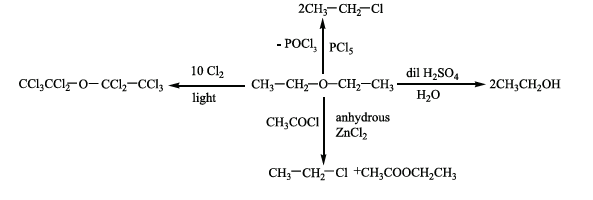
Some of the reactions of diethyl ether.
Aromatic electrophilic substitution reactions
The alkoxy group (-OR) is an ortho, para directing group as well as activating group. It activates the aromatic ring towards electrophilic substitution.
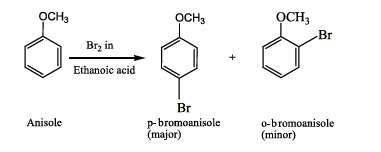
i) Halogenation: Anisole undergoes bromination with bromine in acetic acid even in the absence of a catalyst, para isomer is obtained as the major product.
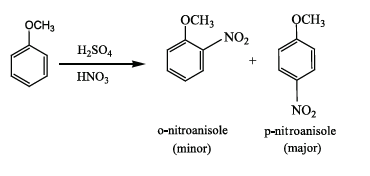
ii) Nitration: Anisole reacts with a mixture of conc. \( \mathrm{H_2SO_4/Conc.\ HNO_3} \) to yield a mixture of ortho nitro anisole and para nitro anisole.
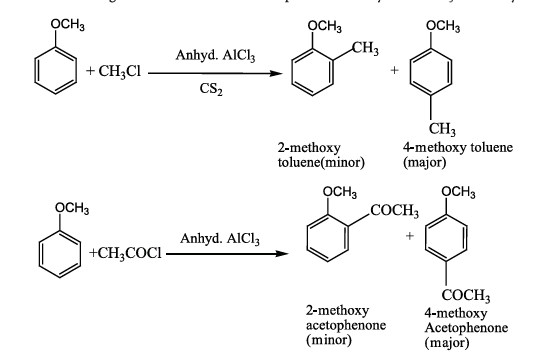
iii) Friedel-Craft’s reaction: Anisole undergoes Friedel-Craft’s reaction in presence of anhydrous \( \mathrm{AlCl_3} \) as a catalyst.