8. IONIC EQUILIBRIUM#
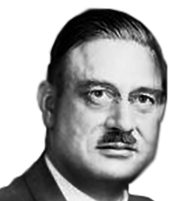
Peter Joseph William Debye was Dutch-American physicist greatly contributed to the theory of electrolyte solutions. He also studied the dipole moments of molecules, Debye won the Nobel Prize in Chemistry (1936) for his contributions to the determination of molecular structure through his investigations on dipole moments and X-rays diffraction.
Learning Objectives#
After studying this unit, the students will be able to
- classify the substances into acids and bases based on Arrhenius, Lowry – Bronsted and Lewis concepts.
- define pH scale and establish relationship between pH and pOH
- describe the equilibrium involved in the ionisation of water.
- explain Ostwald’s dilution Law and derive a relationship between the dissociation constant and degree of dissociation of a weak electrolyte.
- recognise the concept of common ion effect and explain buffer action.
- apply Henderson equation for the preparation of buffer solution
- calculate solubility product and understand the relation between solubility and solubility product.
- solve numerical problems involving ionic equilibria.
INTRODUCTION#
We have already learnt the chemical equilibrium in XI standard. In this unit, we discuss the ionic equilibria, specifically acid - base equilibria. Some of the important processes in our body involve aqueous equilibria. For example, the carbonic acid - bicarbonate buffer in the blood.
$$ H_3O^+ (aq) + HCO_3^- (aq) \rightleftharpoons H_2CO_3 (aq) + H_2O (l) $$We have come across many chemical compounds in our daily life among them acids and bases are the most common. For example, milk contains lactic acid, vinegar contains acetic acid, tea contains tannic acid and antacid tablet contains aluminium hydroxide / magnesium hydroxide. Acids and bases have many important industrial applications. For example, sulphuric acid is used in fertilizer industry and sodium hydroxide in soap industry etc… Hence, it is important to understand the properties of acids and bases.
In this unit we shall learn the definitions of acids and bases and study, their ionisation in aqueous solution. We learn the pH scale and also apply the principles of chemical equilibrium to determine the concentration of the species furnished in aqueous solution by acids and bases.
8.1 Acids and bases#
The term ‘acid’ is derived from the latin word ‘acidus’ meaning sour. We have already learnt in earlier classes that acid tastes sour, turns blue litmus to red and reacts with metals such as zinc and produces hydrogen gas. Similarly base tastes bitter and turns red litmus to blue.
These classical concepts are not adequate to explain the complete behaviour of acids and bases. So, the scientists developed the acid - base concept based on their behaviour.
Let us, learn the concept developed by scientists Arrhenius, Bronsted and Lowry and Lewis to describe the properties of acids and bases.
8.1.1 Arrhenius Concept#
One of the earliest theories about acids and bases was proposed by swedish chemist Svante Arrhenius. According to him, an acid is a substance that dissociates to give hydrogen ions in water. For example, \(HCl\), \(H_2SO_4\) etc., are acids. Their dissociation in aqueous solution is expressed as
$$ HCl(g) \xrightarrow{H_2O} H^+ (aq) + Cl^- (aq) $$The \(H^+\) ion in aqueous solution is highly hydrated and usually represented as \(H_3O^+\) the simplest hydrate of proton \([H(H_2O)]^+\). We use both \(H^+\) and \(H_3O^+\) to mean the same.
Similarly a base is a substance that dissociates to give hydroxyl ions in water. For example, substances like \(NaOH\), \(Ca(OH)_2\) etc., are bases.
$$ Ca(OH)_2 \xrightarrow{H_2O} Ca^{2+} (aq) + 2OH^- (aq) $$Limitations of Arrhenius concept
i. Arrhenius theory does not explain the behaviour of acids and bases in non aqueous solvents such as acetone, Tetrahydrofuran etc…
ii. This theory does not account for the basic nature of the substances like ammonia \((NH_3)\) which do not possess hydroxyl group.
Evaluate yourself - 1#
Classify the following as acid (or) base using Arrhenius concept i) \(HNO_3\) ii) \(Ba(OH)_2\) iii) \(H_3PO_4\) iv) \(CH_3COOH\)
8.1.2 Lowry - Bronsted Theory (Proton Theory)#
In 1923, Lowry and Bronsted suggested a more general definition of acids and bases. According to their concept, an acid is defined as a substance that has a tendency to donate a proton to another substance and base is a substance that has a tendency to accept a proton from other substance. In other words, an acid is a proton donor and a base is a proton acceptor.
When hydrogen chloride is dissolved in water, it donates a proton to the later. Thus, \(HCl\) behaves as an acid and \(H_2O\) is base. The proton transfer from the acid to base can be represented as
$$ HCl + H_2O \rightleftharpoons H_3O^+ + Cl^- $$When ammonia is dissolved in water, it accepts a proton from water. In this case, ammonia \((NH_3)\) acts as a base and \(H_2O\) is acid. The reaction is represented as
$$ H_2O + NH_3 \rightleftharpoons NH_4^+ + OH^- $$Let us consider the reverse reaction in the following equilibrium
$$ HCl_{\text{Proton donor acid}} + H_2O_{\text{Proton acceptor Base}} \rightleftharpoons H_3O^+_{\text{Proton donor acid}} + Cl^-_{\text{Proton acceptor Base}} $$\(H_3O^+\) donates a proton to \(Cl^-\) to form \(HCl\) i.e., the products also behave as acid and base.
In general, Lowry - Bronsted (acid - base) reaction is represented as
$$ Acid_1 + Base_2 \rightleftharpoons Acid_2 + Base_1 $$The species that remains after the donation of a proton is a base \((Base_1)\) and is called the conjugate base of the Bronsted acid \((Acid_1)\). In other words, chemical species that differ only by a proton are called conjugate acid - base pairs.
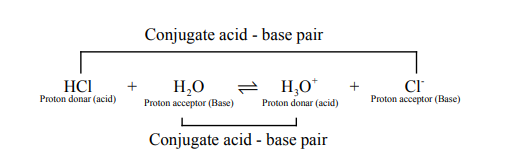
\(HCl\) and \(Cl^-\), \(H_2O\) and \(H_3O^+\) are two conjugate acid - base pairs. i.e., \(Cl^-\) is the conjugate base of the acid \(HCl\) (or) \(HCl\) is conjugate acid of \(Cl^-\). Similarly \(H_3O^+\) is the conjugate acid of \(H_2O\).
Limitations of Lowry - Bronsted theory
i. Substances like \(BF_3\), \(AlCl_3\) etc., that do not donate protons are known to behave as acids.
Evaluate yourself - 2#
Write a balanced equation for the dissociation of the following in water and identify the conjugate acid - base pairs.
i) \(NH_4^+\) ii) \(H_2SO_4\) iii) \(CH_3COOH\)
8.1.3 Lewis concept#
In 1923, Gilbert . N. Lewis proposed a more generalised concept of acids and bases. He considered the electron pair to define a species as an acid (or) a base. According to him, an acid is a species that accepts an electron pair while base is a species that donates an electron pair. We call such species as Lewis acids and bases.
A Lewis acid is a positive ion (or) an electron deficient molecule and a Lewis base is a anion (or) neutral molecule with at least one lone pair of electrons.
Let us consider the reaction between Boron trifluoride and ammonia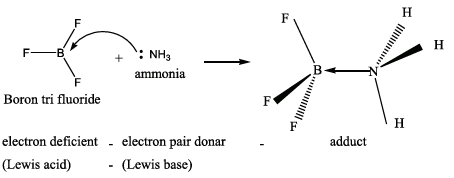
| Lewis acids | Lewis bases |
|---|---|
| Electron deficient molecules such as \(BF_3\), \(AlCl_3\), \(BeF_2\) etc… | Molecules with one (or) more lone pairs of electrons. \(NH_3, H_2O, R-OH, R-O-R, R-NH_2\) |
| All metal ions Examples: \(Fe^{2+}, Fe^{3+}, Cr^{3+}, Cu^{2+}\) etc… | All anions \(F^-, Cl^-, CN^-, SCN^-, SO_4^{2-}\) etc… |
| Molecules that contain a polar double bond Examples: \(SO_2, CO_2, SO_3\) etc… | Molecules that contain carbon - carbon multiple bond Examples: \(CH_2=CH_2, CH \equiv CH\) etc… |
| Molecules in which the central atom can expand its octet due to the availability of empty d - orbitals Example: \(SiF_4, SF_4, FeCl_3\) etc… | All metal oxides \(CaO, MgO, Na_2O\) etc… |
| Carbonium ion \((CH_3)_3C^+\) | Carbanion \(CH_3^-\) |
Example
Identify the Lewis acid and the Lewis base in the following reactions.
$$ Cr^{3+} + 6H_2O \rightarrow [Cr(H_2O)_6]^{3+} $$In the hydration of ion, each of six water molecules donates a pair of electron to \(Cr^{3+}\) to from the hydrated cation, hexaaquachromium (III) ion, thus, the Lewis acid is \(Cr^{3+}\) and the Lewis base \(H_2O\).
Evaluate yourself - 3#
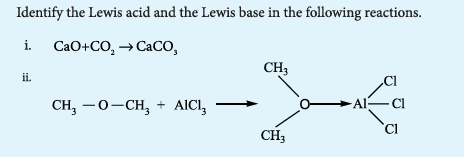
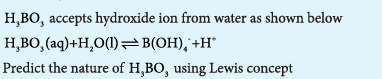
Evaluate yourself - 4#
8.2 Strength of Acids and Bases#
The strength of acids and bases can be determined by the concentration of \(H_3O^+\) (or) \(OH^-\) produced per mole of the substance dissolved in \(H_2O\). Generally we classify the acids / bases either as strong or weak. A strong acid is the one that is almost completely dissociated in water while a weak acid is only partially dissociated in water.
Let us quantitatively define the strength of an acid (HA) by considering the following general equilibrium.
\[ \begin{array}{ccccccc} \mathrm{HA} & + & \mathrm{H_2O} & \rightleftharpoons & \mathrm{H_3O^+} & + & \mathrm{A^-} \\ \text{acid 1} & & \text{base 2} & & \text{acid 2} & & \text{base 1} \end{array} \]The equilibrium constant for the above ionisation is given by the following expression
$$ K_a = \frac{[H_3O^+][A^-]}{[HA][H_2O]} \quad (8.1) $$We can omit the concentration of \(H_2O\) in the above expression since it is present in large excess and essentially unchanged.
$$ K_a = \frac{[H_3O^+][A^-]}{[HA]} \quad (8.2) $$Here, \(K_a\) is called the ionisation constant or dissociation constant of the acid. It measures the strength of an acid. Acids such as \(HCl, HNO_3\) etc… are almost completely ionised and hence they have high \(K_a\) value (\(K_a\) for \(HCl\) at \(25^{\circ}C\) is \(2 \times 10^6\)). Acids such as formic acid (\(K_a = 1.8 \times 10^{-4}\) at \(25^{\circ}C\)), acetic acid (\(1.8 \times 10^{-5}\) at \(25^{\circ}C\)) etc… are partially ionised in solution and in such cases, there is an equilibrium between the unionised acid molecules and their dissociated ions. Generally, acids with \(K_a\) value greater than ten are considered as strong acids and less than one are considered as weak acids.
Let us consider the dissociation of \(HCl\) in aqueous solution,
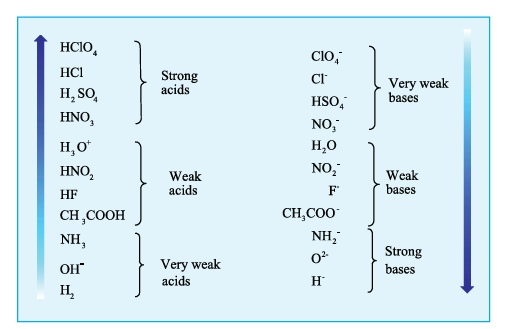
\[ \begin{array}{ccccccc} \mathrm{HCl} & + & \mathrm{H_2O} & \rightleftharpoons & \mathrm{H_3O^+} & + & \mathrm{Cl^-} \\ \text{acid 1} & & \text{base 2} & & \text{acid 2} & & \text{base 1} \end{array} \]As discussed earlier, due to the complete dissociation, the equilibrium lies almost \(100\%\) to the right. i.e., the \(Cl^-\) ion has only a negligible tendency to accept a proton from \(H_3O^+\). It means that the conjugate base of a strong acid is a weak base and vice versa.
The following table illustrates the relative strength of conjugate acid - base pairs.
8.3 Ionisation of water#
We have learnt that when an acidic or a basic substance is dissolved in water, depending upon its nature, it can either donate (or) accept a proton. In addition to that the pure water itself has a little tendency to dissociate. i.e, one water molecule donates a proton to an another water molecule. This is known as auto ionisation of water and it is represented as below.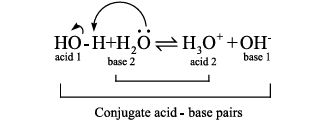
In the above ionisation, one water molecule acts as an acid while the another water molecule acts as a base.
The dissociation constant for the above ionisation is given by the following expression
$$ K = \frac{[H_3O^+][OH^-]}{[H_2O]^2} \quad (8.3) $$The concentration of pure liquid water is one. i.e, \([H_2O]^2 = 1\)
$$ K_w = [H_3O^+][OH^-] \quad (8.4) $$Here, \(K_w\) represents the ionic product (ionic product constant) of water
It was experimentally found that the concentration of \(H_3O^+\) in pure water is \(1 \times 10^{-7}\) at \(25^{\circ}C\). Since the dissociation of water produces equal number of \(H_3O^+\) and \(OH^-\), the concentration of \(OH^-\) is also equal to \(1 \times 10^{-7}\) at \(25^{\circ}C\).
Therefore, the ionic product of water at \(25^{\circ}C\) is
$$ K_w = [H_3O^+][OH^-] \quad (8.4) $$$$ K_w = (1 \times 10^{-7})(1 \times 10^{-7}) = 1 \times 10^{-14} $$Like all equilibrium constants, \(K_w\) is also a constant at a particular temperature. The dissociation of water is an endothermic reaction. With the increase in temperature, the concentration of \(H_3O^+\) and \(OH^-\) also increases, and hence the ionic product also increases.
In neutral aqueous solution like \(NaCl\) solution, the concentration of \(H_3O^+\) is always equal to the concentration of \(OH^-\) whereas in case of an aqueous solution of a substance which may behave as an acid (or) a base, the concentration of \(H_3O^+\) will not be equal to \([OH^-]\).
\(K_w\) values at different temperatures are given in the following below
| Temperature (°C) | \(K_w\) |
|---|---|
| 0 | \(1.14 \times 10^{-15}\) |
| 10 | \(2.95 \times 10^{-15}\) |
| 25 | \(1.00 \times 10^{-14}\) |
| 40 | \(2.71 \times 10^{-14}\) |
| 50 | \(5.30 \times 10^{-14}\) |
We can understand this by considering the aqueous \(HCl\) as an example. In addition to the auto ionisation of water, the following equilibrium due to the dissociation of \(HCl\) can also exist.
$$ HCl + H_2O \rightleftharpoons H_3O^+ + Cl^- $$In this case, in addition to the auto ionisation of water, \(HCl\) molecules also produces \(H_3O^+\) ion by donating a proton to water and hence \([H_3O^+] > [OH^-]\). It means that the aqueous \(HCl\) solution is acidic. Similarly, in basic solution such as aqueous \(NH_3\), \(NaOH\) etc…. \([OH^-] > [H_3O^+]\).
Example 8.1#
Calculate the concentration of \(OH^-\) in a fruit juice which contains \(2 \times 10^{-3} M\) \(H_3O^+\) ion. Identify the nature of the solution.
Given that \(H_3O^+ = 2 \times 10^{-3} M\)
$$ K_w = [H_3O^+][OH^-] $$$$ \therefore [OH^-] = \frac{K_w}{[H_3O^+]} = \frac{1 \times 10^{-14}}{2 \times 10^{-3}} = 5 \times 10^{-12} M $$\(2 \times 10^{-3} > > 5 \times 10^{-12}\)
i.e., \([H_3O^+] > > [OH^-]\), hence the juice is acidic in nature
8.4 The pH scale#
We usually deal with acid / base solution in the concentration range \(10^{-1}\) to \(10^{-7} M\). To express the strength of such low concentrations, Sorensen introduced a logarithmic scale known as the pH scale. The term pH is derived from the French word Purissance de hydrogene meaning, the power of hydrogen. pH of a solution is defined as the negative logarithm of base 10 of the molar concentration of the hydronium ions present in the solution.
$$ pH = -\log_{10}[H_3O^+] \quad (8.5) $$The concentration of \(H_3O^+\) in a solution of known pH can be calculated using the following expression.
$$ [H_3O^+] = 10^{-pH} \quad (\text{or}) \quad [H_3O^+] = \text{antilog}(-pH) \quad (8.6) $$Similarly, pOH can also be defined as follows
$$ pOH = -\log_{10}[OH^-] \quad (8.7) $$As discussed earlier, in neutral solutions, the concentration of \([H_3O^+]\) as well as \([OH^-]\) is equal to \(1 \times 10^{-7} M\) at \(25^{\circ}C\). The pH of a neutral solution can be calculated by substituting this \(H_3O^+\) concentration in the expression (8.5)
\[ \log_{10} 10 = 1 \]$$ pH = -\log_{10}[H_3O^+] = -\log_{10}10^{-7} = (-7)(-1)\log_{10}10 = +7(1) = 7 $$Similarly, we can calculate the pOH of a neutral solution using the expression (8.7), it is also equal to 7.
The negative sign in the expression (8.5) indicates that when the concentration of \([H_3O^+]\) increases the pH value decreases. For example, if the \([H_3O^+]\) increases from \(10^{-7}\) to \(10^{-5} M\) the pH value of the solution decreases from 7 to 5. We know that in acidic solution, \([H_3O^+] > [OH^-]\), i.e., \([H_3O^+] > 10^{-7}\). Similarly in basic solution \([H_3O^+] < 10^{-7}\). So, we can conclude that acidic solution should have pH value less than 7 and basic solution should have pH value greater than 7.
8.4.1 Relation between pH and pOH#
A relation between pH and pOH can be established using their following definitions
$$ pH = -\log_{10}[H_3O^+], \quad pOH = -\log_{10}[OH^-] \quad (8.5) \& (8.7) $$Adding equation (8.5) and (8.7)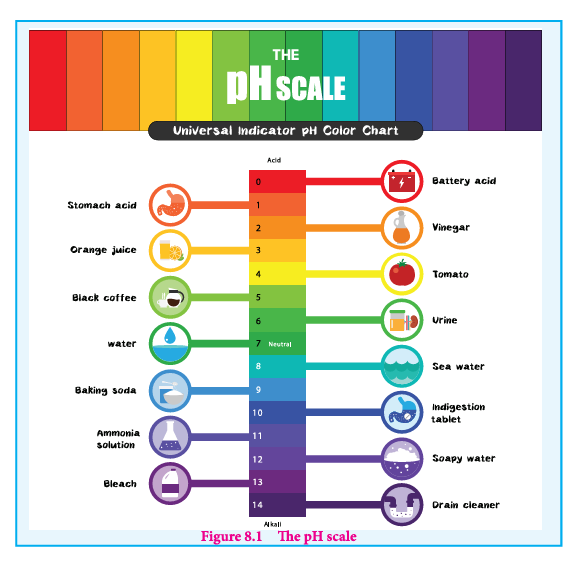
We know that \([H_3O^+][OH^-] = K_w\)
$$ \Rightarrow pH + pOH = -\log_{10} K_w $$$$ \Rightarrow pH + pOH = pK_w \quad [\because pK_w = -\log_{10} K_w] $$at \(25^{\circ}C\), the ionic product of water, \(K_w = 1 \times 10^{-14}\)
$$ pK_w = -\log_{10}10^{-14} = 14 \log_{10}10 = 14 $$$$ \therefore \text{At } 25^{\circ}C, \quad pH + pOH = 14 $$Example 8.2#
Calculate the pH of \(0.001 M\) \(HCl\) solution
\[ \begin{array}{ccc} \mathrm{HCl} & \overset{\mathrm{H_2O}}{\rightleftharpoons} & \mathrm{H_3O^+} + \mathrm{Cl^-} \\ {\scriptstyle 0.001\,M} & & {\scriptstyle 0.001\,M \qquad 0.001\,M} \end{array} \]\(H_3O^+\) from the auto ionisation of \(H_2O (10^{-7} M)\) is negligible when compared to the \(H_3O^+\) from \(10^{-3} M\) \(HCl\).
Hence \([H_3O^+] = 0.001 \ mol \ dm^{-3}\)
$$ pH = -\log_{10}[H_3O^+] = -\log_{10}(0.001) = -\log_{10}(10^{-3}) = 3 $$Note: If the concentration of the acid or base is less than \(10^{-6} M\), the concentration of \(H_3O^+\) produced due to the auto ionisation of water cannot be neglected and in such cases
$$ [H_3O^+] = 10^{-7} (\text{from water}) + [H_3O^+] (\text{from the acid}) $$similarly, \([OH^-] = 10^{-7} M (\text{from water}) + [OH^-] (\text{from the base})\)
Example 8.3#
Calculate pH of \(10^{-7} M\) \(HCl\)
If we do not consider \([H_3O^+]\) from the ionisation of \(H_2O\)
then \([H_3O^+] = [HCl] = 10^{-7} M\)
i.e., \(pH = 7\), which is a pH of a neutral solution. We know that \(HCl\) solution is acidic whatever may be the concentration of \(HCl\) i.e, the pH value should be less than 7. In this case the concentration of the acid is very low \((10^{-7} M)\) Hence, the \(H_3O^+ (10^{-7} M)\) formed due to the auto ionisation of water cannot be neglected.
so, in this case we should consider \([H_3O^+]\) from ionisation of \(H_2O\)
$$ [H_3O^+] = 10^{-7} (\text{from HCl}) + 10^{-7} (\text{from water}) = 10^{-7}(1 + 1) = 2 \times 10^{-7} $$$$ pH = -\log_{10}[H_3O^+] = -\log_{10}(2 \times 10^{-7}) = -[\log 2 + \log 10^{-7}] $$$$ = -\log 2 - (-7) \log_{10}10 = 7 - \log 2 = 7 - 0.3010 = 6.6990 = 6.70 $$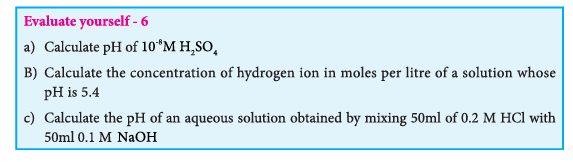
8.5 Ionisation of weak acids#
We have already learnt that weak acids are partially dissociated in water and there is an equilibrium between the undissociated acid and its dissociated ions.
Consider the ionisation of a weak monobasic acid \(HA\) in water.
$$ HA + H_2O \rightleftharpoons H_3O^+ + A^- $$Applying law of chemical equilibrium, the equilibrium constant \(K_c\) is given by the expression
$$ K_c = \frac{[H_3O^+][A^-]}{[HA][H_2O]} \quad (8.9) $$The square brackets, as usual, represent the concentrations of the respective species in moles per litre.
In dilute solutions, water is present in large excess and hence, its concentration may be taken as constant say \(K\). Further \(H_3O^+\) indicates that hydrogen ion is hydrated, for simplicity it may be replaced by \(H^+\). The above equation may then be written as,
$$ K_c = \frac{[H^+][A^-]}{[HA] \times K} \quad (8.10) $$The product of the two constants \(K_c\) and \(K\) gives another constant. Let it be \(K_a\)
$$ K_a = \frac{[H^+][A^-]}{[HA]} \quad (8.11) $$The constant \(K_a\) is called dissociation constant of the acid. Like other equilibrium constants, \(K_a\) also varies only with temperature.
Similarly, for a weak base, the dissociation constant can be written as below.
$$ K_b = \frac{[B^+][OH^-]}{[BOH]} \quad (8.12) $$8.5.1 Ostwald’s dilution law#
Ostwald’s dilution law relates the dissociation constant of the weak acid \((K_a)\) with its degree of dissociation \((\alpha)\) and the concentration (c). Degree of dissociation \((\alpha)\) is the fraction of the total number of moles of a substance that dissociates at equilibrium.
\[ \alpha = \frac{\text{Number of moles dissociated}}{\text{total number of moles}} \]We shall derive an expression for Ostwald’s law by considering a weak acid, i.e. acetic acid (CH\(_3\)COOH). The dissociation of acetic acid can be represented as
\[ \text{CH}_3\text{COOH} \rightleftharpoons \text{H}^+ + \text{CH}_3\text{COO}^- \]The dissociation constant of acetic acid is,
\[ k_a = \frac{[\text{H}^+][\text{CH}_3\text{COO}^-]}{[\text{CH}_3\text{COOH}]} \]\[ \text{......(8.13)} \]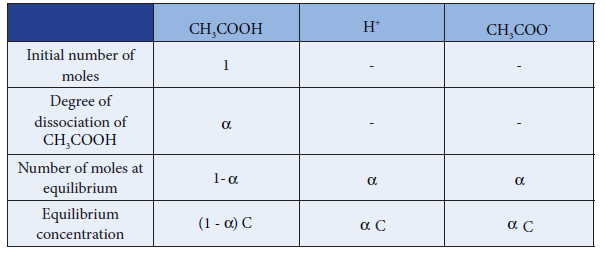
Substituting the equilibrium concentration in equation (8.13)
\[ K_a = \frac{(\alpha C)(\alpha C)}{(1 - \alpha)C} \]\[ K_a = \frac{\alpha^2 C}{1 - \alpha} \]\[ \text{......(8.14)} \]We know that weak acid dissociates only to a very small extent. Compared to one, \(\alpha\) is so small and hence in the denominator \((1 - \alpha) \approx 1\). The above expression (8.14) now becomes,
\[ K_a = \alpha^2 C \]\[ \Rightarrow \alpha^2 = \frac{K_a}{C} \]\[ \alpha = \sqrt{\frac{K_a}{C}} \]\[ \text{......(8.15)} \]Let us consider an acid with \(K_a\) value \(4 \times 10^{-4}\) and calculate the degree of dissociation of that acid at two different concentration \(1 \times 10^{-2}\) M and \(1 \times 10^{-4}\) M using the above expression (8.15)
For \(1 \times 10^{-2}\) M,
\[ \alpha = \sqrt{\frac{4 \times 10^{-4}}{10^{-2}}} = \sqrt{4 \times 10^{-2}} = 2 \times 10^{-1} = 0.2 \]For \( 1 \times 10^{-4} \) M acid,
\[ \alpha = \sqrt{\frac{4 \times 10^{-4}}{10^{-4}}} = 2 \]i.e., When the dilution increases by 100 times (concentration decreases from \( 1 \times 10^{-2} \) M to \( 1 \times 10^{-4} \) M), the dissociation increases by 10 times.
Thus, we can conclude that, when dilution increases, the degree of dissociation of weak electrolyte also increases. This statement is known as Ostwald’s dilution Law.
The concentration of \( \text{H}^+ \) (\( \text{H}_3\text{O}^+ \)) can be calculated using the \( K_a \) value as below.
\[ [\text{H}^+] = \alpha C \quad \text{(Refer table)} \tag{8.16} \]Equilibrium molar concentration of \( [\text{H}^+] \) is equal to \( \alpha C \).
\[ \therefore [\text{H}^+] = \sqrt{\frac{K_a}{C}} \times C \]\[ = \sqrt{\frac{K_a C^2}{C}} \]\[ [\text{H}^+] = \sqrt{K_a C} \]Similarly, for a weak base
\[ K_b = \alpha^2 C \quad \text{and} \quad \alpha = \sqrt{\frac{K_b}{C}} \]\[ [\text{OH}^-] = \alpha C \](or)
\[ [\text{OH}^-] = \sqrt{K_b C} \]Example 8.4#
A solution of \(0.10 M\) of a weak electrolyte is found to be dissociated to the extent of \(1.20\%\) at \(25^{\circ}C\). Find the dissociation constant of the acid.
Given that \(\alpha = 1.20\% = \frac{1.20}{100} = 1.2 \times 10^{-2}\)
$$ K_a = \alpha^2 c = (1.2 \times 10^{-2})^2 (0.1) = 1.44 \times 10^{-4} \times 10^{-1} = 1.44 \times 10^{-5} $$Example 8.5#
Calculate the pH of \(0.1 M\) acetic acid solution. The dissociation constant of acetic acid is \(1.8 \times 10^{-5}\).
$$ pH = -\log[H^+] $$For weak acids, \([H^+] = \sqrt{K_a \times c} = \sqrt{1.8 \times 10^{-5} \times 0.1} = 1.34 \times 10^{-3} M\)
$$ pH = 3 - \log 1.34 = 3 - 0.1271 = 2.8729 \cong 2.87 $$Evaluate yourself - 7#
\(K_b\) for \(NH_4OH\) is \(1.8 \times 10^{-5}\). Calculate the percentage of ionisation of \(0.06 M\) ammonium hydroxide solution.
8.6 Common Ion Effect#
When a salt of a weak acid is added to the acid itself, the dissociation of the weak acid is suppressed further. For example, the addition of sodium acetate to acetic acid solution leads to the suppression in the dissociation of acetic acid which is already weakly dissociated. In this case, \(CH_3COOH\) and \(CH_3COONa\) have the common ion, \(CH_3COO^-\)
Let us analyse why this happens. Acetic acid is a weak acid. It is not completely dissociated in aqueous solution and hence the following equilibrium exists.
$$ CH_3COOH(aq) \rightleftharpoons H^+ (aq) + CH_3COO^- (aq) $$However, the added salt, sodium acetate, completely dissociates to produce \(Na^+\) and \(CH_3COO^-\) ion.
$$ CH_3COONa(aq) \rightarrow Na^+ (aq) + CH_3COO^- (aq) $$Hence, the overall concentration of \(CH_3COO^-\) is increased, and the acid dissociation equilibrium is disturbed. We know from Le chatelier’s principle that when a stress is applied to a system at equilibrium, the system adjusts itself to nullify the effect produced by that stress. So, in order to maintain the equilibrium, the excess \(CH_3COO^-\) ions combine with \(H^+\) ions to produce much more unionized \(CH_3COOH\) i.e, the equilibrium will shift towards the left. In other words, the dissociation of \(CH_3COOH\) is suppressed. Thus, the dissociation of a weak acid \((CH_3COOH)\) is suppressed in the presence of a salt \((CH_3COONa)\) containing an ion common to the weak electrolyte. It is called the common ion effect.
8.7 Buffer Solution#
Do you know that our blood maintains a constant pH, irrespective of a number of cellular acid - base reactions. Is it possible to maintain a constant hydronium ion concentration in such reactions? Yes, it is possible due to buffer action.
Buffer is a solution which consists of a mixture of a weak acid and its conjugate base (or) a weak base and its conjugate acid. This buffer solution resists drastic changes in its pH upon addition of a small quantities of acids (or) bases, and this ability is called buffer action. The buffer containing carbonic acid \((H_2CO_3)\) and its conjugate base \(HCO_3^-\) is present in our blood. There are two types of buffer solutions.
- Acidic buffer solution : a solution containing a weak acid and its salt. Example : solution containing acetic acid and sodium acetate
- Basic buffer solution : a solution containing a weak base and its salt. Example : Solution containing \(NH_4OH\) and \(NH_4Cl\)
8.7.1 Buffer action#
To resist changes in its pH on the addition of an acid (or) a base, the buffer solution should contain both acidic as well as basic components so as to neutralize the effect of added acid (or) base and at the same time, these components should not consume each other.
Let us explain the buffer action in a solution containing \(CH_3COOH\) and \(CH_3COONa\). The dissociation of the buffer components occurs as below.
$$ CH_3COOH(aq) \rightleftharpoons CH_3-COO^- (aq) + H_3O^+ (aq) $$$$ CH_3COONa(s) \xrightarrow{H_2O(l)} CH_3-COO^- (aq) + Na^+ (aq) $$If an acid is added to this mixture, it will be consumed by the conjugate base \(CH_3COO^-\) to form the undissociated weak acid i.e, the increase in the concentration of \(H^+\) does not reduce the pH significantly.
$$ CH_3COO^- (aq) + H^+ (aq) \longrightarrow CH_3COOH(aq) $$If a base is added, it will be neutralized by \(H_3O^+\), and the acetic acid is dissociated to maintain the equilibrium. Hence the pH is not significantly altered.
$$ OH^- (aq) + H_3O^+ (aq) \longrightarrow H_2O(l) $$$$ CH_3COOH(aq) \overset{\mathrm{H_2O(l)}}{\rightleftharpoons} CH_3COO^- (aq) + H_3O^+ (aq) $$Alternatively, we can also write
$$ OH^- (aq) + CH_3COOH(aq) \longrightarrow CH_3COO^- (aq) + H_2O(l) $$These neutralization reactions are identical to those reactions that we have already discussed in common ion effect.
Let us calculate the pH of a buffer solution containing \(0.8 M\) acetic acid and \(0.8 M\) sodium acetate. The dissociation constant of acetic acid is \(1.8 \times 10^{-5}\).
\[ \begin{array}{ccc} \mathrm{CH_3-COOH\,(aq)} & \overset{\mathrm{H_2O}}{\rightleftharpoons} & \mathrm{CH_3COO^{-}(aq)}+\mathrm{H^{+}(aq)} \\[-2pt] {\scriptstyle 0.8-\alpha} & & {\scriptstyle \alpha \qquad\qquad \alpha} \\[8pt] \mathrm{CH_3COONa(aq)} & \overset{\mathrm{H_2O}}{\rightarrow} & \mathrm{CH_3COO^{-}(aq)}+\mathrm{Na^{+}(aq)} \\[-2pt] {\scriptstyle 0.8} & & {\scriptstyle 0.8 \qquad\qquad 0.8} \end{array} \]The dissociation constant for \(CH_3COOH\) is given by
$$ K_a = \frac{[CH_3COO^-][H^+]}{[CH_3COOH]} $$$$ [H^+] = K_a \frac{[CH_3COOH]}{[CH_3COO^-]} $$The above expression shows that the concentration of \(H^+\) is directly proportional to \(\frac{[CH_3COOH]}{[CH_3COO^-]}\).
Let the degree of dissociation of \(CH_3COOH\) be \(\alpha\) then,
\([CH_3COOH] = 0.8 - \alpha\) and \([CH_3COO^-] = \alpha + 0.8\)
$$ \therefore [H^+] = K_a \frac{(0.8 - \alpha)}{(0.8 + \alpha)} $$\(\alpha\) is very small when compared to \(0.8\), \(\therefore 0.8 - \alpha = 0.8\) and \(0.8 + \alpha = 0.8\)
$$ [H^+] = \frac{K_a(0.8)}{(0.8)} \Rightarrow [H^+] = K_a $$Given that \(K_a\) for \(CH_3COOH\) is \(1.8 \times 10^{-5}\)
$$ \therefore [H^+] = 1.8 \times 10^{-5} $$$$ pH = -\log (1.8 \times 10^{-5}) = 5 - \log 1.8 = 5 - 0.26 = 4.74 $$Calculation of pH after adding \(0.01\) mol \(NaOH\) to 1 litre of buffer.
Given that the volume change due to the addition of \(NaOH\) is negligible. \([OH^-] = 0.01 M\)
The consumption of \(OH^-\) are expressed by the following equations.
\[ \begin{array}{ccc} \mathrm{CH_3COOH\,(aq)} & \rightleftharpoons & \mathrm{CH_3COO^{-}(aq)}+\mathrm{H^{+}(aq)} \\[-2pt] {\scriptstyle 0.8-\alpha} & & {\scriptstyle \alpha \qquad\qquad \alpha} \\[8pt] \mathrm{CH_3COONa(aq)} & \rightarrow & \mathrm{CH_3COO^{-}(aq)}+\mathrm{Na^{+}(aq)} \\[-2pt] {\scriptstyle 0.8} & & {\scriptstyle 0.8 \qquad\qquad 0.8} \end{array} \]$$ CH_3COOH + OH^- (aq) \longrightarrow CH_3COO^- (aq) + H_2O(l) $$\[ \therefore\ [\mathrm{CH_3COOH}] =0.8-\alpha-0.01 =0.79-\alpha \]\[ [\mathrm{CH_3COO^-}] =\alpha+0.8+0.01 =0.81+\alpha \qquad \alpha\ll0.8; \]\[ 0.79-\alpha \simeq 0.79 \quad\text{and}\quad 0.81+\alpha \simeq 0.81 \]\[ \therefore\ [\mathrm{H^+}] = \left(1.8\times10^{-5}\right) \times \frac{0.79}{0.81} \]\[ [\mathrm{H^+}] = 1.76 \times 10^{-5} \]\[ \therefore\ \mathrm{pH} = -\log\!\left(1.76\times10^{-5}\right) \]\[ =5-\log 1.76 \]\[ =5-0.25 \]\[ \mathrm{pH}=4.75 \]The addition of a strong base (\(0.01 M\) \(NaOH\)) increased the pH only slightly i.e., from 4.74 to 4.75. So, the buffer action is verified.
Evaluate yourself - 8#
a) Explain the buffer action in a basic buffer containing equimolar ammonium hydroxide and ammonium chloride.
b) Calculate the pH of a buffer solution consisting of \(0.4 M\) \(CH_3COOH\) and \(0.4 M\) \(CH_3COONa\). What is the change in the pH after adding \(0.01 mol\) of \(HCl\) to \(500 ml\) of the above buffer solution. Assume that the addition of \(HCl\) causes negligible change in the volume. Given: \(K_a = 1.8 \times 10^{-5}\).
8.7.2 Buffer capacity and buffer index#
The buffering ability of a solution can be measured in terms of buffer capacity. Vanslyke introduced a quantity called buffer index, \(\beta\), as a quantitative measure of the buffer capacity. It is defined as the number of gram equivalents of acid or base added to 1 litre of the buffer solution to change its pH by unity.
$$ \beta = \frac{dB}{d(pH)} \quad (8.19) $$Here,
\(dB =\) number of gram equivalents of acid / base added to one litre of buffer solution.
\(d(pH) =\) The change in the pH after the addition of acid / base.
8.7.3 Henderson - Hasselbalch equation#
We have already learnt that the concentration of hydronium ion in an acidic buffer solution depends on the ratio of the concentration of the weak acid to the concentration of its conjugate base present in the solution i.e.,
$$ [H_3O^+] = K_a \frac{[acid]_{eq}}{[base]_{eq}} \quad (8.20) $$The weak acid is dissociated only to a small extent. Moreover, due to common ion effect,the dissociation is further suppressed and hence the equilibrium concentration of the acid is nearly equal to the initial concentration of the unionised acid.Similarly, the concentration of the conjugate base is nearly equal to the initial concentration of the added salt.
$$ [H_3O^+] = K_a \frac{[acid]}{[salt]} $$Here [acid] and [salt] represent the initial concentration of the acid and salt, respectively used to prepare the buffer solution Taking logarithm on both sides of the equation
$$ \log[H_3O^+] = \log K_a + \log \frac{[acid]}{[salt]} $$reverse the sign on both sides
$$ -\log[H_3O^+] = -\log K_a - \log \frac{[acid]}{[salt]} $$We know that
$$ pH = pK_a - \log \frac{[acid]}{[salt]} $$$$ pH = pK_a + \log \frac{[salt]}{[acid]} \quad (8.21) $$Similarly for a basic buffer,
$$ pOH = pK_b + \log \frac{[salt]}{[base]} \quad (8.22) $$Example 8.6#
Find the pH of a buffer solution containing \(0.20\) mole per litre sodium acetate and \(0.18\) mole per litre acetic acid. \(K_a\) for acetic acid is \(1.8 \times 10^{-5}\).
$$ pH = pK_a + \log \frac{[salt]}{[acid]} $$Given that \(K_a = 1.8 \times 10^{-5}\)
$$ \therefore pK_a = -\log(1.8 \times 10^{-5}) = 5 - \log 1.8 = 5 - 0.26 = 4.74 $$$$ \therefore pH = 4.74 + \log \frac{0.20}{0.18} = 4.74 + \log \frac{10}{9} = 4.74 + \log 10 - \log 9 $$$$ = 4.74 + 1 - 0.95 = 5.74 - 0.95 = 4.79 $$Example 8.7#
What is the pH of a buffer solution prepared by dissolving \(6 g\) of acetic acid and \(8.2 g\) of sodium acetate in water making the volume equal to \(500 ml\). (Given: \(K_a\) for acetic acid is \(1.8 \times 10^{-5}\))
According to Henderson - Hasselbalch equation,
$$ pH = pK_a + \log \frac{[salt]}{[acid]} $$\(pK_a = -\log K_a = -\log (1.8 \times 10^{-5}) = 4.74\) (Refer previous example)
$$ [Salt] = \frac{\text{Number of moles of sodium acetate}}{\text{Volume of the solution (litre)}} $$Number of moles of sodium acetate \(= \frac{\text{mass of sodium acetate}}{\text{molar mass of sodium acetate}} = \frac{8.2}{82} = 0.1\)
$$ \therefore [Salt] = \frac{0.1 \text{ mole}}{\frac{1}{2} \text{ Litre}} = 0.2 M $$\[ [\mathrm{acid}] = \frac{ \left( \frac{\text{mass of } \mathrm{CH_3COOH}} {\text{molar mass of } \mathrm{CH_3COOH}} \right) } {\text{Volume of solution in litre}} \]$$ = \frac{\left(\frac{6}{60}\right)}{\frac{1}{2}} = 0.2 M $$$$ \therefore pH = 4.74 + \log \frac{(0.2)}{(0.2)} = 4.74 + \log 1 = 4.74 + 0 = 4.74 $$Evaluate yourself - 9#
a) How can you prepare a buffer solution of \(pH 9\). You are provided with \(0.1 M\) \(NH_4OH\) solution and ammonium chloride crystals. (Given: \(pK_b\) for \(NH_4OH\) is 4.7 at \(25^{\circ}C\).)
b) What volume of \(0.6 M\) sodium formate solution is required to prepare a buffer solution of \(pH 4.0\) by mixing it with \(100 ml\) of \(0.8 M\) formic acid. (Given: \(pK_a\) for formic acid is 3.75.)
8.8 Salt Hydrolysis#
When an acid reacts with a base, a salt and water are formed and the reaction is called neutralization. Salts completely dissociate in aqueous solutions to give their constituent ions. The ions so produced are hydrated in water. In certain cases, the cation, anion or both react with water and the reaction is called salt hydrolysis. Hence, salt hydrolysis is the reverse of neutralization reaction.
8.8.1 Salts of strong acid and a strong base#
Let us consider the reaction between \(NaOH\) and nitric acid to give sodium nitrate and water.
$$ NaOH(aq) + HNO_3(aq) \rightarrow NaNO_3(aq) + H_2O(l) $$The salt \(NaNO_3\) completely dissociates in water to produce \(Na^+\) and \(NO_3^-\) ions.
$$ NaNO_3(aq) \rightarrow Na^+ (aq) + NO_3^- (aq) $$Water dissociates to a small extent as
$$ H_2O(l) \rightleftharpoons H^+ (aq) + OH^- (aq) $$Since \([H^+] = [OH^-]\), water is neutral.
\(NO_3^-\) ion is the conjugate base of the strong acid \(HNO_3\) and hence it has no tendency to react with \(H^+\).
Similarly, \(Na^+\) is the conjugate acid of the strong base \(NaOH\) and it has no tendency to react with \(OH^-\).
It means that there is no hydrolysis. In such cases \([H^+] = [OH^-]\), pH is maintained and, therefore, the solution is neutral.
8.8.2 Hydrolysis of Salt of strong base and weak acid (Anionic Hydrolysis)#
Let us consider the reactions between sodium hydroxide and acetic acid to give sodium acetate and water.
$$ NaOH(aq) + CH_3COOH(aq) \rightleftharpoons CH_3COONa(aq) + H_2O(l) $$In aqueous solution, \(CH_3COONa\) is completely dissociated as below
$$ CH_3COONa(aq) \longrightarrow CH_3COO^- (aq) + Na^+ (aq) $$\(CH_3COO^-\) is a conjugate base of the weak acid \(CH_3COOH\) and it has a tendency to react with \(H^+\) from water to produce unionised acid
There is no such tendency for \(Na^+\) to react with \(OH^-\)
$$ CH_3COO^- (aq) + H_2O(l) \rightleftharpoons CH_3COOH (aq) + OH^- (aq) $$and therefore \([OH^-] > [H^+]\), in such cases, the solution is basic due to hydrolysis and the pH is greater than 7.
Let us find a relation between the equilibrium constant for the hydrolysis reaction (hydrolysis constant) and the dissociation constant of the acid.
$$ K_h = \frac{[CH_3COOH][OH^-]}{[CH_3COO^-][H_2O]} \quad ...(1) $$$$ K_h = \frac{[CH_3COOH][OH^-]}{[CH_3COO^-]} \quad ...(1) $$$$ CH_3COOH (aq) \rightleftharpoons CH_3COO^- (aq) + H^+ (aq) $$$$ K_a = \frac{[CH_3COO^-][H^+]}{[CH_3COOH]} \quad ...(2) $$(1) \(\times\) (2) \(\Rightarrow K_h \times K_a = [H^+][OH^-]\)
We know that \([H^+][OH^-] = K_w\)
$$ K_h \times K_a = K_w $$\(K_h\) value in terms of degree of hydrolysis (h) and the concentration of salt (C) for the equilibrium can be obtained as in the case of ostwald’s dilution law. \(K_h = h^2 C\) and \([OH^-] = \sqrt{K_h C}\)
pH of salt solution in terms of \(K_a\) and the concentration of the electrolyte.
$$ pH + pOH = 14 $$$$ pH = 14 - pOH = 14 - \{-\log[OH^-]\} = 14 + \log[OH^-] $$$$ pH = 14 + \log \sqrt{K_h C} = 14 + \frac{1}{2} \log K_h C $$[
\[ K = 10 \]\[ \frac{1}{2} \log K = \frac{1}{2} \log 10 = -14 \]\[ \frac{1}{2} (1) = -7 \]\[ -\log K = pK \]\[ K_w = 10^{-14} \]\[ pK_w = 14 \]]
$$ pH = 14 + \frac{1}{2} \log \frac{K_w}{K_a} C = 14 + \frac{1}{2} \log K_w + \frac{1}{2} \log C - \frac{1}{2} \log K_a $$$$ pH = 14 - 7 + \frac{1}{2} \log C + \frac{1}{2} pK_a $$$$ pH = 7 + \frac{1}{2} pK_a + \frac{1}{2} \log C $$8.8.3 Hydrolysis of salt of strong acid and weak base (Cationic Hydrolysis)#
Let us consider the reactions between a strong acid, \(HCl\), and a weak base, \(NH_4OH\), to produce a salt, \(NH_4Cl\), and water
$$ HCl (aq) + NH_4OH (aq) \rightarrow NH_4Cl (aq) + H_2O(l) $$$$ NH_4Cl (aq) \rightarrow NH_4^+ (aq) + Cl^- (aq) $$\(NH_4^+\) is a strong conjugate acid of the weak base \(NH_4OH\) and it has a tendency to react with \(OH^-\) from water to produce unionised \(NH_4OH\) shown below.
$$ NH_4^+ (aq) + H_2O(l) \rightleftharpoons NH_4OH (aq) + H^+ (aq) $$There is no such tendency shown by \(Cl^-\) and therefore \([H^+] > [OH^-]\); the solution is acidic and the pH is less than 7.
As discussed in the salt hydrolysis of strong base and weak acid. In this case also, we can establish a relationship between the \(K_h\) and \(K_b\) as
$$ K_h \cdot K_b = K_w $$Let us calculate the \(K_h\) value in terms of degree of hydrolysis (h) and the concentration of salt
$$ K_h = h^2 C \quad \text{and} \quad [H^+] = \sqrt{K_h C} $$$$ [H^+] = \sqrt{\frac{K_w}{K_b} C} $$$$ pH = -\log [H^+] = -\log \left(\frac{K_w C}{K_b}\right)^{\frac{1}{2}} = -\frac{1}{2} \log K_w - \frac{1}{2} \log C + \frac{1}{2} \log K_b $$$$ pH = 7 - \frac{1}{2} pK_b - \frac{1}{2} \log C $$8.8.4 Hydrolysis of Salt of weak acid and weak base (Anionic & Cationic Hydrolysis)#
Let us consider the hydrolysis of ammonium acetate.
$$ CH_3COONH_4(aq) \rightarrow CH_3COO^- (aq) + NH_4^+ (aq) $$In this case, both the cation \((NH_4^+)\) and anion \((CH_3COO^-)\) have the tendency to react with water
$$ CH_3COO^- + H_2O \rightleftharpoons CH_3COOH + OH^- $$$$ NH_4^+ + H_2O \rightleftharpoons NH_4OH + H^+ $$The nature of the solution depends on the strength of acid (or) base i.e, if \(K_a > K_b\); then the solution is acidic and \(pH < 7\), if \(K_a < K_b\); then the solution is basic and \(pH > 7\), if \(K_a = K_b\); then the solution is neutral.
The relation between the dissociation constant \((K_a, K_b)\) and the hydrolysis constant is given by the following expression.
$$ K_a \cdot K_b \cdot K_h = K_w $$pH of the solution
pH of the solution can be calculated using the following expression,
$$ pH = 7 + \frac{1}{2} pK_a - \frac{1}{2} pK_b $$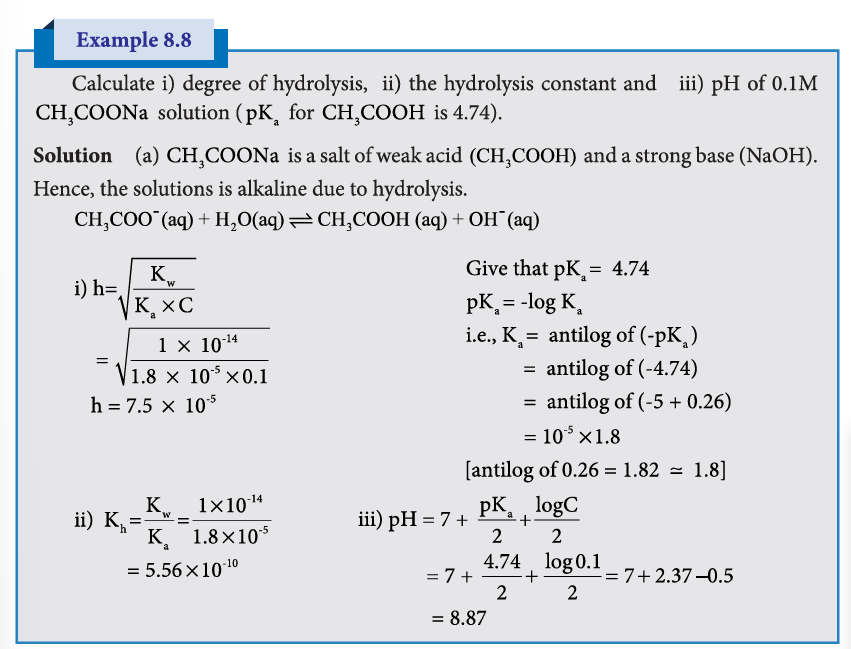
Evaluate yourself - 10#
Calculate the i) hydrolysis constant, ii) degree of hydrolysis and iii) pH of \(0.05 M\) sodium carbonate solution (\(pK_a\) for \(HCO_3^-\) is 10.26).
8.9 Solubility Product#
We have come across many precipitation reactions in inorganic qualitative analysis. For example, dil \(HCl\) is used to precipitate \(Pb^{2+}\) ions as \(PbCl_2\) which is sparingly soluble in water. Kidney stones are developed over a period of time due to the precipitation of \(Ca^{2+}\) (as calcium oxalate etc…). To understand the precipitation, let us consider the solubility equilibria that exist between the undissociated sparingly soluble salt and its constituent ions in solution.
For a general salt \(X_m Y_n\)
$$ X_m Y_n (s) \xrightarrow{H_2O} m X^{n+} (aq) + n Y^{m-} (aq) $$The equilibrium constant for the above is
$$ K = \frac{[X^{n+}]^m [Y^{m-}]^n}{[X_m Y_n]} $$In solubility equilibria, the equilibrium constant is referred as solubility product constant (or) Solubility product.
In such heterogeneous equilibria, the concentration of the solid is a constant and is omitted in the above expression
$$ K_{sp} = [X^{n+}]^m [Y^{m-}]^n $$The solubility product of a compound is defined as the product of the molar concentration of the constituent ions, each raised to the power of its stoichiometric co-efficient in a balanced equilibrium equation.
Solubility product finds useful to decide whether an ionic compound gets precipitated when solution that contains the constituent ions are mixed.
When the product of molar concentration of the constituent ions i.e., ionic product, exceeds the solubility product then the compound gets precipitated.
The expression for the solubility product and the ionic product appears to be the same but in the solubility product expression, the molar concentration represents the equilibrium concentration and in ionic product, the initial concentration (or) concentration at a given time ’t’ is used.
In general we can summarise as,
Ionic product \(> K_{sp}\), precipitation will occur and the solution is super saturated.
Ionic product \(< K_{sp}\), no precipitation and the solution is unsaturated.
Ionic product \(= K_{sp}\), equilibrium exist and the solution is saturated.
Example 8.9#
Find out whether lead chloride gets precipitated or not when \(1 mL\) of \(0.1 M\) lead nitrate and \(0.5 mL\) of \(0.2 M\) \(NaCl\) solution are mixed? \(K_{sp}\) of \(PbCl_2\) is \(1.2 \times 10^{-5}\)
$$ PbCl_2 (s) \xrightarrow{H_2O} Pb^{2+} (aq) + 2Cl^- (aq) $$Ionic product \(= [Pb^{2+}][Cl^-]^2\)
Total volume \(= 1.5 mL\)
\(Pb(NO_3)_2 \Longrightarrow Pb^{2+} + 2NO_3^-\)
Number of moles of \(Pb^{2+} =\) Molarity \(\times\) volume of the solution in litre \(= 0.1 \times 1 \times 10^{-3} = 10^{-4}\)
$$ [Pb^{2+}] = \frac{\text{number of moles of } Pb^{2+}}{\text{Volume of the solution in L}} = \frac{10^{-4}}{1.5 \times 10^{-3} mL} = 6.7 \times 10^{-2} M $$\[ \begin{array}{ccc} \mathrm{NaCl} & {\rightarrow} & \mathrm{Na^{+}}+\mathrm{Cl^{-}} \\[-2pt] {\scriptstyle 0.2M} & & {\scriptstyle 0.2M \qquad 0.2M} \end{array} \]Number of moles of \(Cl^- = 0.2 \times 0.5 \times 10^{-3} = 10^{-4}\)
$$ [Cl^-] = \frac{10^{-4} \text{ moles}}{1.5 \times 10^{-3} L} = 6.7 \times 10^{-2} M $$Ionic product \(= (6.7 \times 10^{-2})(6.7 \times 10^{-2})^2 = 3.01 \times 10^{-4}\)
Since, the ionic product \(3.01 \times 10^{-4}\) is greater than the solubility product \((1.2 \times 10^{-5})\), \(PbCl_2\) will get precipitated.
8.9.1 Determination of solubility product from molar solubility#
Solubility product can be calculated from the molar solubility i.e., the maximum number of moles of solute that can be dissolved in one litre of the solution.
For a solute \(X_m Y_n\)
$$ X_m Y_n (s) \rightleftharpoons m X^{n+} (aq) + n Y^{m-} (aq) $$From the above stoichiometrically balanced equation we have come to know that 1 mole of \(X_m Y_n (s)\) dissociated to furnish ’m’ moles of \(X^{n+}\) and ’n’ moles of \(Y^{m-}\). If ’s’ is molar solubility of \(X_m Y_n\), then
$$ [X^{n+}] = ms \quad \text{and} \quad [Y^{m-}] = ns $$$$ \therefore K_{sp} = [X^{n+}]^m [Y^{m-}]^n $$$$ K_{sp} = (ms)^m (ns)^n $$$$ K_{sp} = (m)^m (n)^n (s)^{m+n} $$Example 8.10#
Establish a relationship between the solubility product and molar solubility for the following
a) \(BaSO_4\) b) \(Ag_2CrO_4\)
$$ BaSO_4(s) \rightleftharpoons{H_2O} Ba^{2+} (aq) + SO_4^{2-} (aq) $$$$ K_{sp} = [Ba^{2+}][SO_4^{2-}] = (s)(s) = S^2 $$$$ Ag_2CrO_4(s) \xrightarrow{H_2O} 2Ag^+ (aq) + CrO_4^{2-} (aq) $$$$ K_{sp} = [Ag^+]^2[CrO_4^{2-}] = (2s)^2 (s) = 4s^3 $$Summary#
According to Arrhenius, an acid is a substance that dissociates to give hydrogen ions in water. According to Lowry and Bronsted concept, an acid is defined as a substance that has a tendency to donate a proton to another substance and base is a substance that has a tendency to accept a proton from other substance. According to Gilbert .N. Lewis, an acid is a species that accepts an electron pair while base is a species that donates an electron pair.
Ionic product (ionic product constant) of water \((K_w) = [H_3O^+] [OH^-]\)
pH of a solution is defined as the negative logarithm of base 10 of the molar concentration of the hydronium ions present in the solution. \(pH = -\log_{10}[H_3O^+]\)
When dilution increases, the degree of dissociation of weak electrolyte also increases. This statement is known as Ostwald’s dilution Law.
When a salt of a weak acid is added to the acid itself, the dissociation of the weak acid is suppressed further this is known as common ion effect.
Buffer is a solution which consists of a mixture of a weak acid and its conjugate base (or) a weak base and its conjugate acid.
Buffer capacity and buffer index is defined as the number of gram equivalents of acid or base added to 1 litre of the buffer solution to change its pH by unity. \(\beta = \frac{dB}{d(pH)}\)
Henderson - Hasselbalch equation For Acid buffer \(\Rightarrow pH = pK_a + \log \frac{[salt]}{[acid]}\) For Basic buffer \(\Rightarrow pOH = pK_b + \log \frac{[salt]}{[base]}\)
Hydrolysis of Salt of strong base and weak acid \(K_h \cdot K_a = K_w\) \(pH = 7 + \frac{1}{2} pK_a + \frac{1}{2} \log C\)
Hydrolysis of salt of strong acid and weak base \(K_h \cdot K_b = K_w\) \(pH = 7 - \frac{1}{2} pK_b - \frac{1}{2} \log C\)
Hydrolysis of Salt of weak acid and weak base \(K_a \cdot K_b \cdot K_h = K_w\) \(pH = 7 + \frac{1}{2} pK_a - \frac{1}{2} pK_b\)
The solubility product of a compound is defined as the product of the molar concentration of the constituent ions, each raised to the power of its stoichiometric co-efficient in a balanced equilibrium equation.