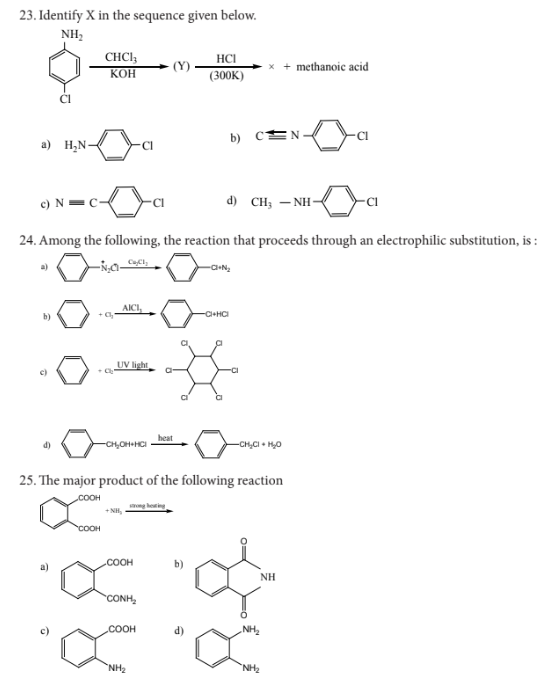
Which of the following reagent can be used to convert nitrobenzene to aniline
a) $\text{Sn / HCl}$
b) $\text{ZnHg / NaOH}$
c) $\text{Zn/NH}_4\text{Cl}$
d) All of these
The method by which aniline cannot be prepared is
a) degradation of benzamide with $\text{Br}_2\text{ / NaOH}$
b) potassium salt of phthalimide treated with chlorobenzene followed by hydrolysis with aqueous $\text{NaOH}$ solution.
c) reduction of Nitrobenzene with $\text{LiAlH}_4$
d) reduction of nitrobenzene by $\text{Sn / HCl}$.
Which one of the following will not undergo Hofmann bromamide reaction
a) $\text{CH}_3\text{CONHCH}_3$
b) $\text{CH}_3\text{CH}_2\text{CONH}_2$
c) $\text{CH}_3\text{CONH}_2$
d) $\text{C}_6\text{H}_5\text{CONH}_2$
Assertion: Acetamide on reaction with $\text{KOH}$ and bromine gives acetic acid Reason: Bromine catalyses hydrolysis of acetamide. a) if both assertion and reason are true and reason is the correct explanation of assertion.
b) if both assertion and reason are true but reason is not the correct explanation of assertion.
c) assertion is true but reason is false
d) both assertion and reason are false.
a) bromomethane
b) $\alpha$ - bromo sodium acetate
c) methanamine
d) acetamide
Which one of the following nitro compounds does not react with nitrous acid
\(\mathrm{Aniline + benzoyl\ chloride \xrightarrow{\mathrm{NaOH}} C_6H_5{-}NH{-}COC_6H_5}\) this reaction is known as
a) Friedel – crafts reaction
b) HVZ reaction
c) Schotten – Baumann reaction
d) none of these
The product formed by the reaction an aldehyde with a primary amine (NEET)
a) carboxylic acid
b) aromatic acid
c) schiff’s base
d) ketone
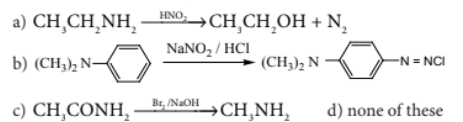
Which of the following reaction is not correct.
When aniline reacts with acetic anhydride the product formed is
a) o – aminoacetophenone
b) m-aminoacetophenone
c) p – aminoacetophenone
d) acetanilide
The order of basic strength for methyl substituted amines in aqueous solution is
a) $\text{N(CH}_3)_3 > \text{N(CH}_3)_2\text{H} > \text{N(CH}_3)\text{H}_2 > \text{NH}_3$
b) $\text{N(CH}_3)_2\text{H} > \text{N(CH}_3)\text{H}_2 > \text{N(CH}_3)_3 > \text{NH}_3$
c) $\text{NH}_3 > \text{N(CH}_3)\text{H}_2 > \text{N(CH}_3)_2\text{H} > \text{N(CH}_3)_3$
d) $\text{N(CH}_3)_2\text{H} > \text{N(CH}_3)\text{H}_2 > \text{NH}_3 > \text{N(CH}_3)_3$
Nitrobenzene on reaction with at $80\text{-}100^\circ\text{C}$ forms which one of the following products?
a) 1,4 – dinitrobenzene
b) 2,4,6 – tirnitrobenzene
c) 1,2 – dinitrobenzene
d) 1,3 – dinitrobenzene
\(\mathrm{C_5H_{13}N\ reacts\ with\ HNO_2}\) to give an optically active compound – The compound is
a) pentan – 1- amine
b) pentan – 2- amine
c) N,N – dimethylpropan -2-amine
d) diethyl methyl amine
Secondary nitro alkanes react with nitrous acid to form
a) red solution
b) blue solution
c) green solution
d) yellow solution
Which of the following amines does not undergo acetylation?
a) t – butylamine
b) ethylamine
c) diethylamine
d) triethylamine
Which one of the following is most basic?
a) 2,4 – dichloroaniline
b) 2,4 – dimethyl aniline
c) 2,4 – dinitroaniline
d) 2,4 – dibromoaniline
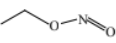
When
is reduced with $\text{Sn / HCl}$ the pair of compounds formed are
a) Ethanol, hydroxylamine hydrochloride
b) Ethanol, ammonium hydroxide
c) Ethanol, $\text{NH}_2\text{OH}$
d) $\text{C}_2\text{H}_5\text{NH}_2\text{, H}_2\text{O}$
22. Ammonium salt of benzoic acid is heated strongly with $\text{P}_2\text{O}_5$ and the product so formed is reduced and then treated with $\text{NaNO}_2\text{ / HCl}$ at low temperature. The final compound formed is
a) Benzene diazonium chloride
b) Benzyl alcohol
c) Phenol
d) Nitrobenzene
Write down the possible isomers of the $\text{C}_4\text{H}_9\text{NO}_2$ give their IUPAC names
There are two isomers with the formula $\text{CH}_3\text{NO}_2$. How will you distinguish between them?
What happens when
i. 2 – Nitropropane boiled with $\text{HCl}$
ii. Nitrobenzene undergo electrolytic-reduction in strongly acidic medium.
iii. Oxidation of tert – butylamine with $\text{KMnO}_4$
iv. Oxidation of acetoneoxime with trifluoroperoxy acetic acid.
How will you convert nitrobenzene into
i. 1,3,5 - trinitrobenzene
ii. o and p- nitrophenol
iii. m – nitro aniline
iv. azoxybenzene
v. hydrozobenzene
vi. N – phenylhydroxylamine
vii. aniline
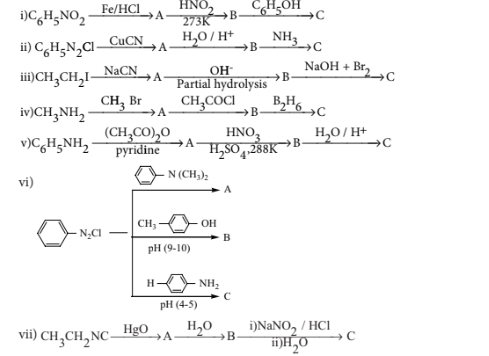
Identify compounds A, B and C in the following sequence of reactions.
Write short notes on the following
i. Hofmann’s bromide reaction
ii. Ammonolysis
iii. Gabriel phthalimide synthesis
iv. Schotten – Baumann reaction
v. Carbylamine reaction
vi. Mustard oil reaction
vii. Coupling reaction
viii. Diazotisation
ix. Gomberg reaction
How will you distinguish between primary secondary and tertiary alphatic amines.
Account for the following
i. Aniline does not undergo Friedel – Crafts reaction
ii. Diazonium salts of aromatic amines are more stable than those of aliphatic amines
iii. $\text{pK}_b$ of aniline is more than that of methylamine
iv. Gabriel phthalimide synthesis is preferred for synthesising primary amines.
v. Ethylamine is soluble in water whereas aniline is not
vi. Amines are more basic than amides
vii. Although amino group is o – and p – directing in aromatic electrophilic substitution reactions, aniline on nitration gives a substantial amount of m – nitroaniline.
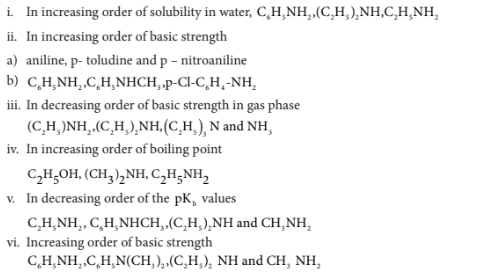
Arrange the following
How will you prepare propan – 1- amine from
i) butane nitrile
ii) propanamide
iii) 1- nitropropane
How will you convert diethylamine into
i) N, N – diethylacetamide
ii) N – nitrosodiethylamine
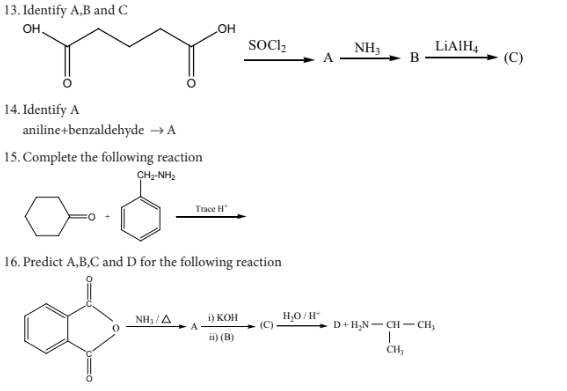
A dibromo derivative (A) on treatment with $\text{KCN}$ followed by acid hydrolysis and heating gives a monobasic acid (B) along with liberation of $\text{CO}_2$. (B) on heating with liquid ammonia followed by treating with $\text{Br}_2/\text{KOH}$ gives (c) which on treating with $\text{NaNO}_2$ and $\text{HCl}$ at low temperature followed by oxidation gives a monobasic acid (D) having molecular mass 74. Identify A to D.
Identify A to E in the following sequence of reactions.