10. SURFACE CHEMISTRY#
Irving Langmuir was an American Chemist and Physicist. He was awarded Nobel Prize in the year 1932 in Chemistry for his works in Surface Chemistry. He outlined the concentric theory of atomic structure. He invented the gas filled incandescent lamp and hydrogen welding technique. The Langmuir Laboratory for Atmospheric Research near Socorro, New Mexico was named in his honor. Langmuir and Tonks discovered electron density waves in plasmas that are now known as Langmuir waves.
Learning Objectives
After studying this unit the student will be able to
■ classify adsorption.
■ distinguish between absorption and adsorption
■ explain Freundlich adsorption isotherm
■ understand catalysis and the characteristics of catalysts.
■ explain the theories of catalysis and enzyme catalysis.
■ classify colloids.
■ explain the methods of preparation and purification of colloids.
■ discuss the properties of colloidal solution.
■ explain the role of colloids and emulsions in daily life.
INTRODUCTION#
Surface chemistry is the branch of chemistry that deals with the processes occurring at interfaces between phases for example, solid and liquid, solid and gas and liquid and liquid. This topic is of immense importance to our everyday life and to numerous industries, from materials and paints to medicine and biotechnology. Surfaces play a key role in heterogeneous catalysis, formation and stability of colloids and electrode reactions. Surfaces of solids are inherently different from their bulk portion. The bonding between the atoms at the mere surface is different from that in the bulk. Hydrogen that exists in the interstellar space are formed on the surfaces of grains and dust particles. Mosquitoes and other small insects can walk on the surface of water but they will drown into the water when soaps are added in the neighbourhood. We are fascinated by the spherical shape of water droplets and mercury droplets. We are also impressed by the non-sticky wings of butterfly and leaves of plants. Blue colour of the sky and red colour of the sunset strongly attract us. In all the above only the surface of matter is important. Many of creams, lotions and other personal care products are complex emulsions. Food companies are interested in developing healthy, tasty and longlasting food products. All these are based on the principles of colloids and surface chemistry. So, surface Chemistry is an exciting topic to learn.
10.1 Adsorption and Absorption#
Solid surfaces have the ability to attract the contacting species due to free valency or residual force on them.
For example: charcoal adsorbs ammonia, silica gel adsorbs water., charcoal adsorbs colorants from sugar.
These examples prove that adsorption is a surface phenomenon. In contrast to adsorption, absorption is a bulk phenomenon i.e. the adsorbate molecules are distributed throughout the adsorbent.
- Adsorbent is the material on which adsorption takes place.
- Adsorbed substance is called an adsorbate.
- The surface of separation of the two phases where the concentration of adsorbed molecule is high is known as interface.
- In adsorption, if the concentration of a substance in the interface is high, then it is called positive adsorption. If it is less, then it is called negative adsorption.
- The process of removing an adsorbed substance from the surface is called desorption.
- The gaseous molecules like \(He, Ne, O_2, N_2, SO_2\) and \(NH_3\) and solutions of \(NaCl\) or \(KCl\) can be adsorbed by suitable adsorbents. These are referred as adsorbates.
- Silica gel and metals like \(Ni, Cu, Pt, Ag\) and \(Pd\) and certain colloids can act as adsorbents.
Characteristics of adsorption#
- Adsorption can occur in all interfacial surfaces i.e. the adsorption can occur in between gas-solid, liquid-solid, liquid-liquid, solid-solid and gas-liquid.
- Adsorption is a spontaneous process and it is always accompanied by decrease in free energy. When \(\Delta G\) reaches zero, the equilibrium is attained. We know, \(\Delta G = \Delta H - T\Delta S\) where \(\Delta G\) is Change in Free energy. \(\Delta H\) is Change in enthalpy and \(\Delta S =\) Change in entropy.
- When molecules are adsorbed, there is always a decrease in randomness of the molecules. ie, \(\Delta S < 0\), and \(T\Delta S\) is negative. Hence, adsorption is exothermic. Adsorption is a quick process whereas absorption is a slow process.
M.C. Bain introduced a term ‘sorption’ to represent the simultaneous adsorption and absorption. T. Graham used a term occlusion for sorption of gases on metal surfaces.
10.1.1 Types of adsorption#
Adsorption is classified as physical adsorption and chemical adsorption, depending on the nature of forces acting between adsorbent and adsorbate. In chemical adsorption, gas molecules are held to the surface by formation of chemical bonds. Since strong bond is formed, nearly 400 KJ / mole is given out as heat of adsorption.
Examples
Adsorption of \(O_2\) on tungsten, Adsorption of \(H_2\) on nickel, Adsorption of ethyl alcohol vapours on nickel.
In physical adsorption, physical forces such as van der waals force of attraction, dipole - dipole interaction, dispersion forces etc., exist between adsorbent and adsorbate. As these forces are weak, heat of adsorption is low, hence physical adsorption occurs at low temperatures.
Examples
(a) Adsorption of \(N_2\) on mica. (b) Adsorption of gases on charcoal.
The following table 10.1 illustrates the distinction between chemical and physical adsorption.
Table 10.1 Distinction between chemical and physical adsorption
| Chemical adsorption or Chemisorption or Activated adsorption | Physical adsorption or van der waals adsorption or Physisorption |
|---|---|
| 1. It is very slow | 1. It is instantaneous |
| 2. It is very specific depends on nature of adsorbent and adsorbate. | 2. It is non-specific |
| 3. Chemical adsorption is fast with increase pressure, it can not alter the amount. | 3. In Physisorption, when pressure increases the extent of adsorption increases. |
| 4. When temperature is raised chemisorption first increases and then decreases. | 4. Physisorption decreases with increase in temperature. |
| 5. Chemisorption involves transfer of electrons between the adsorbent and adsorbate. | 5. No transfer of electrons |
| 6. Heat of adsorption is high i.e., from 40-400 kJ/mole. | 6. Heat of adsorption is low in the order of 40 kJ/mole. |
| 7. Monolayer of the adsorbate is formed. | 7. Multilayer of the adsorbate is formed on the adsorbent. |
| 8. Adsorption occurs at fixed sites called active centres. It depends on surface area | 8. It occurs on all sides |
| 9. Chemisorption involves the formation of activated complex with appreciable activation energy. | 9. Activation energy is insignificant. |
10.1.2 Factors affecting adsorption#
The adsorption is well understood by considering the various factors affecting it. Qualitatively, the extent of surface adsorption depends on the following factors
(i) Nature of adsorbent (ii) Nature of adsorbate (iii) Pressure (iv) Concentration at a given temperature.
1. Surface area of adsorbent:
As the adsorption is a surface phenomenon it depends on the surface area of adsorbent. i.e., higher the surface area, higher is the amount adsorbed.
2. Nature of adsorbate
The nature of adsorbate can influence the adsorption. Gases like \(SO_2, NH_3, HCl\) and \(CO_2\) are easily liquefiable as they have greater van der waal’s force of attraction. On the other hand, permanent gases like \(H_2, N_2\) and \(O_2\) can not be liquefied easily. These permanent gases are having low critical temperature and adsorbed slowly, while gases with high critical temperature are adsorbed readily.
3. Effect of temperature
When temperature is raised chemisorption first increases and then decreases. whereas physisorption decreases with increase in temperature.
4. Effect of pressure:
chemical adsorption is fast with increase in pressure, it can not alter the amount of adsorption. In Physisorption the extent of adsorption increases with increase in pressure.
10.1.3 Adsorption isotherms and isobars.#
Adsorption isotherms represents the variation of adsorption at constant temperature.
When amount of adsorption is plotted versus temperature at constant pressure it is called adsorption isobar.
Adsorption isobars of physisorption and chemisorption are different as represented in the graphs.
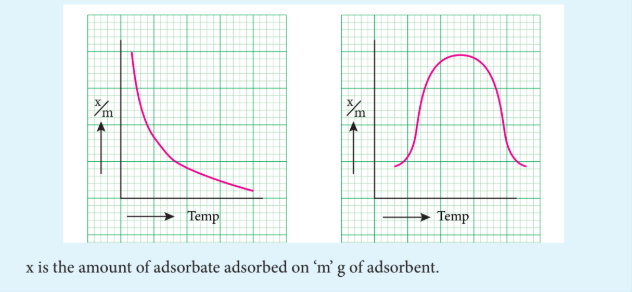
In physical adsorption, \(\frac{x}{m}\) decreases with increase in Temperature, But in chemical adsorption, \(\frac{x}{m}\) increases with rise in temperature and then decreases. The increase illustrates the requirement of activation of the surface for adsorption is due to fact that formation of activated complex requires certain energy.
The decrease at high temperature is due to desorption, as the kinetic energy of the adsorbate increases.
10.1.3.1 Adsorption isotherms#
Adsorption isotherm can be studied quantitatively. A plot between the amount of adsorbate adsorbed and pressure (or concentration of adsorbate) at constant temperature is called adsorption isotherms.
In order to explain these isotherms various equations were suggested as follows:
1) Freundlich adsorption isotherm. According to Freundlich,
$$ \frac{x}{m} = kp^{\frac{1}{n}} $$where \(x\) is the amount of adsorbate, adsorbed on \(m\) gm of adsorbent at a pressure of p. K and n are constant introduced by freundlich.
Value n is always less than unity.
This equation is applicable for adsorption of gases on solid surfaces. The same equation becomes \(\frac{x}{m} = Kc^{\frac{1}{n}}\), when used for adsorption in solutions with c as concentration.
This equation quantitively predicts the effect of pressure(or concentration) on the adsorption of gases(or adsorbates) at constant temperature.
Taking log on both sides of equation \(\frac{x}{m} = Kp^{\frac{1}{n}}\)
$$ \log \frac{x}{m} = \log K + \frac{1}{n} \log p $$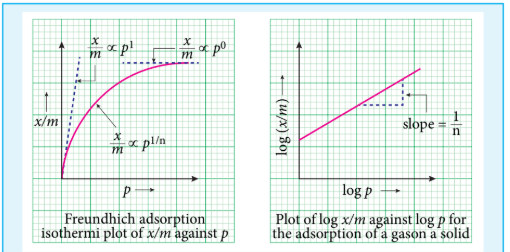
Hence the intercept represents the value of \(\log k\) and the slope gives \(\frac{1}{n}\).
This equation explains the increase of \(\frac{x}{m}\) with increase in pressure. But experimental values show the deviation at low pressure.
Limitations
This equation is purely empirical and valid over a limited pressure range.
The values of constants k and n also found vary with temperature. No theoretical explanations were given.
10.1.4 Applications of adsorption#
Though we have innumerable applications for adsorption, we consider few of them
Gas masks: During world war I charcoal gas mask was employed by both the British and American. Activated charcoal was found to be one of the best adsorbents.
To create high vacuum in vessels, Tail and Dewar used activated charcoal. For dehydration and also purification of gases like \(CO_2, N_2, Cl_2, O_2\) and He, alumina and silica are employed. In the blast furnace silica gel is also used for drying air.
One of the highly important use of adsorption is the softening of hardware. Permutit is employed for this process which adsorbs \(Ca^{2+}\) and \(Mg^{2+}\) ions in its surface, there is an ion exchange as shown below it occurs on the surface.
Exhausted permutit is regenerated by adding a solution of common salt.
$$ CaAl_2Si_4O_{12} + 2NaCl \rightarrow Na_2Al_2Si_4O_{12} + CaCl_2 $$- Ion exchange resins
Ion exchange resins are working only based on the process of adsorption. Ion exchange resins are used to demineralise water. This process is carried out by passing water through two columns of cation and anion exchange resins.
$$ 2RSO_3H + Ca^{2+} (Mg^{2+}) \rightarrow (RSO_3)_2Ca(Mg) + 2H^+ $$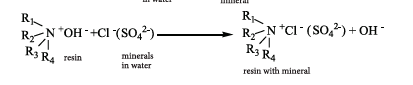
- Petroleum refining and refining of vegetable oil
Fuller’s earth and silica gel are used for refining process.
- Decolourisation of Sugar:
Sugar prepared from molasses is decolourised to remove coloured impurities by adding animal charcoal which acts as decolourising material.
- Chromatography
The chromatographic technique is applied for separation of components in a mixture. It is mainly based on adsorption of components on the surface of adsorbents. This method is very effective and used for identification, detection and estimation of many substances even if they are contained in micro quantities.
- Catalysed reaction
Catalysis is an important branch of surface chemistry which is based on the phenomenon of adsorption of materials on the catalyst surface.
Examples:
In the Haber’s process, ammonia is manufactured from \(N_2\) and \(H_2\) as shown by the following reactions.
$$ N_2 + 3H_2 \rightarrow 2NH_3 $$In this process, Fe is the catalyst and Mo is a promoter. The surface of the Fe catalysts the reaction.
In the hydrogenation of oils to obtain vanaspathi, Nickel is used as a catalyst. Nickel surface catalysts the reaction.
$$\text{vegetable oil} + \text{H}_2 \xrightarrow[\text{473K}]{\text{Ni catalyst}} \text{vanaspathi}$$- Qualitative analysis
When blue litmus solution is added to \(Al^{3+}\) ion, a red coloration is seen due to the acidic nature of the solution. Addition of ammonium hydroxide to it gives a blue lake. This is due to the adsorption of blue colour litmus compound on the surface of \(Al(OH)_3\) which is formed during the addition of \(NH_4OH\).
- Medicine:
Drugs cure diseases by adsorption on body tissues.
- Concentration of Ores of metals
Sulphides ores are concentrated by a process called froth flotation in which light ore particles are wetted by pine oil.
- Mordants and Dyes
Most of the dyes are adsorbed on the surface of the fabrics. Mordants are the substances used for fixing dyes onto the fabric.
- Adsorption indicators
In the precipitation titrations, the end point is indicated by an external indicator which changes its colour after getting adsorbed on precipitate. It is used to indicate the end point of the titration.
10.2 Catalysis#
In 1836 Berzelius identified certain substances loosen the bond in the reacting molecules and increased the rate of the reaction. But he also found these substances didn’t undergo any change chemically. In order to indicate the property, he gave them the name catalyst. (In greek, kata- wholly, lein- to loosen).
Later it was identified that there were many substances which retarded the speed of a reaction.
Hence a catalyst is defined as a substance which alters the rate of chemical reaction without itself undergoing chemical change. The phenomenon which involves the action of a catalyst is called catalysis.
Positive and negative catalysis:
In positive catalysis, the rate of a reaction is increased by the presence of catalyst but in negative catalysis, the rate of reaction is decreased by the presence of a catalyst.
The two main types of catalysis (i) Homogeneous catalysis and (ii) Heterogeneous catalysis
Homogeneous catalysis
In a homogeneous catalysed reaction, the reactants, products and catalyst are present in the same phase.
Illustration (1):
$$ 2SO_{2(g)} + O_{2(g)} + [NO]_{(g)} \rightarrow 2SO_{3(g)} + [NO]_{(g)} $$In this reaction the catalyst NO, reactants, \(SO_2\) and \(O_2\), and product, \(SO_3\) are present in the gaseous form.
Illustration (2):
In the decomposition of acetaldehyde by \(I_2\) catalyst, the reactants and products are all present in the vapour phase.
$$ CH_3CHO_{(g)} + [I_2]_{(g)} \rightarrow CH_{4(g)} + CO_{(g)} + [I_2]_{(g)} $$Let us consider some examples in which the reactants, products and catalyst are present in aqueous solution.
(1) Hydrolysis of cane sugar with a mineral acid as catalyst
$$\underset{\text{Sucrose}}{\text{C}_{12}\text{H}_{22}\text{O}_{11(l)}} + \text{H}_2\text{O}_{(l)} \xrightarrow{\text{H}_2\text{SO}_{4(l)}} \underset{\text{Glucose}}{\text{C}_6\text{H}_{12}\text{O}_{6(l)}} + \underset{\text{Fructose}}{\text{C}_6\text{H}_{12}\text{O}_{6(l)}}$$(2) Ester hydrolysis with acid or alkali as catalyst
$$\underset{\text{Ethyl acetate}}{\text{CH}_3\text{COOC}_2\text{H}_{5(l)}} + \text{H}_2\text{O}_{(l)} \xrightarrow{\text{H}_2\text{SO}_{4(l)}} \underset{\text{acetic acid}}{\text{CH}_3\text{COOH}_{(l)}} + \underset{\text{ethyl alcohol}}{\text{C}_2\text{H}_5\text{OH}_{(l)}}$$Heterogeneous catalysis
In a reaction, the catalyst is present in a different phase i.e. it is not present in the same phase as that of reactants or products. This is generally referred as contact catalysis and the catalyst present is in the form of finely divided metal or as gauze
Illustration
(i) In the manufacture of sulphuric acid by contact process \(SO_3\) is prepared by the action of \(SO_2\) and \(O_2\) in the presence of \(Pt\) or \(V_2O_5\) as a catalyst.
$$ 2SO_{2(g)} + O_{2(g)} \xrightarrow{Pt_{(s)} \text{ or } V_2O_{5(s)}} 2SO_{3(g)} $$(ii) In the Haber’s process for the manufacture of ammonia, iron is used as a catalyst for the reaction between Hydrogen and Nitrogen.
$$ N_{2(g)} + 3H_{2(g)} \xrightarrow{Fe_{(s)}} 2NH_{3(g)} $$(iii) Oxidation of ammonia is carried out in presence of platinum gauze
$$ 4NH_{3(g)} + 5O_{2(g)} \xrightarrow{Pt_{(s)}} 4NO_{(g)} + 6H_2O_{(g)} $$(iv) The hydrogenation of unsaturated organic compounds is carried out using finely divided nickel as a catalyst.
$$ CH_2 = CH_{2(g)} + H_{2(g)} \xrightarrow{Ni_{(s)}} CH_3 \cdot CH_{3(g)} $$(v) Decomposition of \(H_2O_2\) occurs in the presence of the Pt catalyst
$$ 2H_2O_{2(l)} \xrightarrow{Pt_{(s)}} 2H_2O_{(l)} + O_{2(g)} $$(vi) In the presence of anhydrous \(AlCl_3\), benzene reacts with ethanol chloride to produce acetophenone

10.2.1 Characteristics of catalysts#
For a chemical reaction, catalyst is needed in very small quantity. Generally, a pinch of catalyst is enough for a reaction in bulk.
There may be some physical changes, but the catalyst remains unchanged in mass and chemical composition in a chemical reaction.
A catalyst itself cannot initiate a reaction. It means it can not start a reaction which is not taking place. But, if the reaction is taking place in a slow rate it can increase its rate.
A solid catalyst will be more effective if it is taken in a finely divided form.
A catalyst can catalyse a particular type of reaction, hence they are said to be specific in nature.
In an equilibrium reaction, presence of catalyst reduces the time for attainment of equilibrium and hence it does not affect the position of equilibrium and the value of equilibrium constant.
A catalyst is highly effective at a particular temperature called as optimum temperature.
Presence of a catalyst generally does not change the nature of products
For example. \(2SO_2 + O_2 \rightarrow 2SO_3\)
This reaction is slow in the absence of a catalyst, but fast in the presence of Pt catalyst
Promoters and catalyst poison
In a catalysed reaction the presence of a certain substance increases the activity of a catalyst. Such a substance is called a promoter.
For example in the Haber’s process of manufacture of ammonia, the activity of the iron catalyst is increased by the presence of molybdenum. Hence molybdenum is called a promoter. In the same way \(Al_2O_3\) can also be used as a promoter to increase the activity of the iron catalyst.
On the other hand, certain substances when added to a catalysed reaction decreases or completely destroys the activity of catalyst and they are often known as catalytic poisons.
Few examples,
In the reaction, \(2SO_2 + O_2 \rightarrow 2SO_3\) with a Pt catalyst, the poison is \(As_2O_3\)
i.e., \(As_2O_3\) destroys the activity of Pt. \(As_2O_3\) blocks the activity of the catalyst. So, the activity is lost.
In the Haber’s process of the manufacture of ammonia, the Fe catalyst is poisoned by the presence of \(H_2S\).
In the reaction, \(2H_2 + O_2 \rightarrow 2H_2O\)
CO acts as a catalytic poison for Pt - catalyst
Auto catalysis
In certain reactions one of the products formed acts as a catalyst to the reaction. Initially the rate of reaction will be very slow but with the increase in time the rate of reaction increases.
Auto catalysis is observed in the following reactions.
$$ CH_3COOC_2H_5 + H_2O \rightarrow CH_3COOH + C_2H_5OH $$Acetic acid acts as the autocatalyst
$$ 2AsH_3 \rightarrow 2As + 3H_2 $$Arsenic acts as an autocatalyst
Negative Catalysis
In certain reactions, presence of certain substances, decreases the rate of the reaction. Ethanol is a negative catalyst for the following reaction.
(i) \(4CHCl_3 + 3O_2 \rightarrow 4COCl_2 + 2H_2O + 2Cl_2\)
Ethanol decreases the rate of the reaction
(ii) \(2H_2O_2 \rightarrow 2H_2O + O_2\)
In the decomposition of hydrogen peroxide, dilute acid or glycerol acts as a negative catalyst.
10.2.2 Theories of Catalysis#
For a chemical reaction to occur, the reactants are to be activated to form the activated complex. The energy required for the reactants to reach the activated complex is called the activation energy. The activation energy can be decreased by increasing the reaction temperature. In the presence of a catalyst, the reactants are activated at reduced temperatures in otherwords, the activation energy is lowered. The catalyst adsorbs the reactants activates them by weakening the bonds and allows them to react to form the products.
As activation energy is lowered in presence of a catalyst, more molecules take part in the reaction and hence the rate of the reaction increases.
The action of catalysis in chemical reactions is explained mainly by two important theories. They are
(i) the intermediate compound formation theory (ii) the adsorption theory.
The intermediate compound formation theory
A catalyst acts by providing a new path with low energy of activation. In homogeneous catalysed reactions a catalyst may combine with one or more reactant to form an intermediate which reacts with other reactant or decompose to give products and the catalyst is regenerated.
Consider the reactions:
$$ \begin{array}{rl} & A + B \rightarrow AB (1)\\ & A + C \rightarrow AC \quad (\text{intermediate}) (2) \quad (\text{C is the catalyst}) \\ & AC + B \rightarrow AB + C (3) \end{array} $$Activation energies for the reactions (2) and (3) are lower compared to that of (1). Hence the formation and decomposition of the intermediate accelerate the rate of the reaction.
Example 1
The mechanism of Fridel crafts reaction is given below
$$ C_6H_6 + CH_3Cl \xrightarrow{anhydrous \ AlCl_3} C_6H_5CH_3 + HCl $$The action of catalyst is explained as follows
$$ CH_3Cl + AlCl_3 \rightarrow [CH_3]^+[AlCl_4]^- \quad (\text{intermediate}) $$$$ C_6H_6 + [CH_3^+][AlCl_4]^- \rightarrow C_6H_5CH_3 + AlCl_3 + HCl $$Example 2
Thermal decomposition of \(KClO_3\) in presence of \(MnO_2\) proceeds as follows.
Steps in the reaction \(2KClO_3 \rightarrow 2KCl + 3O_2\) can be given as
$$ 2KClO_3 + 6MnO_2 \rightarrow 6MnO_3 + 2KCl \quad (\text{intermediate}) $$$$ 6MnO_3 \rightarrow 6MnO_2 + 3O_2 $$Example 3:
Formation of water due to the reaction of \(H_2\) and \(O_2\) in the presence of Cu proceeds as follows. Steps in the reaction \(H_2 + \frac{1}{2}O_2 \rightarrow H_2O\) can be given as
$$ 2Cu + \frac{1}{2}O_2 \rightarrow Cu_2O \quad (\text{intermediate}) $$$$ Cu_2O + H_2 \rightarrow H_2O + 2Cu $$Example 4:
Oxidation of HCl by air in presence of \(CuCl_2\) proceeds as follows. Steps in the reaction \(4HCl + O_2 \rightarrow 2H_2O + 2Cl_2\) can be given as
$$ 2CuCl_2 \rightarrow Cl_2 + Cu_2Cl_2 $$$$ 2Cu_2Cl_2 + O_2 \rightarrow 2Cu_2OCl_2 \quad (\text{intermediate}) $$$$ 2Cu_2OCl_2 + 4HCl \rightarrow 2H_2O + 4CuCl_2 $$This theory describes
(i) the specificity of a catalyst and
(ii) the increase in the rate of the reaction with increase in the concentration of a catalyst.
Limitations
(i) The intermediate compound theory fails to explain the action of catalytic poison and activators (promoters).
(ii) This theory is unable to explain the mechanism of heterogeneous catalysed reactions.
2. Adsorption theory
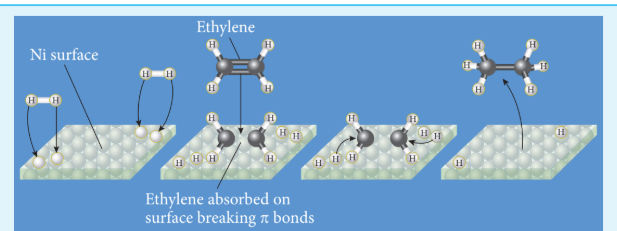
Langmuir explained the action of catalyst in heterogeneous catalysed reactions based on adsorption. The reactant molecules are adsorbed on the catalyst surfaces, so this can also be called as contact catalysis.
According to this theory, the reactants are adsorbed on the catalyst surface to form an activated complex which subsequently decomposes and gives the product.
The various steps involved in a heterogeneous catalysed reaction are given as follows:
- Reactant molecules diffuse from bulk to the catalyst surface.
- The reactant molecules are adsorbed on the surface of the catalyst.
- The adsorbed reactant molecules are activated and form activated complex which is decomposed to form the products.
- The product molecules are desorbed.
- The product diffuse away from the surface of the catalyst.
Active centres
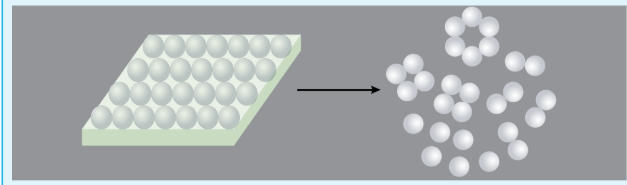
The surface of a catalyst is not smooth. It bears steps, cracks and corners. Hence the atoms on such locations of the surface are co-ordinatively unsaturated. So, they have much residual force of attraction. Such sites are called active centres. So, the surface carries high surface free energy.
The presence of such active centres increases the rate of reaction by adsorbing and activating the reactants.
The adsorption theory explains the following
i. Increase in the surface area of metals and metal oxides by reducing the particle size increases acting of the catalyst and hence the rate of the reaction.
ii. The action of catalytic poison occurs when the poison blocks the active centres of the catalyst.
iii. A promoter or activator increases the number of active centres on the surfaces.
10.3 Enzyme Catalysis#
Enzymes are complex protein molecules with three dimensional structures. They catalyse the chemical reaction in living organism. They are often present in colloidal state and extremely specific in catalytic action. Each enzyme produced in a particular living cell can catalyse a particular reaction in the cell.
Some common examples for enzyme catalysis
The peptide glycyl L-glutamyl L-tyrosin is hydrolysed by an enzyme called pepsin.
The enzyme diastase hydrolyses starch into maltose
- The yeast contains the enzyme zymase which converts glucose into ethanol.
- The enzyme micoderma aceti oxidises alcohol into acetic acid.
- The enzyme urease present in soya beans hydrolyses the urea.
10.3.1 Mechanism of enzyme catalysed reaction#
The following mechanism is proposed for the enzyme catalysis
$$ E + S \rightleftharpoons ES \rightarrow P + E $$Where E is the enzyme, S the substrate (reactant), ES represents activated complex and P the products.
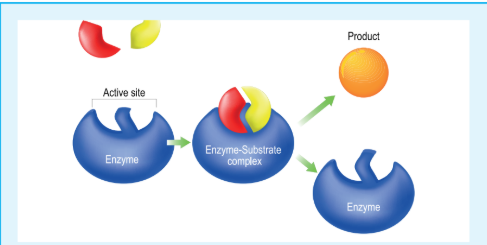
Enzyme catalysed reaction show certain general special characteristics.
(i) Effective and efficient conversion is the special characteristic of enzyme catalysed reactions. An enzyme may transform a million molecules of reactant into product in a minute. For eg. \(2H_2O_2 \rightarrow 2H_2O + O_2\)
For this reaction, the activation energy is 18k cal/mole without a catalyst.
With colloidal platinum as a catalyst the activation energy is 11.7 kcal/mole
But with the enzyme catalyst the activation energy of this reaction is less than 2 kcal/mole.
(ii) Enzyme catalysis is highly specific in nature.
$$ H_2N - CO - NH_2 + H_2O \rightarrow 2NH_3 + CO_2 $$The enzyme urease which catalyses the reaction of urea does not catalyse the following reaction of methyl urea
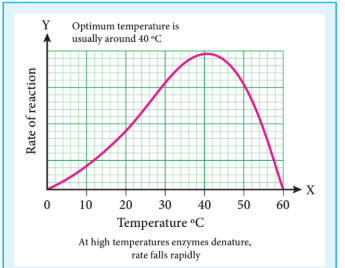
$$ H_2N - CO - NH - CH_3 + H_2O \rightarrow \text{No reaction} $$(3) Enzyme catalyzed reaction has maximum rate at optimum temperature. At first rate of reaction increases with the increase of temperature, but above a particular temperature the activity of enzyme is destroyed. The rate may even drop to zero. The temperature at which enzymic activity is high or maximum is called as optimum temperature.
For example:
Enzymes involved in human body have an optimum temperature \(37^{\circ}C / 98^{\circ}F\).
During high fever, as body temperature rises the enzymatic activity may collapse and lead to danger.
(4) The rate of enzyme catalysed reactions varies with the pH of the system. The rate is maximum at a pH called optimum pH.
(5) Enzymes can be inhibited i.e. poisoned.
Activity of an enzyme is decreased and destroyed by a poison.
The physiological action of drugs is related to their inhibiting action.
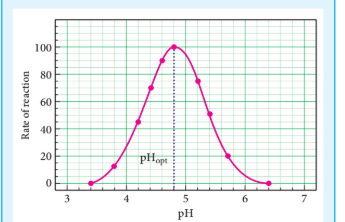
Example: Sulpha drugs. Penicillin inhibits the action of bacteria and used for curing diseases like pneumonia, dysentery, cholera and other infectious diseases.
(6) Catalytic activity of enzymes is increased by coenzymes or activators.
A small non protein (vitamin) called a coenzyme promotes the catalytic activity of enzyme.
10.4 Zeolite Catalysis:#
The details of heterogeneous catalysis will be incomplete, if zeolites are not discussed. Zeolites are microporous, crystalline, hydrated, alumino silicates, made of silicon and aluminium tetrahedron. There are about 50 natural zeolites and 150 synthetic zeolites. As silicon is tetravalent and aluminium is trivalent, the zeolite matrix carries extra negative charge. To balance the negative charge, there are extra framework cations for example, \(H^+\) or \(Na^+\) ions. Zeolites carrying protons are used as solid acid catalysts and they are extensively used in the petrochemical industry for cracking heavy hydrocarbon fractions into gasoline, diesel, etc., Zeolites carrying \(Na^+\) ions are used as basic catalysts.
One of the most important applications of zeolites is their shape selectivity. In zeolites, the active sites namely protons are lying inside their pores. So, reactions occur only inside the pores of zeolites.
Reactant selectivity:
When bulkier molecules in a reactant mixture are prevented from reaching the active sites within the zeolite crystal, this selectivity is called reactant shape selectivity.
Transition state selectivity:
If the transition state of a reaction is large compared to the pore size of the zeolite, then no product will be formed.
Product selectivity:
It is encountered when certain product molecules are too big to diffuse out of the zeolite pores.
Phase Transfer catalysis:
Suppose the reactant of a reaction is present in one solvent and the other reactant is present in another solvent. The reaction between them is very slow, if the solvents are immiscible. As the solvents form separate phases, the reactants have to migrate across the boundary to react. But migration of reactants across the boundary is not easy. For such situations a third solvent is added which is miscible with both. So, the phase boundary is eliminated, reactants freely mix and react fast. But for large scale production of any product, use of a third solvent is not convenient as it may be expensive. For such problems phase transfer catalysis provides a simple solution, which avoids the use of solvents. It directs the use a phase transfer catalyst (a phase transfer reagent) to facilitate transport of a reactant in one solvent to the other solvent where the second reactant is present. As the reactants are now brought together, they rapidly react and form the product.
Example:
Substitution of \(Cl^-\) and \(CN^-\) in the following reaction.
$$ R-Cl + NaCN \rightarrow R-CN + NaCl $$organic phase : aqueous phase : organic phase : aqueous phase
\(R-Cl = 1\)-chlorooctane
\(R-CN = 1\)-cyanooctane
By direct heating of two phase mixture of organic 1-chlorooctane with aqueous sodium cyanide for several days, 1-cyanooctane is not obtained. However, if a small amount of quaternary ammonium salt like tetraalkylammoniumchloride is added, a rapid transition 1-cyanooctane occurs in about \(100\%\) yield after 1 or 2 hours. In this reaction, the tetraalkylammonium cation, which has hydrophobic and hydrophilic ends, transports CN from the aqueous phase to the organic phase using its hydrophilic end and facilitates the reaction with 1-chlorooctane as shown below:
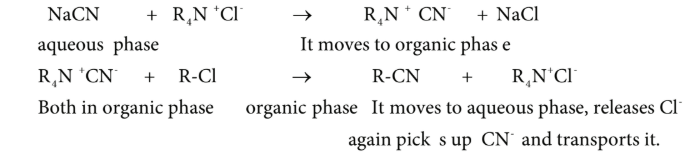
So phase transfer catalyst, speeds up the reaction by transporting one reactant from one phase to another.
Nano Catalysis:
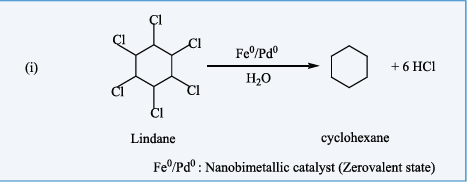
Nano materials such a metallic nano particles, metal oxides, etc., are used as catalyst in many chemical transformation. Nanocatalysts carry the advantages of both homogeneous and heterogeneous catalyses. Like homogeneous catalysts, the nanocatalysts give \(100\%\) selective transformations and excellent yield and show extremely high activity. Like the heterogeneous catalysts, nanocatalysts can be recovered and recycled. Nanocatalysts are actually soluble heterogeneous catalysts. An example for nanoparticles catalysed reaction is given below
10.5 Colloid, Dispersion phase and dispersion medium#
Origin of study of colloid starts with Thomas Graham who observed diffusion of that a solution of sugar, urea or sodium chloride through a membrane but not glue, gelatine or gum. He called the former substances as crystalloids and the latter as colloids (In Greek, kola as gum, eidos- like).
Later it was realised that any substance can be converted into a colloid by reducing its particle size to 1-200 nm.
Hence, colloid is a homogeneous mixture of two substances in which one substance (smaller proportion) is dispersed in another substance (large proportion).
In a colloid, the substance present in larger amount is called dispersing medium and the substance present in less amount is called dispersed phase.
10.5.1 Classifications of Colloidal solution#
Probably the most important colloidal systems have dispersed phase as solid and the dispersion medium as liquid.
If the dispersion medium considered is water, then the colloids are referred as hydrosols or aquasols.
If the dispersion medium is an alcohol, the colloid is termed as alcosol, and if benzene is the dispersion medium, it is called as benzosol.
One more type of classification is based on the forces acting between the dispersal phase and dispersion medium.
In lyophillic colloids definite attractive force or affinity exists between dispersion medium and dispersed phase. Examples: sols of protein and starch. They are more stable and will not get precipitated easily. They can be brought back to colloidal solution even after the precipitation by addition of the dispersion medium.
In a lyophobic colloids, no attractive force exists between the dispersed phase and dispersion medium. They are less stable and precipitated readily, but can not be produced again by just adding the dispersion medium. They themselves undergo coagulation after a span of characteristic life time.
They are called irreversible sols
examples: sols of gold, silver, platinum and copper.
The following table lists the types of colloids based on the physical states of dispersed phase and dispersion medium.
Classification of colloids based on the physical state of dispersed phase and dispersion medium.
| S.No. | Dispersion medium | Dispersed phase | Name of the colloid | Examples |
|---|---|---|---|---|
| 1. | Gas | Liquid | Liquid Aerosol | Fog, Aerosol spray |
| 2. | Gas | Solid | Solid Aerosol | Smoke, Air pollutants like fumes, dust. |
| 3. | Liquid | Gas | Foam | Whipped cream, Shaving cream, Soda water, Froth. |
| 4. | Liquid | Liquid | Emulsion | Milk, Cream, Mayonnaise |
| 5. | Liquid | Solid | Sol | Inks, Paints, colloidal gold. |
| 6. | Solid | Gas | Solid foam | Pumice stone, Foam rubber bread. |
| 7. | Solid | Liquid | Gel | Butter, cheese |
| 8. | Solid | Solid | Solid sol | Pearls, opals, coloured glass alloys, colloidal dispersed eutectics. |
10.5.2 Preparation of Colloids#
Many lyophillic substances are made in their colloidal form by warming with water. Rubber forms colloidal solution with benzene. Soap spontaneously forms a colloidal solution by just mixing with water.
In general, colloidal are prepared by the following methods.
i. Dispersion methods: In this method larger particles are broken to colloidal dimension.
ii. Condensation method: In this method, smaller atom or molecules are converted into larger colloidal sized particles.
1) Dispersion methods
(i) Mechanical Dispersion:
Using a colloid mill, the solid is ground to colloidal dimension. The colloid mill consists of two metal plates rotating in opposite direction at very high speed of nearly 7000 revolution / minute.
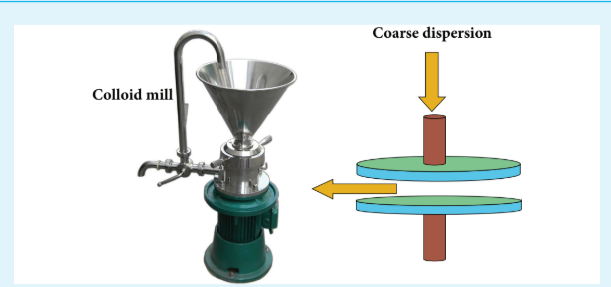
The colloidal particles of required colloidal size is obtained by adjusting the distance between two plates.
By this method, colloidal solutions of ink and graphite are prepared.
(ii) Electro Dispersion:
A brown colloidal solution of platinum was first prepared by George Bredig in 1898. An electrical arc is struck between electrodes dispersed in water surrounded by ice. When a current of 1 amp /100 V is passed an arc produced forms vapours of metal which immediately condense to form colloidal solution. By this method colloidal solution of many metals like copper, silver, gold, platinum, etc. can be prepared. Alkali hydroxide is added as a stabilising agent for the colloidal solution.
Svedberg modified this method for the preparation of non aqueous inflammable liquids like
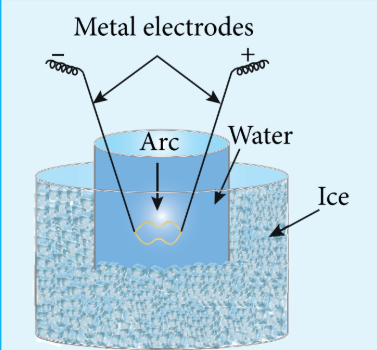
pentane, ether and benzene, etc using high frequency alternating current which prevents the decomposition of liquid.
(iii) Ultrasonic dispersion
Sound waves of frequency more than \(20 \ \mathrm{kHz}\) (audible limit) could cause transformation of coarse suspension to colloidal dimensions.
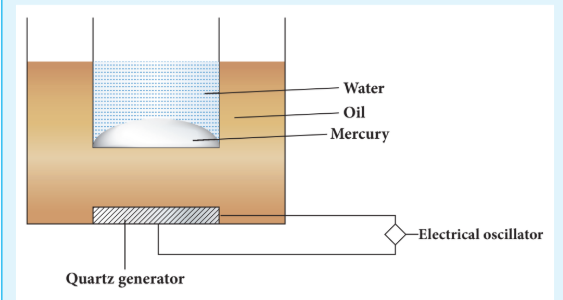
Claus obtained mercury sol by subjecting mercury to sufficiently high frequency ultrasonic vibrations.
The ultrasonic vibrations produced by generator spread the oil and transfer the vibration to the vessel with mercury in water.
(iv) Peptisation:
By addition of suitable electrolytes, precipitated particles can be brought into colloidal state. The process is termed as peptisation and the electrolyte added is called peptising or dispersing agent.
$$\underset{\text{Precipitate}}{\text{AgCl}} \xrightarrow{\text{HCl}} \underset{\text{Colloid}}{\text{AgCl}}$$2) Condensation Methods:
When the substance for colloidal particle is present as small sized particle, molecule or ion, they are brought to the colloidal dimension by condensation methods. Here care should be taken to produce the particle with colloidal size otherwise precipitation will occur. Various chemical methods for the formation of colloidal particles.
(i) Oxidation:
Sols of some non metals are prepared by this method.
(a) When hydroiodic acid is treated with iodic acid, \(I_2\) sol is obtained.
$$ HIO_3 + 5HI \rightarrow 3H_2O + 3I_2 \ (\text{Sol}) $$(b) When \(O_2\) is passed through \(H_2Se\), a sol of selenium is obtained.
$$ 2H_2Se + O_2 \rightarrow 2H_2O + 2Se \ (\text{sol}) $$(ii) Reduction:
Many organic reagents like phenyl hydrazine, formaldehyde, etc are used for the formation of sols. For example: Gold sol is prepared by reduction of auric chloride using formaldehyde.
$$ 2AuCl_3 + 3HCHO + 3H_2O \rightarrow 2Au \ (\text{sol}) + 6HCl + 3HCOOH $$(iii) Hydrolysis
Solts of hydroxides of metals like chromium and aluminium can be produced by this method.
For Example,
$$ FeCl_3 + 3H_2O \rightarrow Fe(OH)_3 + 3HCl $$(iv) Double decomposition
For the preparation of water insoluble sols this method can be used.
When hydrogen sulphide gas is passed through a solution of arsenic oxide, a yellow coloured arsenic sulphide is obtained as a colloidal solution.
$$ As_2O_3 + 3H_2S \rightarrow As_2S_3 + 3H_2O $$(v) Decomposition
When few drops of an acid is added to a dilute solution of sodium thiosulphate, the insoluble free sulphur produced by decomposition of sodium thiosulphate accumulates into small clusters which impart various colours blue, yellow and even red to the system depending on their growth within the size of colloidal dimensions.
$$ S_2O_3^{2-} + 2H^+ \rightarrow S_{\text{sol}} + H_2O + SO_2 $$3) By exchange of solvent:
Colloidal solution of few substances like phosphorous or sulphur is obtained by preparing the solutions in alcohol and pouring them into water. As they are insoluble in water, they form colloidal solution.
$$ P \ \text{in alcohol} + \text{water} \rightarrow P_{\text{sol}} $$10.5.3 Purification of colloids#
The colloidal solutions due to their different methods of preparation may contain impurities. If they are not removed, they may destabilise and precipitate the colloidal solution. This is called coagulation. Hence the impurities mainly electrolytes should be removed to increase the stabilisation of colloid. Purification of colloidal solution can be done by the following methods.
(i) Dialysis (ii) Electrodialysis (iii) Ultrafiltration
(i) Dialysis
In 1861, T. Graham separated the electrolyte from a colloid using a semipermeable membrane (dialyser). In this method, the colloidal solution is taken in a bag made up of semipermeable membrane. It is suspended in a trough of flowing water, the electrolytes diffuse out of the membrane and they are carried away by water.
Do you Know? Kidney malfunction results in the building up of electrolyte concentration within the blood to toxic levels.
In the Dialysis, recycling of patient’s blood is done through considerable length of semipermeable tube in an isotonic saline solution.
(ii) Electrodialysis
The presence of electric field increases the speed of removal of electrolytes from colloidal solution. The colloidal solution containing an electrolyte as impurity is placed between two dialysing membranes enclosed into two compartments filled with water. When current is passed, the impurities pass into water compartment and get removed periodically. This process is faster than dialysis, as the rate of diffusion of electrolytes is increased by the application of electricity.
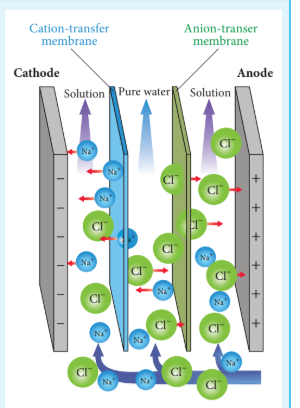
(iii) Ultrafiltration
The pores of ordinary filter papers permit the passage of colloidal solutions. In ultra filtrations, the membranes are made by using collodion cellophane or visiking. When a colloidal solution is filtered using such a filter, colloidal particles are separated on the filter and the impurities are removed as washings. This process is quickened by application of pressure. The separation of sol particles from electrolyte by filteration through an ultrafilter is called ultrafiltration. Collodion is 4% solution of nitrocellulose in a mixture of alcohol and water.
10.5.4 Properties of Colloids#
1) Colour:
The colour of a sol is not always the same as the colour of the substance in the bulk. For example bluish tinge is given by diluted milk in reflected light and reddish tinge in transmitted light.
Colour of the sol, generally depends on the following factors.
(i) Method of preparation
(ii) Wavelength of source of light.
(iii) Size and shape of colloidal particle
(iv) whether the observer views the reflected light or transmitted light.
2) Size:
The size of colloidal particles ranges from \(1 \ \mathrm{nm} \ (10^{-9} \ \mathrm{m})\) to \(1000 \ \mathrm{nm} \ (10^{-6} \ \mathrm{m})\) diameter.
3) Colloidal solutions are heterogeneous in nature having two distinct phases.
Though experiments like dialysis, ultrafiltration and ultracentrifuging clearly show the heterogeneous nature in the recent times colloidal solution are considered as border line cases.
4) Filtrability:
As the size of pores in ordinary filter paper are large the colloidal particles easily pass through the ordinary filter papers.
5) Non-Setting nature
Colloidal solutions are quite stable i.e. they are not affected by gravity.
6) Concentration and density
When the colloidal solution is dilute, it is stable. When the volume of medium is decreased coagulation occurs. Generally, density of sol decreases with decrease in the concentration.
7) Diffusability
Unlike true solution, colloids diffuse less readily through membranes.
8) Colligative properties
The colloidal solutions show colligative properties i.e. elevation of boiling point, depression in freezing point and osmotic pressure. Measurements of osmotic pressure is used to find molecular weight of colloidal particle.
9) Shape of colloidal particles
It is very interesting to know the various shapes of colloidal particles. Here are some examples
| Colloidal Particles | Shapes |
|---|---|
| As₂S₃ | Spherical |
| Fe(OH)₃sol (blue gold sol) | Disc or plate like |
| W₃O₅ sol (tungstic acid sol) | Rod like |
10) Optical property
Colloids have optical property. When a homogeneous solution is seen in the direction of light, it appears clear but it appears dark, in a perpendicular direction.
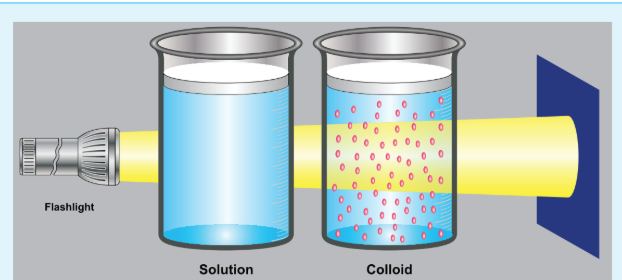
But when light passes through colloidal solution, it is scattered in all directions. This effect was first observed by Faraday, but investigations are made by Tyndall in detail, hence called as Tyndall effect.
The colloidal particles absorb a portion of light and the remaining portion is scattered from the surface of the colloid. Hence the path of light is made clear.
11) Kinetic property
Robert Brown observed that when the pollen grains suspended in water were viewed through ultra microscope, they showed a random, zigzag ceaseless motion.
This is called Brownian movement of colloidal particles.
This can be explained as follows
The colloidal sol particles are continuously bombarded with the molecules of the dispersion medium and hence they follow a zigzag, random, continuous movement.
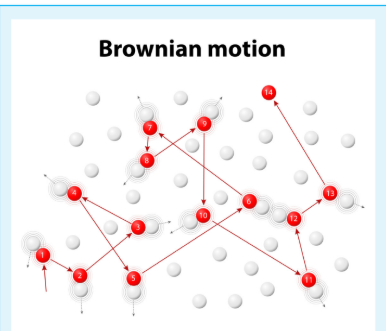
Brownian movement enables us,
I. to calculate Avogadro number.
II. to confirm kinetic theory which considers the ceaseless rapid movement of molecules that increases with increase in temperature.
III. to understand the stability of colloids: As the particles in continuous rapid movement they do not come close and hence not get condensed. That is Brownian movement does not allow the particles to be acted on by force of gravity.
12) Electrical property
(1) Helmholtz double layer
The surface of colloidal particle adsorbs one type of ion due to preferential adsorption. This layer attracts the oppositely charged ions in the medium and hence at the boundary separating the two electrical double layers are setup. This is called as Helmholtz electrical double layer.
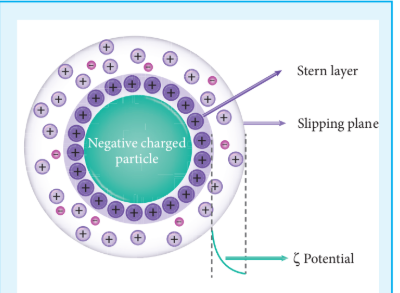
As the particles nearby are having similar charges, they cannot come close and condense. Hence this helps to explain the stability of a colloid.
(ii) Electrophoresis:
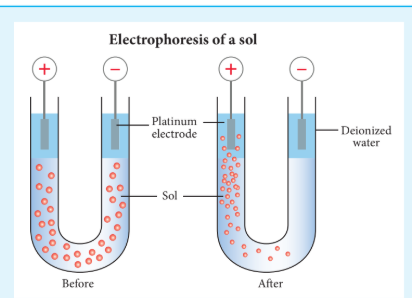
When electric potential is applied across two platinum electrodes dipped in a hydrophilic sol, the dispersed particles move toward one or other electrode.
This migration of sol particles under the influence of electric field is called electrophoresis or cataphoresis. If the sol particles migrate to the cathode, then they possess positive \((+)\) charges, and if the sol particles migrate to the anode then they have negative charges \((-)\). Thus from the direction of migration of sol particles we can determine the charge of the sol particles. Hence electrophoresis is used for detection of presence of charges on the sol particles.
| Positively charged colloids | Negatively charged colloids |
|---|---|
| Ferric hydroxide | Ag, Au & Pt |
| Aluminium hydroxide | Arsenic sulphide |
| Basic dyes | Clay |
| Haemoglobin | Starch |
(iii) Electro osmosis
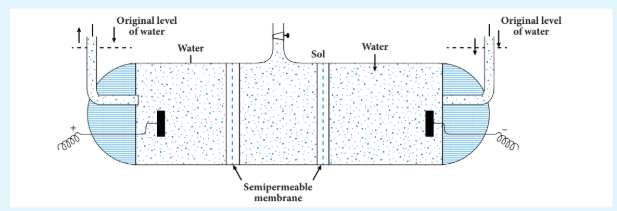
A sol is electrically neutral. Hence the medium carries an equal but opposite charge to that of dispersed particles. When sol particles are prevented from moving, under the influence of electric field the medium moves in a direction opposite to that of the sol particles. This movement of dispersion medium under the influence of electric potential is called electro osmosis.
13. Coagulation or precipitation
The flocculation and settling down of the sol particles is called coagulation.
Various method of coagulation are given below:
(i) Addition of electrolytes
(ii) Electrophoresis
(iii) Mixing oppositely charged sols.
(iv) Boiling
(1) Addition of electrolytes
A negative ion causes the precipitation of positively charged sol and vice versa.
When the valency of ion is high, the precipitation power is increased. For example, the precipitation power of some cations and anions varies in the following order
$$ Al^{3+} > Ba^{2+} > Na^+, \quad \text{Similarly} \ [Fe(CN)_6]^{3-} > SO_4^{2-} > Cl^- $$The precipitation power of electrolyte is determined by finding the minimum concentration (millimoles/lit) required to cause precipitation of a sol in 2 hours. This value is called flocculation value. The smaller the flocculation value greater will be precipitation.
(ii) Electrophoresis:
In the electrophoresis, charged particles migrate to the electrode of opposite sign. It is due to neutralization of the charge of the colloids. The particles are discharged and so they get precipitated.
(iii) By mixing two oppositely charged sols
When colloidal sols with opposite charges are mixed mutual coagulation takes place. It is due to migration of ions from the surface of the particles.
(iv) By boiling
When boiled due to increased collisions, the sol particles combine and settle down.
14. Protective action
Generally, lyophobic sols are precipitated readily even with small amount of electrolytes. But they are stabilised by addition of a small amount of lyophillic colloid.
A small amount of gelatine sol is added to gold sol to protect the gold sol.
| Colloid | Gold number |
|---|---|
| Gelatin | 0.005-0.01 |
| Egg albumin | 0.08-0.10 |
| Gum Arabic | 0.1-0.15 |
| Potato starch | 25 |
Zsigmondy introduced the term ‘gold number’ as a measure of protecting power of a colloid. Gold number is defined as the number of milligrams of hydrophilic colloid that will just prevent the precipitation of \(10 \ \mathrm{ml}\) of gold sol on the addition of \(1 \ \mathrm{ml}\) of \(10\%\) NaCl solution. Smaller the gold number greater the protective power.
10.6 Emulsions#
Emulsions are colloidal solution in which a liquid is dispersed in another liquid. Generally there are two types of emulsions.
(i) Oil in water (O/W) (ii) Water in oil (W/O)
Example:
Milk is example of the oil in water type emulsion.
Stiff greases are emulsion of water in oil i.e. water dispersed in lubricating oil.
The process of preparation of emulsion by the dispersal of one liquid in another liquid is called Emulsification.
A colloid mill can be used as a homogeniser to mix the two liquid. To have a stable emulsion a small amount of emulsifier or emulsification agent is added.
Several types of emulsifiers are known.
i. Most of the lyophillic colloids also act as emulsifiers. Example: glue, gelatine.
ii. Long chain compounds with polar groups like soap and sulphonic acids.
iii. Insoluble powders like clay and lamp black also act as emulsifiers.
Identification of types of emulsion
The two types of emulsions can be identified by the following tests.
(i) Dye test:
A small amount of dye soluble in oil is added to the emulsion. The emulsion is shaken well. The aqueous emulsion will not take the colour whereas oily emulsion will take up the colour of the dye.
(ii) Viscosity test
Viscosity of the emulsion is determined by experiments. Oily emulsions will have higher value than aqueous emulsion.
(iii) Conductivity test
Conductivity of aqueous emulsions are always higher than oily emulsions.
(iv) Spreading test
Oily emulsions spread readily than aqueous emulsion when spread on an oily surface.
10.5.1 Deemulsification:
Emulsion can be separated into two separate layers. The process is called Deemulsification.
Various deemulsification techniques are given below
- Distilling of one component
- Adding an electrolyte to destroy the charge.
- Destroying the emulsifier using chemical methods.
- Using solvent extraction to remove one component.
- By freezing one of the components.
- By applying centrifugal force.
- Adding dehydrating agents for water in oil (W/O) type.
- Using ultrasonic waves.
- Heating at high pressures.
Inversion of Phase:
The change of W/O emulsion into O/W emulsion is called inversion of phases.
For example:
An oil in water emulsion containing potassium soap as emulsifying agent can be converted into water in oil emulsion by adding \(CaCl_2\) or \(AlCl_3\). The mechanism of inversion is in the recent developments of research.
10.7 Various application of colloids#
In every path of life, colloids play a great role. Human body contains the numerous colloidal solutions. The blood in our body, protoplasma of plant and animal cell, and fats in our intestines are in the form of emulsions. Synthetic polymers like polystyrene silicons and PVC are colloids.
Food
Food stuffs like milk cream, butter, etc are present in colloidal form.
Medicines
Antibodies such as penicillin and streptomycin are produced in colloidal form for suitable injections. Colloidal gold and colloidal calcium are used as tonics. Milk of magnesia is used for stomach troubles. Silver sol protected by gelatine known as Argyrol is used as eye lotion.
In Industry
Colloids find many applications in industries.
(i) Water purification:
Purification of drinking water is activated by coagulation of suspended impurities in water using alums containing \(Al^{3+}\)
(ii) In washing:
The cleansing action of soap is due to the formation of emulsion of soap molecules with dirt and grease.
(iii) Tanning of leather
Skin and hides are protein containing positively charged particles which are coagulated by adding tannin to give hardened leather for further application. Chromium salts are used for the purpose. Chrome tanning can produce soft and polishable leather.
(iv) Rubber industry:
Latex is the emulsion of natural rubber with negative particles. By heating rubber with sulphur, vulcanized rubbers are produced for tyres, tubes, etc.
(v) Sewage disposal
Sewage contains dirt, mud and wastes dispersed in water. The passage of electric current deposits the wastes materials which can be used as a manure.
Carbon dust in air is solidified by cortrell’s precipitator. In it, a high potential difference of about 50,000V is used. The charge on carbon is neutralized and solidified. Thus the air is free from carbon particles.
(vii) The blue colour of the sky in nature is due to Tyndall effect of air particles.
(viii) Formation of delta:
The electrolyte in sea and river water coagulates the solid particles in river water at their intersection. So, the earth becomes a fertile land.
(ix) Analytical application
Qualitative and quantitative analysis are based on the various properties of colloids.
Hence we can conclude that in our life, there is hardly any field which is not including the applications of colloids.
Do you know Natural honey is a colloidal sol. It is distinguished from artificial one by adding ammoniacal AgNO3 In case of natural honey a metallic silver is produced, assumes a reddish yellow color due to traces of albumin or ethereal oil which acts as a protective colloid. In case of artificial honey a dark yellow or greenish yellow precipitate is formed.
EVALUATION#
Choose the correct answer:
(1) For Freundlich isotherm a graph of $\log \frac{x}{m}$ is plotted against $\log p$. The slope of the line and its y – axis intercept respectively corresponds to
a) $\frac{1}{n}, k$
b) $\log \frac{1}{n}, k$
c) $\frac{1}{n}, \log k$
d) $\log \frac{1}{n}, \log k$
(2) Which of the following is incorrect for physisorption?
a) reversible
b) increases with increase in temperature
c) low heat of adsorption
d) increases with increase in surface area
(3) Which one of the following characteristics are associated with adsorption? (NEET)
a) $\Delta G$ and $\Delta H$ are negative but $\Delta S$ is positive
b) $\Delta G$ and $\Delta S$ are negative but $\Delta H$ is positive
c) $\Delta G$ is negative but $\Delta H$ and $\Delta S$ are positive
d) $\Delta G$, $\Delta H$ and $\Delta S$ all are negative
(4) Fog is colloidal solution of
a) solid in gas
b) gas in gas
c) liquid in gas
d) gas in liquid
(5) Assertion : Coagulation power of $\text{Al}^{3+}$ is more than $\text{Na}^+$.
Reason : greater the valency of the flocculating ion added, greater is its power to cause precipitation
a) if both assertion and reason are true and reason is the correct explanation of assertion.
b) if both assertion and reason are true but reason is not the correct explanation of assertion.
c) assertion is true but reason is false
d) both assertion and reason are false.
(6) Statement : To stop bleeding from an injury, ferric chloride can be applied. Which comment about the statement is justified? a) It is not true, ferric chloride is a poison.
b) It is true, $\text{Fe}^{3+}$ ions coagulate blood which is a negatively charged sol
c) It is not true; ferric chloride is ionic and gets into the blood stream.
d) It is true, coagulation takes place because of formation of negatively charged sol with $\text{Cl}^-$.
(7) Hair cream is
a) gel b) emulsion c) solid sol d) sol.
(8) Which one of the following is correctly matched?
| a) Emulsion | – Smoke |
| b) Gel | – butter |
| c) foam | – Mist |
| d) whipped cream | – sol |
(9) The most effective electrolyte for the coagulation of $\text{As}_2\text{S}_3$ Sol is
a) $\text{NaCl}$ b) $\text{Ba(NO}_3)_2$ c) $\text{K}_3[\text{Fe(CN)}_6]$ d) $\text{Al}_2(\text{SO}_4)_3$
(10) Which one of the is not a surfactant?
a)
$$\text{CH}_3\text{—(CH}_2)_{15}\text{—}\overset{+}{\text{N}}(\text{CH}_3)_2\text{CH}_2\text{Br}$$b)
$$\text{CH}_3\text{—(CH}_2)_{15}\text{—NH}_2$$c)
$$\text{CH}_3\text{—(CH}_2)_{16}\text{—CH}_2\text{OSO}_3^-\text{Na}^+$$d)
$$\text{OHC—(CH}_2)_{14}\text{—CH}_2\text{—COO}^-\text{Na}^+$$(11) The phenomenon observed when a beam of light is passed through a colloidal solution is
a) Cataphoresis b) Electrophoresis c) Coagulation d) Tyndall effect
(12) In an electrical field, the particles of a colloidal system move towards cathode. The coagulation of the same sol is studied using $\text{K}_2\text{SO}_4\text{(i)}$, $\text{Na}_3\text{PO}_4\text{(ii)}$, $\text{K}_4[\text{Fe(CN)}_6]\ \text{(iii)}$ and $\text{NaCl (iv)}$ Their coagulating power should be
a) $\text{II} > \text{I} > \text{IV} > \text{III}$ b) $\text{III} > \text{II} > \text{I} > \text{IV}$ c) $\text{I} > \text{II} > \text{III} > \text{IV}$ d) none of these
(13) Collodion is a 4% solution of which one of the following compounds in alcohol – ether mixture?
a) Nitroglycerine b) Cellulose acetate c) Glycoldinitrate d) Nitrocellulose
(14) Which one of the following is an example for homogeneous catalysis?
a) manufacture of ammonia by Haber’s process b) manufacture of sulphuric acid by contact process c) hydrogenation of oil d) Hydrolysis of sucrose in presence of dil $\text{HCl}$
(15) Match the following
| A) $\text{V}_2\text{O}_5$ | i) High density polyethylene |
| B) Ziegler – Natta | ii) PAN |
| C) Peroxide | iii) $\text{NH}_3$ |
| D) Finely divided $\text{Fe}$ | iv) $\text{H}_2\text{SO}_4$ |
(16) The coagulation values in millimoles per litre of the electrolytes used for the coagulation of $\text{As}_2\text{S}_3$ are given below $\text{(I) (NaCl)} = 52 \qquad \text{(II) (BaCl}_2) = 0.69 \qquad \text{(III) (MgSO}_4) = 0.22$ The correct order of their coagulating power is
a) $\text{III} > \text{II} > \text{I}$ b) $\text{I} > \text{II} > \text{III}$ c) $\text{I} > \text{III} > \text{II}$ d) $\text{II} > \text{III} > \text{I}$
(17) Adsorption of a gas on solid metal surface is spontaneous and exothermic, then
a) $\Delta H$ increases b) $\Delta S$ increases c) $\Delta G$ increases d) $\Delta S$ decreases
(18) If $x$ is the amount of adsorbate and $m$ is the amount of adsorbent, which of the following relations is not related to adsorption process?
a) $\frac{x}{m} = f(\text{P})$ at constant T b) $\frac{x}{m} = f(\text{T})$ at constant P c) $\text{P} = f(\text{T})$ at constant $\frac{x}{m}$ d) $\frac{x}{m} = \text{PT}$
(19) On which of the following properties does the coagulating power of an ion depend ? (NEET – 2018)
a) Both magnitude and sign of the charge on the ion. b) Size of the ion alone c) the magnitude of the charge on the ion alone d) the sign of charge on the ion alone.
(20) Match the following
| A) Pure nitrogen | i) Chlorine |
| B) Haber process | ii) Sulphuric acid |
| C) Contact process | iii) Ammonia |
| D) Deacons Process | iv) sodium azide (or) Barium azide |
Which of the following is the correct option?
$$\begin{array}{ccccc} & \text{A} & \text{B} & \text{C} & \text{D} \\ \text{a)} & \text{(i)} & \text{(ii)} & \text{(iii)} & \text{(iv)} \\ \text{b)} & \text{(ii)} & \text{(iv)} & \text{(i)} & \text{(iii)} \\ \text{c)} & \text{(iii)} & \text{(iv)} & \text{(ii)} & \text{(i)} \\ \text{d)} & \text{(iv)} & \text{(iii)} & \text{(ii)} & \text{(i)} \end{array}$$
Short Answer
Give two important characteristics of physisorption
Differentiate physisorption and chemisorption
In case of chemisorption, why adsorption first increases and then decreases with temperature?
Which will be adsorbed more readily on the surface of charcoal and why? $\text{NH}_3$
Heat of adsorption is greater for chemisorptions than physisorption. Why?
Peptising agent is added to convert precipitate into colloidal solution. Explain with an example
What happens when a colloidal sol of $\text{Fe(OH)}_3$ and $\text{As}_2\text{S}_3$ are mixed?
What is the difference between a sol and a gel?
Why are lyophillic colloidal sols are more stable than lyophobic colloidal sol.
Addition of Alum purifies water. Why?
What are the factors which influence the adsorption of a gas on a solid?
What are enzymes? Write a brief note on the mechanism of enzyme catalysis.
What do you mean by activity and selectivity of catalyst?
Describe some feature of catalysis by Zeolites.
Give three uses of emulsions
Why does bleeding stop by rubbing moist alum
Why is desorption important for a substance to act as good catalyst?
Comment on the statement: Colloid is not a substance but it is a state of substance.
Explain any one method for coagulation
Write a note on electro osmosis
Write a note on catalytic poison
Explain intermediate compound formation theory of catalysis with an example
What is the difference between homogenous and hetrogenous catalysis?
What is the difference between homogenous and hetrogenous catalysis?