The primary objective of differential calculus is to partition something into smaller parts (infinitesimal parts), in order to determine how it changes. For this reason today’s differential calculus was earlier named as infinitesimal calculus. Applications of differential calculus to problems in physics and astronomy was contemporary with the origin of science. All through the $18^{\mathrm{th}}$ century these applications were multiplied until Laplace and Lagrange, towards the end of the 18th century, had brought the whole range of the study of forces into the realm of analysis.
The development of applications of differentiation are also due to Lejeune Dirichlet, Riemann, von Neumann, Heine, Kronecker, Lipschitz, Christoffel, Kirchhoff, Beltrami, and many of the leading physicists of the century.
Differential calculus has applications in geometry and dynamics. Derivatives of function, representing cost, strength, materials in a process, profit, etc., are used to determine the monotonicity of functions and there by to determine the extreme values of the quantities represented by those functions. Derivatives of a function do find a prominent place in many of the modelling problems in engineering and sciences. Differential calculus has applications in social sciences and medical sciences too.
Using just the first two derivatives of a function $f(x)$, in this chapter, the nature of the function, sketching of curve $y = f(x)$, and local extrema (maxima or minima) of $f(x)$ are determined. Further, using certain higher derivatives of $f(x)$ (if they exist), series expansion of $f(x)$ about a point are also discussed.
Learning Objectives
Upon completion of this chapter, students will be able to
apply derivatives to geometrical problems
use derivatives to physical problems
identify the nature of curves like monotonicity, convexity, and concavity
model real time problems for computing the extreme values using derivatives
trace the curves for polynomials and other functions.
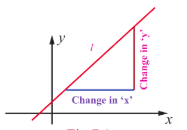
Slope or Gradient of a line: Let $l$ be any given non vertical line as in the Fig. 7.1. Taking a finite horizontal line segment of any length with the starting point in the given line $l$ and the vertical line segment starting from the end of the horizontal line to touch the given line. It can be observed that the ratio of the vertical length to the horizontal length is always a constant. This ratio is called the slope of the line $l$ and it is denoted as $m$.
The slope can be used as a measure to determine the increasing or decreasing nature of a line. The line is said to be increasing or decreasing according as $m > 0$ or $m < 0$ respectively. When $m = 0$, the value of $y$ does not change. Recall that $y = mx + c$ represents a straight line in the $XY$ plane where $m$ denotes the slope of the line.
Fig. 7.1
Slope or Gradient of a curve: Let $y = f(x)$ be a given curve. The slope of the line joining the two distinct points $(x,f(x))$ and the point $(x + h,f(x + h))$ is
$$
\lim_{h\to 0}\frac{f(x + h) - f(x)}{h} = f^{\prime}(x), \quad (\text{limit of Newton quotient}) \quad (2)
$$
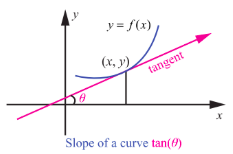
which is the slope of the curve at the point $(x,y)$ or $(x,f(x))$.
Remark
If $\theta$ is the angle made by the tangent to the curve $y = f(x)$ at the point $(x,y)$, then the slope of the curve at $(x,y)$ is $f^{\prime}(x) = \tan \theta$, where $\theta$ is measured in the anti-clockwise direction from the $X$-axis. Note that, $f^{\prime}(x)$ is also denoted by $\frac{dy}{dx}$ and also called instantaneous rate of change. The average rate of change in an interval is calculated using Newton quotient.
Fig. 7.2
Example 7.1
For the function $f(x) = x^{2}, x \in [0,2]$ compute the average rate of changes in the subintervals $[0,0.5]$, $[0.5,1]$, $[1,1.5]$, $[1.5,2]$ and the instantaneous rate of changes at the points $x = 0.5, 1, 1.5, 2$.
Solution
The average rate of change in an interval $[a,b]$ is $\frac{f(b) - f(a)}{b - a}$ whereas, the instantaneous rate of change at a point $x$ is $f^{\prime}(x)$ for the given function. They are respectively, $b + a$ and $2x$.
We have seen how the derivative is used to determine slope. The derivative can also be used to determine the rate of change of one variable with respect to another. A few examples are population growth rates, production rates, water flow rates, velocity, and acceleration.
A common use of rate of change is to describe the motion of an object moving in a straight line. In such problems, it is customary to use either a horizontal or a vertical line with a designated origin to represent the line of motion. On such lines, movements in the forward direction considered to be in the positive direction and movements in the backward direction is considered to be in the negative direction.
The function $s(t)$ that gives the position (relative to the origin) of an object as a function of time $t$ is called a position function. It is denoted by $s = f(t)$. The velocity and the acceleration at time $t$ is denoted as $v(t) = \frac{ds}{dt}$, and $a(t) = \frac{dv}{dt} = \frac{d^2s}{dt^2}$.
Remark
The following remarks are easy to observe:
(1) Speed is the absolute value of velocity regardless of direction and hence,
When the particle is moving forward then $v(t) > 0$.
When the particle is moving backward then $v(t) < 0$.
When the particle changes direction, $v(t)$ then changes its sign.
(3) If $t_{c}$ is the time point between the time points $t_{1}$ and $t_{2}$ $(t_{1} < t_{c} < t_{2})$ where the particle changes direction then the total distance travelled from time $t_{1}$ to time $t_{2}$ is calculated as
(4) Near the surface of the planet Earth, all bodies fall with the same constant acceleration. When air resistance is absent or insignificant and only force acting on a falling body is the force of gravity, we call the way the body falls is a free fall.
An object thrown at time $t = 0$ from initial height $s_0$ with initial velocity $v_0$ satisfies the equation.
A few examples of quantities which are the rates of change with respect to some other quantity in our daily life are given below:
Slope is the rate of change in vertical length with respect to horizontal length.
Velocity is the rate of displacement with respect to time.
Acceleration is the rate of change in velocity with respect to time.
The steepness of a hillside is the rate of change in its elevation with respect to linear distance.
Consider the following two situations:
A person is continuously driving a car from Chennai to Dharmapuri. The distance (measured in kilometre) travelled is expressed as a function of time (measured in hours) by $D(t)$. What is the meaning one can attribute to $D'(3) = 70$?
It means that, “the rate of distance when $t = 3$ is 70 kmph”.
A water source is draining with respect to the time $t$. The amount of water so drained after $t$ days is expressed as $V(t)$. What is the meaning of the slope of the tangent to the curve $y = V(t)$ at $t = 7$ is $-3$?
It means that, “the water is draining at the rate of 3 units per day on day 7”.
Likewise the rate of change concept can be used in our daily life problems. Let us now illustrate this with more examples.
Example 7.2
The temperature $T$ in celsius in a long rod of length $10\mathrm{m}$, insulated at both ends, is a function of length $x$ given by $T = x(10 - x)$. Prove that the rate of change of temperature at the midpoint of the rod is zero.
Solution
We are given that, $T = 10x - x^2$. Hence, the rate of change at any distance from one end is given by $\frac{dT}{dx} = 10 - 2x$. The mid point of the rod is at $x = 5$. Substituting $x = 5$, we get $\frac{dT}{dx} = 0$.
Example 7.3
A person learnt 100 words for an English test. The number of words the person remembers in $t$ days after learning is given by $W(t) = 100 \times (1 - 0.1t)^2$ , $0 \leq t \leq 10$ . What is the rate at which the person forgets the words 2 days after learning?
That is, the person forgets at the rate of 16 words after 2 days of studying.
Example 7.4
The distance travelled by a moving particle in time $t$ is given by $s(t) = \frac{t^3}{3} - t^2 + 3$. Find the time when the velocity and acceleration are zero.
Solution
Distance moved in time $t$ is $s = \frac{t^{3}}{3} - t^{2} + 3$.
Velocity at time $t$ is $v(t) = \frac{ds}{dt} = t^{2} - 2t$.
Acceleration at time $t$ is $a(t) = \frac{dv}{dt} = 2t - 2$.
Therefore, the velocity is zero when $t^2 - 2t = 0$, that is $t = 0, 2$. The acceleration is zero when $2t - 2 = 0$. That is at time $t = 1$.
Example 7.5
A particle is fired straight up from the ground to reach a height of $s$ feet in $t$ seconds, where $s(t) = 128t - 16t^2$.
(i) Compute the maximum height of the particle reached.
(ii) What is the velocity when the particle hits the ground?
Solution
(i) At the maximum height, the velocity $v(t)$ of the particle is zero.
Now, we find the velocity of the particle at time $t$.
At $t = 4$ seconds, the particle reaches the maximum height.
The height at $t = 4$ is $s(4) = 128(4) - 16(4)^2 = 256$ ft.
(ii) When the particle hits the ground then $s = 0$.
$$
s = 0 \Rightarrow 128t - 16t^2 = 0
$$$$
\Rightarrow t = 0, 8 \text{ seconds}.
$$
The particle hits the ground at $t = 8$ seconds. The velocity when it hits the ground is $v(8) = -128$ ft/s.
Example 7.6
A particle moves along a horizontal line such that its position at any time $t \geq 0$ is given by $s(t) = t^3 - 6t^2 + 9t + 1$, where $s$ is measured in metres and $t$ in seconds.
(i) At what time the particle is at rest?
(ii) At what time the particle changes its direction?
(iii) Find the total distance travelled by the particle in the first 2 seconds.
Solution
Given that $s(t) = t^3 - 6t^2 + 9t + 1$. On differentiating, we get $v(t) = 3t^2 - 12t + 9$ and $a(t) = 6t - 12$.
(i) The particle is at rest when $v(t) = 0$. Therefore, $v(t) = 3(t - 1)(t - 3) = 0$ gives $t = 1$ and $t = 3$.
(ii) The particle changes its direction when $v(t)$ changes its sign. Now,
if $0 \leq t < 1$ then both $(t - 1)$ and $(t - 3) < 0$ and hence, $v(t) > 0$
if $1 < t < 3$ then $(t - 1) > 0$ and $(t - 3) < 0$ and hence, $v(t) < 0$
if $t > 3$ then both $(t - 1)$ and $(t - 3) > 0$ and hence, $v(t) > 0$
Therefore, the particle changes its direction when $t = 1$ and $t = 3$.
(iii) The total distance travelled by the particle from time $t = 0$ to $t = 2$ is given by,
$|s(0) - s(1)| + |s(1) - s(2)| = |1 - 5| + |5 - 3| = 6$ metres.
A related rates problem is a problem which involves at least two changing quantities and asks you to figure out the rate at which one is changing given sufficient information on all of the others. For instance, when two vehicles drive in different directions we should be able to deduce the speed at which they are separating if we know their individual speeds and directions.
Example 7.7
If we blow air into a balloon of spherical shape at a rate of $1000\mathrm{cm}^3$ per second, at what rate the radius of the balloon changes when the radius is $7\mathrm{cm}$? Also compute the rate at which the surface area changes.
Solution
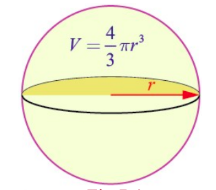
The volume of the balloon of radius $r$ is $V = \frac{4}{3}\pi r^3$.
We are given $\frac{dV}{dt} = 1000$ and we need to find $\frac{dr}{dt}$ when $r = 7$.
Now,
$$
\frac{dV}{dt} = 4\pi r^2 \frac{dr}{dt}.
$$
Substituting $r = 7$ and $\frac{dV}{dt} = 1000$, we get $1000 = 4\pi \times 49 \times \frac{dr}{dt}$.
Therefore, the rate of change of radius is $\frac{250}{49\pi}$ cm/sec and the rate of change of surface area is $\frac{2000}{7}$ cm²/sec.
Example 7.8
The price of a product is related to the number of units available (supply) by the equation $P x + 3P - 16x = 234$, where $P$ is the price of the product per unit in Rupees (₹) and $x$ is the number of units. Find the rate at which the price is changing with respect to time when 90 units are available and the supply is increasing at a rate of 15 units/week.
That is the price is changing, in fact decreasing at the rate of 0.32 per week.
Example 7.9
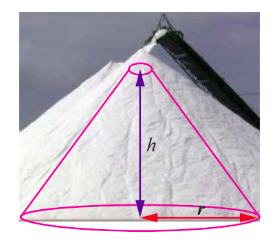
Salt is poured from a conveyor belt at a rate of 30 cubic metre per minute forming a conical pile with a circular base whose height and diameter of base are always equal. How fast is the height of the pile increasing when the pile is 10 metre high?
Solution
Let $h$ and $r$ be the height and the base radius. Therefore $h = 2r$. Let $V$ be the volume of the salt cone.
$$
V = \frac{1}{3}\pi r^2 h = \frac{1}{12}\pi h^3; \quad \frac{dV}{dt} = 30 \text{ m}^3/\text{min}.
$$
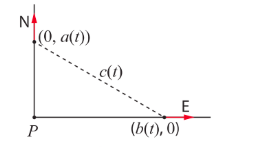
A road running north to south crosses a road going east to west at the point $P$. Car $A$ is driving north along the first road, and car $B$ is driving east along the second road. At a particular time car $A$ is 10 kilometres to the north of $P$ and traveling at $80 \text{ km/hr}$, while car $B$ is 15 kilometres to the east of $P$ and traveling at $100 \text{ km/hr}$. How fast is the distance between the two cars changing?
Solution
Let $a(t)$ be the distance of car $A$ north of $P$ at time $t$, and $b(t)$ the distance of car $B$ east of $P$ at time $t$, and let $c(t)$ be the distance from car $A$ to car $B$ at time $t$. By the Pythagorean Theorem, $c(t)^2 = a(t)^2 + b(t)^2$.
Taking derivatives, we get $2c(t)c'(t) = 2a(t)a'(t) + 2b(t)b'(t)$.
A particle moves along a straight line in such a way that after $t$ seconds its distance from the origin is $s = 2t^2 + 3t$ metres.
(i) Find the average velocity between $t = 3$ and $t = 6$ seconds.
(ii) Find the instantaneous velocities at $t = 3$ and $t = 6$ seconds.
A camera is accidentally knocked off an edge of a cliff 400 ft high. The camera falls a distance of $s = 16t^2$ in $t$ seconds.
(i) How long does the camera fall before it hits the ground?
(ii) What is the average velocity with which the camera falls during the last 2 seconds?
(iii) What is the instantaneous velocity of the camera when it hits the ground?
A particle moves along a line according to the law $s(t) = 2t^3 - 9t^2 + 12t - 4$, where $t \geq 0$.
(i) At what times the particle changes direction?
(ii) Find the total distance travelled by the particle in the first 4 seconds.
(iii) Find the particle’s acceleration each time the velocity is zero.
If the volume of a cube of side length $x$ is $v = x^3$. Find the rate of change of the volume with respect to $x$ when $x = 5$ units.
If the mass $m(x)$ (in kilograms) of a thin rod of length $x$ (in metres) is given by, $m(x) = \sqrt{3x}$ then what is the rate of change of mass with respect to the length when it is $x = 3$ and $x = 27$ metres.
A stone is dropped into a pond causing ripples in the form of concentric circles. The radius $r$ of the outer ripple is increasing at a constant rate at $2 \text{ cm}$ per second. When the radius is $5 \text{ cm}$ find the rate of changing of the total area of the disturbed water.
A beacon makes one revolution every 10 seconds. It is located on a ship which is anchored $5 \text{ km}$ from a straight shore line. How fast is the beam moving along the shore line when it makes an angle of $45^{\circ}$ with the shore?
A conical water tank with vertex down of 12 metres height has a radius of 5 metres at the top. If water flows into the tank at a rate 10 cubic m/min, how fast is the depth of the water increases when the water is 8 metres deep?
A ladder 17 metre long is leaning against the wall. The base of the ladder is pulled away from the wall at a rate of $5 \text{ m/s}$. When the base of the ladder is 8 metres from the wall,
(i) how fast is the top of the ladder moving down the wall?
(ii) at what rate, the area of the triangle formed by the ladder, wall, and the floor, is changing?
A police jeep, approaching an orthogonal intersection from the northern direction, is chasing a speeding car that has turned and moving straight east. When the jeep is $0.6 \text{ km}$ north of the intersection and the car is $0.8 \text{ km}$ to the east. The police determine with a radar that the distance between them and the car is increasing at $20 \text{ km/hr}$. If the jeep is moving at $60 \text{ km/hr}$ at the instant of measurement, what is the speed of the car?
According to Leibniz, tangent is the line through a pair of very close points on the curve.
Definition 7.1
The tangent line (or simply tangent) to a plane curve at a given point is the straight line that just touches the curve at that point.
Definition 7.2
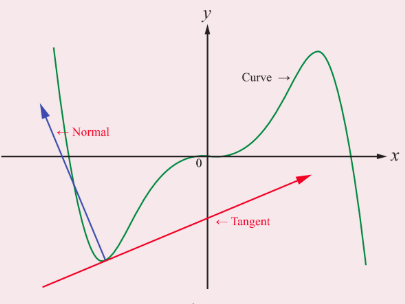
The normal at a point on the curve is the straight line which is perpendicular to the tangent at that point.
The tangent and the normal of a curve at a point are illustrated in Fig. 7.7.
Fig. 7.7
Consider the given curve $y = f(x)$.
The equation of the tangent to the curve at the point, say $(a,b)$, is given by
$$
y - b = (x - a) \left(\frac{dy}{dx}\right)_{(a,b)} \quad \text{or} \quad y - b = f^{\prime}(a) (x - a).
$$
In order to get the equation of the normal to the same curve at the same point, we observe that normal is perpendicular to the tangent at the point. Therefore, the slope of the normal at $(a,b)$ is the negative of the reciprocal of the slope of the tangent which is $-\left(\frac{1}{\frac{dy}{dx}}\right)_{(a,b)}$.
Hence, the equation of the normal is,
$$
(y - b) = -\left(\frac{1}{\frac{dy}{dx}}\right)_{(a,b)} (x - a) \quad \text{or} \quad (y - b) \left(\frac{dy}{dx}\right)_{(a,b)} = -(x - a).
$$
Remark
(i) If the tangent to a curve is horizontal at a point, then the derivative at that point is 0. Hence, at that point $(x_{1},y_{1})$ the equation of the tangent is $y = y_{1}$ and equation of the normal is $x = x_{1}$.
(ii) If the tangent to a curve is vertical at a point, then the derivative exists and infinite $(\infty)$ at the point. Hence, at that point $(x_{1},y_{1})$ the equation of the tangent is $x = x_{1}$ and the equation of the normal is $y = y_{1}$.
Example 7.11
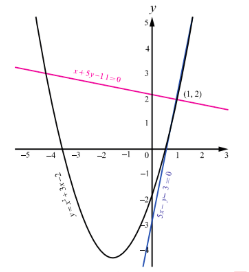
Find the equations of tangent and normal to the curve $y = x^{2} + 3x - 2$ at the point $(1,2)$.
Solution
We have, $\frac{dy}{dx} = 2x + 3$. Hence at $(1,2)$, $\frac{dy}{dx} = 5$.
Find the points on the curve $y = x^{3} - 3x^{2} + x - 2$ at which the tangent is parallel to the line $y = x$.
Solution
The slope of the line $y = x$ is 1. The tangent to the given curve will be parallel to the line, if the slope of the tangent to the curve at a point is also 1. Hence,
$$
\frac{dy}{dx} = 3x^{2} - 6x + 1 = 1
$$
which gives $3x^{2} - 6x = 0$.
Hence, $x = 0$ and $x = 2$.
Therefore, at $(0, -2)$ and $(2, -4)$ the tangent is parallel to the line $y = x$.
Example 7.13
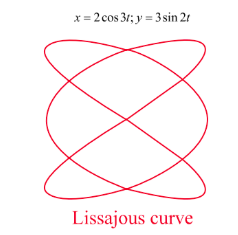
Find the equation of the tangent and normal at any point to the Lissajous curve given by $x = 2\cos 3t$ and $y = 3\sin 2t$, $t \in \mathbb{R}$.
Solution
Observe that the given curve is neither a circle nor an ellipse. For your reference the curve is shown in Fig. 7.9.
The slope of the normal is the negative of the reciprocal of the tangent which in this case is $\frac{\sin 3t}{\cos 2t}$. Hence, the equation of the normal is
Angle between two curves, if they intersect, is defined as the acute angle between the tangent lines to those two curves at the point of intersection.
For the given curves, at the point of intersection using the slopes of the tangents, we can measure the acute angle between the two curves. Suppose $y = m_{1}x + c_{1}$ and $y = m_{2}x + c_{2}$ are two lines, then the acute angle $\theta$ between these lines is given by,
(i) If the two curves are parallel at $(x_{1},y_{1})$, then $m_{1} = m_{2}$.
(ii) If the two curves are perpendicular at $(x_{1},y_{1})$ and if $m_{1}$ and $m_{2}$ exists and finite then $m_{1}m_{2} = -1$.
Example 7.14
Find the angle between $y = x^{2}$ and $y = (x - 3)^{2}$.
Solution
Let us now find the point of intersection of the two given curves. Equating $x^{2} = (x - 3)^{2}$ we get, $x = \frac{3}{2}$. Therefore, the point of intersection is $\left(\frac{3}{2}, \frac{9}{4}\right)$. Let $\theta$ be the angle between the curves. The slopes of the curves are as follows:
For $y = x^{2}$,
$$
\frac{dy}{dx} = 2x.
$$
Let $m_{1} = \frac{dy}{dx}$ at $\left(\frac{3}{2}, \frac{9}{4}\right) = 3$.
For $y = (x - 3)^{2}$,
$$
\frac{dy}{dx} = 2(x - 3).
$$
Let $m_{2} = \frac{dy}{dx}$ at $\left(\frac{3}{2}, \frac{9}{4}\right) = -3$.
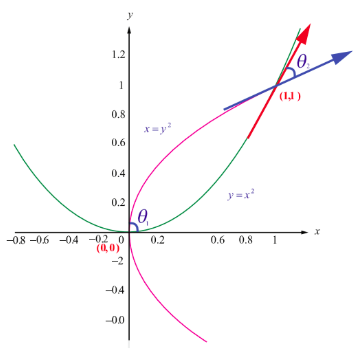
Find the angle between the curves $y = x^2$ and $x = y^2$ at their points of intersection $(0,0)$ and $(1,1)$ .
Solution
Let us now find the slopes of the curves. Let $m_1$ be the slope of the curve $y = x^2$ , then $m_1 = \frac{dy}{dx} = 2x$ .
Let $m_2$ be the slope of the curve $x = y^2$ , then $m_2 = \frac{dy}{dx} = \frac{1}{2y}$ .
Let $\theta_1$ and $\theta_2$ be the angles at $(0,0)$ and $(1,1)$ respectively. At $(0,0)$ , we come across the indeterminate form of $0 \times \infty$ in the denominator of
$\tan \theta_1 = \left| \frac{2x - \frac{1}{2y}}{1 + (2x)\left(\frac{1}{2y}\right)} \right|$ and so we follow the limiting process.
If the curves $ax^{2} + by^{2} = 1$ and $cx^{2} + dy^{2} = 1$ intersect each other orthogonally then prove that $\frac{1}{a} - \frac{1}{b} = \frac{1}{c} - \frac{1}{d}$.
Solution
Let the two curves intersect at a point $(x_{0}, y_{0})$. This leads to $(a - c)x_{0}^{2} + (b - d)y_{0}^{2} = 0$.
Let us now find the slope of the curves at the point of intersection $(x_{0}, y_{0})$. The slopes of the curves are as follows:
For the curve $ax^{2} + by^{2} = 1$,
$$
\frac{dy}{dx} = -\frac{ax}{by}.
$$
For the curve $cx^{2} + dy^{2} = 1$,
$$
\frac{dy}{dx} = -\frac{cx}{dy}.
$$
Now, if two curves cut orthogonally, then the product of their slopes, at the point of intersection $(x_{0}, y_{0})$, is $-1$. Hence, if the above two curves cut orthogonally at $(x_{0}, y_{0})$ then
In the above example, the converse is also true. That is assuming the condition $\frac{1}{a} - \frac{1}{b} = \frac{1}{c} - \frac{1}{d}$ one can easily establish that the curves cut orthogonally.
Example 7.18
Prove that the ellipse $x^{2} + 4y^{2} = 8$ and the hyperbola $x^{2} - 2y^{2} = 4$ intersect orthogonally.
Solution
Let the point of intersection of the two curves be $(a,b)$. Hence,
Solving the equations in (4) for $a^2$ and $b^2$:
Adding the two equations: $2a^2 + 2b^2 = 12 \Rightarrow a^2 + b^2 = 6$.
Subtracting the second from the first: $(a^2+4b^2) - (a^2-2b^2) = 8-4 \Rightarrow 6b^2 = 4 \Rightarrow b^2 = \frac{2}{3}$.
Then $a^2 = 6 - b^2 = 6 - \frac{2}{3} = \frac{16}{3}$.
Find the slope of the tangent to the following curves at the respective given points.
(i) $y = x^{4} + 2x^{2} - x$ at $x = 1$
(ii) $x = a\cos^{3}t, y = b\sin^{3}t$ at $t = \frac{\pi}{2}$.
Find the point on the curve $y = x^{2} - 5x + 4$ at which the tangent is parallel to the line $3x + y = 7$.
Find the points on the curve $y = x^{3} - 6x^{2} + x + 3$ where the normal is parallel to the line $x + y = 1729$.
Find the points on the curve $y^{2} - 4xy = x^{2} + 5$ for which the tangent is horizontal.
Find the tangent and normal to the following curves at the given points on the curve.
(i) $y = x^{2} - x^{4}$ at $(1,0)$
(ii) $y = x^{4} + 2e^{x}$ at $(0,2)$
(iii) $y = x\sin x$ at $\left(\frac{\pi}{2}, \frac{\pi}{2}\right)$
(iv) $x = \cos t, y = 2\sin^{2}t$ at $t = \frac{\pi}{3}$
Find the equations of the tangents to the curve $y = 1 + x^{3}$ for which the tangent is orthogonal with the line $x + 12y = 12$.
Find the equations of the tangents to the curve $y = \frac{x + 1}{x - 1}$ which are parallel to the line $x + 2y = 6$.
Find the equation of tangent and normal to the curve given by $x = 7\cos t$ and $y = 2\sin t$, $t \in \mathbb{R}$ at any point on the curve.
Find the angle between the rectangular hyperbola $xy = 2$ and the parabola $x^{2} + 4y = 0$.
Show that the two curves $x^{2} - y^{2} = r^{2}$ and $xy = c^{2}$ where $c, r$ are constants, cut orthogonally.
Mean value theorem establishes the existence of a point, in between two points, at which the tangent to the curve is parallel to the secant joining those two points of the curve. We start this section with the statement of the intermediate value theorem as follows:
Theorem 7.1 (Intermediate Value Theorem)
If $f$ is continuous on a closed interval $[a,b]$, and $c$ is any number between $f(a)$ and $f(b)$ inclusive, then there is at least one number $x$ in the closed interval $[a,b]$, such that $f(x) = c$.
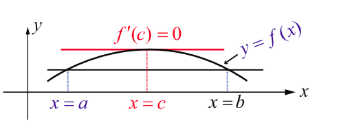
Let $f(x)$ be continuous on a closed interval $[a,b]$ and differentiable on the open interval $(a,b)$. If $f(a) = f(b)$, then there is at least one point $c \in (a,b)$ where $f^{\prime}(c) = 0$.
Geometrically this means that if the tangent is moving along the curve starting at $x = a$ towards $x = b$ then there exists a $c \in (a,b)$ at which the tangent is parallel to the $x$-axis.
Fig. 7.12
Example 7.19
Compute the value of $c$ satisfied by the Rolle’s theorem for the function $f(x) = x^{2}(1 - x)^{2}$, $x \in [0,1]$.
Solution
Observe that, $f(0) = 0 = f(1)$, $f(x)$ is continuous in the interval $[0,1]$ and is differentiable in $(0,1)$. Now,
$$
f^{\prime}(x) = 2x(1 - x)(1 - 2x).
$$
Therefore, $f^{\prime}(c) = 0$ gives $c = 0, 1$, and $\frac{1}{2}$ which $\Rightarrow c = \frac{1}{2} \in (0,1)$.
Example 7.20
Find the value in the interval $\left(\frac{1}{2}, 2\right)$ satisfied by the Rolle’s theorem for the function $f(x) = x + \frac{1}{x}$, $x \in \left[\frac{1}{2}, 2\right]$.
Solution
We have, $f(x)$ is continuous in $\left[\frac{1}{2}, 2\right]$ and differentiable in $\left(\frac{1}{2}, 2\right)$ with $f\left(\frac{1}{2}\right) = \frac{5}{2} = f(2)$. By the Rolle’s theorem there must exist a value $c \in \left(\frac{1}{2}, 2\right)$ such that,
As $1 \in \left(\frac{1}{2}, 2\right)$, we choose $c = 1$.
Example 7.21
Compute the value of $c$ satisfied by Rolle’s theorem for the function $f(x) = \log \left(\frac{x^{2} + 6}{5x}\right)$ in the interval $[2,3]$.
Solution
Observe that, $f(2) = \log\left(\frac{4+6}{10}\right) = \log(1) = 0 = f(3) = \log\left(\frac{9+6}{15}\right) = \log(1) = 0$ and $f(x)$ is continuous in the interval $[2,3]$ and differentiable in $(2,3)$. Now,
Hence by the Rolle’s theorem there do not exist $a, b \in (0,1)$ such that $f(a) = 0 = f(b)$. Therefore the equation $f(x) = 0$ cannot have two roots in the interval $(0,1)$. But, $f(0) = -2 < 0$ and $f(1) = 1 + 2 - 2 = 1 > 0$ tells us the curve $y = f(x)$ crosses the $x$-axis between 0 and 1 only once by the Intermediate value theorem. Therefore the equation $x^{4} + 2x^{3} - 2 = 0$ has only one real root in the interval $(0,1)$.
As an application of the Rolle’s theorem we have the following:
Example 7.23
Prove that between any two distinct real zeros of the polynomial $a_{n}x^{n} + a_{n-1}x^{n-1} + \dots + a_{1}x + a_{0}$ there is a zero of the polynomial $n a_{n}x^{n-1} + (n-1)a_{n-1}x^{n-2} + \dots + a_{1}$ using the Rolle’s theorem.
Solution
Let $P(x) = a_{n}x^{n} + a_{n-1}x^{n-1} + \dots + a_{1}x + a_{0}$. Let $\alpha < \beta$ be two real zeros of $P(x)$. Therefore, $P(\alpha) = P(\beta) = 0$. Since $P(x)$ is continuous in $[\alpha, \beta]$ and differentiable in $(\alpha, \beta)$ by an application of Rolle’s theorem there exists $\gamma \in (\alpha, \beta)$ such that $P^{\prime}(\gamma) = 0$. Since,
Prove that there is a zero of the polynomial $2x^{3} - 9x^{2} - 11x + 12$ in the interval $(2, 7)$ given that 2 and 7 are the zeros of the polynomial $x^{4} - 6x^{3} - 11x^{2} + 24x + 28$.
This implies that there is a zero of the polynomial $Q(x)$ in the interval $(2, 7)$.
For verification,
$Q(2) = 16 - 36 - 22 + 12 = 28 - 58 = -30 < 0$,
$Q(7) = 686 - 441 - 77 + 12 = 698 - 518 = 180 > 0$.
From this we may see that there is a zero of the polynomial $Q(x)$ in the interval $(2, 7)$.
There are functions for which Rolle’s theorem may not be applicable.
(1) For the function $f(x) = |x|$, $x \in [-1,1]$ Rolle’s theorem is not applicable, even though $f(-1) = 1 = f(1)$ because $f(x)$ is not differentiable at $x = 0$.
(2) For the function,
$$
f(x) = \begin{cases}
1, & x = 0 \\
x, & 0 < x \leq 1
\end{cases}
$$
even though $f(0) = f(1) = 1$, Rolle’s theorem is not applicable because the function $f(x)$ is not continuous at $x = 0$.
(3) For the function $f(x) = \sin x$, $x \in \left[0, \frac{\pi}{2}\right]$ Rolle’s theorem is not applicable, even though $f(x)$ is continuous in the closed interval $\left[0, \frac{\pi}{2}\right]$ and differentiable in the open interval $\left(0, \frac{\pi}{2}\right)$ because $0 = f(0) \neq f\left(\frac{\pi}{2}\right) = 1$.
If $f(x)$ is continuous in the closed interval $[a,b]$ and differentiable in the open interval $(a,b)$ and even if $f(a) \neq f(b)$ then the Rolle’s theorem can be generalised as follows.
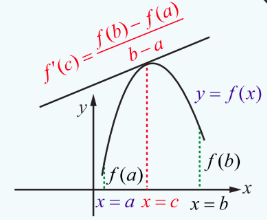
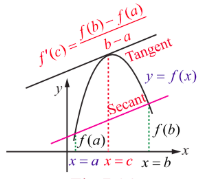
Let $f(x)$ be continuous in a closed interval $[a,b]$ and differentiable in the open interval $(a,b)$ (where $f(a), f(b)$ are not necessarily equal). Then there exist at least one point $c \in (a,b)$ such that,
If $f(a) = f(b)$ then Lagrange’s Mean Value Theorem gives the Rolle’s theorem. It is also known as rotated Rolle’s Theorem.
Remark
A physical meaning of the above theorem is the number $\frac{f(b) - f(a)}{b - a}$ can be thought of as the average rate of change in $f(x)$ over $(a,b)$ and $f^{\prime}(c)$ as an instantaneous change.
A geometrical meaning of the Lagrange’s mean value theorem is that the instantaneous rate of change at some interior point is equal to the average rate of change over the entire interval. This is illustrated as follows:
If a car accelerating from zero takes just 8 seconds to travel 200 m, its average velocity for the 8 second interval is
$\frac{200}{8} = 25 \, \text{m/s}$ .
The Mean Value Theorem says that at some point during the travel the speedometer must read exactly 90 km/h which is equal to 25 m/s.
Theorem 7.4
If $f(x)$ is continuous in closed interval $[a, b]$ and differentiable in open interval $(a, b)$ and if
$f'(x) > 0$ , $\forall x \in (a, b)$ ,
then for, $x_1, x_2 \in [a, b]$ , such that $x_1 < x_2$ we have,
$f(x_1) < f(x_2)$ .
Proof
By the mean value theorem, there exists a $c \in (x_1, x_2) \subset (a, b)$ such that,
$\frac{f(x_2) - f(x_1)}{x_2 - x_1} = f'(c)$
Since $f'(c) > 0$ , and $x_2 - x_1 > 0$ we have
$f(x_2) - f(x_1) > 0$ .
We conclude that, whenever $x_1 < x_2$ , we have $f(x_1) < f(x_2)$ .
Remark
If $f'(x) < 0$ , $\forall x \in (a, b)$ , then for, $x_1, x_2 \in [a, b]$ , such that $x_1 < x_2$ we have, $f(x_1) > f(x_2)$ .
Find the values in the interval $(1,2)$ of the mean value theorem satisfied by the function $f(x) = x - x^2$ for $1 \leq x \leq 2$ .
Solution
$f(1) = 0$ and $f(2) = -2$ . Clearly $f(x)$ is defined and differentiable in $1 < x < 2$ . Therefore, by the Mean Value Theorem, there exists a $c \in (1,2)$ such that
$f'(c) = \frac{f(2) - f(1)}{2 - 1} = 1 - 2c$
That is,
$1 - 2c = -2 \implies c = \frac{3}{2}$
Geometrical meaning
Geometrically, the mean value theorem says the secant to the curve $y = f(x)$ between $x = a$ and $x = b$ is parallel to a tangent line of the curve, at some point $c \in (a,b)$ .
Fig. 7.14
Consequences of Lagrange’s Mean Value Theorem
There are three important consequences of MVT for derivatives.
To determine the monotonicity of the given function (Theorem 7.4)
If $f'(x) = 0$ for all $x$ in $(a,b)$ , then $f$ is constant on $(a,b)$ .
If $f'(x) = g'(x)$ for all $x$ , then $f(x) = g(x) + C$ for some constant $C$ .
Example 7.26
A truck travels on a toll road with a speed limit of $80 \text{ km/hr}$. The truck completes a $164 \text{ km}$ journey in 2 hours. At the end of the toll road the trucker is issued with a speed violation notice. Justify this using the Mean Value Theorem.
Solution
Let $f(t)$ be the distance travelled by the trucker in $t$ hours. This is a continuous function in $[0,2]$ and differentiable in $(0,2)$. Now, $f(0) = 0$ and $f(2) = 164$. By an application of the Mean Value Theorem, there exists a time $c$ such that,
Therefore at some point of time, during the travel in 2 hours the trucker must have travelled with a speed more than $80 \text{ km/hr}$ which justifies the issuance of a speed violation notice.
Example 7.27
Suppose $f(x)$ is a differentiable function for all $x$ with $f^{\prime}(x) \leq 29$ and $f(2) = 17$. What is the maximum value of $f(7)$?
Solution
By the mean value theorem we have, there exists $c \in (2,7)$ such that,
Prove that $|\sin \alpha - \sin \beta| \leq |\alpha - \beta|$, $\alpha, \beta \in \mathbb{R}$ using mean value theorem.
Solution
Let $f(x) = \sin x$ which is a differentiable function in any open interval. Consider an interval $[\alpha, \beta]$. Applying the mean value theorem there exists $c \in (\alpha, \beta)$ such that,
If we take $\beta = 0$ in the above problem, we get $|\sin \alpha| \leq |\alpha|$.
Example 7.29
A thermometer was taken from a freezer and placed in a boiling water. It took 22 seconds for the thermometer to raise from $-10^{\circ}\mathrm{C}$ to $100^{\circ}\mathrm{C}$. Show that the rate of change of temperature at some time $t$ is $5^{\circ}\mathrm{C}$ per second.
Solution
Let $f(t)$ be the temperature at time $t$. By the mean value theorem, we have
Hence the instantaneous rate of change of temperature at some time $t$ is $5^{\circ}\mathrm{C}$ per second.
EXERCISE 7.3
Explain why Rolle’s theorem is not applicable to the following functions in the respective intervals.
(i) $f(x) = \left|\frac{1}{x}\right|$, $x \in [-1,1]$
(ii) $f(x) = \tan x$, $x \in [0, \pi]$
(iii) $f(x) = x - 2\log x$, $x \in [2,7]$
Using the Rolle’s theorem, determine the values of $x$ at which the tangent is parallel to the $x$-axis for the following functions:
(i) $f(x) = x^{2} - x$, $x \in [0,1]$
(ii) $f(x) = \frac{x^{2} - 2x}{x + 2}$, $x \in [-1,6]$
(iii) $f(x) = \sqrt{x} - \frac{x}{3}$, $x \in [0,9]$
Explain why Lagrange’s mean value theorem is not applicable to the following functions in the respective intervals:
(i) $f(x) = \frac{x + 1}{x}$, $x \in [-1,2]$
(ii) $f(x) = |3x + 1|$, $x \in [-1,3]$
Using the Lagrange’s mean value theorem determine the values of $x$ at which the tangent is parallel to the secant line at the end points of the given interval:
(i) $f(x) = x^{3} - 3x + 2$, $x \in [-2,2]$
(ii) $f(x) = (x - 2)(x - 7)$, $x \in [3,11]$
Show that the value in the conclusion of the mean value theorem for
(i) $f(x) = \frac{1}{x}$ on a closed interval of positive numbers $[a,b]$ is $\sqrt{ab}$
(ii) $f(x) = Ax^{2} + Bx + C$ on any interval $[a,b]$ is $\frac{a + b}{2}$.
A race car driver is in kilometer stone 20. If his speed never exceeds $150 \mathrm{km/hr}$, what is the maximum kilometer stone he can reach in the next two hours.
Suppose that for a function $f(x)$, $f'(x) \leq 1$ for all $1 \leq x \leq 4$. Show that $f(4) - f(1) \leq 3$.
Does there exist a differentiable function $f(x)$ such that $f(0) = -1$, $f(2) = 4$ and $f^{\prime}(x) \leq 2$ for all $x$. Justify your answer.
Show that there lies a point on the curve $f(x) = x(x + 3)e^{-\frac{x}{2}}$, $-3 \leq x \leq 0$ where tangent drawn is parallel to the $x$-axis.
Using mean value theorem prove that for $a > 0$, $b > 0$, $|e^{-a} - e^{-b}| < |a - b|$.
Taylor’s series and Maclaurin’s series expansion of a function which are infinitely differentiable.
Theorem 7.5
(a) Taylor’s Series
Let $f(x)$ be a function infinitely differentiable at $x = a$. Then $f(x)$ can be expanded as a series, in an interval $(a - \epsilon, a + \epsilon)$, $\epsilon > 0$, of the form
Substituting $x = a$ gives $A_{k} = \frac{f^{(k)}(a)}{k!}$ which completes the proof of the theorem.
In order to expand a function around a point say $x = a$, equivalently in powers of $(x - a)$ we need to differentiate the given function as many times as the required powers and evaluate at $x = a$. This will give the value for the coefficients of the required powers of $(x - a)$.
Example 7.30
Expand $\log (1 + x)$ as a Maclaurin’s series upto 4 non-zero terms for $-1 < x \leq 1$.
Solution
Let $f(x) = \log (1 + x)$, then the Maclaurin’s series of $f(x)$ is $f(x) = \sum_{n = 0}^{n = \infty} a_{n} x^{n}$, where $a_{n} = \frac{f^{(n)}(0)}{n!}$. Various derivatives of the function $f(x)$ evaluated at $x = 0$ are given below:
Function and its derivatives
$\log(1+x)$ and its derivatives
Value at $x=0$
$f(x)$
$\log(1+x)$
$0$
$f'(x)$
$\frac{1}{1+x}$
$1$
$f''(x)$
$-\frac{1}{(1+x)^2}$
$-1$
$f'''(x)$
$\frac{2}{(1+x)^3}$
$2$
$f^{(iv)}(x)$
$-\frac{6}{(1+x)^4}$
$-6$
Substituting the values and on simplification we get the required expansion of the function given by,
Write the Maclaurin’s series expansion of the following functions:
(i) $e^{x}$
(ii) $\sin x$
(iii) $\cos x$
(iv) $\log (1 - x); -1 \leq x < 1$
(v) $\tan^{-1}(x); -1 \leq x \leq 1$
Write down the Taylor’s series expansion, of the function $\log x$ about $x = 1$ upto three non-zero terms for $x > 0$.
Expand $\sin x$ in ascending powers $x - \frac{\pi}{4}$ upto three non-zero terms.
Expand the polynomial $f(x) = x^{2} - 3x + 2$ in powers of $x - 1$.
We say that they have the form of a number. But values cannot be assigned to them in a way that is consistent with the usual rules of addition and multiplication of numbers. We call these expressions indeterminate forms. Although they are not numbers, these indeterminate forms play a useful role in the limiting behaviour of a function.
John (Johann) Bernoulli discovered a rule using derivatives to compute the limits of fractions whose numerators and denominators both approach zero or $\infty$. The rule is known today as L’Hopital’s Rule (pronounced as Lho pi tal Rule), named after Guillaume de l’Hospital’s, a French nobleman who wrote the earliest introductory differential calculus text, where the rule first appeared in print.
If we put directly $x = 1$ we observe that the given function is in an indeterminate form $\frac{0}{0}$. As the numerator and the denominator functions are polynomials of degree 2 they both are differentiable. Hence, by an application of the L’Hopital’s Rule, we get
Note that this limit may also be evaluated through the factorization of the numerator and denominator as $\frac{x^2 - 3x + 2}{x^2 - 4x + 3} = \frac{(x - 1)(x - 2)}{(x - 1)(x - 3)}$.
If we put directly $x = a$ we observe that the given function is in an indeterminate form $\frac{0}{0}$. As the numerator and the denominator functions are polynomials they both are differentiable.
Hence by an application of the L’Hopital’s Rule we get,
This is an indeterminate of the form $\infty - \infty$. To evaluate this limit we first simplify and bring it in the form $\left( \frac{0}{0} \right)$ and applying the L’Hopital’s Rule, we get
This is an indeterminate of the form $(0 \times \infty)$. To evaluate this limit, we first simplify and bring it to the form $\left( \frac{\infty}{\infty} \right)$ and apply L’Hopital’s Rule. Thus, we get
(1) Let $A = \lim_{x\to a} g(x)$. Then taking logarithm, with the assumption that $A > 0$ to ensure the continuity of the logarithm function, we get $\log A = \lim_{x\to a} \log (g(x))$. Therefore using the above theorem with $f(x) = \log x$ we have the limit
(2) We have the limit $\lim_{x\to a} \log (g(x))$ into either $\left( \frac{0}{0} \right)$ or $\left( \frac{\infty}{\infty} \right)$ form evaluate it using L’Hopital’s Rule.
(3) Let that evaluated limit be say $\alpha$. Then the required limit is $e^{\alpha}$.
Example 7.43
Using the L’Hopital’s Rule, prove that $\lim_{x\to 0} (1 + x)^{\frac{1}{x}} = e$.
Solution
This is an indeterminate of the form $1^{\infty}$. Let $g(x) = (1 + x)^{\frac{1}{x}}$. Taking the logarithm, we get
If an initial amount $A_{0}$ of money is invested at an interest rate $r$ compounded $n$ times a year, the value of the investment after $t$ years is $A = A_{0} \left(1 + \frac{r}{n}\right)^{nt}$. If the interest is compounded continuously, (that is as $n \to \infty$), show that the amount after $t$ years is $A = A_{0} e^{rt}$.
Using the first derivative we can test a function $f(x)$ for its monotonicity (increasing or decreasing), focusing on a particular point in its domain and the local extrema (maxima or minima) on a domain.
Monotonicity of functions are its behaviour of increasing or decreasing.
Definition 7.4
A function $f(x)$ is said to be an increasing function in an interval $I$ if $a < b \Rightarrow f(a) \leq f(b)$, $\forall a, b \in I$.
Definition 7.5
A function $f(x)$ is said to be a decreasing function in an interval $I$ if $a < b \Rightarrow f(a) \geq f(b)$, $\forall a, b \in I$.
The function $f(x) = x$ is an increasing function in the entire real line, whereas the function $f(x) = -x$ is a decreasing function in the entire real line. In general, a given function may be increasing in some interval and decreasing in some other interval, say for instance, the function $f(x) = |x|$ is decreasing in $(-\infty, 0]$ and is increasing in $[0, \infty)$. These functions are simple to observe for their monotonicity. But given an arbitrary function how we determine its monotonicity in an interval of a real line? That is where following theorem (stated without proof) will be useful.
Theorem 7.7
If the function $f(x)$ is differentiable in an open interval $(a,b)$ then we say,
It is very important to note the following fact. It is false to say that if a differentiable function $f(x)$ on $I$ is strictly increasing on $I$, then $f^{\prime}(x) > 0$ for all $x \in I$. For instance, consider $y = x^{3}$, $x \in (-\infty, \infty)$. It is strictly increasing on $(-\infty, \infty)$. To prove this, let $a > b$. Then we have to prove that $f(a) > f(b)$. For this purpose, we have to prove $a^{3} - b^{3} > 0$.
Now,
$$
> a^{3} - b^{3} = (a - b)(a^{2} + ab + b^{2}) = (a - b) \frac{1}{2} (2a^{2} + 2ab + 2b^{2}) = (a - b) \frac{1}{2} \big((a + b)^{2} + a^{2} + b^{2}\big) > 0
> $$
since $a - b > 0$ and other terms inside the bracket are $> 0$.
Hence it is clear that the quadratic expression is always positive (it is equal to zero only if $a = b = 0$, which contradicts the condition $a < b$). Therefore the function $y = x^{3}$ is strictly increasing in $(-\infty, \infty)$. But $f^{\prime}(x) = 3x^{2}$ which is equal to zero at $x = 0$.
Definition 7.6
A stationary point $(x_{0}, f(x_{0}))$ of a differentiable function $f(x)$ is where $f^{\prime}(x_{0}) = 0$.
Definition 7.7
A critical point $(x_{0}, f(x_{0}))$ of a function $f(x)$ is where $f^{\prime}(x_{0}) = 0$ or does not exist.
Note
We state that if $(x,y)$ is a stationary point or critical point of $f$, where $x$ from the domain of $f$ is called stationary number or critical number.
Every stationary point is a critical point however all critical points need not be stationary points. As an example, the function $f(x) = |x - 17|$ has a critical point at $(17,0)$ but $(17,0)$ is not a stationary point as the function has no derivative at $x = 17$.
Example 7.46
Prove that the function $f(x) = x^{2} + 2$ is strictly increasing in the interval $(2,7)$ and strictly decreasing in the interval $(-2,0)$.
The absolute maxima and absolute minima are referred to describing the largest and smallest values of a function on an interval.
Definition 7.8
Let $x_{0}$ be a number in the domain $D$ of a function $f(x)$. Then $f(x_{0})$ is the absolute maximum value of $f(x)$ on $D$, if $f(x_{0}) \geq f(x) \ \forall x \in D$, and $f(x_{0})$ is the absolute minimum value of $f(x)$ on $D$ if $f(x_{0}) \leq f(x) \ \forall x \in D$.
In general, there is no guarantee that a function will actually have an absolute maximum or absolute minimum on a given interval. The following figures show that a continuous function may or may not have absolute maxima or minima on an infinite interval or on a finite open interval.
Fig. 7.15
- $f(x)$ has an absolute minimum but no absolute maximum on $(-\infty, \infty)$
Fig. 7.16
- $f(x)$ has no absolute extrema on $(-\infty, \infty)$
Fig. 7.17
- $f(x)$ has an absolute maximum and an absolute minimum on $(-\infty, \infty)$
Fig. 7.18
- $f(x)$ has no absolute extrema on $(a,b)$
Fig. 7.19
- $f(x)$ has an absolute maximum and an absolute minimum on $[a,b]$
However, the following theorem shows that a continuous function must have both an absolute maximum and an absolute minimum on every closed interval.
Theorem 7.8 (Extreme Value Theorem)
If $f(x)$ is continuous on a closed interval $[a,b]$, then $f$ has both an absolute maximum and an absolute minimum on $[a,b]$.
The absolute extrema of $f(x)$ occur either at the endpoints of closed interval $[a,b]$ or inside the open interval $(a,b)$. If the absolute extrema occurs inside, then it must occur at critical numbers of $f(x)$. Thus, we can use the following procedure to find the absolute extrema of a continuous function on closed interval $[a,b]$.
A procedure for finding the absolute extrema of a continuous function $f(x)$ on closed interval $[a,b]$.
Step 1: Find the critical numbers of $f(x)$ in $(a,b)$.
Step 2: Evaluate $f(x)$ at all the critical numbers and at the endpoints $a$ and $b$.
Step 3: The largest and the smallest of the values in step 2 is the absolute maximum and absolute minimum of $f(x)$ respectively on the closed interval $[a,b]$.
Example 7.48
Find the absolute maximum and absolute minimum values of the function $f(x) = 2x^{3} + 3x^{2} - 12x$ on $[-3,2]$.
Therefore, the critical numbers are $x = -2, 1$. Evaluating $f(x)$ at the endpoints $x = -3, 2$ and at critical numbers $x = -2, 1$, we get $f(-3) = 9$, $f(2) = 4$, $f(-2) = 20$ and $f(1) = -7$.
From these values, the absolute maximum is 20 which occurs at $x = -2$, and the absolute minimum is $-7$ which occurs at $x = 1$.
Example 7.49
Find the absolute extrema of the function $f(x) = 3\cos x$ on the closed interval $[0, 2\pi]$.
Solution
Differentiating the given function, we get $f^{\prime}(x) = -3 \sin x$.
Thus, $f^{\prime}(x) = 0 \Rightarrow \sin x = 0 \Rightarrow x = \pi \in (0, 2\pi)$. Evaluating $f(x)$ at the endpoints $x = 0, 2\pi$ and at critical number $x = \pi$, we get $f(0) = 3$, $f(2\pi) = 3$, and $f(\pi) = -3$.
From these values, the absolute maximum is 3 which occurs at $x = 0, 2\pi$, and the absolute minimum is $-3$ which occurs at $x = \pi$.
A function $f(x)$ is said to have a relative maximum at $x_{0}$, if there is an open interval containing $x_{0}$ on which $f(x_{0})$ is the largest value. Similarly, $f(x)$ is said to have a relative minimum at $x_{0}$, if there is an open interval containing $x_{0}$ on which $f(x_{0})$ is the smallest value.
A relative maximum need not be the largest value on the entire domain, while a relative minimum need not be the smallest value on the entire domain. Therefore, there may be more than one relative maximum or relative minimum on the entire domain.
A relative extrema of a function is the extreme values (maximum or minimum) of the functions among all the evaluated values of $f(x)$, $\forall x \in I \subset D$ where $I$ may be open or closed. Usually the local extreme value of a function is attained at a critical point. Note that, a function may have a critical point at $x = c$ without having a local extreme value there. For instance, both of the functions $y = x^{3}$ and $y = x^{\frac{1}{3}}$ have critical points at the origin, but neither function has a local extreme value at the origin.
Theorem 7.9 (Fermat)
If $f(x)$ has a relative extrema at $x = c$ then $c$ is a critical number. Invariably there will be critical numbers of the function obtained as solutions of the equation $f^{\prime}(x) = 0$ or as values of $x$ at which $f^{\prime}(x)$ does not exist.
After we have determined the intervals on which a function is increasing or decreasing, it is not difficult to locate the relative extrema of the function. The location or points at which the relative extrema occurs for a given function $f(x)$ can be observed through the graph $y = f(x)$. However to find the exact point and the value of the extrema of functions we need to use certain test on functions. One such test is the first derivative test, which is stated in the following theorem.
Theorem 7.10 (First Derivative Test)
Let $(c, f(c))$ be a critical point of function $f(x)$ that is continuous on an open interval $I$ containing $c$. If $f(x)$ is differentiable on the interval, except possibly at $c$, then $f(c)$ can be classified as follows:
(when moving across the interval $I$ from left to right)
(i) If $f^{\prime}(x)$ changes from negative to positive at $c$, then $f(x)$ has a local minimum $f(c)$.
(ii) If $f^{\prime}(x)$ changes from positive to negative at $c$, then $f(x)$ has a local maximum $f(c)$.
(iii) If $f^{\prime}(x)$ is positive on both sides of $c$ or negative on both sides of $c$, then $f(c)$ is neither a local minimum nor a local maximum.
Example 7.50
Find the intervals of monotonicity and hence find the local extrema for the function $f(x) = x^{2} - 4x + 4$.
The intervals of monotonicity are $(-\infty, 2)$ and $(2, \infty)$. Since $f^{\prime}(x) < 0$, for $x \in (-\infty, 2)$ the function $f(x)$ is strictly decreasing on $(-\infty, 2)$. As $f^{\prime}(x) > 0$, for $x \in (2, \infty)$ the function $f(x)$ is strictly increasing on $(2, \infty)$. Because $f^{\prime}(x)$ changes its sign from negative to positive when passing through $x = 2$ for the function $f(x)$, it has a local minimum at $x = 2$. The local minimum value is $f(2) = 0$.
Example 7.51
Find the intervals of monotonicity and hence find the local extrema for the function $f(x) = x^{\frac{2}{3}}$.
Solution
We have, $f(x) = x^{\frac{2}{3}}$, then $f^{\prime}(x) = \frac{2}{3} x^{-\frac{1}{3}} = \frac{2}{3x^{\frac{1}{3}}}$. $f^{\prime}(x) \neq 0 \ \forall x \in \mathbb{R}$ and $f^{\prime}(x)$ does not exist at $x = 0$. Therefore, there are no stationary points but there is a critical point at $x = 0$.
Interval
$(-\infty, 0)$
$(0, \infty)$
Sign of $f'(x)$
$-$
$+$
Monotonicity
strictly decreasing
strictly increasing
Fig. 7.21
Because $f^{\prime}(x)$ changes its sign from negative to positive when passing through $x = 0$ for the function $f(x)$, it has a local minimum at $x = 0$. The local minimum value is $f(0) = 0$. Note that here the local minimum occurs at a critical point which is not a stationary point.
Example 7.52
Prove that the function $f(x) = x - \sin x$ is increasing on the real line. Also discuss for the existence of local extrema.
Solution
Since $f^{\prime}(x) = 1 - \cos x \geq 0$ and zero at the points $x = 2n\pi$, $n \in \mathbb{Z}$ and hence the function is increasing on the real line.
Since there is no sign change in $f^{\prime}(x)$ when passing through $x = 2n\pi$, $n \in \mathbb{Z}$ by the first derivative test there is no local extrema.
Example 7.53
Discuss the monotonicity and local extrema of the function
$f^{\prime}(x) < 0$ for $-1 < x < 0$ and $f^{\prime}(x) > 0$ for $x > 0$.
Therefore $f(x)$ is strictly increasing for $x > 0$ and strictly decreasing for $x < 0$. Since $f^{\prime}(x)$ changes from negative to positive when passing through $x = 0$, the first derivative test tells us there is a local minimum at $x = 0$ which is $f(0) = 0$.
Example 7.54
Find the intervals of monotonicity and local extrema of the function $f(x) = x \log x + 3x$.
Solution
The given function is defined and is differentiable at all $x \in (0, \infty)$.
$$
f(x) = x \log x + 3x.
$$$$
f^{\prime}(x) = \log x + 1 + 3 = \log x + 4.
$$
The stationary numbers are given by $\log x + 4 = 0$.
That is $x = e^{-4}$.
Hence the intervals of monotonicity are $(0, e^{-4})$ and $(e^{-4}, \infty)$.
At $x = e^{-5} \in (0, e^{-4})$, $f^{\prime}(e^{-5}) = -1 < 0$ and hence in the interval $(0, e^{-4})$ the function is strictly decreasing.
At $x = e^{-3} \in (e^{-4}, \infty)$, $f^{\prime}(e^{-3}) = 1 > 0$ and hence strictly increasing in the interval $(e^{-4}, \infty)$. Since $f^{\prime}(x)$ changes from negative to positive when passing through $x = e^{-4}$, the first derivative test tells us there is a local minimum at $x = e^{-4}$ and it is $f(e^{-4}) = -e^{-4}$.
Example 7.55
Find the intervals of monotonicity and local extrema of the function $f(x) = \frac{1}{1 + x^{2}}$.
Solution
The given function is defined and is differentiable at all $x \in (-\infty, \infty)$. As
The stationary numbers are given by $-\frac{2x}{(1 + x^{2})^{2}} = 0$ that is $x = 0$.
Hence the intervals of monotonicity are $(-\infty, 0)$ and $(0, \infty)$.
On the interval $(-\infty, 0)$ the function strictly increases because $f^{\prime}(x) > 0$ in that interval.
The function $f(x)$ strictly decreases in the interval $(0, \infty)$ because $f^{\prime}(x) < 0$ in that interval. Since $f^{\prime}(x)$ changes from positive to negative when passing through $x = 0$, the first derivative test tells us there is local maximum at $x = 0$ and the local maximum value is $f(0) = 1$.
Example 7.56
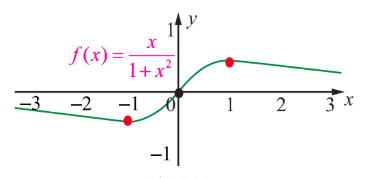
Find the intervals of monotonicity and local extrema of the function $f(x) = \frac{x}{1 + x^{2}}$.
Solution
The given function is defined and differentiable at all $x \in (-\infty, \infty)$. As
The stationary numbers are given by $1 - x^{2} = 0$ that is $x = \pm 1$.
Hence the intervals of monotonicity are $(-\infty, -1)$, $(-1, 1)$ and $(1, \infty)$.
Interval
$(-\infty, -1)$
$(-1, 1)$
$(1, \infty)$
Sign of $f'(x)$
$-$
$+$
$-$
Monotonicity
strictly decreasing
strictly increasing
strictly decreasing
Therefore, $f(x)$ strictly decreasing on $(-\infty, -1)$, strictly increasing on $(-1, 1)$, strictly decreasing on $(1, \infty)$.
Since $f^{\prime}(x)$ changes from negative to positive when passing through $x = -1$, the first derivative test tells us there is a local minimum at $x = -1$ and the local minimum value is $f(-1) = -\frac{1}{2}$. As $f^{\prime}(x)$ changes from positive to negative when passing through $x = 1$, the first derivative test tells us there is a local maximum at $x = 1$ and the local maximum value is $f(1) = \frac{1}{2}$.
Fig. 7.22
EXERCISE 7.6
Find the absolute extrema of the following functions on the given closed interval.
Second derivative of a function is used to determine the concavity, convexity, the points of inflection, and local extrema of functions.
7.7.1 Concavity, Convexity, and Points of Inflection#
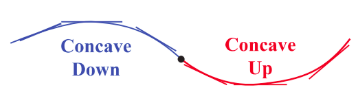
A graph is said to be concave down (convex up) at a point if the tangent line lies above the graph in the vicinity of the point. It is said to be concave up (convex down) at a point if the tangent line to the graph at that point lies below the graph in the vicinity of the point. This may be easily observed from the adjoining graph.
Fig. 7.23
Definition 7.8
Let $f(x)$ be a function whose second derivative exists in an open interval $I = (a,b)$. Then the function $f(x)$ is said to be
(i) If $f^{\prime}(x)$ is strictly increasing on $I$, then the function is concave up on an open interval $I$.
(ii) If $f^{\prime}(x)$ is strictly decreasing on $I$, then the function is concave down on an open interval $I$.
Analytically, given a differentiable function whose graph $y = f(x)$, then the concavity is given by the following result.
Theorem 7.11 (Test of Concavity)
(i) If $f^{\prime \prime}(x) > 0$ on an open interval $I$, then $f(x)$ is concave up on $I$.
(ii) If $f^{\prime \prime}(x) < 0$ on an open interval $I$, then $f(x)$ is concave down on $I$.
Remark
(1) Any local maximum of a convex upward function defined on the interval $[a,b]$ is also its absolute maximum on this interval.
(2) Any local minimum of a convex downward function defined on the interval $[a,b]$ is also its absolute minimum on this interval.
(3) There is only one absolute maximum (and one absolute minimum) but there can be more than one local maximum or minimum.
The points where the graph of the function changes from “concave up to concave down” or “concave down to concave up” are called the points of inflection of $f(x)$.
Theorem 7.12 (Test for Points of Inflection)
(i) If $f^{\prime \prime}(c)$ exists and $f^{\prime \prime}(c)$ changes sign when passing through $x = c$, then the point $(c, f(c))$ is a point of inflection of the graph of $f$.
(ii) If $f^{\prime \prime}(c)$ exists at the point of inflection, then $f^{\prime \prime}(c) = 0$.
Remark
To determine the position of points of inflexion on the curve $y = f(x)$ it is necessary to find the points where $f^{\prime \prime}(x)$ changes sign. For ‘smooth’ curves (no sharp corners), this may happen when either
(i) $f^{\prime \prime}(x) = 0$ or
(ii) $f^{\prime \prime}(x)$ does not exist at the point.
Remark
(1) It is also possible that $f^{\prime \prime}(c)$ may not exist, but $(c, f(c))$ could be a point of inflection. For instance, $f(x) = x^{\frac{1}{3}}$ at $c = 0$.
(2) It is possible that $f^{\prime \prime}(c) = 0$ at a point but $(c, f(c))$ need not be a point of inflection. For instance, $f(x) = x^{4}$ at $c = 0$.
(3) A point of inflection need not be a stationary point. For instance, if $f(x) = \sin x$ then, $f^{\prime}(x) = \cos x$ and $f^{\prime \prime}(x) = -\sin x$ and hence $(\pi, 0)$ is a point of inflection but not a stationary point for $f(x)$.
Example 7.57
Determine the intervals of concavity of the curve $f(x) = (x - 1)^{3} \cdot (x - 5)$, $x \in \mathbb{R}$ and, points of inflection if any.
Solution
Fig. 7.24
The given function is a polynomial of degree 4. Now,
$$
f^{\prime \prime}(x) = 0 \Rightarrow x = 1, \quad x = 3.
Interval
$(-\infty, 1)$
$(1, 3)$
$(3, \infty)$
Sign of $f''(x)$
$+$
$-$
$+$
Concavity
concave up
concave down
concave up
The curve is concave upwards on $(-\infty, 1)$ and $(3, \infty)$.
The curve is concave downwards on $(1, 3)$.
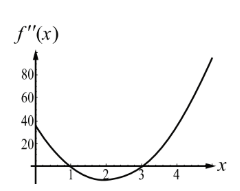
As $f^{\prime \prime}(x)$ changes its sign when it passes through $x = 1$ and $x = 3$, $(1, f(1)) = (1, 0)$ and $(3, f(3)) = (3, -16)$ are points of inflection for the graph $y = f(x)$. The sign change may be observed from the adjoining figure of the curve $f^{\prime \prime}(x)$.
Example 7.58
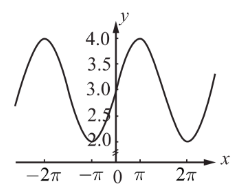
Determine the intervals of concavity of the curve $y = 3 + \sin x$.
Solution
The given function is a periodic function with period $2\pi$ and hence there will be stationary points and points of inflections in each period interval. We have,
$$
\frac{dy}{dx} = \cos x \quad \text{and} \quad \frac{d^{2}y}{dx^{2}} = -\sin x
$$
Now,
$$
\frac{d^{2}y}{dx^{2}} = -\sin x = 0 \Rightarrow x = n\pi.
$$
We now consider an interval $(-\pi, \pi)$ by splitting into two sub intervals $(-\pi, 0)$ and $(0, \pi)$.
Fig. 7.25
In the interval $(-\pi, 0)$, $\frac{d^{2}y}{dx^{2}} > 0$ and hence the function is concave upward.
In the interval $(0, \pi)$, $\frac{d^{2}y}{dx^{2}} < 0$ and hence the function is concave downward. Therefore $(0, 3)$ is a point of inflection (see Fig. 7.25). The general intervals need to be considered to discuss the concavity of the curve are $(n\pi, (n+1)\pi)$, where $n$ is any integer which can be discussed as before to conclude that $(n\pi, 3)$ are also points of inflection.
The Second Derivative Test relates the concepts of critical points, extreme values, and concavity to give a very useful tool for determining whether a critical point on the graph of a function is a relative minimum or maximum.
Theorem 7.13 (The Second Derivative Test)
Suppose that $c$ is a critical point at which $f^{\prime}(c) = 0$, that $f^{\prime}(x)$ exists in a neighborhood of $c$, and that $f^{\prime \prime}(c)$ exists. Then $f$ has a relative maximum value at $c$ if $f^{\prime \prime}(c) < 0$ and a relative minimum value at $c$ if $f^{\prime \prime}(c) > 0$. If $f^{\prime \prime}(c) = 0$, the test is not informative.
Example 7.59
Find the local extremum of the function $f(x) = x^{4} + 32x$.
As $f^{\prime \prime}(-2) > 0$, the function has local minimum at $x = -2$. The local minimum value is $f(-2) = -48$. Therefore, the extreme point is $(-2, -48)$.
Example 7.60
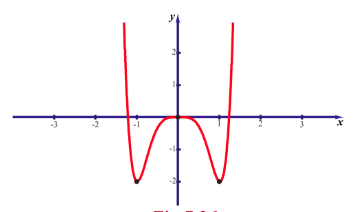
Find the local extrema of the function $f(x) = 4x^{6} - 6x^{4}$.
As $f^{\prime \prime}(-1)$ and $f^{\prime \prime}(1)$ are positive by the second derivative test, the function $f(x)$ has local minimum. But at $x = 0$, $f^{\prime \prime}(0) = 0$. That is the second derivative test does not give any information about local extrema at $x = 0$. Therefore, we need to go back to the first derivative test. The intervals of monotonicity is tabulated in Table 7.8.
Interval
$(-\infty, -1)$
$(-1, 0)$
$(0, 1)$
$(1, \infty)$
Sign of $f'(x)$
$-$
$+$
$-$
$+$
Monotonicity
strictly decreasing
strictly increasing
strictly decreasing
strictly increasing
By the first derivative test $f(x)$ has local minimum at $x = -1$, its local minimum value is $-2$. At $x = 0$, the function $f(x)$ has local maximum at $x = 0$, and its local maximum value is $0$. At $x = 1$, the function $f(x)$ has local minimum at $x = 1$, and its local minimum value is $-2$.
Remark
When the second derivative vanishes, we have no information about extrema. We have used the first derivative test to find out the extrema of the function!
Example 7.61
Find the local maximum and minimum of the function $x^{2}y^{2}$ on the line $x + y = 10$.
Solution
Let the given function be written as $f(x) = x^{2}(10 - x)^{2}$. Now,
The stationary numbers of $f(x)$ are $x = 0, 5, 10$; at these points the values of $f^{\prime \prime}(x)$ are respectively $200$, $-100$ and $200$. At $x = 0$, it has local minimum and its value is $f(0) = 0$. At $x = 5$, it has local maximum and its value is $f(5) = 625$. At $x = 10$, it has local minimum and its value is $f(10) = 0$.
EXERCISE 7.7
Find intervals of concavity and points of inflection for the following functions:
(i) $f(x) = x(x - 4)^{3}$
(ii) $f(x) = \sin x + \cos x$, $0 < x < 2\pi$
(iii) $f(x) = \frac{1}{2}(e^{x} - e^{-x})$
Find the local extrema for the following functions using second derivative test:
(i) $f(x) = -3x^{5} + 5x^{3}$
(ii) $f(x) = x \log x$
(iii) $f(x) = x^{2}e^{-2x}$
For the function $f(x) = 4x^{3} + 3x^{2} - 6x + 1$ find the intervals of monotonicity, local extrema, intervals of concavity and points of inflection.
Optimization is a process of finding an extreme value (either maximum or minimum) under certain conditions.
A procedure for solving for an extremum or optimization problems.
Step 1: Draw an appropriate figure and label the quantities relevant to the problem.
Step 2: Find an expression for the quantity to be maximized or minimized.
Step 3: Using the given conditions of the problem, express the quantity to be extremized in terms of a single variable.
Step 4: Determine the interval of possible values for this variable from the conditions given in the problem.
Step 5: Using the techniques of extremum (absolute extremum, first derivative test or second derivative test) obtain the maximum or minimum.
Example 7.62
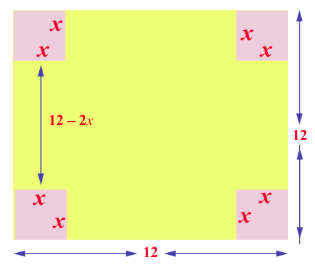
We have a 12 unit square piece of thin material and want to make an open box by cutting small squares from the corners of our material and folding the sides up. The question is, which cut produces the box of maximum volume?
Solution
Let $x =$ length of the cut on each side of the little squares.
$V =$ the volume of the folded box.
The length of the base after two cuts along each edge of size $x$ is $12 - 2x$. The depth of the box after folding is $x$, so the volume is $V = x \times (12 - 2x)^{2}$. Note that, when $x = 0$ or $6$, the volume is zero and hence there cannot be a box. Therefore the problem is to maximize $V = x \times (12 - 2x)^{2}$, $x \in (0, 6)$.
Since $6 \notin (0, 6)$ the only stationary number is at $x = 2 \in (0, 6)$. Further, $\frac{dV}{dx}$ changes its sign from positive to negative when passing through $x = 2$. Therefore at $x = 2$ the volume $V$ is local maximum. The local maximum volume value is $V = 128$ units. Hence the maximum cut can only be $2$ units.
Fig. 7.27
Example 7.63
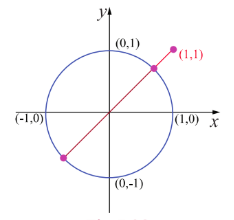
Find the points on the unit circle $x^{2} + y^{2} = 1$ nearest and farthest from $(1, 1)$.
Solution
The distance from the point $(1, 1)$ to any point $(x, y)$ is $d = \sqrt{(x - 1)^2 + (y - 1)^2}$. Instead of extremising $d$, for convenience we extremise $D = d^{2} = (x - 1)^{2} + (y - 1)^{2}$, subject to the condition $x^{2} + y^{2} = 1$. Now, $\frac{dD}{dx} = 2(x - 1) + 2(y - 1) \times \frac{dy}{dx}$, where $\frac{dy}{dx}$ will be computed by differentiating $x^{2} + y^{2} = 1$ with respect to $x$. Therefore, we get $2x + 2y\frac{dy}{dx} = 0$ which gives us $\frac{dy}{dx} = -\frac{x}{y}$.
Since $(x, y)$ lie on the circle $x^{2} + y^{2} = 1$, we get $2x^{2} = 1$ which gives $x = \pm \frac{1}{\sqrt{2}}$. Hence the points at which the extremum distance occur are $\left(\frac{1}{\sqrt{2}}, \frac{1}{\sqrt{2}}\right)$, $\left(-\frac{1}{\sqrt{2}}, -\frac{1}{\sqrt{2}}\right)$.
To find the extrema, we apply second derivative test. So,
The value of $\left(\frac{d^{2}D}{dx^{2}}\right)_{(\frac{1}{\sqrt{2}}, \frac{1}{\sqrt{2}})} > 0$; $\left(\frac{d^{2}D}{dx^{2}}\right)_{(-\frac{1}{\sqrt{2}}, -\frac{1}{\sqrt{2}})} < 0$.
This implies the nearest and farthest points are $\left(\frac{1}{\sqrt{2}}, \frac{1}{\sqrt{2}}\right)$ and $\left(-\frac{1}{\sqrt{2}}, -\frac{1}{\sqrt{2}}\right)$ respectively.
Therefore, the nearest and the farthest distances are respectively $\sqrt{2} - 1$ and $\sqrt{2} + 1$.
Example 7.64
A steel plant is capable of producing $x$ tonnes per day of a low-grade steel and $y$ tonnes per day of a high-grade steel, where $y = \frac{40 - 5x}{10 - x}$. If the fixed market price of low-grade steel is half that of high-grade steel, then what should be optimal productions in low-grade steel and high-grade steel in order to have maximum receipts.
Solution
Let the price of low-grade steel be ₹ $p$ per tonne. Then the price of high-grade steel is ₹ $2p$ per tonne.
The total receipt per day is given by $R = px + 2py = px + 2p\left(\frac{40 - 5x}{10 - x}\right)$. Hence the problem is to maximise $R$. Now, simplifying and differentiating $R$ with respect to $x$, we get
At $x = 10 - 2\sqrt{5}$, $\frac{d^{2}R}{dx^{2}} < 0$ and hence $R$ will be maximum. If $x = 10 - 2\sqrt{5}$ then $y = 5 - \sqrt{5}$. Therefore the steel plant must produce low-grade and high-grade steels respectively in tonnes per day are
Prove that among all the rectangles of the given area square has the least perimeter.
Solution
Let $x, y$ be the sides of the rectangle. Hence the area of the rectangle is $xy = k$ (given). The perimeter of the rectangle $P$ is $2(x + y)$. So the problem is to minimize $2(x + y)$ subject to the condition $xy = k$. Let $P(x) = 2\left(x + \frac{k}{x}\right)$.
As $x, y$ are sides of the rectangle, $x = \sqrt{k}$ is a critical number.
Now, $P^{\prime \prime}(x) = \frac{4k}{x^{3}}$ and $P^{\prime \prime}(\sqrt{k}) > 0 \Rightarrow P(x)$ has its minimum value at $x = \sqrt{k}$.
Substituting $x = \sqrt{k}$ in $xy = k$ we get $y = \sqrt{k}$. Therefore the minimum perimeter rectangle of a given area is a square.
EXERCISE 7.8
Find two positive numbers whose sum is 12 and their product is maximum.
Find two positive numbers whose product is 20 and their sum is minimum.
Find the smallest possible value of $x^{2} + y^{2}$ given that $x + y = 10$.
A garden is to be laid out in a rectangular area and protected by wire fence. What is the largest possible area of the fenced garden with 40 metres of wire.
A rectangular page is to contain $24 \text{ cm}^2$ of print. The margins at the top and bottom of the page are $1.5 \text{ cm}$ and the margins at other sides of the page is $1 \text{ cm}$. What should be the dimensions of the page so that the area of the paper used is minimum.
A farmer plans to fence a rectangular pasture adjacent to a river. The pasture must contain $1,80,000 \text{ sq.m}$ in order to provide enough grass for herds. No fencing is needed along the river. What is the length of the minimum needed fencing material?
Find the dimensions of the rectangle with maximum area that can be inscribed in a circle of radius $10 \text{ cm}$.
Prove that among all the rectangles of the given perimeter, the square has the maximum area.
Find the dimensions of the largest rectangle that can be inscribed in a semi circle of radius $r$ cm.
A manufacturer wants to design an open box having a square base and a surface area of $108 \text{ sq.cm}$. Determine the dimensions of the box for the maximum volume.
The volume of a cylinder is given by the formula $V = \pi r^{2}h$. Find the greatest and least values of $V$ if $r + h = 6$.
A hollow cone with base radius $a$ cm and height $b$ cm is placed on a table. Show that the volume of the largest cylinder that can be hidden underneath is $\frac{4}{9}$ times volume of the cone.
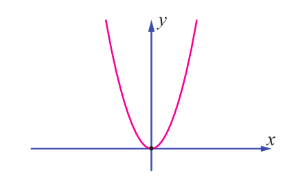
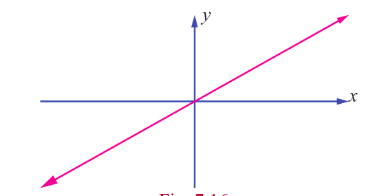
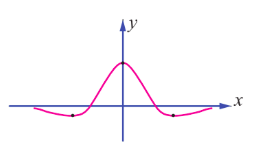
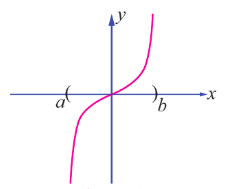
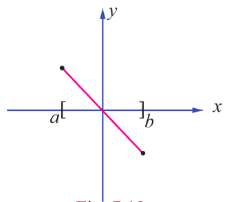
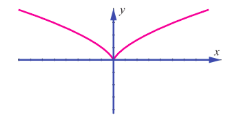
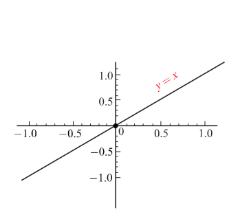
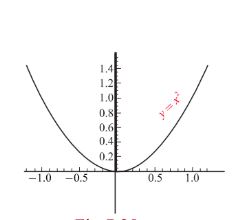
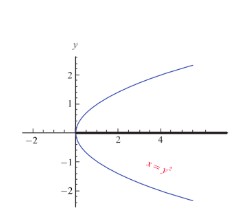
Consider the following curves and observe that each of them is having some special properties, called symmetry with respect to a point, with respect to a line.
Fig. 7.29
|Fig. 7.30
|Fig. 7.31
We now formally define the symmetry as follows:
If an image or a curve is a mirror reflection of another image with respect to a line, we say the image or the curve is symmetric with respect to that line. The line is called the line of symmetry.
A curve is said to have a $\theta$ angle rotational symmetry with respect to a point if the curve is unchanged by a rotation of an angle $\theta$ with respect to that point.
A curve may be symmetric with respect to many lines. Specifically, we consider the symmetry with respect to the coordinate axes and symmetric with respect to the origin. Mathematically, a curve $f(x, y) = 0$ is said to be
Symmetric with respect to the $y$-axis if $f(x, y) = f(-x, y) \ \forall x, y$ or if $(x, y)$ is a point on the graph of the curve then so is $(-x, y)$. If we keep a mirror on the $y$-axis the portion of the curve on one side of the mirror is the same as the portion of the curve on the other side of the mirror.
Symmetric with respect to the $x$-axis if $f(x, y) = f(x, -y) \ \forall x, y$ or if $(x, y)$ is a point on the graph of the curve then so is $(x, -y)$. If we keep a mirror on the $x$-axis the portion of the curve on one side of the mirror is the same as the portion of the curve on the other side of the mirror.
Symmetric with respect to the origin if $f(x, y) = f(-x, -y) \ \forall x, y$ or if $(x, y)$ is a point on the graph of the curve then so is $(-x, -y)$. That is the curve is unchanged if we rotate it by $180^{\circ}$ about the origin.
For instance, the curves mentioned above $x = y^{2}$, $y = x^{2}$ and $y = x$ are symmetric with respect to $x$-axis, $y$-axis and origin respectively.
An asymptote for the curve $y = f(x)$ is a straight line which is a tangent at $\infty$ to the curve. In other words the distance between the curve and the straight line tends to zero when the points on the curve approach infinity. There are three types of asymptotes. They are
Horizontal asymptote, which is parallel to the $x$-axis. The line $y = L$ is said to be a horizontal asymptote for the curve $y = f(x)$ if either $\lim_{x \to \infty} f(x) = L$ or $\lim_{x \to -\infty} f(x) = L$.
Vertical asymptote, which is parallel to the $y$-axis. The line $x = a$ is said to be vertical asymptote for the curve $y = f(x)$ if $\lim_{x \to a^{+}} f(x) = \pm \infty$ or $\lim_{x \to a^{-}} f(x) = \pm \infty$.
Slant asymptote: A slant (oblique) asymptote occurs when the polynomial in the numerator is a higher degree than the polynomial in the denominator.
To find the slant asymptote you must divide the numerator by the denominator using either long division or synthetic division.
Example 7.66
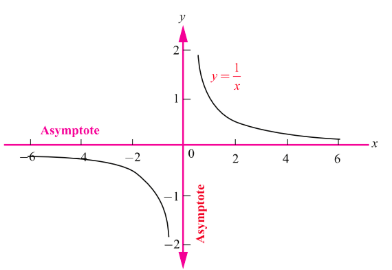
Find the asymptotes of the function $f(x) = \frac{1}{x}$.
Solution
We have, $\lim_{x \to 0^{-}} \frac{1}{x} = -\infty$ and $\lim_{x \to 0^{+}} \frac{1}{x} = \infty$. Hence, the required vertical asymptote is $x = 0$ or the $y$-axis.
As the curve is symmetric with respect to both the axes, $y = 0$ or the $x$-axis is also an asymptote. Hence this (rectangular hyperbola) curve has both the vertical and horizontal asymptotes.
Fig. 7.32
Example 7.67
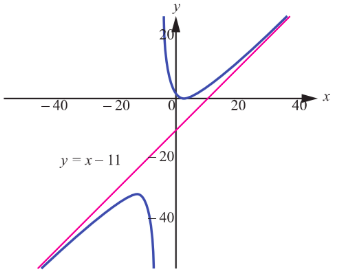
Find the slant (oblique) asymptote for the function $f(x) = \frac{x^{2} - 6x + 7}{x + 5}$.
Solution
Since the polynomial in the numerator is a higher degree $(2^{\text{nd}})$ than the denominator $(1^{\text{st}})$, we know we have a slant asymptote. To find it, we must divide the numerator by the denominator. We can use long division to do that:
Notice that we don’t need to finish the long division problem to find the remainder. We only need the terms that will make up the equation of the line. The slant asymptote is $y = x - 11$.
Fig. 7.33
As you can see in this graph of the function, the curve approaches the slant asymptote $y = x - 11$ but never crosses it.
Example 7.68
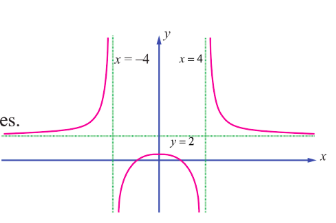
Find the asymptotes of the curve $f(x) = \frac{2x^{2} - 8}{x^{2} - 16}$.
When we are sketching the graph of functions either by hand or through any graphing software we cannot show the entire graph. Only a part of the graph can be sketched. Hence a crucial question is which part of the curve we need to show and how to decide that part. To decide on this we use the derivatives of functions. We enlist few guidelines for determining a good viewing rectangle for the graph of a function. They are:
(i) The domain and the range of the function.
(ii) The intercepts of the curve (if any).
(iii) Critical points of the function.
(iv) Local extrema of the function.
(v) Intervals of concavity.
(vi) Points of inflexions (if any).
(vii) Asymptotes of the curve (if exists)
Example 7.69
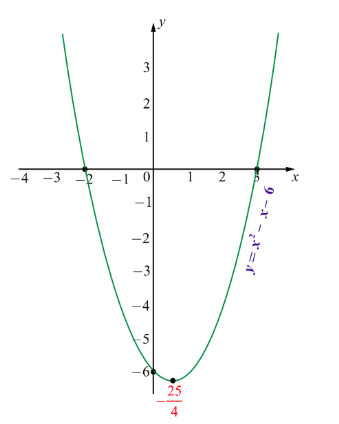
Sketch the curve $y = f(x) = x^{2} - x - 6$.
Solution
Factorising the given function, we have $y = f(x) = (x - 3)(x + 2)$.
(1) The domain of the given function $f(x)$ is the entire real line.
(2) Putting $y = 0$ we get $x = -2, 3$. Therefore the $x$-intercepts are $(-2, 0)$ and $(3, 0)$; putting $x = 0$ we get $y = -6$. Therefore the $y$-intercept is $(0, -6)$.
(3) $f^{\prime}(x) = 2x - 1$ and hence the critical point of the curve occurs at $x = \frac{1}{2}$.
(4) $f^{\prime \prime}(x) = 2 > 0$, $\forall x$. Therefore at $x = \frac{1}{2}$ the curve has a local minimum which is $f\left(\frac{1}{2}\right) = -\frac{25}{4}$.
(5) The range of the function is $y \geq -\frac{25}{4}$.
(6) Since $f^{\prime \prime}(x) = 2 > 0$, $\forall x$ the function is concave upward in the entire real line.
(7) Since $f^{\prime \prime}(x) \neq 0$, $\forall x$ the curve has no points of inflection.
(8) The curve has no asymptotes.
The rough sketch of the curve is shown on the right side.
Fig. 7.35
Example 7.70
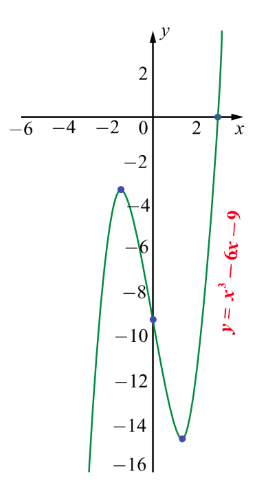
Sketch the curve $y = f(x) = x^{3} - 6x - 9$.
Solution
Factorising the given function, we have
$$
y = f(x) = (x - 3)(x^{2} + 3x + 3).
$$
(1) The domain and the range of the given function $f(x)$ are the entire real line.
(2) Putting $y = 0$, we get $x = 3$. The other two roots are imaginary. Therefore, the $x$-intercept is $(3, 0)$. Putting $x = 0$, we get $y = -9$. Therefore, the $y$-intercept is $(0, -9)$.
(3) $f^{\prime}(x) = 3(x^{2} - 2)$ and hence the critical points of the curve occur at $x = \pm \sqrt{2}$.
(4) $f^{\prime \prime}(x) = 6x$. Therefore at $x = \sqrt{2}$ the curve has a local minimum because $f^{\prime \prime}(\sqrt{2}) = 6\sqrt{2} > 0$. The local minimum is $f(\sqrt{2}) = -4\sqrt{2} - 9$. Similarly at $x = -\sqrt{2}$ the curve has a local maximum because $f^{\prime \prime}(-\sqrt{2}) = -6\sqrt{2} < 0$. The local maximum is $f(-\sqrt{2}) = 4\sqrt{2} - 9$.
(5) Since $f^{\prime \prime}(x) = 6x > 0$ $\forall x > 0$ the function is concave upward in the positive real line. As $f^{\prime \prime}(x) = 6x < 0$ $\forall x < 0$ the function is concave downward in the negative real line.
(6) Since $f^{\prime \prime}(x) = 0$ at $x = 0$ and $f^{\prime \prime}(x)$ changes its sign when passing through $x = 0$. Therefore the point of inflection is $(0, f(0)) = (0, -9)$.
(7) The curve has no asymptotes.
The rough sketch of the curve is shown on the right side.
Fig. 7.36
Example 7.71
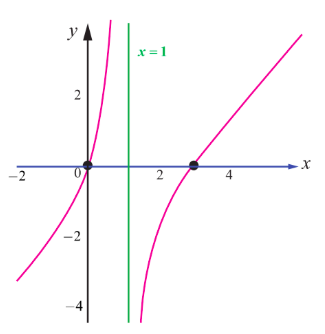
Sketch the curve $y = \frac{x^{2} - 3x}{(x - 1)}$.
Solution
Factorising the given function we have,
$$
y = f(x) = \frac{x(x - 3)}{(x - 1)}.
$$
(1) The domain and the range of $f(x)$ are respectively $\mathbb{R} \setminus \{1\}$ and the entire real line.
(2) Putting $y = 0$ we get $x = 0, 3$. Therefore the $x$-intercepts are $(0, 0)$ and $(3, 0)$. Putting $x = 0$, we get $y = 0$. Therefore the curve passes through the origin.
(3) $f^{\prime}(x) = \frac{x^{2} - 2x + 3}{(x - 1)^{2}}$ and hence the critical point of the curve occurs at $x = 1$ as $f^{\prime}(1)$ does not exist. But $x^{2} - 2x + 3 = 0$ has no real solution. Hence the only critical point occurs at $x = 1$.
(4) $x = 1$ is not in the domain of the function and $f^{\prime}(x) \neq 0$ $\forall x \in \mathbb{R} \setminus \{1\}$, there is no local maximum or local minimum.
(5) $f^{\prime \prime}(x) = -\frac{4}{(x - 1)^{3}}$ $\forall x \in \mathbb{R} \setminus \{1\}$. Therefore when $x < 1$, $f^{\prime \prime}(x) > 0$ the curve is concave upwards in $(-\infty, 1)$ and when $x > 1$, $f^{\prime \prime}(x) < 0$ the curve is concave downwards in $(1, \infty)$. Since $x = 1$ is not in the domain $f^{\prime \prime}(x) \neq 0$ $\forall x \in \mathbb{R} \setminus \{1\}$ there is no point of inflection for $f(x)$.
(6) Since $\lim_{x \to 1^{-}} \frac{x^{2} - 3x}{(x - 1)} = +\infty$ and $\lim_{x \to 1^{+}} \frac{x^{2} - 3x}{(x - 1)} = -\infty$, $x = 1$ is a vertical asymptote.
The rough sketch is shown on the right side.
Fig. 7.37
Example 7.72
Sketch the graph of the function $y = \frac{3x}{x^{2} - 1}$.
Solution
(1) The domain of $f(x)$ is $\mathbb{R} \setminus \{-1, 1\}$.
(2) Since $f(-x, -y) = f(x, y)$, the curve is symmetric about the origin.
(3) Putting $y = 0$, we get $x = 0$. Hence the $x$-intercept is $(0, 0)$.
(4) Putting $x = 0$, we get $y = 0$. Hence the $y$-intercept is $(0, 0)$.
(5) To determine monotonicity, we find the first derivative as $f^{\prime}(x) = \frac{-3(x^{2} + 1)}{(x^{2} - 1)^{2}}$.
Hence, $f^{\prime}(x)$ does not exist at $x = -1, 1$. Therefore, critical numbers are $x = -1, 1$. The intervals of monotonicity is tabulated in Table 7.9.
Interval
$(-\infty, -1)$
$(-1, 1)$
$(1, \infty)$
Sign of $f'(x)$
$-$
$-$
$-$
Monotonicity
strictly decreasing
strictly decreasing
strictly decreasing
(6) Since there is no sign change in $f^{\prime}(x)$ when passing through critical numbers, there is no local extrema.
(7) To determine the concavity, we find the second derivative as $f^{\prime \prime}(x) = \frac{6x(x^{2} + 3)}{(x^{2} - 1)^{3}}$.
$f^{\prime \prime}(x) = 0 \Rightarrow x = 0$ and $f^{\prime \prime}(x)$ does not exist at $x = -1, 1$.
The intervals of concavity is tabulated in Table 7.10.
Interval
$(-\infty, -1)$
$(-1, 0)$
$(0, 1)$
$(1, \infty)$
Sign of $f''(x)$
$-$
$+$
$-$
$+$
Concavity
concave down
concave up
concave down
concave up
(8) As $x = -1$ and $1$ are not in the domain of $f(x)$ and at $x = 0$, the second derivative is zero and $f^{\prime \prime}(x)$ changes its sign from negative to positive when passing through $x = 0$. Therefore, the point of inflection is $(0, f(0)) = (0, 0)$.