Chapter 6: Applications of Vector Algebra#
“Mathematics is the science of the connection of magnitudes. Magnitude is anything that can be put equal or unequal to another thing. Two things are equal when in every assertion each may be replaced by the other.”
— Hermann Gunther Grassmann
6.1 Introduction#
We are familiar with the concept of vectors, (vectors in Latin means “to carry”) from our XI standard text book. Further the modern version of Theory of Vectors arises from the ideas of Wessel(1745- 1818) and Argand (1768- 1822) when they attempt to describe the complex numbers geometrically as a directed line segment in a coordinate plane. We have seen that a vector has magnitude and direction and two vectors with same magnitude and direction regardless of positions of their initial points are always equal.
We also have studied addition of two vectors, scalar multiplication of vectors, dot product, and cross product by denoting an arbitrary vector by the notation $\vec{a}$ or $a_{i}\hat{i} + a_{j}\hat{j} + a_{k}\hat{k}$. To understand the direction and magnitude of a given vector and all other concepts with a little more rigor, we shall recall the geometric introduction of vectors, which will be useful to discuss the equations of straight lines and planes. Great mathematicians Grassmann, Hamilton, Clifford and Gibbs were pioneers to introduce the dot and cross products of vectors.
The vector algebra has a few direct applications in physics and it has a lot of applications along with vector calculus in physics, engineering, and medicine. Some of them are mentioned below.
- To calculate the volume of a parallelepiped, the scalar triple product is used.
- To find the work done and torque in mechanics, the dot and cross products are respectively used.
- To introduce curl and divergence of vectors, vector algebra is used along with calculus. Curl and divergence are very much used in the study of electromagnetism, hydrodynamics, blood flow, rocket launching, and the path of a satellite.
- To calculate the distance between two aircrafts in the space and the angle between their paths, the dot and cross products are used.
- To install the solar panels by carefully considering the tilt of the roof, and the direction of the Sun so that it generates more solar power, a simple application of dot product of vectors is used. One can calculate the amount of solar power generated by a solar panel by using vector algebra.
- To measure angles and distance between the panels in the satellites, in the construction of networks of pipes in various industries, and, in calculating angles and distance between beams and structures in civil engineering, vector algebra is used.
Learning Objectives#
Upon completion of this chapter, students will be able to
- apply scalar and vector products of two and three vectors
- solve problems in geometry, trigonometry, and physics
- derive equations of a line in parametric, non-parametric, and cartesian forms in different situations
- derive equations of a plane in parametric, non-parametric, and cartesian forms in different situations
- find angle between the lines and distance between skew lines
- find the coordinates of the image of a point
6.2 Geometric introduction to vectors#
A vector $\bar{\nu}$ is represented as a directed straight line segment in a 3-dimensional space $\mathbb{R}^3$, with an initial point $A = (a_{1},a_{2},a_{3})\in \mathbb{R}^{3}$ and an end point $B = (b_{1},b_{2},b_{3})\in \mathbb{R}^{3}$, and it is denoted by $\overline{AB}$. The length of the line segment $AB$ is the magnitude of the vector $\bar{\nu}$ and the direction from $A$ to $B$ is the direction of the vector $\bar{\nu}$. Hereafter, a vector will be interchangeably denoted by $\bar{\nu}$ or $\overline{AB}$. Two vectors $\overline{AB}$ and $\overline{CD}$ in $\mathbb{R}^3$ are said to be equal if and only if the length $AB$ is equal to the length $CD$ and the direction from $A$ to $B$ is parallel to the direction from $C$ to $D$. If $\overline{AB}$ and $\overline{CD}$ are equal, we write $\overline{AB} = \overline{CD}$, and $\overline{CD}$ is called a translate of $\overline{AB}$.
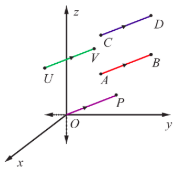
It is easy to observe that every vector $\overline{AB}$ can be translated to anywhere in $\mathbb{R}^3$, equal to a vector with initial point $U\in \mathbb{R}^3$ and end point $V\in \mathbb{R}^3$ such that $\overline{AB} = \overline{UV}$. In particular, if $O$ is the origin of $\mathbb{R}^3$, then a point $P\in \mathbb{R}^3$ can be found such that $\overline{AB} = \overline{OP}$. The vector $\overline{OP}$ is called the position vector of the point $P$. Moreover, we observe that given any vector $\bar{\nu}$, there exists a unique point $P\in \mathbb{R}^3$ such that the position vector $\overline{OP}$ of $P$ is equal to $\bar{\nu}$. A vector $\overline{AB}$ is said to be the zero vector if the initial point $A$ is the same as the end point $B$. We use the standard notations $\hat{i},\hat{j},\hat{k}$ and $\bar{0}$ to denote the position vectors of the points $(1,0,0),(0,1,0),(0,0,1)$, and $(0,0,0)$, respectively. For a given point $(a_{1},a_{2},a_{3})\in \mathbb{R}^{3}$, $a_{1}\hat{i} + a_{2}\hat{j} + a_{3}\hat{k}$ is called the position vector of the point $(a_{1},a_{2},a_{3})$, which is the directed straight line segment with initial point $(0,0,0)$ and end point $(a_{1},a_{2},a_{3})$. All real numbers are called scalars.
Given a vector $\overline{AB}$, the length of the vector is calculated by
$$ \sqrt{(b_{1} - a_{1})^{2} + (b_{2} - a_{2})^{2} + (b_{3} - a_{3})^{2}}, $$where $A$ is $(a_{1},a_{2},a_{3})$ and $B$ is $(b_{1},b_{2},b_{3})$. In particular, if a vector is the position vector $\vec{b}$ of $(b_{1},b_{2},b_{3})$, then its length is $\sqrt{b_{1}^{2} + b_{2}^{2} + b_{3}^{2}}$. A vector having length 1 is called a unit vector. We use the notation $\hat{u}$, for a unit vector. Note that $\hat{i},\hat{j}$, and $\hat{k}$ are unit vectors and $\vec{0}$ is the unique vector with length 0. The direction of $\vec{0}$ is specified according to the context.
The addition and scalar multiplication on vectors in 3-dimensional space are defined by
$$ \vec{a} +\vec{b} = (a_{1} + b_{1})\hat{i} + (a_{2} + b_{2})\hat{j} + (a_{3} + b_{3})\hat{k}. $$$$ \alpha \vec{a} = (\alpha a_{1})\hat{i} + (\alpha a_{2})\hat{j} + (\alpha a_{3})\hat{k}; $$where
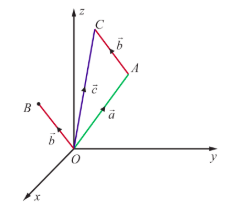
$$ \vec{a} = a_{1}\hat{i} + a_{2}\hat{j} + a_{3}\hat{k},\quad \vec{b} = b_{1}\hat{i} + b_{2}\hat{j} + b_{3}\hat{k}\in \mathbb{R}^{3}\quad \text{and}\quad \alpha \in \mathbb{R}. $$To see the geometric interpretation of $\vec{a} +\vec{b}$, let $\vec{a}$ and $\vec{b}$, denote the position vectors of $A = (a_{1},a_{2},a_{3})$ and $B = (b_{1},b_{2},b_{3})$, respectively. Translate the position vector $\vec{b}$ to the vector with initial point as $A$ and end point as $C = (c_{1},c_{2},c_{3})$, for a suitable $(c_{1},c_{2},c_{3})\in \mathbb{R}^{3}$. See the Fig (6.2). Then, the position vector $\vec{c}$ of the point $(c_{1},c_{2},c_{3})$ is equal to $\vec{a} +\vec{b}$.
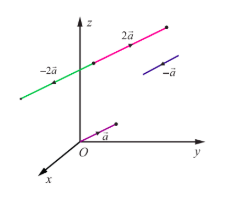
The vector $\alpha \vec{a}$ is another vector parallel to $\vec{a}$ and its length is magnified (if $\alpha >1$) or contracted (if $0< \alpha < 1$). If $\alpha < 0$, then $\alpha \vec{a}$ is a vector whose magnitude is $|\alpha|$ times that of $\vec{a}$ and direction opposite to that of $\vec{a}$. In particular, if $\alpha = -1$, then $\alpha \vec{a} = -\vec{a}$ is the vector with same length and direction opposite to that of $\vec{a}$. See Fig. 6.3
6.3 Scalar Product and Vector Product#
Next we recall the scalar product and vector product of two vectors as follows.
Definition 6.1
Given two vectors $\vec{a} = a_{1}\hat{i} + a_{2}\hat{j} + a_{3}\hat{k}$ and $\vec{b} = b_{1}\hat{i} + b_{2}\hat{j} + b_{3}\hat{k}$ the scalar product (or dot product) is denoted by $\vec{a}\cdot \vec{b}$ and is calculated by
$$ \vec{a}\cdot \vec{b} = a_{1}b_{1} + a_{2}b_{2} + a_{3}b_{3}, $$and the vector product (or cross product) is denoted by $\vec{a}\times \vec{b}$, and is calculated by
$$ \vec{a}\times \vec{b} = \begin{vmatrix} \hat{i} & \hat{j} & \hat{k} \\ a_{1} & a_{2} & a_{3} \\ b_{1} & b_{2} & b_{3} \end{vmatrix}. $$
Note
$\vec{a}\cdot \vec{b}$ is a scalar, and $\vec{a}\times \vec{b}$ is a vector.
6.3.1 Geometrical interpretation#
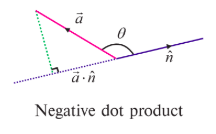
Geometrically, if $\vec{a}$ is an arbitrary vector and $\hat{n}$ is a unit vector, then $\vec{a}\cdot \hat{n}$ is the projection of the vector $\vec{a}$ on the straight line on which $\hat{n}$ lies. The quantity $\vec{a}\cdot \hat{n}$ is positive if the angle between $\vec{a}$ and $\hat{n}$ is acute, see Fig. 6.4 and negative if the angle between $\vec{a}$ and $\hat{n}$ is obtuse see Fig. 6.5.
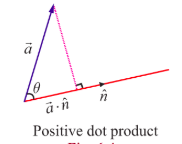
If $\vec{a}$ and $\vec{b}$ are arbitrary non-zero vectors, then $|\vec{a}\cdot \vec{b}| = |\vec{b}| \left|\vec{a}\cdot \left(\frac{\vec{b}}{|\vec{b}|}\right)\right| = |\vec{a}| \left|\vec{b}\cdot \left(\frac{\vec{a}}{|\vec{a}|}\right)\right|$ and so $|\vec{a}\cdot \vec{b}|$ means either the length of the straight line segment obtained by projecting the vector $|\vec{b}| \vec{a}$ along the direction of $\vec{b}$ or the length of the line segment obtained by projecting the vector $|\vec{a}| \vec{b}$ along the direction of $\vec{a}$. We recall that $\vec{a}\cdot \vec{b} = |\vec{a}| |\vec{b}| \cos \theta$, where $\theta$ is the angle between the two vectors $\vec{a}$ and $\vec{b}$. We recall that the angle between $\vec{a}$ and $\vec{b}$ is defined as the measure from $\vec{a}$ to $\vec{b}$ in the counter clockwise direction.
The vector $\vec{a}\times \vec{b}$ is either $\vec{0}$ or a vector perpendicular to the plane parallel to both $\vec{a}$ and $\vec{b}$ having magnitude as the area of the parallelogram formed by coterminus vectors parallel to $\vec{a}$ and $\vec{b}$. If $\vec{a}$ and $\vec{b}$ are non-zero vectors, then the magnitude of $\vec{a}\times \vec{b}$ can be calculated by the formula
$$ |\vec{a}\times \vec{b}| = |\vec{a}| |\vec{b}| |\sin \theta|, \text{where } \theta \text{ is the angle between } \vec{a} \text{ and } \vec{b}. $$Two vectors are said to be coterminus if they have same initial point.
Remark
(1) An angle between two non-zero vectors $\vec{a}$ and $\vec{b}$ is found by the following formula
$$ \theta = \cos^{-1} \left( \frac{\vec{a}\cdot \vec{b}}{|\vec{a}| |\vec{b}|} \right). $$(2) $\vec{a}$ and $\vec{b}$ are said to be parallel if the angle between them is $0$ or $\pi$.
(3) $\vec{a}$ and $\vec{b}$ are said to be perpendicular if the angle between them is $\frac{\pi}{2}$ or $\frac{3\pi}{2}$.
Property
(1) Let $\vec{a}$ and $\vec{b}$ be any two nonzero vectors. Then
- $\vec{a}\cdot \vec{b} = 0$ if and only if $\vec{a}$ and $\vec{b}$ are perpendicular to each other.
- $\vec{a}\times \vec{b} = \vec{0}$ if and only if $\vec{a}$ and $\vec{b}$ are parallel to each other.
(2) If $\vec{a},\vec{b}$, and $\vec{c}$ are any three vectors and $\alpha$ is a scalar, then
$$ \vec{a}\cdot \vec{b} = \vec{b}\cdot \vec{a},\quad (\vec{a} +\vec{b})\cdot \vec{c} = \vec{a}\cdot \vec{b} +\vec{b}\cdot \vec{c},\quad (\alpha \vec{a})\cdot \vec{b} = \alpha (\vec{a}\cdot \vec{b}) = \vec{a}\cdot (\alpha \vec{b}); $$$$ \vec{a}\times \vec{b} = -(\vec{b}\times \vec{a}),\quad (\vec{a} +\vec{b})\times \vec{c} = \vec{a}\times \vec{c} +\vec{b}\times \vec{c},\quad (\alpha \vec{a})\times \vec{b} = \alpha (\vec{a}\times \vec{b}) = \vec{a}\times (\alpha \vec{b}). $$6.3.2 Application of dot and cross products in plane Trigonometry#
We apply the concepts of dot and cross products of two vectors to derive a few formulae in plane trigonometry.
Example 6.1 (Cosine formulae)
With usual notations, in any triangle $ABC$, prove the following by vector method.
$$ a^{2} = b^{2} + c^{2} - 2bc\cos A $$$$ c^{2} = a^{2} + b^{2} - 2ab\cos C $$Solution
With usual notations in triangle $ABC$, we have $\overline{BC} = \vec{a},\overline{CA} = \vec{b}$ and $\overline{AB} = \vec{c}$. Then $|\overline{BC}| = a,|\overline{CA}| = b$, $|\overline{AB}| = c$ and $\overline{BC} +\overline{CA} +\overline{AB} = \vec{0}$.
So, $\overline{BC} = -\overline{CA} -\overline{AB}$.
Then applying dot product, we get
$$ \overline{BC}\cdot \overline{BC} = (-\overline{CA} -\overline{AB})\cdot (-\overline{CA} -\overline{AB}) $$$$ \Rightarrow |\overline{BC}|^{2} = |\overline{CA}|^{2} + |\overline{AB}|^{2} + 2\overline{CA}\cdot \overline{AB} $$$$ \Rightarrow a^{2} = b^{2} + c^{2} + 2bc\cos (\pi -A) $$$$ \Rightarrow a^{2} = b^{2} + c^{2} - 2bc\cos A. $$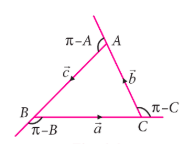
The results in (ii) and (iii) are proved in a similar way.
Example 6.2
With usual notations, in any triangle $ABC$, prove the following by vector method.
$$ a = b\cos C + c\cos B $$$$ c = a\cos B + b\cos A $$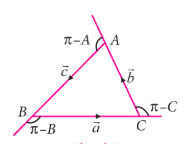
Solution
With usual notations in triangle $ABC$, we have $\overrightarrow{BC} = \vec{a}$, $\overrightarrow{CA} = \vec{b}$, and $\overrightarrow{AB} = \vec{c}$. Then
$$ |\overrightarrow{BC}| = a, |\overrightarrow{CA}| = b, |\overrightarrow{AB}| = c \text{ and } \overrightarrow{BC} +\overrightarrow{CA} +\overrightarrow{AB} = \vec{0} $$So, $\overrightarrow{BC} = -\overrightarrow{CA} -\overrightarrow{AB}$
Applying dot product, we get
$$ \overrightarrow{BC}\cdot \overrightarrow{BC} = -\overrightarrow{BC}\cdot \overrightarrow{CA} -\overrightarrow{BC}\cdot \overrightarrow{AB} $$$$ \Rightarrow |\overrightarrow{BC}|^{2} = -|\overrightarrow{BC}| |\overrightarrow{CA}| \cos (\pi -C) - |\overrightarrow{BC}| |\overrightarrow{AB}| \cos (\pi -B) $$$$ \Rightarrow a^{2} = ab\cos C + ac\cos B $$Therefore $a = b\cos C + c\cos B$. The results in (ii) and (iii) are proved in a similar way.
Example 6.3
By vector method, prove that $\cos (\alpha +\beta) = \cos \alpha \cos \beta - \sin \alpha \sin \beta$.
Solution
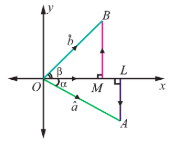
Let $\hat{a} = \overrightarrow{OA}$ and $\hat{b} = \overrightarrow{OB}$ be the unit vectors and which make angles $\alpha$ and $\beta$, respectively, with positive $x$-axis, where $A$ and $B$ are as in the Fig. 6.8. Draw $AL$ and $BM$ perpendicular to the $x$-axis. Then $|\overrightarrow{OL}| = |\overrightarrow{OA}| \cos \alpha = \cos \alpha$, $|\overrightarrow{LA}| = |\overrightarrow{OA}| \sin \alpha = \sin \alpha$.
$$ \overrightarrow{OL} = |\overrightarrow{OL}| \hat{i} = \cos \alpha \hat{i},\quad \overrightarrow{LA} = \sin \alpha (-\hat{j}). $$Therefore, $\hat{a} = \overrightarrow{OA} = \overrightarrow{OL} +\overrightarrow{LA} = \cos \alpha \hat{i} - \sin \alpha \hat{j}$ … (1)
Similarly, $\hat{b} = \cos \beta \hat{i} + \sin \beta \hat{j}$ … (2)
The angle between $\hat{a}$ and $\hat{b}$ is $\alpha +\beta$ and so,
$$ \hat{a}\cdot \hat{b} = |\hat{a}| |\hat{b}| \cos (\alpha +\beta) = \cos (\alpha +\beta) \quad \dots (3) $$On the other hand, from (1) and (2)
$$ \hat{a}\cdot \hat{b} = (\cos \alpha \hat{i} - \sin \alpha \hat{j})\cdot (\cos \beta \hat{i} + \sin \beta \hat{j}) = \cos \alpha \cos \beta - \sin \alpha \sin \beta \dots (4) $$From (3) and (4), we get $\cos (\alpha +\beta) = \cos \alpha \cos \beta - \sin \alpha \sin \beta$.
Example 6.4
With usual notations, in any triangle $ABC$, prove by vector method that $\frac{a}{\sin A} = \frac{b}{\sin B} = \frac{c}{\sin C}$.
Solution
With usual notations in triangle $ABC$, we have $\overrightarrow{BC} = \vec{a},\overrightarrow{CA} = \vec{b}$, and $\overrightarrow{AB} = \vec{c}$. Then $|\overrightarrow{BC}| = a$, $|\overrightarrow{CA}| = b$ and $|\overrightarrow{AB}| = c$.
Since in $\Delta ABC$, $\overrightarrow{BC} +\overrightarrow{CA} +\overrightarrow{AB} = 0$, we have $\overrightarrow{BC}\times (\overrightarrow{BC} +\overrightarrow{CA} +\overrightarrow{AB}) = \vec{0}$.
Simplification gives,
$$ \overrightarrow{BC}\times \overrightarrow{CA} = \overrightarrow{AB}\times \overrightarrow{BC}. $$Similarly, since $\overrightarrow{BC} +\overrightarrow{CA} +\overrightarrow{AB} = \vec{0}$, we have
$$ \overrightarrow{CA}\times (\overrightarrow{BC} +\overrightarrow{CA} +\overrightarrow{AB}) = \vec{0}. $$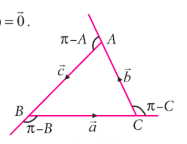
On Simplification, we obtain $\overrightarrow{BC}\times \overrightarrow{CA} = \overrightarrow{CA}\times \overrightarrow{AB}$ … (2)
Equations (1) and (2), we get
$$ \overrightarrow{AB}\times \overrightarrow{BC} = \overrightarrow{CA}\times \overrightarrow{AB} = \overrightarrow{BC}\times \overrightarrow{CA}. $$So, $|\overrightarrow{AB}\times \overrightarrow{BC}| = |\overrightarrow{CA}\times \overrightarrow{AB}| = |\overrightarrow{BC}\times \overrightarrow{CA}|$.
$$ ca\sin (\pi -B) = bc\sin (\pi -A) = ab\sin (\pi -C). $$That is, $ca\sin B = bc\sin A = ab\sin C$. Dividing by $abc$, leads to
$$ \frac{\sin A}{a} = \frac{\sin B}{b} = \frac{\sin C}{c} \quad \text{or} \quad \frac{a}{\sin A} = \frac{b}{\sin B} = \frac{c}{\sin C}. $$Example 6.5
Prove by vector method that $\sin (\alpha - \beta) = \sin \alpha \cos \beta - \cos \alpha \sin \beta$.
Solution
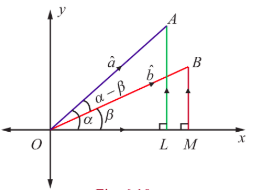
Let $\hat{a} = \overline{OA}$ and $\vec{b} = \overline{OB}$ be the unit vectors making angles $\alpha$ and $\beta$ respectively, with positive $x$-axis, where $A$ and $B$ are as shown in the Fig. 6.10. Then, we get $\hat{a} = \cos \alpha \hat{i} + \sin \alpha \hat{j}$ and $\hat{b} = \cos \beta \hat{i} + \sin \beta \hat{j}$.
The angle between $\hat{a}$ and $\hat{b}$ is $\alpha - \beta$ and, the vectors $\hat{b},\hat{a},\hat{k}$ form a right-handed system.
Hence, we get
$$ \hat{b}\times \hat{a} = |\hat{b}| |\hat{a}| \sin (\alpha -\beta)\hat{k} = \sin (\alpha -\beta)\hat{k}. \quad (1) $$On the other hand,
$$ \hat{b}\times \hat{a} = \begin{vmatrix} \hat{i} & \hat{j} & \hat{k} \\ \cos \beta & \sin \beta & 0 \\ \cos \alpha & \sin \alpha & 0 \end{vmatrix} = (\sin \alpha \cos \beta - \cos \alpha \sin \beta)\hat{k} \quad (2) $$Hence, equations (1) and (2), leads to
$$ \sin (\alpha -\beta) = \sin \alpha \cos \beta - \cos \alpha \sin \beta. $$6.3.3 Application of dot and cross products in Geometry#
Example 6.6 (Apollonius’s theorem)
If $D$ is the midpoint of the side $BC$ of a triangle $ABC$, show by vector method that $|\overline{AB}|^{2} + |\overline{AC}|^{2} = 2(|\overline{AD}|^{2} + |\overline{BD}|^{2})$.
Solution
Let $A$ be the origin, $\vec{b}$ be the position vector of $B$ and $\vec{c}$ be the position vector of $C$. Now $D$ is the midpoint of $BC$, and so the, position vector of $D$ is $\frac{\vec{b} + \vec{c}}{2}$. Therefore, we have
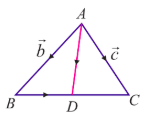
Now, $\overline{BD} = \overline{AD} - \overline{AB} = \frac{\bar{b} + \bar{c}}{2} - \bar{b} = \frac{\bar{c} - \bar{b}}{2}$.
Then, this gives,
$$ |\overline{BD}|^{2} = \overline{BD}\cdot \overline{BD} = \left(\frac{\bar{c} - \bar{b}}{2}\right)\cdot \left(\frac{\bar{c} - \bar{b}}{2}\right) = \frac{1}{4} (|\bar{b}|^{2} + |\bar{c}|^{2} - 2\bar{b}\cdot \bar{c}) \quad (2) $$Now, adding (1) and (2), we get
$$ |\overline{AD}|^{2} + |\overline{BD}|^{2} = \frac{1}{4} (|\bar{b}|^{2} + |\bar{c}|^{2} + 2\bar{b}\cdot \bar{c}) + \frac{1}{4} (|\bar{b}|^{2} + |\bar{c}|^{2} - 2\bar{b}\cdot \bar{c}) = \frac{1}{2} (|\bar{b}|^{2} + |\bar{c}|^{2}) $$$$ \Rightarrow |\overline{AD}|^{2} + |\overline{BD}|^{2} = \frac{1}{2} (|\overline{AB}|^{2} + |\overline{AC}|^{2}). $$Hence, $|\overline{AB}|^{2} + |\overline{AC}|^{2} = 2(|\overline{AD}|^{2} + |\overline{BD}|^{2})$.
Example 6.7
Prove by vector method that the perpendiculars (altitudes) from the vertices to the opposite sides of a triangle are concurrent.
Solution
Consider a triangle ABC in which the two altitudes AD and BE intersect at O. Let CO be produced to meet AB at F. We take O as the origin and let $\overline{OA} = \overline{a},\overline{OB} = \overline{b}$ and $\overline{OC} = \overline{c}$.
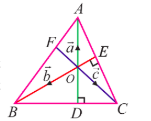
Since $\overline{AD}$ is perpendicular to $\overline{BC}$, we have $\overline{OA}$ is perpendicular to $\overline{BC}$, and hence we get $\overline{OA}\cdot \overline{BC} = 0$. That is, $\overline{a}\cdot (\overline{c} - \overline{b}) = 0$, which means
$$ \overline{a}\cdot \overline{c} - \overline{a}\cdot \overline{b} = 0. \quad (1) $$Similarly, since $\overline{BE}$ is perpendicular to $\overline{CA}$, we have $\overline{OB}$ is perpendicular to $\overline{CA}$, and hence we get $\overline{OB}\cdot \overline{CA} = 0$. That is, $\overline{b}\cdot (\overline{a} - \overline{c}) = 0$, which means,
$$ \overline{a}\cdot \overline{b} - \overline{b}\cdot \overline{c} = 0. \quad (2) $$Adding equations (1) and (2), gives $\overline{a}\cdot \overline{c} - \overline{b}\cdot \overline{c} = 0$. That is, $\overline{c}\cdot (\overline{a} - \overline{b}) = 0$.
That is, $\overline{OC}\cdot \overline{BA} = 0$. Therefore, $\overline{BA}$ is perpendicular to $\overline{OC}$ which implies that $\overline{CF}$ is perpendicular to $\overline{AB}$. Hence, the perpendicular drawn from C to the side AB passes through O. Thus, the altitudes are concurrent.
Example 6.8
In triangle ABC, the points D, E, F are the midpoints of the sides BC, CA, and AB respectively. Using vector method, show that the area of $\Delta DEF$ is equal to $\frac{1}{4}$ (area of $\Delta ABC$).
Solution
In triangle $ABC$, consider $A$ as the origin. Then the position vectors of $D,E,F$ are given by $\frac{\overline{AB} + \overline{AC}}{2}, \frac{\overline{AC}}{2}, \frac{\overline{AB}}{2}$ respectively. Since $|\overline{AB}\times \overline{AC}|$ is the area of the parallelogram formed by the two vectors $\overline{AB}$ and $\overline{AC}$ as adjacent sides, the area of $\Delta ABC$ is $\frac{1}{2} |\overline{AB}\times \overline{AC}|$.
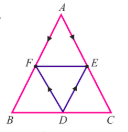
Similarly, considering $\Delta DEF$, we have the area of $\Delta DEF = \frac{1}{2} |\overline{DE}\times \overline{DF}|$.
Now, $\overline{DE} = \frac{\overline{AC}}{2} - \frac{\overline{AB} + \overline{AC}}{2} = -\frac{\overline{AB}}{2}$ and $\overline{DF} = \frac{\overline{AB}}{2} - \frac{\overline{AB} + \overline{AC}}{2} = -\frac{\overline{AC}}{2}$.
Hence, $\overline{DE}\times \overline{DF} = \left(-\frac{\overline{AB}}{2}\right) \times \left(-\frac{\overline{AC}}{2}\right) = \frac{1}{4} (\overline{AB}\times \overline{AC})$.
Therefore, area of $\Delta DEF = \frac{1}{2} |\overline{DE}\times \overline{DF}| = \frac{1}{2} \cdot \frac{1}{4} |\overline{AB}\times \overline{AC}| = \frac{1}{4} \left( \frac{1}{2} |\overline{AB}\times \overline{AC}| \right) = \frac{1}{4} (\text{area of } \Delta ABC)$.
6.3.4 Application of dot and cross product in Physics#
Definition 6.2
If $\vec{d}$ is the displacement vector of a particle moved from a point to another point after applying a constant force $\vec{F}$ on the particle, then the work done by the force on the particle is $w = \vec{F}\cdot \vec{d}$.

If the force has an acute angle, perpendicular angle, and an obtuse angle, the work done by the force is positive, zero, and negative respectively.
Example 6.9
A particle acted upon by constant forces $2\hat{i} +5\hat{j} +6\hat{k}$ and $-\hat{i} - 2\hat{j} - \hat{k}$ is displaced from the point $(4, -3, -2)$ to the point $(6,1, -3)$. Find the total work done by the forces.
Solution
Resultant of the given forces is $\vec{F} = (2\hat{i} +5\hat{j} +6\hat{k}) + (-\hat{i} - 2\hat{j} - \hat{k}) = \hat{i} +3\hat{j} +5\hat{k}$.
Let $A$ and $B$ be the points $(4, -3, -2)$ and $(6,1, -3)$ respectively. Then the displacement vector of the particle is $\vec{d} = \overline{AB} = \overline{OB} -\overline{OA} = (6\hat{i} +\hat{j} - 3\hat{k}) - (4\hat{i} - 3\hat{j} - 2\hat{k}) = 2\hat{i} +4\hat{j} - \hat{k}$.
Therefore the work done $w = \vec{F}\cdot \vec{d} = (\hat{i} +3\hat{j} +5\hat{k})\cdot (2\hat{i} +4\hat{j} - \hat{k}) = 9$ units.
Example 6.10
A particle is acted upon by the forces $3\hat{i} - 2\hat{j} +2\hat{k}$ and $2\hat{i} +\hat{j} -\hat{k}$ is displaced from the point $(1,3, -1)$ to the point $(4, -1,\lambda)$. If the work done by the forces is 16 units, find the value of $\lambda$.
Solution
Resultant of the given forces is $\vec{F} = (3\hat{i} - 2\hat{j} +2\hat{k}) + (2\hat{i} +\hat{j} -\hat{k}) = 5\hat{i} -\hat{j} +\hat{k}$.
The displacement of the particle is given by
$$ \vec{d} = (4\hat{i} -\hat{j} +\lambda \hat{k}) - (\hat{i} +3\hat{j} -\hat{k}) = (3\hat{i} -4\hat{j} +(\lambda +1)\hat{k}). $$As the work done by the forces is 16 units, we have
$$ \vec{F}\cdot \vec{d} = 16. $$That is, $(5\hat{i} -\hat{j} +\hat{k})\cdot (3\hat{i} -4\hat{j} +(\lambda +1)\hat{k}) = 16 \Rightarrow \lambda + 20 = 16$.
So, $\lambda = -4$.
Definition 6.3
If a force $\vec{F}$ is applied on a particle at a point with position vector $\vec{r}$, then the torque or moment on the particle is given by $\vec{t} = \vec{r}\times \vec{F}$. The torque is also called the rotational force.
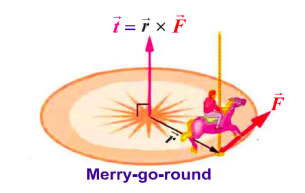
Example 6.11
Find the magnitude and the direction cosines of the torque about the point $(2,0, -1)$ of a force $2\hat{i} +\hat{j} -\hat{k}$, whose line of action passes through the origin.
Solution
Let $A$ be the point $(2,0, -1)$. Then the position vector of $A$ is $\overrightarrow{OA} = 2\hat{i} -\hat{k}$ and therefore $\vec{r} = \overrightarrow{AO} = -2\hat{i} +\hat{k}$.
Then the given force is $\vec{F} = 2\hat{i} +\hat{j} -\hat{k}$. So, the torque is
$$ \vec{t} = \vec{r}\times \vec{F} = \begin{vmatrix} \hat{i} & \hat{j} & \hat{k} \\ -2 & 0 & 1 \\ 2 & 1 & -1 \end{vmatrix} = \hat{i}(0 \cdot (-1) - 1 \cdot 1) - \hat{j}((-2)(-1) - 1 \cdot 2) + \hat{k}((-2) \cdot 1 - 0 \cdot 2) = -\hat{i} - 0\hat{j} - 2\hat{k}. $$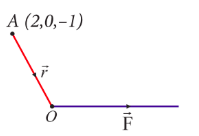
The magnitude of the torque $= |-\hat{i} - 2\hat{k}| = \sqrt{1 + 4} = \sqrt{5}$ and the direction cosines of the torque are $-\frac{1}{\sqrt{5}}, 0, -\frac{2}{\sqrt{5}}$.
Exercise 6.1
- Prove by vector method that if a line is drawn from the centre of a circle to the midpoint of a chord, then the line is perpendicular to the chord.
- Prove by vector method that the median to the base of an isosceles triangle is perpendicular to the base.
- Prove by vector method that an angle in a semi-circle is a right angle.
- Prove by vector method that the diagonals of a rhombus bisect each other at right angles.
- Using vector method, prove that if the diagonals of a parallelogram are equal, then it is a rectangle.
- Prove by vector method that the area of the quadrilateral ABCD having diagonals AC and BD is $\frac{1}{2} |\overrightarrow{AC} \times \overrightarrow{BD}|$.
- Prove by vector method that the parallelograms on the same base and between the same parallels are equal in area.
- If $G$ is the centroid of a $\Delta ABC$, prove that (area of $\Delta GAB$) = (area of $\Delta GBC$) = (area of $\Delta GCA$) = $\frac{1}{3}$ (area of $\Delta ABC$).
- Using vector method, prove that $\cos (\alpha - \beta) = \cos \alpha \cos \beta + \sin \alpha \sin \beta$.
- Prove by vector method that $\sin (\alpha + \beta) = \sin \alpha \cos \beta + \cos \alpha \sin \beta$.
- A particle acted on by constant forces $8\vec{i} + 2\vec{j} - 6\vec{k}$ and $6\vec{i} + 2\vec{j} - 2\vec{k}$ is displaced from the point $(1,2,3)$ to the point $(5,4,1)$. Find the total work done by the forces.
- Forces of magnitudes $5\sqrt{2}$ and $10\sqrt{2}$ units acting in the directions $3\vec{i} + 4\vec{j} + 5\vec{k}$ and $10\vec{i} + 6\vec{j} - 8\vec{k}$, respectively, act on a particle which is displaced from the point with position vector $4\vec{i} - 3\vec{j} - 2\vec{k}$ to the point with position vector $6\vec{i} + \vec{j} - 3\vec{k}$. Find the work done by the forces.
- Find the magnitude and direction cosines of the torque of a force represented by $3\vec{i} + 4\vec{j} - 5\vec{k}$ about the point with position vector $2\vec{i} - 3\vec{j} + 4\vec{k}$ acting through a point whose position vector is $4\vec{i} + 2\vec{j} - 3\vec{k}$.
- Find the torque of the resultant of the three forces represented by $-3\vec{i} + 6\vec{j} - 3\vec{k}$, $4\vec{i} - 10\vec{j} + 12\vec{k}$ and $4\vec{i} + 7\vec{j}$ acting at the point with position vector $8\vec{i} - 6\vec{j} - 4\vec{k}$, about the point with position vector $18\vec{i} + 3\vec{j} - 9\vec{k}$.
6.4 Scalar triple product#
Definition 6.4
For a given set of three vectors $\vec{a}, \vec{b}$, and $\vec{c}$, the scalar $(\vec{a} \times \vec{b}) \cdot \vec{c}$ is called a scalar triple product of $\vec{a}, \vec{b}, \vec{c}$.
Remark
$\vec{a} \cdot \vec{b}$ is a scalar and so $(\vec{a} \cdot \vec{b}) \times \vec{c}$ has no meaning.
Note
Given any three vectors $\vec{a}$, $\vec{b}$ and $\vec{c}$, the following are scalar triple products:
$(\vec{a} \times \vec{b}) \cdot \vec{c}$, $(\vec{b} \times \vec{c}) \cdot \vec{a}$, $(\vec{c} \times \vec{a}) \cdot \vec{b}$, $\vec{a} \cdot (\vec{b} \times \vec{c})$, $\vec{b} \cdot (\vec{c} \times \vec{a})$, $\vec{c} \cdot (\vec{a} \times \vec{b})$,
$(\vec{b} \times \vec{a}) \cdot \vec{c}$, $(\vec{c} \times \vec{b}) \cdot \vec{a}$, $(\vec{a} \times \vec{c}) \cdot \vec{b}$, $\vec{a} \cdot (\vec{c} \times \vec{b})$, $\vec{b} \cdot (\vec{a} \times \vec{c})$, $\vec{c} \cdot (\vec{b} \times \vec{a})$
Geometrical interpretation of scalar triple product
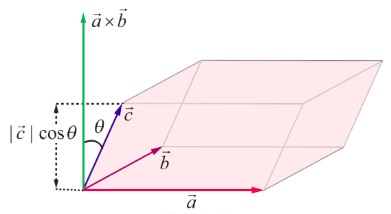
Geometrically, the absolute value of the scalar triple product $(\vec{a} \times \vec{b}) \cdot \vec{c}$ is the volume of the parallelepiped formed by using the three vectors $\vec{a}, \vec{b}$ , and $\vec{c}$ as co-terminus edges. Indeed, the magnitude of the vector $(\vec{a} \times \vec{b})$ is the area of the parallelogram formed by using $\vec{a}$ and $\vec{b}$ ; and the direction of the vector $(\vec{a} \times \vec{b})$ is perpendicular to the plane parallel to both $\vec{a}$ and $\vec{b}$ .
Therefore, $|\vec{a} \times \vec{b}| \cdot |\vec{c}| \cdot |\cos \theta|$ , where $\theta$ is the angle between $\vec{a} \times \vec{b}$ and $\vec{c}$ . From Fig. 6.17, we observe that $|\vec{c}| \cdot |\cos \theta|$ is the height of the parallelepiped formed by using the three vectors as adjacent vectors. Thus, $|\vec{a} \times \vec{b}| \cdot |\vec{c}| \cdot |\cos \theta|$ is the volume of the parallelepiped.
The following theorem is useful for computing scalar triple products.
$$ (\vec{a} \times \vec{b}) \cdot \vec{c} = \left| \begin{array}{ccc} a_1 & a_2 & a_3 \\ b_1 & b_2 & b_3 \\ c_1 & c_2 & c_3 \end{array} \right|. $$Theorem 6.1
If $\vec{a} = a_1 \hat{i} + a_2 \hat{j} + a_3 \hat{k}, \, \vec{b} = b_1 \hat{i} + b_2 \hat{j} + b_3 \hat{k}$ and $\vec{c} = c_1 \hat{i} + c_2 \hat{j} + c_3 \hat{k}$ , then
Proof
By definition, we have
$$ \begin{aligned} (\vec{a} \times \vec{b}) \cdot \vec{c} &= \begin{vmatrix} \hat{i} & \hat{j} & \hat{k}\\ a_1 & a_2 & a_3\\ b_1 & b_2 & b_3 \end{vmatrix} \cdot \vec{c} \\[1ex] &= \left[ (a_2b_3-a_3b_2)\hat{i} -(a_1b_3-a_3b_1)\hat{j} +(a_1b_2-a_2b_1)\hat{k} \right] \cdot (c_1\hat{i}+c_2\hat{j}+c_3\hat{k}) \\[1ex] &= (a_2b_3-a_3b_2)c_1 +(a_3b_1-a_1b_3)c_2 +(a_1b_2-a_2b_1)c_3 \\[1ex] &= \begin{vmatrix} a_1&a_2&a_3\\ b_1&b_2&b_3\\ c_1&c_2&c_3 \end{vmatrix} \end{aligned} $$which completes the proof of the theorem.
6.4.1 Properties of the scalar triple product#
Theorem 6.2
For any three vectors $\vec{a}, \vec{b},$ and $\vec{c}, \, (\vec{a} \times \vec{b}) \cdot \vec{c} = \vec{a} \cdot (\vec{b} \times \vec{c})$ .
Proof
Let $\vec{a} = a_1\hat{i} + a_2\hat{j} + a_3\hat{k}$ , $\vec{b} = b_1\hat{i} + b_2\hat{j} + b_3\hat{k}$ and $\vec{c} = c_1\hat{i} + c_2\hat{j} + c_3\hat{k}$ .
Then, $\vec{a} \cdot (\vec{b} \times \vec{c}) = (\vec{b} \times \vec{c}) \cdot \vec{a} = \left| \begin{array}{ccc} b_1 & b_2 & b_3 \\ c_1 & c_2 & c_3 \\ a_1 & a_2 & a_3 \end{array} \right| = \left| \begin{array}{ccc} a_1 & a_2 & a_3 \\ b_1 & b_2 & b_3 \\ c_1 & c_2 & c_3 \end{array} \right|$ , by $R_1 \leftrightarrow R_3$
$= \left| \begin{array}{ccc} a_1 & a_2 & a_3 \\ b_1 & b_2 & b_3 \\ c_1 & c_2 & c_3 \end{array} \right|$ , by $R_2 \leftrightarrow R_3$
$= (\vec{a} \times \vec{b}) \cdot \vec{c}$ .
Hence the theorem is proved.
Note
By Theorem 6.2, it follows that, in a scalar triple product, dot and cross can be interchanged without altering the order of occurrences of the vectors, by placing the parentheses in such a way that dot lies outside the parentheses, and cross lies between the vectors inside the parentheses. For instance, we have
$$ (\vec{a}\times \vec{b})\cdot \vec{c} = \vec{a}\cdot (\vec{b}\times \vec{c}), \text{ since dot and cross can be interchanged.} $$$$ = (\vec{b}\times \vec{c})\cdot \vec{a}, \text{ since dot product is commutative.} $$$$ = \vec{b}\cdot (\vec{c}\times \vec{a}), \text{ since dot and cross can be interchanged} $$$$ = (\vec{c}\times \vec{a})\cdot \vec{b}, \text{ since dot product is commutative} $$$$ = \vec{c}\cdot (\vec{a}\times \vec{b}), \text{ since dot and cross can be interchanged} $$
Notation
For any three vectors $\vec{a},\vec{b}$ and $\vec{c}$, the scalar triple product $(\vec{a}\times \vec{b})\cdot \vec{c}$ is denoted by $[\vec{a},\vec{b},\vec{c}]$.
$[\vec{a},\vec{b},\vec{c}]$ is read as box $\vec{a},\vec{b},\vec{c}$. For this reason and also because the absolute value of a scalar triple product represents the volume of a box (rectangular parallelepiped), a scalar triple product is also called a box product.
Note
$$ [\vec{a},\vec{b},\vec{c}] = (\vec{a}\times \vec{b})\cdot \vec{c} = \vec{a}\cdot (\vec{b}\times \vec{c}) = (\vec{b}\times \vec{c})\cdot \vec{a} = \vec{b}\cdot (\vec{c}\times \vec{a}) = [\vec{b},\vec{c},\vec{a}] $$$$ [\vec{b},\vec{c},\vec{a}] = (\vec{b}\times \vec{c})\cdot \vec{a} = \vec{b}\cdot (\vec{c}\times \vec{a}) = (\vec{c}\times \vec{a})\cdot \vec{b} = \vec{c}\cdot (\vec{a}\times \vec{b}) = [\vec{c},\vec{a},\vec{b}]. $$In other words, $[\vec{a},\vec{b},\vec{c}] = [\vec{b},\vec{c},\vec{a}] = [\vec{c},\vec{a},\vec{b}]$; that is, if the three vectors are permuted in the same cyclic order, the value of the scalar triple product remains the same.
(2) If any two vectors are interchanged in their position in a scalar triple product, then the value of the scalar triple product is $(-1)$ times the original value. More explicitly,
$$ [\vec{a},\vec{b},\vec{c}] = [\vec{b},\vec{c},\vec{a}] = [\vec{c},\vec{a},\vec{b}] = -[\vec{a},\vec{c},\vec{b}] = -[\vec{c},\vec{b},\vec{a}] = -[\vec{b},\vec{a},\vec{c}] $$
Theorem 6.3
The scalar triple product preserves addition and scalar multiplication. That is,
$[(\vec{a} + \vec{b}), \vec{c}, \vec{d}] = [\vec{a}, \vec{c}, \vec{d}] + [\vec{b}, \vec{c}, \vec{d}]$ ;
$[\lambda \vec{a}, \vec{b}, \vec{c}] = \lambda [\vec{a}, \vec{b}, \vec{c}]$ , $\forall \lambda \in \mathbb{R}$
$[\vec{a}, (\vec{b} + \vec{c}), \vec{d}] = [\vec{a}, \vec{b}, \vec{d}] + [\vec{a}, \vec{c}, \vec{d}]$ ;
$[\vec{a}, \lambda \vec{b}, \vec{c}] = \lambda [\vec{a}, \vec{b}, \vec{c}]$ , $\forall \lambda \in \mathbb{R}$
$[\vec{a}, \vec{b}, (\vec{c} + \vec{d})] = [\vec{a}, \vec{b}, \vec{c}] + [\vec{a}, \vec{b}, \vec{d}]$ ;
$[\vec{a}, \vec{b}, \lambda \vec{c}] = \lambda [\vec{a}, \vec{b}, \vec{c}]$ , $\forall \lambda \in \mathbb{R}$ .
Proof
Using the properties of scalar product and vector product, we get
$[(\vec{a} + \vec{b}), \vec{c}, \vec{d}] = ((\vec{a} + \vec{b}) \times \vec{c}) \cdot \vec{d}$
$= (\vec{a} \times \vec{c} + \vec{b} \times \vec{c}) \cdot \vec{d}$
$= (\vec{a} \times \vec{c}) \cdot \vec{d} + (\vec{b} \times \vec{c}) \cdot \vec{d}$
$= [\vec{a}, \vec{c}, \vec{d}] + [\vec{b}, \vec{c}, \vec{d}]$
$[\lambda \vec{a}, \vec{b}, \vec{c}] = ((\lambda \vec{a}) \times \vec{b}) \cdot \vec{c} = (\lambda (\vec{a} \times \vec{b})) \cdot \vec{c} = \lambda ((\vec{a} \times \vec{b}) \cdot \vec{c}) = \lambda [\vec{a}, \vec{b}, \vec{c}]$ .
Using the first statement of this result, we get the following.
$[\vec{a}, (\vec{b} + \vec{c}), \vec{d}] = [(\vec{b} + \vec{c}), \vec{d}, \vec{a}] = [\vec{b}, \vec{d}, \vec{a}] + [\vec{c}, \vec{d}, \vec{a}]$
$= [\vec{a}, \vec{b}, \vec{d}] + [\vec{a}, \vec{c}, \vec{d}]$
$[\vec{a}, \lambda \vec{b}, \vec{c}] = [\lambda \vec{b}, \vec{c}, \vec{a}] = \lambda [\vec{b}, \vec{c}, \vec{a}] = \lambda [\vec{a}, \vec{b}, \vec{c}]$ .
Similarly, the remaining equalities are proved.
We have studied about coplanar vectors in XI standard as three nonzero vectors of which, one can be expressed as a linear combination of the other two. Now we use scalar triple product for the characterisation of coplanar vectors.
Theorem 6.4
The scalar triple product of three non-zero vectors is zero if, and only if, the three vectors are coplanar.
Proof
Let $\vec{a}, \vec{b}, \vec{c}$ be any three non-zero vectors. Then,
$(\vec{a} \times \vec{b}) \cdot \vec{c} = 0 \iff \vec{c}$ is perpendicular to $\vec{a} \times \vec{b}$
$\iff \vec{c}$ lies in the plane which is parallel to both $\vec{a}$ and $\vec{b}$
$\iff \vec{a}, \vec{b}, \vec{c}$ are coplanar.
Theorem 6.5
Three vectors $\vec{a}, \vec{b}, \vec{c}$ are coplanar if, and only if, there exist scalars $r, s, t \in \mathbb{R}$ such that atleast one of them is non-zero and $r\vec{a} + s\vec{b} + t\vec{c} = \vec{0}$ .
Proof
Let $\vec{a} = a_{1}\hat{i} + a_{2}\hat{j} + a_{3}\hat{k}$, $\vec{b} = b_{1}\hat{i} + b_{2}\hat{j} + b_{3}\hat{k}$, $\vec{c} = c_{1}\hat{i} + c_{2}\hat{j} + c_{3}\hat{k}$. Then, we have
$$ [\vec{a}, \vec{b}, \vec{c}] = \begin{vmatrix} a_{1} & a_{2} & a_{3} \\ b_{1} & b_{2} & b_{3} \\ c_{1} & c_{2} & c_{3} \end{vmatrix}. $$The vectors $\vec{a}, \vec{b}, \vec{c}$ are coplanar if and only if the above determinant is zero.
$\Leftrightarrow$ there exist scalars $r,s,t\in \mathbb{R}$ at least one of them non-zero such that
$$ a_{1}r + a_{2}s + a_{3}t = 0,\quad b_{1}r + b_{2}s + b_{3}t = 0,\quad c_{1}r + c_{2}s + c_{3}t = 0 $$$\Leftrightarrow$ there exist scalars $r,s,t\in \mathbb{R}$ at least one of them non-zero such that $r\vec{a} + s\vec{b} + t\vec{c} = \vec{0}$.
Theorem 6.6
If $\vec{a}, \vec{b}, \vec{c}$ and $\vec{p}, \vec{q}, \vec{r}$ are any two systems of three vectors, and if $\vec{p} = x_1 \vec{a} + y_1 \vec{b} + z_1 \vec{c}$ ,
$$\begin{bmatrix} \vec{p}, \vec{q}, \vec{r} \end{bmatrix} = \left| \begin{array}{ccc} x_1 & y_1 & z_1 \\ x_2 & y_2 & z_2 \\ x_3 & y_3 & z_3 \end{array} \right| \begin{bmatrix} \vec{a}, \vec{b}, \vec{c} \end{bmatrix} .$$
$\vec{q} = x_2 \vec{a} + y_2 \vec{b} + z_2 \vec{c}$ , and, $\vec{r} = x_3 \vec{a} + y_3 \vec{b} + z_3 \vec{c}$ , then
Note
By theorem 6.6, if $\vec{a},\vec{b},\vec{c}$ are non-coplanar and
$$ \begin{vmatrix} x_{1} & y_{1} & z_{1} \\ x_{2} & y_{2} & z_{2} \\ x_{3} & y_{3} & z_{3} \end{vmatrix} \neq 0, $$then the three vectors $\overrightarrow{p} = x_{1}\vec{a} + y_{1}\vec{b} + z_{1}\vec{c}$, $\vec{q} = x_{2}\vec{a} + y_{2}\vec{b} + z_{2}\vec{c}$, and $\vec{r} = x_{3}\vec{a} + y_{3}\vec{b} + z_{3}\vec{c}$ are also non-coplanar.
Example 6.12
If $\vec{a} = -3\hat{i} - \hat{j} + 5\hat{k}$ , $\vec{b} = \hat{i} - 2\hat{j} + \hat{k}$ , $\vec{c} = 4\hat{j} - 5\hat{k}$ , find $\vec{a} \cdot (\vec{b} \times \vec{c})$ .
Solution: By the definition of scalar triple product of three vectors,
$\vec{a} \cdot (\vec{b} \times \vec{c}) = \left| \begin{array}{ccc} -3 & -1 & 5 \\ 1 & -2 & 1 \\ 0 & 4 & -5 \end{array} \right| = -3$ .
Example 6.13
Find the volume of the parallelepiped whose coterminus edges are given by the vectors
$2\hat{i} - 3\hat{j} + 4\hat{k}$ , $\hat{i} + 2\hat{j} - \hat{k}$ and $3\hat{i} - \hat{j} + 2\hat{k}$ .
Solution
We know that the volume of the parallelepiped whose coterminus edges are $\vec{a}, \vec{b}, \vec{c}$ is given by $|[\vec{a}, \vec{b}, \vec{c}]|$ .
Here, $\vec{a} = 2\hat{i} - 3\hat{j} + 4\hat{k}$ , $\vec{b} = \hat{i} + 2\hat{j} - \hat{k}$ , $\vec{c} = 3\hat{i} - \hat{j} + 2\hat{k}$ .
Since
$[\vec{a}, \vec{b}, \vec{c}] = \left| \begin{array}{ccc} 2 & -3 & 4 \\ 1 & 2 & -1 \\ 3 & -1 & 2 \end{array} \right| = -7$ ,
the volume of the parallelepiped is $|-7| = 7$ cubic units.
Example 6.14
Show that the vectors $\hat{i} + 2\hat{j} - 3\hat{k}$ , $\hat{i} - \hat{j} + 2\hat{k}$ and $3\hat{i} + \hat{j} - \hat{k}$ are coplanar.
Solution
Here, $\vec{a} = \hat{i} + 2\hat{j} - 3\hat{k}$ , $\vec{b} = \hat{i} - \hat{j} + 2\hat{k}$ , $\vec{c} = 3\hat{i} + \hat{j} - \hat{k}$ .
We know that $\vec{a}, \vec{b}, \vec{c}$ are coplanar if and only if $[\vec{a}, \vec{b}, \vec{c}] = 0$ .
Now,
$[\vec{a}, \vec{b}, \vec{c}] = \left| \begin{array}{ccc} 1 & 2 & -3 \\ 2 & -1 & 2 \\ 3 & 1 & -1 \end{array} \right| = 0$ .
Therefore, the three given vectors are coplanar.
Example 6.15
If $2\hat{i} - \hat{j} + 3\hat{k}$ , $3\hat{i} + 2\hat{j} + \hat{k}$ , $\hat{i} + m\hat{j} + 4\hat{k}$ are coplanar, find the value of $m$ .
Solution
Since the given three vectors are coplanar, we have
$\left| \begin{array}{ccc} 2 & -1 & 3 \\ 3 & 2 & 1 \\ 1 & m & 4 \end{array} \right| = 0 \implies m = -3$ .
Example 6.16
Show that the four points $(6, -7, 0)$ , $(16, -19, -4)$ , $(0, 3, -6)$ , $(2, -5, 10)$ lie on a same plane.
Solution
Let $A = (6, -7, 0)$ , $B = (16, -19, -4)$ , $C = (0, 3, -6)$ , $D = (2, -5, 10)$ . To show that the four points $A, B, C, D$ lie on a plane, we have to prove that the three vectors $\overrightarrow{AB}$ , $\overrightarrow{AC}$ , $\overrightarrow{AD}$ are coplanar.
Now,
$\overrightarrow{AB} = \overrightarrow{OB} - \overrightarrow{OA} = (16\hat{i} - 19\hat{j} - 4\hat{k}) - (6\hat{i} - 7\hat{j}) = 10\hat{i} - 12\hat{j} - 4\hat{k}$ .
$\overrightarrow{AC} = \overrightarrow{OC} - \overrightarrow{OA} = -6\hat{i} + 10\hat{j} - 6\hat{k}$ and $\overrightarrow{AD} = \overrightarrow{OD} - \overrightarrow{OA} = -4\hat{i} + 2\hat{j} + 10\hat{k}$ .
We have
$[\overrightarrow{AB}, \overrightarrow{AC}, \overrightarrow{AD}] = \left| \begin{array}{ccc} 10 & -12 & -4 \\ -6 & 10 & -6 \\ -4 & 2 & 10 \end{array} \right| = 0$ .
Therefore, the three vectors $\overrightarrow{AB}$ , $\overrightarrow{AC}$ , $\overrightarrow{AD}$ are coplanar and hence the four points $A, B, C,$ and $D$ lie on a plane.
EXERCISE 6.2
If $\vec{a} = \hat{i} - 2\hat{j} + 3\hat{k}$ , $\vec{b} = 2\hat{i} + \hat{j} - 2\hat{k}$ , $\vec{c} = 3\hat{i} + 2\hat{j} + \hat{k}$ , find $\vec{a} \cdot (\vec{b} \times \vec{c})$ .
Find the volume of the parallelepiped whose coterminous edges are represented by the vectors
$-6\hat{i} + 14\hat{j} + 10\hat{k}$ , $14\hat{i} - 10\hat{j} - 6\hat{k}$ and $2\hat{i} + 4\hat{j} - 2\hat{k}$ .The volume of the parallelepiped whose coterminous edges are $7\hat{i} + \lambda \hat{j} - 3\hat{k}$ , $\hat{i} + 2\hat{j} - \hat{k}$ , $-3\hat{i} + 7\hat{j} + 5\hat{k}$ is 90 cubic units. Find the value of $\lambda$ .
If $\vec{a}, \vec{b}, \vec{c}$ are three non-coplanar vectors represented by concurrent edges of a parallelepiped of volume 4 cubic units, find the value of $(\vec{a} + \vec{b}) \cdot (\vec{b} \times \vec{c}) + (\vec{b} + \vec{c}) \cdot (\vec{c} \times \vec{a}) + (\vec{c} + \vec{a}) \cdot (\vec{a} \times \vec{b})$ .
Find the altitude of a parallelepiped determined by the vectors $\vec{a} = -2\hat{i} + 5\hat{j} + 3\hat{k}$ , $\vec{b} = \hat{i} + 3\hat{j} - 2\hat{k}$ and $\vec{c} = -3\hat{i} + \hat{j} + 4\hat{k}$ if the base is taken as the parallelogram determined by $\vec{b}$ and $\vec{c}$ .
Determine whether the three vectors $2\hat{i} + 3\hat{j} + \hat{k}$ , $\hat{i} - 2\hat{j} + 2\hat{k}$ and $3\hat{i} + \hat{j} + 3\hat{k}$ are coplanar.
Let $\vec{a} = \hat{i} + \hat{j} + \hat{k}$ , $\vec{b} = \hat{i}$ and $\vec{c} = c_1\hat{i} + c_2\hat{j} + c_3\hat{k}$ . If $c_1 = 1$ and $c_2 = 2$ , find $c_3$ such that $\vec{a}, \vec{b}$ and $\vec{c}$ are coplanar.
If $\vec{a} = \hat{i} - \hat{k}$ , $\vec{b} = x\hat{i} + \hat{j} + (1-x)\hat{k}$ , $\vec{c} = y\hat{i} + x\hat{j} + (1+x-y)\hat{k}$ , show that $[\vec{a}, \vec{b}, \vec{c}]$ depends on neither $x$ nor $y$ .
If the vectors $a\hat{i} + a\hat{j} + c\hat{k}$ , $\hat{i} + \hat{k}$ and $c\hat{i} + c\hat{j} + b\hat{k}$ are coplanar, prove that $c$ is the geometric mean of $a$ and $b$ .
Let $\vec{a}, \vec{b}, \vec{c}$ be three non-zero vectors such that $\vec{c}$ is a unit vector perpendicular to both $\vec{a}$ and $\vec{b}$ . If the angle between $\vec{a}$ and $\vec{b}$ is $\frac{\pi}{6}$ , show that $[\vec{a}, \vec{b}, \vec{c}]^2 = \frac{1}{4} |\vec{a}|^2 |\vec{b}|^2$ .
6.5 Vector Triple Product#
Definition 6.5
For a given set of three vectors $\vec{a}, \vec{b}, \vec{c}$ , the vector $\vec{a} \times (\vec{b} \times \vec{c})$ is called a vector triple product.
Note
Given any three vectors $\vec{a}, \vec{b}, \vec{c}$ the following are vector triple products:
$(\vec{a} \times \vec{b}) \times \vec{c}$ , $(\vec{b} \times \vec{c}) \times \vec{a}$ , $(\vec{c} \times \vec{a}) \times \vec{b}$ , $\vec{c} \times (\vec{a} \times \vec{b})$ , $\vec{a} \times (\vec{b} \times \vec{c})$ , $\vec{b} \times (\vec{c} \times \vec{a})$
Using the well known properties of the vector product, we get the following theorem.
Theorem 6.7
The vector triple product satisfies the following properties.
$(\vec{a}_1 + \vec{a}_2) \times (\vec{b} \times \vec{c}) = \vec{a}_1 \times (\vec{b} \times \vec{c}) + \vec{a}_2 \times (\vec{b} \times \vec{c})$ , $(\lambda \vec{a}) \times (\vec{b} \times \vec{c}) = \lambda (\vec{a} \times (\vec{b} \times \vec{c}))$ , $\lambda \in \mathbb{R}$
$\vec{a} \times ((\vec{b}_1 + \vec{b}_2) \times \vec{c}) = \vec{a} \times (\vec{b}_1 \times \vec{c}) + \vec{a} \times (\vec{b}_2 \times \vec{c})$ , $\vec{a} \times ((\lambda \vec{b}) \times \vec{c}) = \lambda (\vec{a} \times (\vec{b} \times \vec{c}))$ , $\lambda \in \mathbb{R}$
$\vec{a} \times (\vec{b} \times (\vec{c}_1 + \vec{c}_2)) = \vec{a} \times (\vec{b} \times \vec{c}_1) + \vec{a} \times (\vec{b} \times \vec{c}_2)$ , $\vec{a} \times (\vec{b} \times (\lambda \vec{c})) = \lambda (\vec{a} \times (\vec{b} \times \vec{c}))$ , $\lambda \in \mathbb{R}$
Remark
Vector triple product is not associative. This means that $\vec{a} \times (\vec{b} \times \vec{c}) \neq (\vec{a} \times \vec{b}) \times \vec{c}$ , for some vectors $\vec{a}, \vec{b}, \vec{c}$ .
Justification
We take $\vec{a} = \hat{i}$ , $\vec{b} = \hat{i}$ , $\vec{c} = \hat{j}$ . Then,
$\vec{a} \times (\vec{b} \times \vec{c}) = \hat{i} \times (\hat{i} \times \hat{j}) = \hat{i} \times \hat{k} = -\hat{j}$ but $(\hat{i} \times \hat{i}) \times \hat{j} = \vec{0} \times \hat{j} = \vec{0}$ .
Therefore,
$\vec{a} \times (\vec{b} \times \vec{c}) \neq (\vec{a} \times \vec{b}) \times \vec{c}$ .
The following theorem gives a simple formula to evaluate the vector triple product.
Theorem 6.8 (Vector Triple product expansion)
For any three vectors $\vec{a}, \vec{b}, \vec{c}$ we have
$$\vec{a} \times (\vec{b} \times \vec{c}) = (\vec{a} \cdot \vec{c}) \vec{b} - (\vec{a} \cdot \vec{b}) \vec{c} .$$
Proof
Let us choose the coordinate axes as follows:
Let $x$ -axis be chosen along the line of action of $\vec{a}$ , $y$ -axis be chosen in the plane passing through $\vec{a}$ and parallel to $\vec{b}$ , and $z$ -axis be chosen perpendicular to the plane containing $\vec{a}$ and $\vec{b}$ . Then, we have
$\vec{a} = a_1 \hat{i}$
$\vec{b} = b_1 \hat{i} + b_2 \hat{j}$
$\vec{c} = c_1 \hat{i} + c_2 \hat{j} + c_3 \hat{k}$
Now,
$\vec{a} \times (\vec{b} \times \vec{c}) = a_1 \hat{i} \times \left| \begin{array}{ccc} \hat{i} & \hat{j} & \hat{k} \\ b_1 & b_2 & 0 \\ c_1 & c_2 & c_3 \end{array} \right|$
$= a_1 \hat{i} \times (b_2 c_3 \hat{i} - b_1 c_3 \hat{j} + (b_1 c_2 - b_2 c_1) \hat{k})$
$= -a_1 b_1 c_3 \hat{k} + a_1 (b_2 c_1 - b_1 c_2) \hat{j}$ $\dots$ (1)
$(\vec{a} \cdot \vec{c}) \vec{b} - (\vec{a} \cdot \vec{b}) \vec{c} = a_1 c_1 (b_1 \hat{i} + b_2 \hat{j}) - a_1 b_1 (c_1 \hat{i} + c_2 \hat{j} + c_3 \hat{k})$
$= a_1 (b_2 c_1 - b_1 c_2) \hat{j} - a_1 b_1 c_3 \hat{k}$ $\dots$ (2)
From equations (1) and (2), we get
$\vec{a} \times (\vec{b} \times \vec{c}) = (\vec{a} \cdot \vec{c}) \vec{b} - (\vec{a} \cdot \vec{b}) \vec{c}$
Note
$$(\vec{a} \times \vec{b}) \times \vec{c} = -\vec{c} \times (\vec{a} \times \vec{b}) = -\{(\vec{c} \cdot \vec{b}) \vec{a} - (\vec{c} \cdot \vec{a}) \vec{b}\} = (\vec{a} \cdot \vec{c}) \vec{b} - (\vec{b} \cdot \vec{c}) \vec{a}$$
$\vec{a} \times (\vec{b} \times \vec{c}) = \alpha \vec{b} + \beta \vec{c}$ , where $\alpha = \vec{a} \cdot \vec{c}$ and $\beta = -(\vec{a} \cdot \vec{b})$ , and so it lies in the plane parallel to $\vec{b}$ and $\vec{c}$ .
We also note that
Therefore, $(\vec{a} \times \vec{b}) \times \vec{c}$ lies in the plane parallel to $\vec{a}$ and $\vec{b}$ .
$$\lambda \text{ (middle vector)} - \mu \text{ (non-middle vector)}$$
- In $(\vec{a} \times \vec{b}) \times \vec{c}$ , consider the vectors inside the brackets, call $\vec{b}$ as the middle vector and $\vec{a}$ as the non-middle vector. Similarly, in $\vec{a} \times (\vec{b} \times \vec{c})$ , $\vec{b}$ is the middle vector and $\vec{c}$ is the non-middle vector. Then we observe that a vector triple product of these vectors is equal to
where $\lambda$ is the dot product of the vectors other than the middle vector and $\mu$ is the dot product of the vectors other than the non-middle vector.
6.6 Jacobi’s Identity and Lagrange’s Identity#
Theorem 6.9 (Jacobi’s identity)
For any three vectors $\vec{a},\vec{b},\vec{c}$, we have
$$ \vec{a}\times (\vec{b}\times \vec{c}) + \vec{b}\times (\vec{c}\times \vec{a}) + \vec{c}\times (\vec{a}\times \vec{b}) = \vec{0}. $$
Proof
Using vector triple product expansion, we have
$$ \vec{a}\times (\vec{b}\times \vec{c}) = (\vec{a}\cdot \vec{c})\vec{b} - (\vec{a}\cdot \vec{b})\vec{c} $$$$ \vec{b}\times (\vec{c}\times \vec{a}) = (\vec{b}\cdot \vec{a})\vec{c} - (\vec{b}\cdot \vec{c})\vec{a} $$$$ \vec{c}\times (\vec{a}\times \vec{b}) = (\vec{c}\cdot \vec{b})\vec{a} - (\vec{c}\cdot \vec{a})\vec{b} $$Adding these three equations, we get the result.
Theorem 6.10 (Lagrange’s identity)
For any four vectors $\vec{a}, \vec{b}, \vec{c}, \vec{d}$ , we have
$$(\vec{a} \times \vec{b}) \cdot (\vec{c} \times \vec{d}) = \left| \begin{array}{cc} \vec{a} \cdot \vec{c} & \vec{a} \cdot \vec{d} \\ \vec{b} \cdot \vec{c} & \vec{b} \cdot \vec{d} \end{array} \right| .$$
Proof
Since dot and cross can be interchanged in a scalar product, we get
$(\vec{a} \times \vec{b}) \cdot (\vec{c} \times \vec{d}) = \vec{a} \cdot (\vec{b} \times (\vec{c} \times \vec{d}))$
$= \vec{a} \cdot ((\vec{b} \cdot \vec{d}) \vec{c} - (\vec{b} \cdot \vec{c}) \vec{d})$ (by vector triple product expansion)
$= (\vec{a} \cdot \vec{c})(\vec{b} \cdot \vec{d}) - (\vec{a} \cdot \vec{d})(\vec{b} \cdot \vec{c})$
$= \left| \begin{array}{cc} \vec{a} \cdot \vec{c} & \vec{a} \cdot \vec{d} \\ \vec{b} \cdot \vec{c} & \vec{b} \cdot \vec{d} \end{array} \right|$
Example 6.19
Prove that $[\vec{a} \times \vec{b}, \vec{b} \times \vec{c}, \vec{c} \times \vec{a}] = [\vec{a}, \vec{b}, \vec{c}]^2$ .
Solution
Using the definition of the scalar triple product, we get
$[\vec{a} \times \vec{b}, \vec{b} \times \vec{c}, \vec{c} \times \vec{a}] = (\vec{a} \times \vec{b}) \cdot \{(\vec{b} \times \vec{c}) \times (\vec{c} \times \vec{a})\}$ $\dots$ (1)
By treating $(\vec{b} \times \vec{c})$ as the first vector in the vector triple product, we find
$(\vec{b} \times \vec{c}) \times (\vec{c} \times \vec{a}) = ((\vec{b} \times \vec{c}) \cdot \vec{a}) \vec{c} - ((\vec{b} \times \vec{c}) \cdot \vec{c}) \vec{a} = [\vec{a}, \vec{b}, \vec{c}] \vec{c}$ .
Using this value in (1), we get
$[\vec{a} \times \vec{b}, \vec{b} \times \vec{c}, \vec{c} \times \vec{a}] = (\vec{a} \times \vec{b}) \cdot ([\vec{a}, \vec{b}, \vec{c}] \vec{c}) = [\vec{a}, \vec{b}, \vec{c}] (\vec{a} \times \vec{b}) \cdot \vec{c} = [\vec{a}, \vec{b}, \vec{c}]^2$ .
Example 6.20
Prove that $(\vec{a} \cdot (\vec{b} \times \vec{c}))\vec{a} = (\vec{a} \times \vec{b}) \times (\vec{a} \times \vec{c})$ .
Solution
Treating $(\vec{a} \times \vec{b})$ as the first vector on the right hand side of the given equation and using the vector triple product expansion, we get
$(\vec{a} \times \vec{b}) \times (\vec{a} \times \vec{c}) = ((\vec{a} \times \vec{b}) \cdot \vec{c})\vec{a} - ((\vec{a} \times \vec{b}) \cdot \vec{a})\vec{c} = (\vec{a} \cdot (\vec{b} \times \vec{c}))\vec{a}$ .
Example 6.21
For any four vectors $\vec{a}, \vec{b}, \vec{c}, \vec{d}$ , we have
$(\vec{a} \times \vec{b}) \times (\vec{c} \times \vec{d}) = [\vec{a}, \vec{b}, \vec{d}] \vec{c} - [\vec{a}, \vec{b}, \vec{c}] \vec{d} = [\vec{a}, \vec{c}, \vec{d}] \vec{b} - [\vec{b}, \vec{c}, \vec{d}] \vec{a}$ .
Solution
Taking $\vec{p} = (\vec{a} \times \vec{b})$ as a single vector and using the vector triple product expansion, we get
$(\vec{a} \times \vec{b}) \times (\vec{c} \times \vec{d}) = \vec{p} \times (\vec{c} \times \vec{d})$
$= (\vec{p} \cdot \vec{d}) \vec{c} - (\vec{p} \cdot \vec{c}) \vec{d}$
$= ((\vec{a} \times \vec{b}) \cdot \vec{d}) \vec{c} - ((\vec{a} \times \vec{b}) \cdot \vec{c}) \vec{d} = [\vec{a}, \vec{b}, \vec{d}] \vec{c} - [\vec{a}, \vec{b}, \vec{c}] \vec{d}$
Similarly, taking $\vec{q} = \vec{c} \times \vec{d}$ , we get
$(\vec{a} \times \vec{b}) \times (\vec{c} \times \vec{d}) = (\vec{a} \times \vec{b}) \times \vec{q}$
$= (\vec{a} \cdot \vec{q}) \vec{b} - (\vec{b} \cdot \vec{q}) \vec{a}$
$= [\vec{a}, \vec{c}, \vec{d}] \vec{b} - [\vec{b}, \vec{c}, \vec{d}] \vec{a}$
Example 6.22
If $\vec{a} = -2\hat{i} + 3\hat{j} - 2\hat{k}$ , $\vec{b} = 3\hat{i} - \hat{j} + 3\hat{k}$ , $\vec{c} = 2\hat{i} - 5\hat{j} + \hat{k}$ , find $(\vec{a} \times \vec{b}) \times \vec{c}$ and $\vec{a} \times (\vec{b} \times \vec{c})$ . State whether they are equal.
Solution
By definition, $\vec{a} \times \vec{b} = \left| \begin{array}{ccc} \hat{i} & \hat{j} & \hat{k} \\ -2 & 3 & -2 \\ 3 & -1 & 3 \end{array} \right| = 7\hat{i} - 7\hat{k}$ .
Then,
$(\vec{a} \times \vec{b}) \times \vec{c} = \left| \begin{array}{ccc} \hat{i} & \hat{j} & \hat{k} \\ 7 & 0 & -7 \\ 2 & -5 & 1 \end{array} \right| = -35\hat{i} - 21\hat{j} - 35\hat{k}$ . $\dots$ (1)
$\vec{b} \times \vec{c} = \left| \begin{array}{ccc} \hat{i} & \hat{j} & \hat{k} \\ 3 & -1 & 3 \\ 2 & -5 & 1 \end{array} \right| = 14\hat{i} + 3\hat{j} - 13\hat{k}$ .
Next,
$\vec{a} \times (\vec{b} \times \vec{c}) = \left| \begin{array}{ccc} \hat{i} & \hat{j} & \hat{k} \\ -2 & 3 & -2 \\ 14 & 3 & -13 \end{array} \right| = -33\hat{i} - 54\hat{j} - 48\hat{k}$ . $\dots$ (2)
Therefore, equations (1) and (2) lead to
$(\vec{a} \times \vec{b}) \times \vec{c} \neq \vec{a} \times (\vec{b} \times \vec{c})$ .
Example 6.23
If $\vec{a} = \hat{i} - \hat{j}$ , $\vec{b} = \hat{i} - \hat{j} - 4\hat{k}$ , $\vec{c} = 3\hat{j} - \hat{k}$ and $\vec{d} = 2\hat{i} + 5\hat{j} + \hat{k}$ , verify that
- $(\vec{a} \times \vec{b}) \times (\vec{c} \times \vec{d}) = [\vec{a}, \vec{b}, \vec{d}] \vec{c} - [\vec{a}, \vec{b}, \vec{c}] \vec{d}$
- $(\vec{a} \times \vec{b}) \times (\vec{c} \times \vec{d}) = [\vec{a}, \vec{c}, \vec{d}] \vec{b} - [\vec{b}, \vec{c}, \vec{d}] \vec{a}$
Solution (i)
By definition,
$\vec{a} \times \vec{b} = \left| \begin{array}{ccc} \hat{i} & \hat{j} & \hat{k} \\ 1 & -1 & 0 \\ 1 & -1 & -4 \end{array} \right| = 4\hat{i} + 4\hat{j}$ , $\vec{c} \times \vec{d} = \left| \begin{array}{ccc} \hat{i} & \hat{j} & \hat{k} \\ 0 & 3 & -1 \\ 2 & 5 & 1 \end{array} \right| = 8\hat{i} - 2\hat{j} - 6\hat{k}$
Then,
$(\vec{a} \times \vec{b}) \times (\vec{c} \times \vec{d}) = \left| \begin{array}{ccc} \hat{i} & \hat{j} & \hat{k} \\ 4 & 4 & 0 \\ 8 & -2 & -6 \end{array} \right| = -24\hat{i} + 24\hat{j} - 40\hat{k}$ $\dots$ (1)
On the other hand, we have
$[\vec{a}, \vec{b}, \vec{d}] \vec{c} - [\vec{a}, \vec{b}, \vec{c}] \vec{d} = 28(3\hat{j} - \hat{k}) - 12(2\hat{i} + 5\hat{j} + \hat{k}) = -24\hat{i} + 24\hat{j} - 40\hat{k}$ $\dots$ (2)
Therefore, from equations (1) and (2), identity (i) is verified.
The verification of identity (ii) is left as an exercise to the reader.
Exercise 6.3
- If $\vec{a} = \hat{i} - 2\hat{j} +3\hat{k}$, $\vec{b} = 2\hat{i} +\hat{j} - 2\hat{k}$, $\vec{c} = 3\hat{i} +2\hat{j} +\hat{k}$, find (i) $(\vec{a}\times \vec{b})\times \vec{c}$ (ii) $\vec{a}\times (\vec{b}\times \vec{c})$
- For any vector $\vec{a}$, prove that $\hat{i}\times (\vec{a}\times \hat{i}) + \hat{j}\times (\vec{a}\times \hat{j}) + \hat{k}\times (\vec{a}\times \hat{k}) = 2\vec{a}$.
- Prove that $[\vec{a} -\vec{b},\vec{b} -\vec{c},\vec{c} -\vec{a}] = 0$.
- If $\vec{a} = 2\hat{i} +3\hat{j} -\hat{k}$, $\vec{b} = 3\hat{i} +5\hat{j} +2\hat{k}$, $\vec{c} = -\hat{i} -2\hat{j} +3\hat{k}$, verify that (i) $(\vec{a}\times \vec{b})\times \vec{c} = (\vec{a}\cdot \vec{c})\vec{b} -(\vec{b}\cdot \vec{c})\vec{a}$ (ii) $\vec{a}\times (\vec{b}\times \vec{c}) = (\vec{a}\cdot \vec{c})\vec{b} -(\vec{a}\cdot \vec{b})\vec{c}$
- If $\vec{a} = 2\hat{i} +3\hat{j} -\hat{k}$, $\vec{b} = -\hat{i} +2\hat{j} -4\hat{k}$, $\vec{c} = \hat{i} +\hat{j} +\hat{k}$, then find the value of $(\vec{a}\times \vec{b})\cdot (\vec{a}\times \vec{c})$.
- If $\vec{a},\vec{b},\vec{c},\vec{d}$ are coplanar vectors, show that $(\vec{a}\times \vec{b})\times (\vec{c}\times \vec{d}) = \vec{0}$.
- If $\vec{a} = \hat{i} +2\hat{j} +3\hat{k}$, $\vec{b} = 2\hat{i} -\hat{j} +\hat{k}$, $\vec{c} = 3\hat{i} +2\hat{j} +\hat{k}$ and $\vec{a}\times (\vec{b}\times \vec{c}) = l\vec{a} + m\vec{b} + n\vec{c}$, find the values of $l, m, n$.
- If $\hat{a},\hat{b},\hat{c}$ are three unit vectors such that $\hat{b}$ and $\hat{c}$ are non-parallel and $\hat{a}\times (\hat{b}\times \hat{c}) = \frac{1}{2}\hat{b}$, find the angle between $\hat{a}$ and $\hat{c}$.
6.7 Application of Vectors to 3-Dimensional Geometry#
Vectors provide an elegant approach to study straight lines and planes in three dimension. All straight lines and planes are subsets of $\mathbb{R}^{3}$. For brevity, we shall call a straight line simply as line. A plane is a surface which is understood as a set $P$ of points in $\mathbb{R}^{3}$ such that, if $A,B$, and $C$ are any three non-collinear points of $P$, then the line passing through any two of them is a subset of $P$. Two planes are said to be intersecting if they have at least one point in common and at least one point which lies on one plane but not on the other. Two planes are said to be coincident if they have exactly the same points. Two planes are said to be parallel but not coincident if they have no point in common. Similarly, a straight line can be understood as the set of points common to two intersecting planes. In this section, we obtain vector and Cartesian equations of straight line and plane by applying vector methods. By a vector form of equation of a geometrical object, we mean an equation which is satisfied by the position vector of every point of the object. The equation may be a vector equation or a scalar equation.
6.7.1 Different forms of equation of a straight line#
A straight line can be uniquely fixed if
- a point on the straight line and the direction of the straight line are given
- two points on the straight line are given
We find equations of a straight line in vector and Cartesian form. To find the equation of a straight line in vector form, an arbitrary point $P$ with position vector $\vec{r}$ on the straight line is taken and a relation satisfied by $\vec{r}$ is obtained by using the given conditions. This relation is called the vector equation of the straight line. A vector equation of a straight line may or may not involve parameters. If a vector equation involves parameters, then it is called a vector equation in parametric form. If no parameter is involved, then the equation is called a vector equation in non-parametric form.
6.7.2 A point on the straight line and the direction of the straight line are given#
(a) Parametric form of vector equation
Theorem 6.11
The vector equation of a straight line passing through a fixed point with position vector $\vec{a}$ and parallel to a given vector $\vec{b}$ is $\vec{r} = \vec{a} + t\vec{b}$, where $t\in \mathbb{R}$.
Proof
If $\vec{a}$ is the position vector of a given point $A$ and $\vec{r}$ is the position vector of an arbitrary point $P$ on the straight line, then $\overrightarrow{AP} = \vec{r} - \vec{a}$.
Since $\overrightarrow{AP}$ is parallel to $\vec{b}$, we have
$$ \vec{r} -\vec{a} = t\vec{b}, \quad t\in \mathbb{R} $$$$ \vec{r} = \vec{a} + t\vec{b}, \quad t\in \mathbb{R} $$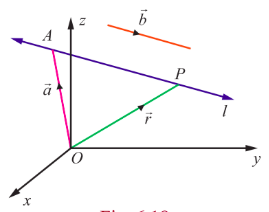
This is the vector equation of the straight line in parametric form.
Remark
The position vector of any point on the line is taken as $\vec{a} + t\vec{b}$.
(b) Non-parametric form of vector equation
Since $\overrightarrow{AP}$ is parallel to $\vec{b}$, we have $\overrightarrow{AP}\times \vec{b} = \vec{0}$.
That is, $(\vec{r} - \vec{a})\times \vec{b} = \vec{0}$.
This is known as the vector equation of the straight line in non-parametric form.
(c) Cartesian equation
Suppose $P$ is $(x,y,z)$, $A$ is $(x_{1},y_{1},z_{1})$ and $\vec{b} = b_{1}\hat{i} + b_{2}\hat{j} + b_{3}\hat{k}$. Then, substituting $\vec{r} = x\hat{i} + y\hat{j} + z\hat{k}$, $\vec{a} = x_{1}\hat{i} + y_{1}\hat{j} + z_{1}\hat{k}$ in (1) and comparing the coefficients of $\hat{i},\hat{j},\hat{k}$, we get
$$ x - x_{1} = tb_{1},\quad y - y_{1} = tb_{2},\quad z - z_{1} = tb_{3} \quad (4) $$Conventionally (4) can be written as
$$ \frac{x - x_{1}}{b_{1}} = \frac{y - y_{1}}{b_{2}} = \frac{z - z_{1}}{b_{3}} \quad (5) $$which are called the Cartesian equations or symmetric equations of a straight line passing through the point $(x_{1},y_{1},z_{1})$ and parallel to a vector with direction ratios $b_{1},b_{2},b_{3}$.
Remark
(i) Every point on the line (5) is of the form $(x_{1} + t b_{1}, y_{1} + t b_{2}, z_{1} + t b_{3})$, where $t\in \mathbb{R}$.
(ii) Since the direction cosines of a line are proportional to direction ratios of the line, if $l,m,n$ are the direction cosines of the line, then the Cartesian equations of the line are
$$ > \frac{x - x_{1}}{l} = \frac{y - y_{1}}{m} = \frac{z - z_{1}}{n}. > $$(iii) In (5), if any one or two of $b_{1},b_{2},b_{3}$ are zero, it does not mean that we are dividing by zero. But it means that the corresponding numerator is zero. For instance, If $b_{1}\neq 0$, $b_{2}\neq 0$ and $b_{3} = 0$, then
$$ > \frac{x - x_{1}}{b_{1}} = \frac{y - y_{1}}{b_{2}} = \frac{z - z_{1}}{0} > $$(iv) We know that the direction cosines of $x$-axis are $1,0,0$. Therefore, the equations of $x$-axis are
$$ > \frac{x - 0}{1} = \frac{y - 0}{0} = \frac{z - 0}{0} \quad \text{or} \quad x = t,\ y = 0,\ z = 0, \text{ where } t\in \mathbb{R}. > $$Similarly the equations of $y$-axis and $z$-axis are given by $\frac{x - 0}{0} = \frac{y - 0}{1} = \frac{z - 0}{0}$ and $\frac{x - 0}{0} = \frac{y - 0}{0} = \frac{z - 0}{1}$ respectively.
6.7.3 Straight Line passing through two given points#
(a) Parametric form of vector equation
Theorem 6.12
The parametric form of vector equation of a line passing through two given points whose position vectors are $\vec{a}$ and $\vec{b}$ respectively is $\vec{r} = \vec{a} + t(\vec{b} -\vec{a}),\ t\in \mathbb{R}$.
(b) Non-parametric form of vector equation
The above equation can be written equivalently in non-parametric form of vector equation as
$$ (\vec{r} -\vec{a})\times (\vec{b} -\vec{a}) = \vec{0} $$(c) Cartesian form of equation
Suppose $P$ is $(x,y,z)$, $A$ is $(x_{1},y_{1},z_{1})$ and $B$ is $(x_{2},y_{2},z_{2})$. Then substituting $\vec{r} = x\hat{i} + y\hat{j} + z\hat{k}$, $\vec{a} = x_{1}\hat{i} + y_{1}\hat{j} + z_{1}\hat{k}$ and $\vec{b} = x_{2}\hat{i} + y_{2}\hat{j} + z_{2}\hat{k}$ in theorem 6.12 and comparing the coefficients of $\hat{i},\hat{j},\hat{k}$, we get $x - x_{1} = t(x_{2} - x_{1}), y - y_{1} = t(y_{2} - y_{1}), z - z_{1} = t(z_{2} - z_{1})$ and so the Cartesian equations of a line passing through two given points $(x_{1},y_{1},z_{1})$ and $(x_{2},y_{2},z_{2})$ are given by
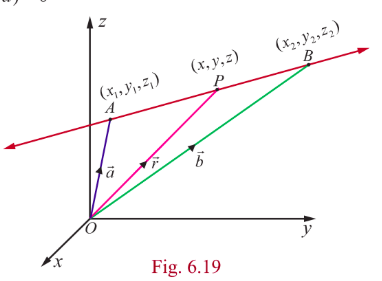
From the above equation, we observe that the direction ratios of a line passing through two given points $(x_1, y_1, z_1)$ and $(x_2, y_2, z_2)$ are given by $x_2 - x_1, y_2 - y_1, z_2 - z_1$ , which are also given by any three numbers proportional to them and in particular $x_1 - x_2, y_1 - y_2, z_1 - z_2$ .
Example 6.24
A straight line passes through the point $(1, 2, -3)$ and parallel to $4\hat{i} + 5\hat{j} - 7\hat{k}$ . Find (i) vector equation in parametric form (ii) vector equation in non-parametric form (iii) Cartesian equations of the straight line.
Solution
The required line passes through $(1, 2, -3)$ . So, the position vector of the point is $\hat{i} + 2\hat{j} - 3\hat{k}$ .
Let $\vec{a} = \hat{i} + 2\hat{j} - 3\hat{k}$ and $\vec{b} = 4\hat{i} + 5\hat{j} - 7\hat{k}$ . Then, we have
(i) vector equation of the required straight line in parametric form is $\vec{r} = \vec{a} + t\vec{b}$ , $t \in \mathbb{R}$ .
Therefore, $\vec{r} = (\hat{i} + 2\hat{j} - 3\hat{k}) + t(4\hat{i} + 5\hat{j} - 7\hat{k})$ , $t \in \mathbb{R}$ .
(ii) vector equation of the required straight line in non-parametric form is $(\vec{r} - \vec{a}) \times \vec{b} = \vec{0}$ .
Therefore, $(\vec{r} - (\hat{i} + 2\hat{j} - 3\hat{k})) \times (4\hat{i} + 5\hat{j} - 7\hat{k}) = \vec{0}$ .
(iii) Cartesian equations of the required line are
$\frac{x - x_1}{b_1} = \frac{y - y_1}{b_2} = \frac{z - z_1}{b_3}$ .
Here, $(x_1, y_1, z_1) = (1, 2, -3)$ and direction ratios of the required line are proportional to $4, 5, -7$ . Therefore, Cartesian equations of the straight line are
$\frac{x - 1}{4} = \frac{y - 2}{5} = \frac{z + 3}{-7}$ .
Example 6.25
The vector equation in parametric form of a line is $\vec{r} = (3\hat{i} - 2\hat{j} + 6\hat{k}) + t(2\hat{i} - \hat{j} + 3\hat{k})$ . Find (i) the direction cosines of the straight line (ii) vector equation in non-parametric form of the line (iii) Cartesian equations of the line.
Solution
Comparing the given equation with equation of a straight line $\vec{r} = \vec{a} + t\vec{b}$ , we have $\vec{a} = 3\vec{i} - 2\vec{j} + 6\vec{k}$ and $\vec{b} = 2\vec{i} - \vec{j} + 3\vec{k}$ . Therefore,
If $\vec{b} = b_1\vec{i} + b_2\vec{j} + b_3\vec{k}$ , then direction ratios of the straight line are $b_1, b_2, b_3$ . Therefore, direction ratios of the given straight line are proportional to $2, -1, 3$ , and hence the direction cosines of the given straight line are
$\frac{2}{\sqrt{14}} , \frac{-1}{\sqrt{14}} , \frac{3}{\sqrt{14}}$ .
vector equation of the straight line in non-parametric form is given by $(\vec{r} - \vec{a}) \times \vec{b} = \vec{0}$ . Therefore, $(\vec{r} - (3\vec{i} - 2\vec{j} + 6\vec{k})) \times (2\vec{i} - \vec{j} + 3\vec{k}) = \vec{0}$ .
Here $(x_1, y_1, z_1) = (3, -2, 6)$ and the direction ratios are proportional to $2, -1, 3$ .
Therefore, Cartesian equations of the straight line are
$\frac{x - 3}{2} = \frac{y + 2}{-1} = \frac{z - 6}{3}$ .
Example 6.26
Find the vector equation in parametric form and Cartesian equations of the line passing through $(-4,2,-3)$ and is parallel to the line $\frac{-x - 2}{4} = \frac{y + 3}{-2} = \frac{2z - 6}{3}$.
Solution
Rewriting the given equations as $\frac{x + 2}{-4} = \frac{y + 3}{-2} = \frac{z - 3}{3/2}$ and comparing with $\frac{x - x_{1}}{b_{1}} = \frac{y - y_{1}}{b_{2}} = \frac{z - z_{1}}{b_{3}}$, we have $\vec{b} = b_{1}\hat{i} + b_{2}\hat{j} + b_{3}\hat{k} = -4\hat{i} - 2\hat{j} + \frac{3}{2}\hat{k} = -\frac{1}{2}(8\hat{i} + 4\hat{j} - 3\hat{k})$. Clearly, $\vec{b}$ is parallel to the vector $8\hat{i} + 4\hat{j} - 3\hat{k}$. Therefore, a vector equation of the required straight line passing through the given point $(-4,2,-3)$ and parallel to the vector $8\hat{i} + 4\hat{j} - 3\hat{k}$ in parametric form is
$$ \vec{r} = (-4\hat{i} + 2\hat{j} - 3\hat{k}) + t(8\hat{i} + 4\hat{j} - 3\hat{k}), \quad t\in \mathbb{R}. $$Therefore, Cartesian equations of the required straight line are given by
$$ \frac{x + 4}{8} = \frac{y - 2}{4} = \frac{z + 3}{-3}. $$Example 6.27
Find the vector equation in parametric form and Cartesian equations of a straight line passing through the points $(-5,7,-4)$ and $(13,-5,2)$. Find the point where the straight line crosses the $xy$-plane.
Solution
The straight line passes through the points $(-5,7,-4)$ and $(13,-5,2)$, and therefore, direction ratios of the straight line joining these two points are $18, -12, 6$. That is, $3, -2, 1$.
So, the straight line is parallel to $3\hat{i} - 2\hat{j} + \hat{k}$. Therefore,
Required vector equation of the straight line in parametric form is $\vec{r} = (-5\hat{i} + 7\hat{j} - 4\hat{k}) + t(3\hat{i} - 2\hat{j} + \hat{k})$ or $\vec{r} = (13\hat{i} - 5\hat{j} + 2\hat{k}) + s(3\hat{i} - 2\hat{j} + \hat{k})$ where $s,t\in \mathbb{R}$.
Required Cartesian equations of the straight line are $\frac{x + 5}{3} = \frac{y - 7}{-2} = \frac{z + 4}{1}$ or $\frac{x - 13}{3} = \frac{y + 5}{-2} = \frac{z - 2}{1}$.
An arbitrary point on the straight line is of the form
$$ (3t - 5, -2t + 7, t - 4) \quad \text{or} \quad (3s + 13, -2s - 5, s + 2) $$Since the straight line crosses the $xy$-plane, the $z$-coordinate of the point of intersection is zero. Therefore, we have $t - 4 = 0$, that is, $t = 4$, and hence the straight line crosses the $xy$-plane at $(7, -1, 0)$.
Example 6.28
Find the angle made by the straight line $\frac{x + 3}{2} = \frac{y - 1}{2} = -z$ with coordinate axes.
Solution
If $\hat{b}$ is a unit vector parallel to the given line, then
$\hat{b} = \frac{2\hat{i} + 2\hat{j} - \hat{k}}{|2\hat{i} + 2\hat{j} - \hat{k}|} = \frac{1}{3}(2\hat{i} + 2\hat{j} - \hat{k})$ .
Therefore, from the definition of direction cosines of $\hat{b}$ , we have
$\cos \alpha = \frac{2}{3}$ , $\cos \beta = \frac{2}{3}$ , $\cos \gamma = -\frac{1}{3}$ ,
where $\alpha, \beta, \gamma$ are the angles made by $\hat{b}$ with the positive $x$ -axis, positive $y$ -axis, and positive $z$ -axis, respectively. As the angle between the given straight line with the coordinate axes are same as the angles made by $\hat{b}$ with the coordinate axes, we have
$\alpha = \cos^{-1}\left(\frac{2}{3}\right)$ , $\beta = \cos^{-1}\left(\frac{2}{3}\right)$ , $\gamma = \cos^{-1}\left(-\frac{1}{3}\right)$ ,
respectively.
6.7.4 Angle between two straight lines#
(a) Vector form
The acute angle between two given straight lines $\vec{r} = \vec{a} + s\vec{b}$ and $\vec{r} = \vec{c} + t\vec{d}$ is same as that of the angle between $\vec{b}$ and $\vec{d}$. So,
$$ \cos \theta = \frac{|\vec{b}\cdot \vec{d}|}{|\vec{b}| |\vec{d}|} \quad \text{or} \quad \theta = \cos^{-1}\left(\frac{|\vec{b}\cdot \vec{d}|}{|\vec{b}| |\vec{d}|}\right). $$Remark
(i) The two given lines $\vec{r} = \vec{a} + s\vec{b}$ and $\vec{r} = \vec{c} + t\vec{d}$ are parallel
$\Leftrightarrow \theta = 0 \Leftrightarrow \cos \theta = 1 \Leftrightarrow |\vec{b}\cdot \vec{d}| = |\vec{b}| |\vec{d}|$.
(ii) The two given lines $\vec{r} = \vec{a} + s\vec{b}$ and $\vec{r} = \vec{c} + t\vec{d}$ are parallel if, and only if $\vec{b} = \lambda \vec{d}$, for some scalar $\lambda$.
(iii) The two given lines $\vec{r} = \vec{a} + s\vec{b}$ and $\vec{r} = \vec{c} + t\vec{d}$ are perpendicular if, and only if $\vec{b}\cdot \vec{d} = 0$.
(b) Cartesian form
If two lines are given in Cartesian form as $\frac{x - x_{1}}{b_{1}} = \frac{y - y_{1}}{b_{2}} = \frac{z - z_{1}}{b_{3}}$ and $\frac{x - x_{2}}{d_{1}} = \frac{y - y_{2}}{d_{2}} = \frac{z - z_{2}}{d_{3}}$, then the acute angle $\theta$ between the two given lines is given by
$$ \theta = \cos^{-1}\left(\frac{|b_{1}d_{1} + b_{2}d_{2} + b_{3}d_{3}|}{\sqrt{b_{1}^{2} + b_{2}^{2} + b_{3}^{2}}\sqrt{d_{1}^{2} + d_{2}^{2} + d_{3}^{2}}}\right) $$Remark
(i) The two given lines with direction ratios $b_{1},b_{2},b_{3}$ and $d_{1},d_{2},d_{3}$ are parallel if, and only if
$$ > \frac{b_{1}}{d_{1}} = \frac{b_{2}}{d_{2}} = \frac{b_{3}}{d_{3}}. > $$(ii) The two given lines with direction ratios $b_{1},b_{2},b_{3}$ and $d_{1},d_{2},d_{3}$ are perpendicular if and only if $b_{1}d_{1} + b_{2}d_{2} + b_{3}d_{3} = 0$.
(iii) If the direction cosines of two given straight lines are $l_{1},m_{1},n_{1}$ and $l_{2},m_{2},n_{2}$, then the angle between the two given straight lines is $\cos \theta = |l_{1}l_{2} + m_{1}m_{2} + n_{1}n_{2}|$.
Example 6.29
Find the acute angle between the lines $\vec{r} = (\hat{i} + 2\hat{j} + 4\hat{k}) + t(2\hat{i} + 2\hat{j} + \hat{k})$ and the straight line passing through the points $(5,1,4)$ and $(9,2,12)$.
Solution
We know that the line $\vec{r} = (\hat{i} + 2\hat{j} + 4\hat{k}) + t(2\hat{i} + 2\hat{j} + \hat{k})$ is parallel to the vector $2\hat{i} + 2\hat{j} + \hat{k}$.
Direction ratios of the straight line joining the two given points $(5,1,4)$ and $(9,2,12)$ are $4,1,8$ and hence this line is parallel to the vector $4\hat{i} + \hat{j} + 8\hat{k}$.
Therefore, the acute angle between the given two straight lines is
$$ \theta = \cos^{-1}\left(\frac{|\vec{b}\cdot \vec{d}|}{|\vec{b}| |\vec{d}|}\right), \text{ where } \vec{b} = 2\hat{i} + 2\hat{j} + \hat{k} \text{ and } \vec{d} = 4\hat{i} + \hat{j} + 8\hat{k}. $$$$ \vec{b}\cdot \vec{d} = (2)(4) + (2)(1) + (1)(8) = 8 + 2 + 8 = 18. $$$$ |\vec{b}| = \sqrt{2^{2} + 2^{2} + 1^{2}} = \sqrt{9} = 3,\quad |\vec{d}| = \sqrt{4^{2} + 1^{2} + 8^{2}} = \sqrt{16 + 1 + 64} = \sqrt{81} = 9. $$Thus, $\theta = \cos^{-1}\left(\frac{18}{3 \times 9}\right) = \cos^{-1}\left(\frac{2}{3}\right)$.
Example 6.30
Find the acute angle between the straight lines $\frac{x - 4}{2} = \frac{y}{1} = \frac{z + 1}{-2}$ and $\frac{x - 1}{4} = \frac{y + 1}{-4} = \frac{z - 2}{2}$ and state whether they are parallel or perpendicular.
Solution
Comparing the given lines with the general Cartesian equations of straight lines,
$$ \frac{x - x_{1}}{b_{1}} = \frac{y - y_{1}}{b_{2}} = \frac{z - z_{1}}{b_{3}} \quad \text{and} \quad \frac{x - x_{2}}{d_{1}} = \frac{y - y_{2}}{d_{2}} = \frac{z - z_{2}}{d_{3}} $$we find $(b_{1},b_{2},b_{3}) = (2,1,-2)$ and $(d_{1},d_{2},d_{3}) = (4,-4,2)$. Therefore, the acute angle between the two straight lines is
$$ \theta = \cos^{-1}\left(\frac{|(2)(4) + (1)(-4) + (-2)(2)|}{\sqrt{2^{2} + 1^{2} + (-2)^{2}}\sqrt{4^{2} + (-4)^{2} + 2^{2}}}\right) = \cos^{-1}\left(\frac{|8 - 4 - 4|}{\sqrt{9}\sqrt{36}}\right) = \cos^{-1}(0) = \frac{\pi}{2}. $$Thus the two straight lines are perpendicular.
Example 6.31
Show that the straight line passing through the points $A(6,7,5)$ and $B(8,10,6)$ is perpendicular to the straight line passing through the points $C(10,2,-5)$ and $D(8,3,-4)$.
Solution
The straight line passing through the points $A(6,7,5)$ and $B(8,10,6)$ is parallel to the vector $\vec{b} = \overrightarrow{AB} = \overrightarrow{OB} - \overrightarrow{OA} = 2\hat{i} + 3\hat{j} + \hat{k}$ and the straight line passing through the points $C(10,2,-5)$ and $D(8,3,-4)$ is parallel to the vector $\vec{d} = \overrightarrow{CD} = -2\hat{i} + \hat{j} + \hat{k}$. Therefore, the angle between the two straight lines is the angle between the two vectors $\vec{b}$ and $\vec{d}$. Since
$$ \vec{b}\cdot \vec{d} = (2\hat{i} + 3\hat{j} + \hat{k})\cdot (-2\hat{i} + \hat{j} + \hat{k}) = -4 + 3 + 1 = 0, $$the two vectors are perpendicular, and hence the two straight lines are perpendicular.
Aliter
We find that direction ratios of the straight line joining the points $A(6,7,5)$ and $B(8,10,6)$ are $(b_{1},b_{2},b_{3}) = (2,3,1)$ and direction ratios of the line joining the points $C(10,2,-5)$ and $D(8,3,-4)$ are $(d_{1},d_{2},d_{3}) = (-2,1,1)$. Since $b_{1}d_{1} + b_{2}d_{2} + b_{3}d_{3} = (2)(-2) + (3)(1) + (1)(1) = -4 + 3 + 1 = 0$, the two straight lines are perpendicular.
Example 6.32
Show that the lines $\frac{x - 1}{4} = \frac{2 - y}{6} = \frac{z - 4}{12}$ and $\frac{x - 3}{-2} = \frac{y - 3}{3} = \frac{5 - z}{6}$ are parallel.
Solution
We observe that the straight line $\frac{x - 1}{4} = \frac{2 - y}{6} = \frac{z - 4}{12}$ is parallel to the vector $4\hat{i} - 6\hat{j} + 12\hat{k}$ and the straight line $\frac{x - 3}{-2} = \frac{y - 3}{3} = \frac{5 - z}{6}$ is parallel to the vector $-2\hat{i} + 3\hat{j} - 6\hat{k}$.
Since $4\hat{i} - 6\hat{j} + 12\hat{k} = -2(-2\hat{i} + 3\hat{j} - 6\hat{k})$, the two vectors are parallel, and hence the two straight lines are parallel.
Exercise 6.4#
- Find the non-parametric form of vector equation and Cartesian equations of the straight line passing through the point with position vector $4\hat{i} + 3\hat{j} - 7\hat{k}$ and parallel to the vector $2\hat{i} - 6\hat{j} + 7\hat{k}$.
- Find the parametric form of vector equation and Cartesian equations of the straight line passing through the point $(-2,3,4)$ and parallel to the straight line $\frac{x - 1}{-4} = \frac{y + 3}{5} = \frac{8 - z}{6}$.
- Find the points where the straight line passes through $(6,7,4)$ and $(8,4,9)$ cuts the $xz$ and $yz$ planes.
- Find the direction cosines of the straight line passing through the points $(5,6,7)$ and $(7,9,13)$. Also, find the parametric form of vector equation and Cartesian equations of the straight line passing through two given points.
- Find the acute angle between the following lines. (i) $\vec{r}=(4\hat{i}-\hat{j})+t(\hat{i}+2\hat{j}-2\hat{k}),\ \vec{r}=(\hat{i}-2\hat{j}+4\hat{k})+s(-\hat{i}-2\hat{j}+2\hat{k})$ (ii) $\frac{x+4}{3}=\frac{y-7}{4}=\frac{z+5}{5},\ \vec{r}=4\hat{k}+t(2\hat{i}+\hat{j}+\hat{k})$
- The vertices of $\Delta ABC$ are $A(7,2,1), B(6,0,3)$, and $C(4,2,4)$. Find $\angle ABC$.
- If the straight line joining the points $(2,1,4)$ and $(a-1,4,-1)$ is parallel to the line joining the points $(0,2,b-1)$ and $(5,3,-2)$, find the values of $a$ and $b$.
- If the straight lines $\frac{x-5}{5m+2} = \frac{2-y}{5} = \frac{1-z}{-1}$ and $x = \frac{2y+1}{4m} = \frac{1-z}{-3}$ are perpendicular to each other, find the value of $m$.
- Show that the points $(2,3,4), (-1,4,5)$ and $(8,1,2)$ are collinear.
6.7.5 Point of intersection of two straight lines#
If $\frac{x - x_{1}}{a_{1}} = \frac{y - y_{1}}{a_{2}} = \frac{z - z_{1}}{a_{3}}$ and $\frac{x - x_{2}}{b_{1}} = \frac{y - y_{2}}{b_{2}} = \frac{z - z_{2}}{b_{3}}$ are two lines, then every point on the line is of the form $(x_{1} + sa_{1}, y_{1} + sa_{2}, z_{1} + sa_{3})$ and $(x_{2} + tb_{1}, y_{2} + tb_{2}, z_{2} + tb_{3})$ respectively. If the lines are intersecting, then there must be a common point. So, at the point of intersection, for some values of $s$ and $t$, we have
$$ (x_{1} + sa_{1}, y_{1} + sa_{2}, z_{1} + sa_{3}) = (x_{2} + tb_{1}, y_{2} + tb_{2}, z_{2} + tb_{3}) $$Therefore, $x_{1} + sa_{1} = x_{2} + tb_{1},\ y_{1} + sa_{2} = y_{2} + tb_{2},\ z_{1} + sa_{3} = z_{2} + tb_{3}$.
By solving any two of the above three equations, we obtain the values of $s$ and $t$. If $s$ and $t$ satisfy the remaining equation, the lines are intersecting lines. Otherwise the lines are non-intersecting. Substituting the value of $s$, (or by substituting the value of $t$), we get the point of intersection of two lines.
If the equations of straight lines are given in vector form, write them in cartesian form and proceed as above to find the point of intersection.
Example 6.33
Find the point of intersection of the lines $\frac{x - 1}{2} = \frac{y - 2}{3} = \frac{z - 3}{4}$ and $\frac{x - 4}{5} = \frac{y - 1}{2} = z$.
Solution
Every point on the line $\frac{x - 1}{2} = \frac{y - 2}{3} = \frac{z - 3}{4} = s$ (say) is of the form $(2s+1, 3s+2, 4s+3)$ and every point on the line $\frac{x - 4}{5} = \frac{y - 1}{2} = z = t$ (say) is of the form $(5t+4, 2t+1, t)$. So, at the point of intersection, for some values of $s$ and $t$, we have
$$ (2s+1, 3s+2, 4s+3) = (5t+4, 2t+1, t) $$Therefore, $2s - 5t = 3$, $3s - 2t = -1$ and $4s - t = -3$. Solving the first two equations we get $t = -1$, $s = -1$. These values of $s$ and $t$ satisfy the third equation. Therefore, the given lines intersect. Substituting these values of $t$ or $s$ in the respective points, the point of intersection is $(-1, -1, -1)$.
6.7.6 Shortest distance between two straight lines#
We have just explained how the point of intersection of two lines are found and we have also studied how to determine whether the given two lines are parallel or not.
Definition 6.6
Two lines are said to be coplanar if they lie in the same plane.
Note
If two lines are either parallel or intersecting, then they are coplanar.
Definition 6.7
Two lines in space are called skew lines if they are not parallel and do not intersect.
Note
If two lines are skew lines, then they are non coplanar.
If the lines are not parallel and intersect, the distance between them is zero. If they are parallel and non-intersecting, the distance is determined by the length of the line segment perpendicular to both the parallel lines. In the same way, the shortest distance between two skew lines is defined as the length of the line segment perpendicular to both the skew lines. Two lines will either be parallel or skew.
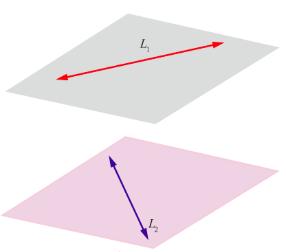
Theorem 6.13
The shortest distance between the two parallel lines $\vec{r} = \vec{a} + s\vec{b}$ and $\vec{r} = \vec{c} + t\vec{b}$ is given by $d = \frac{|(\vec{c} - \vec{a})\times \vec{b}|}{|\vec{b}|}$, where $|\vec{b}| \neq 0$.
Proof
The given two parallel lines $\vec{r} = \vec{a} + s\vec{b}$ and $\vec{r} = \vec{c} + t\vec{b}$ are denoted by $L_{1}$ and $L_{2}$ respectively. Let $A$ and $B$ be the points on $L_{1}$ and $L_{2}$ whose position vectors are $\vec{a}$ and $\vec{c}$ respectively. The two given lines are parallel to $\vec{b}$.
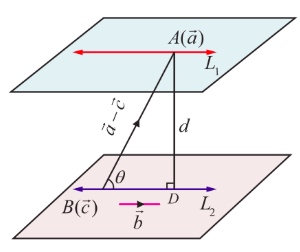
Let $AD$ be a perpendicular to the two given lines. If $\theta$ is the acute angle between $\overline{AB}$ and $\vec{b}$, then
$$ \sin \theta = \frac{|\overline{AB}\times \vec{b}|}{|\overline{AB}| |\vec{b}|} = \frac{|(\vec{c} - \vec{a})\times \vec{b}|}{|\vec{c} - \vec{a}| |\vec{b}|} \quad (1) $$But, from the right angle triangle $ABD$
$$ \sin \theta = \frac{d}{AB} = \frac{d}{|\vec{c} - \vec{a}|} \quad (2) $$From (1) and (2), we have $d = \frac{|(\vec{c} - \vec{a})\times \vec{b}|}{|\vec{b}|}$, where $|\vec{b}| \neq 0$.
$$ \delta = \frac{|(\vec{c} - \vec{a})\cdot(\vec{b}\times \vec{d})|}{|\vec{b}\times \vec{d}|}, \quad \text{where } |\vec{b}\times \vec{d}| \neq 0. $$Theorem 6.14
The shortest distance between the two skew lines $\vec{r} = \vec{a} + s\vec{b}$ and $\vec{r} = \vec{c} + t\vec{d}$ is given by
Proof
The two skew lines $\vec{r} = \vec{a} + s\vec{b}$ and $\vec{r} = \vec{c} + t\vec{d}$ are denoted by $L_{1}$ and $L_{2}$ respectively.
Let $A$ and $C$ be the points on $L_{1}$ and $L_{2}$ with position vectors $\vec{a}$ and $\vec{c}$ respectively.
From the given equations of skew lines, we observe that $L_{1}$ is parallel to the vector $\vec{b}$ and $L_{2}$ is parallel to the vector $\vec{d}$. So, $\vec{b} \times \vec{d}$ is perpendicular to the lines $L_{1}$ and $L_{2}$.
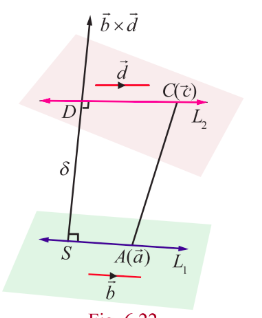
Let $SD$ be the line segment perpendicular to both the lines $L_{1}$ and $L_{2}$. Then the vector $\overline{SD}$ is perpendicular to the vectors $\vec{b}$ and $\vec{d}$ and therefore it is parallel to the vector $\vec{b} \times \vec{d}$.
So, $\frac{\vec{b} \times \vec{d}}{|\vec{b} \times \vec{d}|}$ is a unit vector in the direction of $\overline{SD}$. Then, the shortest distance $|\overline{SD}|$ is the absolute value of the projection of $\overline{AC}$ on $\overline{SD}$. That is,
$$ \delta = |\overline{SD}| = \left| \overline{AC} \cdot \left( \text{Unit vector in the direction of } \overline{SD} \right) \right| = \left| (\vec{c} - \vec{a}) \cdot \frac{\vec{b}\times \vec{d}}{|\vec{b}\times \vec{d}|} \right| = \frac{|(\vec{c} - \vec{a})\cdot(\vec{b}\times \vec{d})|}{|\vec{b}\times \vec{d}|}, \quad \text{where } |\vec{b}\times \vec{d}| \neq 0. \quad (1) $$Remark
(i) It follows from theorem (6.14) that two straight lines $\vec{r} = \vec{a} + s\vec{b}$ and $\vec{r} = \vec{c} + t\vec{d}$ intersect each other (that is, coplanar) if $(\vec{c} - \vec{a})\cdot (\vec{b}\times \vec{d}) = 0$.
(ii) If two lines $\frac{x - x_{1}}{b_{1}} = \frac{y - y_{1}}{b_{2}} = \frac{z - z_{1}}{b_{3}}$ and $\frac{x - x_{2}}{d_{1}} = \frac{y - y_{2}}{d_{2}} = \frac{z - z_{2}}{d_{3}}$ intersect each other (that is, coplanar), then we have
$$ > \begin{vmatrix} > x_{2} - x_{1} & y_{2} - y_{1} & z_{2} - z_{1} \\ > b_{1} & b_{2} & b_{3} \\ > d_{1} & d_{2} & d_{3} > \end{vmatrix} = 0. > $$
Example 6.34
Find the parametric form of vector equation of a straight line passing through the point of intersection of the straight lines $\vec{r} = (\hat{i} + 3\hat{j} - \hat{k}) + t(2\hat{i} + 3\hat{j} + 2\hat{k})$ and $\frac{x - 2}{1} = \frac{y - 4}{2} = \frac{z + 3}{4}$, and perpendicular to both straight lines.
Solution
The Cartesian equations of the straight line $\vec{r} = (\hat{i} + 3\hat{j} - \hat{k}) + t(2\hat{i} + 3\hat{j} + 2\hat{k})$ is
$$ \frac{x - 1}{2} = \frac{y - 3}{3} = \frac{z + 1}{2} = s \quad \text{(say)}. $$Then any point on this line is of the form $(2s + 1, 3s + 3, 2s - 1)$ … (1)
The Cartesian equation of the second line is $\frac{x - 2}{1} = \frac{y - 4}{2} = \frac{z + 3}{4} = t$ (say)
Then any point on this line is of the form $(t + 2, 2t + 4, 4t - 3)$ … (2)
If the given lines intersect, then there must be a common point. Therefore, for some $s, t \in \mathbb{R}$ we have $(2s + 1, 3s + 3, 2s - 1) = (t + 2, 2t + 4, 4t - 3)$.
Equating the coordinates of $x, y$ and $z$ we get
$$ 2s - t = 1, \quad 3s - 2t = 1 \quad \text{and} \quad s - 2t = -1. $$Solving the first two of the above three equations, we get $s = 1$ and $t = 1$. These values of $s$ and $t$ satisfy the third equation. So, the lines are intersecting.
Now, using the value of $s$ in (1) or the value of $t$ in (2), the point of intersection $(3, 6, 1)$ of these two straight lines is obtained.
If we take $\vec{b} = 2\hat{i} + 3\hat{j} + 2\hat{k}$ and $\vec{d} = \hat{i} + 2\hat{j} + 4\hat{k}$, then $\vec{b}\times \vec{d} = \begin{vmatrix} \hat{i} & \hat{j} & \hat{k} \\ 2 & 3 & 2 \\ 1 & 2 & 4 \end{vmatrix} = 8\hat{i} - 6\hat{j} + \hat{k}$ is a vector perpendicular to both the given straight lines. Therefore, the required straight line passing through $(3, 6, 1)$ and perpendicular to both the given straight lines is the same as the straight line passing through $(3, 6, 1)$ and parallel to $8\hat{i} - 6\hat{j} + \hat{k}$. Thus, the equation of the required straight line is
$$ \vec{r} = (3\hat{i} + 6\hat{j} + \hat{k}) + m(8\hat{i} - 6\hat{j} + \hat{k}), \quad m \in \mathbb{R}. $$Example 6.35
Determine whether the pair of straight lines $\vec{r} = (2\hat{i} + 6\hat{j} + 3\hat{k}) + t(2\hat{i} + 3\hat{j} + 4\hat{k})$ and $\vec{r} = (2\hat{j} - 3\hat{k}) + s(\hat{i} + 2\hat{j} + 3\hat{k})$ are parallel. Find the shortest distance between them.
Solution
Comparing the given two equations with
$$ \vec{r} = \vec{a} + s\vec{b} \quad \text{and} \quad \vec{r} = \vec{c} + s\vec{d}, $$$\vec{a} = 2\hat{i} + 6\hat{j} + 3\hat{k}$, $\vec{b} = 2\hat{i} + 3\hat{j} + 4\hat{k}$, $\vec{c} = 2\hat{j} - 3\hat{k}$, $\vec{d} = \hat{i} + 2\hat{j} + 3\hat{k}$.
Clearly, $\vec{b}$ is not a scalar multiple of $\vec{d}$. So, the two vectors are not parallel and hence the two lines are not parallel.
The shortest distance between the two straight lines is given by
$$ \delta = \frac{|(\vec{c} - \vec{a})\cdot (\vec{b}\times \vec{d})|}{|\vec{b}\times \vec{d}|}. $$Now, $\vec{c} - \vec{a} = (2\hat{j} - 3\hat{k}) - (2\hat{i} + 6\hat{j} + 3\hat{k}) = -2\hat{i} - 4\hat{j} - 6\hat{k}$.
$$ \vec{b}\times \vec{d} = \begin{vmatrix} \hat{i} & \hat{j} & \hat{k} \\ 2 & 3 & 4 \\ 1 & 2 & 3 \end{vmatrix} = (9 - 8)\hat{i} - (6 - 4)\hat{j} + (4 - 3)\hat{k} = \hat{i} - 2\hat{j} + \hat{k}. $$So, $(\vec{c} - \vec{a})\cdot (\vec{b}\times \vec{d}) = (-2\hat{i} - 4\hat{j} - 6\hat{k})\cdot (\hat{i} - 2\hat{j} + \hat{k}) = -2 + 8 - 6 = 0$.
Therefore, the distance between the two given straight lines is zero. Thus, the given lines intersect each other.
Example 6.36
Find the shortest distance between the two given straight lines $\vec{r} = (2\vec{i} + 3\vec{j} + 4\vec{k}) + t(-2\vec{i} + \vec{j} - 2\vec{k})$ and $\frac{x - 3}{2} = \frac{y}{-1} = \frac{z + 2}{2}$.
Solution
The parametric form of vector equations of the given straight lines are
$$ \vec{r} = (2\vec{i} + 3\vec{j} + 4\vec{k}) + t(-2\vec{i} + \vec{j} - 2\vec{k}) $$and
$$ \vec{r} = (3\vec{i} - 2\vec{k}) + s(2\vec{i} - \vec{j} + 2\vec{k}). $$Comparing the given two equations with $\vec{r} = \vec{a} + t\vec{b}$ and $\vec{r} = \vec{c} + s\vec{d}$,
we have $\vec{a} = 2\vec{i} + 3\vec{j} + 4\vec{k}$, $\vec{b} = -2\vec{i} + \vec{j} - 2\vec{k}$, $\vec{c} = 3\vec{i} - 2\vec{k}$, $\vec{d} = 2\vec{i} - \vec{j} + 2\vec{k}$.
Clearly, $\vec{b}$ is a scalar multiple of $\vec{d}$, and hence the two straight lines are parallel. We know that the shortest distance between two parallel straight lines is given by $d = \frac{|(\vec{c} - \vec{a})\times \vec{b}|}{|\vec{b}|}$.
Now, $\vec{c} - \vec{a} = (3\vec{i} - 2\vec{k}) - (2\vec{i} + 3\vec{j} + 4\vec{k}) = \vec{i} - 3\vec{j} - 6\vec{k}$.
$$ (\vec{c} - \vec{a})\times \vec{b} = \begin{vmatrix} \hat{i} & \hat{j} & \hat{k} \\ 1 & -3 & -6 \\ -2 & 1 & -2 \end{vmatrix} = \hat{i}(6 + 6) - \hat{j}(-2 - 12) + \hat{k}(1 - 6) = 12\hat{i} + 14\hat{j} - 5\hat{k}. $$Thus, $|(\vec{c} - \vec{a})\times \vec{b}| = \sqrt{12^{2} + 14^{2} + (-5)^{2}} = \sqrt{144 + 196 + 25} = \sqrt{365}$.
Also, $|\vec{b}| = \sqrt{(-2)^{2} + 1^{2} + (-2)^{2}} = \sqrt{4 + 1 + 4} = 3$.
Hence, $d = \frac{\sqrt{365}}{3}$ units.
Example 6.37
Find the coordinate of the foot of the perpendicular drawn from the point $(-1, 2, 3)$ to the straight line $\vec{r} = (\vec{i} - 4\vec{j} + 3\vec{k}) + t(2\vec{i} + 3\vec{j} + \vec{k})$. Also, find the shortest distance from the given point to the straight line.
Solution
Figure 6.23
Comparing the given equation $\vec{r} = (\vec{i} - 4\vec{j} + 3\vec{k}) + t(2\vec{i} + 3\vec{j} + \vec{k})$ with $\vec{r} = \vec{a} + t\vec{b}$, we get $\vec{a} = \vec{i} - 4\vec{j} + 3\vec{k}$, and $\vec{b} = 2\vec{i} + 3\vec{j} + \vec{k}$. We denote the given point $(-1, 2, 3)$ by $D$, and the point $(1, -4, 3)$ on the straight line by $A$. If $F$ is the foot of the perpendicular from $D$ to the straight line, then $F$ is of the form $(2t + 1, 3t - 4, t + 3)$ and $\overline{DF} = \overline{OF} - \overline{OD} = (2t + 2)\hat{i} + (3t - 6)\hat{j} + t\hat{k}$.
Since $\vec{b}$ is perpendicular to $\overline{DF}$, we have
$$ \vec{b}\cdot \overline{DF} = 0 \Rightarrow 2(2t + 2) + 3(3t - 6) + 1(t) = 0 \Rightarrow 4t + 4 + 9t - 18 + t = 0 \Rightarrow 14t - 14 = 0 \Rightarrow t = 1. $$Therefore, the coordinate of $F$ is $(3, -1, 4)$.
Now, the perpendicular distance from the given point to the given line is
$$ DF = |\overline{DF}| = \sqrt{4^{2} + (-3)^{2} + 1^{2}} = \sqrt{16 + 9 + 1} = \sqrt{26} \text{ units}. $$Exercise 6.5
Find the parametric form of vector equation and Cartesian equations of a straight line passing through $(5, 2, 8)$ and is perpendicular to the straight lines $\vec{r} = (\hat{i} + \hat{j} - \hat{k}) + s(2\hat{i} - 2\hat{j} + \hat{k})$ and $\vec{r} = (2\hat{i} - \hat{j} - 3\hat{k}) + t(\hat{i} + 2\hat{j} + 2\hat{k})$.
Show that the lines $\vec{r} = (6\hat{i} + \hat{j} + 2\hat{k}) + s(\hat{i} + 2\hat{j} - 3\hat{k})$ and $\vec{r} = (3\hat{i} + 2\hat{j} - 2\hat{k}) + t(2\hat{i} + 4\hat{j} - 5\hat{k})$ are skew lines and hence find the shortest distance between them.
If the two lines $\frac{x - 1}{2} = \frac{y + 1}{3} = \frac{z - 1}{4}$ and $\frac{x - 3}{1} = \frac{y - m}{2} = z$ intersect at a point, find the value of $m$.
Show that the lines $\frac{x - 3}{3} = \frac{y - 3}{-1}, z - 1 = 0$ and $\frac{x - 6}{2} = \frac{z - 1}{3}, y - 2 = 0$ intersect. Also find the point of intersection.
Show that the straight lines $x + 1 = 2y = -12z$ and $x = y + 2 = 6z - 6$ are skew and hence find the shortest distance between them.
Find the parametric form of vector equation of the straight line passing through $(-1, 2, 1)$ and parallel to the straight line $\vec{r} = (2\hat{i} + 3\hat{j} - \hat{k}) + t(\hat{i} - 2\hat{j} + \hat{k})$ and hence find the shortest distance between the lines.
Find the foot of the perpendicular drawn from the point $(5, 4, 2)$ to the line $\frac{x + 1}{2} = \frac{y - 3}{3} = \frac{z - 1}{-1}$. Also, find the equation of the perpendicular.
6.8 Different forms of Equation of a plane#
We have already seen the notion of a plane.
Definition 6.8
A vector which is perpendicular to a plane is called a normal to the plane.
Note
Every normal to a plane is perpendicular to every straight line lying on the plane.
A plane is uniquely fixed if any one of the following is given:
- a unit normal to the plane and the distance of the plane from the origin
- a point of the plane and a normal to the plane
- three non-collinear points of the plane
- a point of the plane and two non-parallel lines or non-parallel vectors which are parallel to the plane
- two distinct points of the plane and a straight line or non-zero vector parallel to the plane but not parallel to the line joining the two points.
Let us find the vector and Cartesian equations of planes using the above situations.
6.8.1 Equation of a plane when a normal to the plane and the distance of the plane from the origin are given#
(a) Vector equation of a plane in normal form
Theorem 6.15
The equation of the plane at a distance $p$ from the origin and perpendicular to the unit normal vector $\hat{d}$ is $\vec{r}\cdot \hat{d} = p$.
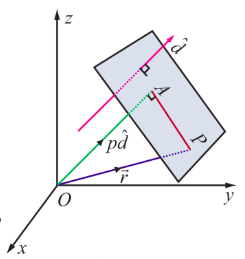
Consider a plane whose perpendicular distance from the origin is $p$.
Let $A$ be the foot of the perpendicular from $O$ to the plane.
Let $\hat{d}$ be the unit normal vector in the direction of $\overline{OA}$.
Then $\overline{OA} = p\hat{d}$.
If $\vec{r}$ is the position vector of an arbitrary point $P$ on the plane,
then $\overline{AP}$ is perpendicular to $\overline{OA}$.
Therefore, $\overline{AP} \cdot \overline{OA} = 0 \Rightarrow (\vec{r} - p\hat{d}) \cdot p\hat{d} = 0$
$$ \Rightarrow (\vec{r} - p\hat{d})\cdot \hat{d} = 0 $$which gives $\vec{r} \cdot \hat{d} = p$.
The above equation is called the vector equation of the plane in normal form.
(b) Cartesian equation of a plane in normal form
Let $l, m, n$ be the direction cosines of $\hat{d}$. Then we have $\hat{d} = l\hat{i} + m\hat{j} + n\hat{k}$.
Thus, equation (1) becomes
$$ \vec{r}\cdot (l\hat{i} + m\hat{j} + n\hat{k}) = p. $$If $P$ is $(x, y, z)$, then $\vec{r} = x\hat{i} + y\hat{j} + z\hat{k}$.
Therefore, $(x\hat{i} + y\hat{j} + z\hat{k})\cdot (l\hat{i} + m\hat{j} + n\hat{k}) = p$ or $lx + my + nz = p$.
Equation (2) is called the Cartesian equation of the plane in normal form.
Remark
(i) If the plane passes through the origin, then $p = 0$. So, the equation of the plane is
$$ > lx + my + nz = 0. > $$(ii) If $\vec{d}$ is normal vector to the plane, then $\hat{d} = \frac{\vec{d}}{|\vec{d}|}$ is a unit normal to the plane. So, the vector equation of the plane is $\vec{r} \cdot \frac{\vec{d}}{|\vec{d}|} = p$ or $\vec{r} \cdot \vec{d} = q$, where $q = p |\vec{d}|$. The equation $\vec{r} \cdot \vec{d} = q$ is the vector equation of a plane in standard form.
Note
In the standard form $\vec{r} \cdot \vec{d} = q$, $\vec{d}$ need not be a unit normal and $q$ need not be the perpendicular distance.
6.8.2 Equation of a plane perpendicular to a vector and passing through a given point#
(a) Vector form of equation
Consider a plane passing through a point $A$ with position vector $\vec{a}$ and $\vec{n}$ is a normal vector to the given plane.
Let $\vec{r}$ be the position vector of an arbitrary point $P$ on the plane.
{AP}$ is perpendicular to $\vec{n}$.
$$ \overline{AP}\cdot \vec{n} = 0 \quad (1) $$which is the vector form of the equation of a plane passing through a point with position vector $\vec{a}$ and perpendicular to $\vec{n}$.
Note
$$ > (\vec{r} - \vec{a})\cdot \vec{n} = 0 \Rightarrow \vec{r}\cdot \vec{n} = \vec{a}\cdot \vec{n} \Rightarrow \vec{r}\cdot \vec{n} = q, \quad \text{where } q = \vec{a}\cdot \vec{n}. > $$
(b) Cartesian form of equation
If $a, b, c$ are the direction ratios of $\vec{n}$, then we have $\vec{n} = a\hat{i} + b\hat{j} + c\hat{k}$. Suppose $A$ is $(x_{1}, y_{1}, z_{1})$, then equation (1) becomes $\left((x - x_{1})\hat{i} + (y - y_{1})\hat{j} + (z - z_{1})\hat{k}\right) \cdot (a\hat{i} + b\hat{j} + c\hat{k}) = 0$. That is,
$$ a(x - x_{1}) + b(y - y_{1}) + c(z - z_{1}) = 0 $$which is the Cartesian equation of a plane, normal to a vector with direction ratios $a, b, c$ and passing through a given point $(x_{1}, y_{1}, z_{1})$.
6.8.3 Intercept form of the equation of a plane#
Let the plane $\vec{r}\cdot \vec{n} = q$ meets the coordinate axes at $A, B, C$ respectively such that the intercepts on the axes are $OA = a$, $OB = b$, $OC = c$. Now position vector of the point $A$ is $a\hat{i}$. Since $A$ lies on the given plane, we have $a\hat{i}\cdot \vec{n} = q$ which gives $\hat{i}\cdot \vec{n} = \frac{q}{a}$. Similarly, since the vectors $b\hat{j}$ and $c\hat{k}$ lie on the given plane, we have $\hat{j}\cdot \vec{n} = \frac{q}{b}$ and $\hat{k}\cdot \vec{n} = \frac{q}{c}$. Substituting $\vec{r} = x\hat{i} + y\hat{j} + z\hat{k}$ in $\vec{r}\cdot \vec{n} = q$, we get $x\hat{i}\cdot \vec{n} + y\hat{j}\cdot \vec{n} + z\hat{k}\cdot \vec{n} = q$. So $x\left(\frac{q}{a}\right) + y\left(\frac{q}{b}\right) + z\left(\frac{q}{c}\right) = q$.
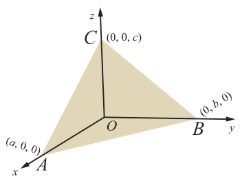
Dividing by $q$, we get $\frac{x}{a} + \frac{y}{b} + \frac{z}{c} = 1$. This is called the intercept form of equation of the plane having intercepts $a, b, c$ on the $x, y, z$ axes respectively.
Theorem 6.16
The general equation $ax + by + cz + d = 0$ of first degree in $x, y, z$ represents a plane.
Proof
The equation $ax + by + cz + d = 0$ can be written in the vector form as follows
$$ (x\hat{i} + y\hat{j} + z\hat{k})\cdot (a\hat{i} + b\hat{j} + c\hat{k}) = -d \quad \text{or} \quad \vec{r}\cdot \vec{n} = -d. $$Since this is the vector form of the equation of a plane in standard form, the given equation $ax + by + cz + d = 0$ represents a plane. Here $\vec{n} = a\hat{i} + b\hat{j} + c\hat{k}$ is a vector normal to the plane.
Note
In the general equation $ax + by + cz + d = 0$ of a plane, $a, b, c$ are direction ratios of the normal to the plane.
Example 6.38
Find the vector and Cartesian form of the equations of a plane which is at a distance of 12 units from the origin and perpendicular to $6\hat{i} + 2\hat{j} - 3\hat{k}$.
Solution
Let $\vec{d} = 6\hat{i} + 2\hat{j} - 3\hat{k}$ and $p = 12$.
If $\hat{d}$ is the unit normal vector in the direction of the vector $6\hat{i} + 2\hat{j} - 3\hat{k}$,
then $\hat{d} = \frac{\vec{d}}{|\vec{d}|} = \frac{1}{7} (6\hat{i} + 2\hat{j} - 3\hat{k})$.
If $\vec{r}$ is the position vector of an arbitrary point $(x, y, z)$ on the plane, then using $\vec{r}\cdot \hat{d} = p$, the vector equation of the plane in normal form is $\vec{r}\cdot \frac{1}{7} (6\hat{i} + 2\hat{j} - 3\hat{k}) = 12$.
Substituting $\vec{r} = x\hat{i} + y\hat{j} + z\hat{k}$ in the above equation, we get $(x\hat{i} + y\hat{j} + z\hat{k})\cdot \frac{1}{7} (6\hat{i} + 2\hat{j} - 3\hat{k}) = 12$. Applying dot product in the above equation and simplifying, we get $6x + 2y - 3z = 84$, which is the Cartesian equation of the required plane.
Example 6.39
If the Cartesian equation of a plane is $3x - 4y + 3z = -8$, find the vector equation of the plane in the standard form.
Solution
If $\vec{r} = x\hat{i} + y\hat{j} + z\hat{k}$ is the position vector of an arbitrary point $(x, y, z)$ on the plane, then the given equation can be written as $(x\hat{i} + y\hat{j} + z\hat{k})\cdot (3\hat{i} - 4\hat{j} + 3\hat{k}) = -8$ or $(x\hat{i} + y\hat{j} + z\hat{k})\cdot (-3\hat{i} + 4\hat{j} - 3\hat{k}) = 8$. That is, $\vec{r}\cdot (-3\hat{i} + 4\hat{j} - 3\hat{k}) = 8$, which is the vector equation of the given plane in standard form.
Example 6.40
Find the direction cosines of the normal to the plane and length of the perpendicular from the origin to the plane $\vec{r}\cdot (3\hat{i} - 4\hat{j} + 12\hat{k}) = 5$.
Solution
Let $\vec{d} = 3\hat{i} - 4\hat{j} + 12\hat{k}$ and $q = 5$.
If $\hat{d}$ is the unit vector in the direction of the vector $3\hat{i} - 4\hat{j} + 12\hat{k}$, then $\hat{d} = \frac{1}{13} (3\hat{i} - 4\hat{j} + 12\hat{k})$.
Now, dividing the given equation by 13, we get
$$ \vec{r}\cdot \left(\frac{3}{13}\hat{i} - \frac{4}{13}\hat{j} + \frac{12}{13}\hat{k}\right) = \frac{5}{13} $$which is the equation of the plane in the normal form $\vec{r}\cdot \hat{d} = p$.
From this equation, we infer that $\hat{d} = \frac{1}{13} (3\hat{i} - 4\hat{j} + 12\hat{k})$ is a unit vector normal to the plane from the origin. Therefore, the direction cosines of $\hat{d}$ are $\frac{3}{13}, \frac{-4}{13}, \frac{12}{13}$ and the length of the perpendicular from the origin to the plane is $\frac{5}{13}$.
Example 6.41
Find the vector and Cartesian equations of the plane passing through the point with position vector $4\hat{i} + 2\hat{j} - 3\hat{k}$ and normal to vector $2\hat{i} - \hat{j} + \hat{k}$.
Solution
If the position vector of the given point is $\vec{a} = 4\hat{i} + 2\hat{j} - 3\hat{k}$ and $\vec{n} = 2\hat{i} - \hat{j} + \hat{k}$, then the equation of the plane passing through a point and normal to a vector is given by $(\vec{r} - \vec{a})\cdot \vec{n} = 0$ or $\vec{r}\cdot \vec{n} = \vec{a}\cdot \vec{n}$.
Substituting $\vec{a} = 4\hat{i} + 2\hat{j} - 3\hat{k}$ and $\vec{n} = 2\hat{i} - \hat{j} + \hat{k}$ in the above equation, we get
$$ \vec{r}\cdot (2\hat{i} - \hat{j} + \hat{k}) = (4\hat{i} + 2\hat{j} - 3\hat{k})\cdot (2\hat{i} - \hat{j} + \hat{k}) = 8 - 2 - 3 = 3. $$Thus, the required vector equation of the plane is $\vec{r}\cdot (2\hat{i} - \hat{j} + \hat{k}) = 3$. If $\vec{r} = x\hat{i} + y\hat{j} + z\hat{k}$, then we get the Cartesian equation of the plane $2x - y + z = 3$.
Example 6.42
A variable plane moves in such a way that the sum of the reciprocals of its intercepts on the coordinate axes is a constant. Show that the plane passes through a fixed point.
Solution
The equation of the plane having intercepts $a, b, c$ on the $x, y, z$ axes respectively is $\frac{x}{a} + \frac{y}{b} + \frac{z}{c} = 1$. Since the sum of the reciprocals of the intercepts on the coordinate axes is a constant, we have $\frac{1}{a} + \frac{1}{b} + \frac{1}{c} = k$, where $k$ is a constant, and which can be written as $\frac{1}{a}\left(\frac{1}{k}\right) + \frac{1}{b}\left(\frac{1}{k}\right) + \frac{1}{c}\left(\frac{1}{k}\right) = 1$. This shows that the plane $\frac{x}{a} + \frac{y}{b} + \frac{z}{c} = 1$ passes through the fixed point $\left(\frac{1}{k}, \frac{1}{k}, \frac{1}{k}\right)$.
Exercise 6.6
Find the vector equation of a plane which is at a distance of 7 units from the origin having $3, -4, 5$ as direction ratios of a normal to it.
Find the direction cosines of the normal to the plane $12x + 3y - 4z = 65$. Also, find the non-parametric form of vector equation of a plane and the length of the perpendicular to the plane from the origin.
Find the vector and Cartesian equations of the plane passing through the point with position vector $2\hat{i} + 6\hat{j} + 3\hat{k}$ and normal to the vector $\hat{i} + 3\hat{j} + 5\hat{k}$.
A plane passes through the point $(-1, 1, 2)$ and the normal to the plane of magnitude $3\sqrt{3}$ makes equal acute angles with the coordinate axes. Find the equation of the plane.
Find the intercepts cut off by the plane $\vec{r}\cdot (6\hat{i} + 4\hat{j} - 3\hat{k}) = 12$ on the coordinate axes.
If a plane meets the coordinate axes at $A, B, C$ such that the centroid of the triangle $ABC$ is the point $(u, v, w)$, find the equation of the plane.
6.8.4 Equation of a plane passing through three given non-collinear points#
(a) Parametric form of vector equation
Theorem 6.17
If three non-collinear points with position vectors $\vec{a}, \vec{b}, \vec{c}$ are given, then the vector equation of the plane passing through the given points in parametric form is
$$ \vec{r} = \vec{a} + s(\vec{b} - \vec{a}) + t(\vec{c} - \vec{a}), \quad \text{where } \vec{b} \neq \vec{0}, \vec{c} \neq \vec{0} \text{ and } s, t \in \mathbb{R}. > $$
Proof
Consider a plane passing through three non-collinear points $A, B, C$ with position vectors $\vec{a}, \vec{b}, \vec{c}$ respectively. Then at least two of them are non-zero vectors. Let us take $\vec{b} \neq \vec{0}$ and $\vec{c} \neq \vec{0}$. Let $\vec{r}$ be the position vector of an arbitrary point $P$ on the plane. Take a point $D$ on $AB$ (produced) such that $\overline{AD}$ is parallel to $\overline{AB}$ and $\overline{DP}$ is parallel to $\overline{AC}$. Therefore,
$$ \overline{AD} = s(\vec{b} - \vec{a}), \quad \overline{DP} = t(\vec{c} - \vec{a}). $$Now, in triangle $ADP$, we have
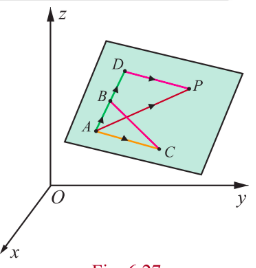
That is, $\vec{r} = \vec{a} + s(\vec{b} - \vec{a}) + t(\vec{c} - \vec{a})$.
This is the parametric form of vector equation of the plane passing through the given three non-collinear points.
(b) Non-parametric form of vector equation
Let $A, B$, and $C$ be the three non collinear points on the plane with position vectors $\vec{a}, \vec{b}, \vec{c}$ respectively. Then at least two of them are non-zero vectors. Let us take $\vec{b} \neq \vec{0}$ and $\vec{c} \neq \vec{0}$. Now $\overline{AB} = \vec{b} - \vec{a}$ and $\overline{AC} = \vec{c} - \vec{a}$. The vectors $(\vec{b} - \vec{a})$ and $(\vec{c} - \vec{a})$ lie on the plane. Since $\vec{a}, \vec{b}, \vec{c}$ are non-collinear, $\overline{AB}$ is not parallel to $\overline{AC}$. Therefore, $(\vec{b} - \vec{a})\times (\vec{c} - \vec{a})$ is perpendicular to the plane.
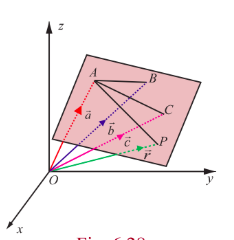
If $\vec{r}$ is the position vector of an arbitrary point $P(x, y, z)$ on the plane, then the equation of the plane passing through the point $A$ with position vector $\vec{a}$ and perpendicular to the vector $(\vec{b} - \vec{a})\times (\vec{c} - \vec{a})$ is given by
$$ (\vec{r} - \vec{a})\cdot ((\vec{b} - \vec{a})\times (\vec{c} - \vec{a})) = 0 \quad \text{or} \quad [\vec{r} - \vec{a}, \vec{b} - \vec{a}, \vec{c} - \vec{a}] = 0. $$This is the non-parametric form of vector equation of the plane passing through three non-collinear points.
(c) Cartesian form of equation
If $(x_{1}, y_{1}, z_{1}), (x_{2}, y_{2}, z_{2})$ and $(x_{3}, y_{3}, z_{3})$ are the coordinates of three non-collinear points $A, B, C$ with position vectors $\vec{a}, \vec{b}, \vec{c}$ respectively and $(x, y, z)$ is the coordinates of the point $P$ with position vector $\vec{r}$, then we have $\vec{a} = x_{1}\hat{i} + y_{1}\hat{j} + z_{1}\hat{k}$, $\vec{b} = x_{2}\hat{i} + y_{2}\hat{j} + z_{2}\hat{k}$, $\vec{c} = x_{3}\hat{i} + y_{3}\hat{j} + z_{3}\hat{k}$ and $\vec{r} = x\hat{i} + y\hat{j} + z\hat{k}$.
Using these vectors, the non-parametric form of vector equation of the plane passing through the given three non-collinear points can be equivalently written as
$$ \begin{vmatrix} x - x_{1} & y - y_{1} & z - z_{1} \\ x_{2} - x_{1} & y_{2} - y_{1} & z_{2} - z_{1} \\ x_{3} - x_{1} & y_{3} - y_{1} & z_{3} - z_{1} \end{vmatrix} = 0, $$which is the Cartesian equation of the plane passing through three non-collinear points.
6.8.5 Equation of a plane passing through a given point and parallel to two given non-parallel vectors.#
(a) Parametric form of vector equation
Consider a plane passing through a given point $A$ with position vector $\vec{a}$ and parallel to two given non-parallel vectors $\vec{b}$ and $\vec{c}$. If $\vec{r}$ is the position vector of an arbitrary point $P$ on the plane, then the vectors $(\vec{r} - \vec{a}), \vec{b}$ and $\vec{c}$ are coplanar. So, $(\vec{r} - \vec{a})$ lies in the plane containing $\vec{b}$ and $\vec{c}$. Then, there exists scalars $s, t \in \mathbb{R}$ such that $\vec{r} - \vec{a} = s\vec{b} + t\vec{c}$ which implies
$$ \vec{r} = \vec{a} + s\vec{b} + t\vec{c}, \quad \text{where } s, t \in \mathbb{R}. \quad (1) $$This is the parametric form of vector equation of the plane passing through a given point and parallel to two given non-parallel vectors.
(b) Non-parametric form of vector equation
Equation (1) can be equivalently written as
$$ (\vec{r} - \vec{a})\cdot (\vec{b}\times \vec{c}) = 0 \quad (2) $$which is the non-parametric form of vector equation of the plane passing through a given point and parallel to two given non-parallel vectors.
(c) Cartesian form of equation
If $\vec{a} = x_{1}\hat{i} + y_{1}\hat{j} + z_{1}\hat{k}$, $\vec{b} = b_{1}\hat{i} + b_{2}\hat{j} + b_{3}\hat{k}$, $\vec{c} = c_{1}\hat{i} + c_{2}\hat{j} + c_{3}\hat{k}$ and $\vec{r} = x\hat{i} + y\hat{j} + z\hat{k}$, then the equation (2) is equivalent to
$$ \begin{vmatrix} x - x_{1} & y - y_{1} & z - z_{1} \\ b_{1} & b_{2} & b_{3} \\ c_{1} & c_{2} & c_{3} \end{vmatrix} = 0. $$This is the Cartesian equation of the plane passing through a given point and parallel to two given non-parallel vectors.
6.8.6 Equation of a plane passing through two given distinct points and is parallel to a non-zero vector#
(a) Parametric form of vector equation
The parametric form of vector equation of the plane passing through two given distinct points $A$ and $B$ with position vectors $\vec{a}$ and $\vec{b}$, and parallel to a non-zero vector $\vec{c}$ is
$$ \vec{r} = \vec{a} + s(\vec{b} - \vec{a}) + t\vec{c} \quad \text{or} \quad \vec{r} = (1 - s)\vec{a} + s\vec{b} + t\vec{c}, \quad (1) $$where $s, t \in \mathbb{R}$, $(\vec{b} - \vec{a})$ and $\vec{c}$ are not parallel vectors.
(b) Non-parametric form of vector equation
Equation (1) can be written equivalently in non-parametric vector form as
$$ (\vec{r} - \vec{a})\cdot ((\vec{b} - \vec{a})\times \vec{c}) = 0 \quad (2) $$where $(\vec{b} - \vec{a})$ and $\vec{c}$ are not parallel vectors.
(c) Cartesian form of equation
If $\vec{a} = x_{1}\hat{i} + y_{1}\hat{j} + z_{1}\hat{k}$, $\vec{b} = x_{2}\hat{i} + y_{2}\hat{j} + z_{2}\hat{k}$, $\vec{c} = c_{1}\hat{i} + c_{2}\hat{j} + c_{3}\hat{k} \neq \vec{0}$ and $\vec{r} = x\hat{i} + y\hat{j} + z\hat{k}$, then equation (2) is equivalent to
$$ \begin{vmatrix} x - x_{1} & y - y_{1} & z - z_{1} \\ x_{2} - x_{1} & y_{2} - y_{1} & z_{2} - z_{1} \\ c_{1} & c_{2} & c_{3} \end{vmatrix} = 0. $$This is the required Cartesian equation of the plane.
Example 6.43
Find the non-parametric form of vector equation, and Cartesian equation of the plane passing through the point $(0, 1, -5)$ and parallel to the straight lines $\vec{r} = (\hat{i} + 2\hat{j} - 4\hat{k}) + s(2\hat{i} + 3\hat{j} + 6\hat{k})$ and $\vec{r} = (\hat{i} - 3\hat{j} + 5\hat{k}) + t(\hat{i} + \hat{j} - \hat{k})$.
Solution
We observe that the required plane is parallel to the vectors $\vec{b} = 2\hat{i} + 3\hat{j} + 6\hat{k}$, $\vec{c} = \hat{i} + \hat{j} - \hat{k}$ and passing through the point $(0, 1, -5)$ with position vector $\vec{a} = \hat{j} - 5\hat{k}$. We observe that $\vec{b}$ is not parallel to $\vec{c}$. Then the vector equation of the plane in non-parametric form is given by $(\vec{r} - \vec{a})\cdot (\vec{b}\times \vec{c}) = 0$.
Now, $\vec{b}\times \vec{c} = \begin{vmatrix} \hat{i} & \hat{j} & \hat{k} \\ 2 & 3 & 6 \\ 1 & 1 & -1 \end{vmatrix} = \hat{i}(-3 - 6) - \hat{j}(-2 - 6) + \hat{k}(2 - 3) = -9\hat{i} + 8\hat{j} - \hat{k}$.
Thus, $(\vec{r} - (\hat{j} - 5\hat{k}))\cdot (-9\hat{i} + 8\hat{j} - \hat{k}) = 0$, which implies that
$$ \vec{r}\cdot (-9\hat{i} + 8\hat{j} - \hat{k}) = (\hat{j} - 5\hat{k})\cdot (-9\hat{i} + 8\hat{j} - \hat{k}) = 0 + 8 + 5 = 13. $$If $\vec{r} = x\hat{i} + y\hat{j} + z\hat{k}$ is the position vector of an arbitrary point on the plane, then from the above equation, we get the Cartesian equation of the plane as $-9x + 8y - z = 13$ or $9x - 8y + z + 13 = 0$.
Example 6.44
Find the vector parametric, vector non-parametric and Cartesian form of the equation of the plane passing through the points $(-1, 2, 0)$, $(2, 2, -1)$ and parallel to the straight line $\frac{x - 1}{1} = \frac{2y + 1}{2} = \frac{z + 1}{-1}$.
Solution
The required plane is parallel to the given line and so it is parallel to the vector $\vec{c} = \hat{i} + \hat{j} - \hat{k}$ and the plane passes through the points $\vec{a} = -\hat{i} + 2\hat{j}$, $\vec{b} = 2\hat{i} + 2\hat{j} - \hat{k}$.
Vector equation of the plane in parametric form is $\vec{r} = \vec{a} + s(\vec{b} - \vec{a}) + t\vec{c}$, where $s, t \in \mathbb{R}$ which implies that $\vec{r} = (-\hat{i} + 2\hat{j}) + s(3\hat{i} - \hat{k}) + t(\hat{i} + \hat{j} - \hat{k})$, where $s, t \in \mathbb{R}$.
Vector equation of the plane in non-parametric form is $(\vec{r} - \vec{a})\cdot ((\vec{b} - \vec{a})\times \vec{c}) = 0$.
Now, $(\vec{b} - \vec{a})\times \vec{c} = \begin{vmatrix} \hat{i} & \hat{j} & \hat{k} \\ 3 & 0 & -1 \\ 1 & 1 & -1 \end{vmatrix} = \hat{i}(0 + 1) - \hat{j}(-3 + 1) + \hat{k}(3 - 0) = \hat{i} + 2\hat{j} + 3\hat{k}$.
We have $(\vec{r} - (-\hat{i} + 2\hat{j}))\cdot (\hat{i} + 2\hat{j} + 3\hat{k}) = 0 \Rightarrow \vec{r}\cdot (\hat{i} + 2\hat{j} + 3\hat{k}) = (-\hat{i} + 2\hat{j})\cdot (\hat{i} + 2\hat{j} + 3\hat{k}) = -1 + 4 + 0 = 3$.
If $\vec{r} = x\hat{i} + y\hat{j} + z\hat{k}$ is the position vector of an arbitrary point on the plane, then from the above equation, we get the Cartesian equation of the plane as $x + 2y + 3z = 3$.
Exercise 6.7
Find the non-parametric form of vector equation, and Cartesian equation of the plane passing through the point $(2, 3, 6)$ and parallel to the straight lines $\frac{x - 1}{2} = \frac{y + 1}{3} = \frac{z - 3}{1}$ and $\frac{x + 3}{2} = \frac{y - 3}{-5} = \frac{z + 1}{-3}$.
Find the non-parametric form of vector equation, and Cartesian equations of the plane passing through the points $(2, 2, 1)$, $(9, 3, 6)$ and perpendicular to the plane $2x + 6y + 6z = 9$.
Find parametric form of vector equation and Cartesian equations of the plane passing through the points $(2, 2, 1)$, $(1, -2, 3)$ and parallel to the straight line passing through the points $(2, 1, -3)$ and $(-1, 5, -8)$.
Find the non-parametric form of vector equation and cartesian equation of the plane passing through the point $(1, -2, 4)$ and perpendicular to the plane $x + 2y - 3z = 11$ and parallel to the line $\frac{x + 7}{3} = \frac{y + 3}{-1} = \frac{z}{1}$.
Find the parametric form of vector equation, and Cartesian equations of the plane containing the line $\vec{r} = (\hat{i} - \hat{j} + 3\hat{k}) + t(2\hat{i} - \hat{j} + 4\hat{k})$ and perpendicular to plane $\vec{r}\cdot (\hat{i} + 2\hat{j} + \hat{k}) = 8$.
Find the parametric vector, non-parametric vector and Cartesian form of the equations of the plane passing through the three non-collinear points $(3, 6, -2)$, $(-1, -2, 6)$, and $(6, 4, -2)$.
Find the non-parametric form of vector equation, and Cartesian equations of the plane $\vec{r} = (6\hat{i} - \hat{j} + \hat{k}) + s(-\hat{i} + 2\hat{j} + \hat{k}) + t(-5\hat{i} - 4\hat{j} - 5\hat{k})$.
6.8.7 Condition for a line to lie in a plane#
We observe that a straight line will lie in a plane if every point on the line lies in the plane and the normal to the plane is perpendicular to the line.
(i) If the line $\vec{r} = \vec{a} + t\vec{b}$ lies in the plane $\vec{r}\cdot \vec{n} = d$, then $\vec{a}\cdot \vec{n} = d$ and $\vec{b}\cdot \vec{n} = 0$.
(ii) If the line $\frac{x - x_{1}}{a} = \frac{y - y_{1}}{b} = \frac{z - z_{1}}{c}$ lies in the plane $Ax + By + Cz + D = 0$, then
$$ Ax_{1} + By_{1} + Cz_{1} + D = 0 \quad \text{and} \quad aA + bB + cC = 0. $$Example 6.45
Verify whether the line $\frac{x - 3}{-4} = \frac{y - 4}{-7} = \frac{z + 3}{12}$ lies in the plane $5x - y + z = 8$.
Solution
Here, $(x_{1}, y_{1}, z_{1}) = (3, 4, -3)$ and direction ratios of the given straight line are $(a, b, c) = (-4, -7, 12)$. Direction ratios of the normal to the given plane are $(A, B, C) = (5, -1, 1)$.
We observe that the given point $(x_{1}, y_{1}, z_{1}) = (3, 4, -3)$ satisfies the given plane $5x - y + z = 8$ because $5(3) - 4 + (-3) = 15 - 4 - 3 = 8$.
Next, $aA + bB + cC = (-4)(5) + (-7)(-1) + (12)(1) = -20 + 7 + 12 = -1 \neq 0$. So, the normal to the plane is not perpendicular to the line. Hence, the given line does not lie in the plane.
6.8.8 Condition for coplanarity of two lines#
(a) Condition in vector form
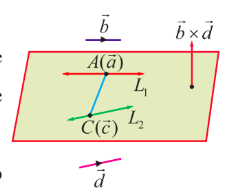
The two given non-parallel lines $\vec{r} = \vec{a} + s\vec{b}$ and $\vec{r} = \vec{c} + t\vec{d}$ are coplanar. So they lie in a single plane. Let $A$ and $C$ be the points whose position vectors are $\vec{a}$ and $\vec{c}$. Then $A$ and $C$ lie on the plane. Since $\vec{b}$ and $\vec{d}$ are parallel to the plane, $\vec{b}\times \vec{d}$ is perpendicular to the plane. So $\overrightarrow{AC}$ is perpendicular to $\vec{b}\times \vec{d}$. That is,
$$ (\vec{c} - \vec{a})\cdot (\vec{b}\times \vec{d}) = 0. $$This is the required condition for coplanarity of two lines in vector form.
(b) Condition in Cartesian form
Two lines $\frac{x - x_{1}}{b_{1}} = \frac{y - y_{1}}{b_{2}} = \frac{z - z_{1}}{b_{3}}$ and $\frac{x - x_{2}}{d_{1}} = \frac{y - y_{2}}{d_{2}} = \frac{z - z_{2}}{d_{3}}$ are coplanar if
$$ \begin{vmatrix} x_{2} - x_{1} & y_{2} - y_{1} & z_{2} - z_{1} \\ b_{1} & b_{2} & b_{3} \\ d_{1} & d_{2} & d_{3} \end{vmatrix} = 0. $$This is the required condition for coplanarity of two lines in Cartesian form.
6.8.9 Equation of plane containing two non-parallel coplanar lines#
(a) Parametric form of vector equation
Let $\vec{r} = \vec{a} + s\vec{b}$ and $\vec{r} = \vec{c} + t\vec{d}$ be two non-parallel coplanar lines. Then $\vec{b}\times \vec{d} \neq \vec{0}$. Let $P$ be any point on the plane and let $\vec{r}_{0}$ be its position vector. Then, the vectors $\vec{r}_{0} - \vec{a}, \vec{b}, \vec{d}$ as well as $\vec{r}_{0} - \vec{c}, \vec{b}, \vec{d}$ are also coplanar. So, we get $\vec{r}_{0} - \vec{a} = t\vec{b} + s\vec{d}$ or $\vec{r}_{0} - \vec{c} = t\vec{b} + s\vec{d}$. Hence, the vector equation in parametric form is $\vec{r} = \vec{a} + t\vec{b} + s\vec{d}$ or $\vec{r} = \vec{c} + t\vec{b} + s\vec{d}$.
(b) Non-parametric form of vector equation
Let $\vec{r} = \vec{a} + s\vec{b}$ and $\vec{r} = \vec{c} + t\vec{d}$ be two non-parallel coplanar lines. Then $\vec{b}\times \vec{d} \neq \vec{0}$. Let $P$ be any point on the plane and let $\vec{r}_{0}$ be its position vector. Then, the vectors $\vec{r}_{0} - \vec{a}, \vec{b}, \vec{d}$ as well as $\vec{r}_{0} - \vec{c}, \vec{b}, \vec{d}$ are also coplanar. So, we get $(\vec{r}_{0} - \vec{a})\cdot (\vec{b}\times \vec{d}) = 0$ or $(\vec{r}_{0} - \vec{c})\cdot (\vec{b}\times \vec{d}) = 0$. Hence, the vector equation in non-parametric form is $(\vec{r} - \vec{a})\cdot (\vec{b}\times \vec{d}) = 0$ or $(\vec{r} - \vec{c})\cdot (\vec{b}\times \vec{d}) = 0$.
(c) Cartesian form of equation of plane
In Cartesian form the equation of the plane containing the two given coplanar lines
$\frac{x - x_{1}}{b_{1}} = \frac{y - y_{1}}{b_{2}} = \frac{z - z_{1}}{b_{3}}$ and $\frac{x - x_{2}}{d_{1}} = \frac{y - y_{2}}{d_{2}} = \frac{z - z_{2}}{d_{3}}$ is given by
$$ \begin{vmatrix} x - x_{1} & y - y_{1} & z - z_{1} \\ b_{1} & b_{2} & b_{3} \\ d_{1} & d_{2} & d_{3} \end{vmatrix} = 0 $$or equivalently
$$ \begin{vmatrix} x - x_{2} & y - y_{2} & z - z_{2} \\ b_{1} & b_{2} & b_{3} \\ d_{1} & d_{2} & d_{3} \end{vmatrix} = 0. $$Example 6.46
Show that the lines $\vec{r} = (-\hat{i} - 3\hat{j} - 5\hat{k}) + s(3\hat{i} + 5\hat{j} + 7\hat{k})$ and $\vec{r} = (2\hat{i} + 4\hat{j} + 6\hat{k}) + t(\hat{i} + 4\hat{j} + 7\hat{k})$ are coplanar. Also, find the non-parametric form of vector equation of the plane containing these lines.
Solution
Comparing the two given lines with
$$ \vec{r} = \vec{a} + t\vec{b}, \quad \vec{r} = \vec{c} + s\vec{d}, $$$\vec{a} = -\hat{i} - 3\hat{j} - 5\hat{k}$, $\vec{b} = 3\hat{i} + 5\hat{j} + 7\hat{k}$, $\vec{c} = 2\hat{i} + 4\hat{j} + 6\hat{k}$ and $\vec{d} = \hat{i} + 4\hat{j} + 7\hat{k}$.
We know that the two given lines are coplanar, if $(\vec{c} - \vec{a})\cdot (\vec{b}\times \vec{d}) = 0$.
Now, $\vec{c} - \vec{a} = (2\hat{i} + 4\hat{j} + 6\hat{k}) - (-\hat{i} - 3\hat{j} - 5\hat{k}) = 3\hat{i} + 7\hat{j} + 11\hat{k}$.
$$ \vec{b}\times \vec{d} = \begin{vmatrix} \hat{i} & \hat{j} & \hat{k} \\ 3 & 5 & 7 \\ 1 & 4 & 7 \end{vmatrix} = \hat{i}(35 - 28) - \hat{j}(21 - 7) + \hat{k}(12 - 5) = 7\hat{i} - 14\hat{j} + 7\hat{k}. $$Then, $(\vec{c} - \vec{a})\cdot (\vec{b}\times \vec{d}) = (3\hat{i} + 7\hat{j} + 11\hat{k})\cdot (7\hat{i} - 14\hat{j} + 7\hat{k}) = 21 - 98 + 77 = 0$.
Therefore the two given lines are coplanar. Then we find the non-parametric form of vector equation of the plane containing the two given coplanar lines. We know that the plane containing the two given coplanar lines is
$$ (\vec{r} - \vec{a})\cdot (\vec{b}\times \vec{d}) = 0 $$which implies that $(\vec{r} - (-\hat{i} - 3\hat{j} - 5\hat{k}))\cdot (7\hat{i} - 14\hat{j} + 7\hat{k}) = 0$. Thus, the required non-parametric vector equation of the plane containing the two given coplanar lines is $\vec{r}\cdot (\hat{i} - 2\hat{j} + \hat{k}) = 0$.
Exercise 6.8
Show that the straight lines $\vec{r} = (5\hat{i} + 7\hat{j} - 3\hat{k}) + s(4\hat{i} + 4\hat{j} - 5\hat{k})$ and $\vec{r} = (8\hat{i} + 4\hat{j} + 5\hat{k}) + t(7\hat{i} + \hat{j} + 3\hat{k})$ are coplanar. Find the vector equation of the plane in which they lie.
Show that the lines $\frac{x - 2}{1} = \frac{y - 3}{1} = \frac{z - 4}{3}$ and $\frac{x - 1}{-3} = \frac{y - 4}{2} = \frac{z - 5}{1}$ are coplanar. Also, find the plane containing these lines.
If the straight lines $\frac{x - 1}{1} = \frac{y - 2}{2} = \frac{z - 3}{m^{2}}$ and $\frac{x - 3}{1} = \frac{y - 2}{m^{2}} = \frac{z - 1}{2}$ are coplanar, find the distinct real values of $m$.
If the straight lines $\frac{x - 1}{2} = \frac{y + 1}{\lambda} = \frac{z}{2}$ and $\frac{x + 1}{5} = \frac{y + 1}{2} = \frac{z}{\lambda}$ are coplanar, find $\lambda$ and equations of the planes containing these two lines.
6.8.10 Angle between two planes#
The angle between two given planes is same as the angle between their normals.
Theorem 6.18
The acute angle $\theta$ between the two planes $\vec{r}\cdot \vec{n}_{1} = p_{1}$ and $\vec{r}\cdot \vec{n}_{2} = p_{2}$ is given by
$$ \theta = \cos^{-1}\left(\frac{|\vec{n}_{1}\cdot \vec{n}_{2}|}{|\vec{n}_{1}| |\vec{n}_{2}|}\right). > $$
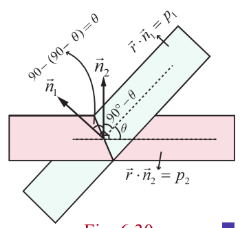
Proof
If $\theta$ is the acute angle between two planes $\vec{r}\cdot \vec{n}_{1} = p_{1}$ and $\vec{r}\cdot \vec{n}_{2} = p_{2}$, then $\theta$ is the acute angle between their normal vectors $\vec{n}_{1}$ and $\vec{n}_{2}$.
Therefore, $\cos \theta = \frac{|\vec{n}_{1}\cdot \vec{n}_{2}|}{|\vec{n}_{1}| |\vec{n}_{2}|} \Rightarrow \theta = \cos^{-1}\left(\frac{|\vec{n}_{1}\cdot \vec{n}_{2}|}{|\vec{n}_{1}| |\vec{n}_{2}|}\right)$.
Remark
(i) If two planes $\vec{r}\cdot \vec{n}_{1} = p_{1}$ and $\vec{r}\cdot \vec{n}_{2} = p_{2}$ are perpendicular, then $\vec{n}_{1}\cdot \vec{n}_{2} = 0$.
(ii) If the planes $\vec{r}\cdot \vec{n}_{1} = p_{1}$ and $\vec{r}\cdot \vec{n}_{2} = p_{2}$ are parallel, then $\vec{n}_{1} = \lambda \vec{n}_{2}$, where $\lambda$ is a scalar.
(iii) Equation of a plane parallel to the plane $\vec{r}\cdot \vec{n} = p$ is $\vec{r}\cdot \vec{n} = k$, $k \in \mathbb{R}$.
Theorem 6.19
The acute angle $\theta$ between the planes $a_{1}x + b_{1}y + c_{1}z + d_{1} = 0$ and $a_{2}x + b_{2}y + c_{2}z + d_{2} = 0$ is given by
$$ \theta = \cos^{-1}\left(\frac{|a_{1}a_{2} + b_{1}b_{2} + c_{1}c_{2}|}{\sqrt{a_{1}^{2} + b_{1}^{2} + c_{1}^{2}}\sqrt{a_{2}^{2} + b_{2}^{2} + c_{2}^{2}}}\right). > $$
Proof
If $\vec{n}_{1}$ and $\vec{n}_{2}$ are the vectors normal to the two given planes $a_{1}x + b_{1}y + c_{1}z + d_{1} = 0$ and $a_{2}x + b_{2}y + c_{2}z + d_{2} = 0$ respectively. Then, $\vec{n}_{1} = a_{1}\hat{i} + b_{1}\hat{j} + c_{1}\hat{k}$ and $\vec{n}_{2} = a_{2}\hat{i} + b_{2}\hat{j} + c_{2}\hat{k}$.
Therefore, using equation (1) in theorem 6.18 the acute angle $\theta$ between the planes is given by
$$ \theta = \cos^{-1}\left(\frac{|a_{1}a_{2} + b_{1}b_{2} + c_{1}c_{2}|}{\sqrt{a_{1}^{2} + b_{1}^{2} + c_{1}^{2}}\sqrt{a_{2}^{2} + b_{2}^{2} + c_{2}^{2}}}\right). $$Remark
(i) The planes $a_{1}x + b_{1}y + c_{1}z + d_{1} = 0$ and $a_{2}x + b_{2}y + c_{2}z + d_{2} = 0$ are perpendicular if
$$ > a_{1}a_{2} + b_{1}b_{2} + c_{1}c_{2} = 0. > $$(ii) The planes $a_{1}x + b_{1}y + c_{1}z + d_{1} = 0$ and $a_{2}x + b_{2}y + c_{2}z + d_{2} = 0$ are parallel if $\frac{a_{1}}{a_{2}} = \frac{b_{1}}{b_{2}} = \frac{c_{1}}{c_{2}}$.
(iii) Equation of a plane parallel to the plane $ax + by + cz = p$ is $ax + by + cz = k$, $k \in \mathbb{R}$.
Example 6.47
Find the acute angle between the planes $\vec{r}\cdot (2\hat{i} + 2\hat{j} + 2\hat{k}) = 11$ and $4x - 2y + 2z = 15$.
Solution
The normal vectors of the two given planes $\vec{r}\cdot (2\hat{i} + 2\hat{j} + 2\hat{k}) = 11$ and $4x - 2y + 2z = 15$ are $\vec{n}_{1} = 2\hat{i} + 2\hat{j} + 2\hat{k}$ and $\vec{n}_{2} = 4\hat{i} - 2\hat{j} + 2\hat{k}$ respectively.
If $\theta$ is the acute angle between the planes, then we have
$$ \cos \theta = \frac{|\vec{n}_{1}\cdot \vec{n}_{2}|}{|\vec{n}_{1}| |\vec{n}_{2}|} = \frac{|(2)(4) + (2)(-2) + (2)(2)|}{\sqrt{4 + 4 + 4} \sqrt{16 + 4 + 4}} = \frac{|8 - 4 + 4|}{\sqrt{12} \sqrt{24}} = \frac{8}{\sqrt{288}} = \frac{8}{12\sqrt{2}} = \frac{2}{3\sqrt{2}} = \frac{\sqrt{2}}{3}. $$Thus, $\theta = \cos^{-1}\left(\frac{\sqrt{2}}{3}\right)$.
6.8.11 Angle between a line and a plane#
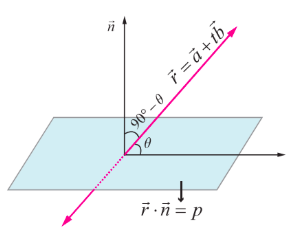
We know that the angle between a line and a plane is the complement of the angle between the normal to the plane and the line.
Let $\vec{r} = \vec{a} + t\vec{b}$ be the equation of the line and $\vec{r}\cdot \vec{n} = p$ be the equation of the plane. We know that $\vec{b}$ is parallel to the given line and $\vec{n}$ is normal to the given plane. If $\theta$ is the acute angle between the line and the plane, then the acute angle between $\vec{n}$ and $\vec{b}$ is $\left(\frac{\pi}{2} - \theta\right)$. Therefore,
$$ \cos \left(\frac{\pi}{2} - \theta\right) = \sin \theta = \frac{|\vec{b}\cdot \vec{n}|}{|\vec{b}| |\vec{n}|}. $$So, the acute angle between the line and the plane is given by
$$ \theta = \sin^{-1}\left(\frac{|\vec{b}\cdot \vec{n}|}{|\vec{b}| |\vec{n}|}\right). \quad (1) $$In Cartesian form if $\frac{x - x_{1}}{a_{1}} = \frac{y - y_{1}}{b_{1}} = \frac{z - z_{1}}{c_{1}}$ and $ax + by + cz = p$ are the equations of the line and the plane, then $\vec{b} = a_{1}\hat{i} + b_{1}\hat{j} + c_{1}\hat{k}$ and $\vec{n} = a\hat{i} + b\hat{j} + c\hat{k}$. Therefore, using (1), the acute angle $\theta$ between the line and plane is given by
$$ \theta = \sin^{-1}\left(\frac{|aa_{1} + bb_{1} + cc_{1}|}{\sqrt{a^{2} + b^{2} + c^{2}}\sqrt{a_{1}^{2} + b_{1}^{2} + c_{1}^{2}}}\right). $$Remark
(i) If the line is perpendicular to the plane, then the line is parallel to the normal to the plane. So, $\vec{b}$ is parallel to $\vec{n}$. Then we have $\vec{b} = \lambda \vec{n}$ where $\lambda \in \mathbb{R}$, which gives $\frac{a_{1}}{a} = \frac{b_{1}}{b} = \frac{c_{1}}{c}$.
(ii) If the line is parallel to the plane, then the line is perpendicular to the normal to the plane.
$$ > \vec{b}\cdot \vec{n} = 0 \Rightarrow a a_{1} + b b_{1} + c c_{1} = 0. > $$
Example 6.48
Find the angle between the straight line $\vec{r} = (2\hat{i} + 3\hat{j} + \hat{k}) + t(\hat{i} - \hat{j} + \hat{k})$ and the plane $2x - y + z = 5$.
Solution
The angle between a line $\vec{r} = \vec{a} + t\vec{b}$ and a plane $\vec{r}\cdot \vec{n} = p$ with normal $\vec{n}$ is $\theta = \sin^{-1}\left(\frac{|\vec{b}\cdot \vec{n}|}{|\vec{b}| |\vec{n}|}\right)$.
Here, $\vec{b} = \hat{i} - \hat{j} + \hat{k}$ and $\vec{n} = 2\hat{i} - \hat{j} + \hat{k}$.
$$ |\vec{b}| = \sqrt{1 + 1 + 1} = \sqrt{3}, \quad |\vec{n}| = \sqrt{4 + 1 + 1} = \sqrt{6}. $$$$ \vec{b}\cdot \vec{n} = (1)(2) + (-1)(-1) + (1)(1) = 2 + 1 + 1 = 4. $$Thus, $\sin \theta = \frac{4}{\sqrt{3} \sqrt{6}} = \frac{4}{\sqrt{18}} = \frac{4}{3\sqrt{2}} = \frac{2\sqrt{2}}{3}$.
Therefore, $\theta = \sin^{-1}\left(\frac{2\sqrt{2}}{3}\right)$.
6.8.12 Distance of a point from a plane#
(a) Equation of a plane in vector form
Theorem 6.20
The perpendicular distance from a point with position vector $\vec{u}$ to the plane $\vec{r}\cdot \vec{n} = p$ is given by
$$ \delta = \frac{|\vec{u}\cdot \vec{n} - p|}{|\vec{n}|}. > $$
Proof
Let $A$ be the point whose position vector is $\vec{u}$.
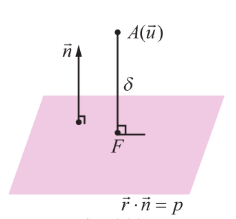
Let $F$ be the foot of the perpendicular from the point $A$ to the plane $\vec{r}\cdot \vec{n} = p$. The line joining $F$ and $A$ is parallel to the normal vector $\vec{n}$ and hence its equation is $\vec{r} = \vec{u} + t\vec{n}$.
But $F$ is the point of intersection of the line $\vec{r} = \vec{u} + t\vec{n}$ and the given plane $\vec{r}\cdot \vec{n} = p$. If $\vec{r}_{1}$ is the position vector of $F$, then $\vec{r}_{1} = \vec{u} + t_{1}\vec{n}$ for some $t_{1} \in \mathbb{R}$, and $\vec{r}_{1}\cdot \vec{n} = p$. Eliminating $\vec{r}_{1}$ we get
$$ (\vec{u} + t_{1}\vec{n})\cdot \vec{n} = p \Rightarrow \vec{u}\cdot \vec{n} + t_{1}(\vec{n}\cdot \vec{n}) = p \Rightarrow t_{1} = \frac{p - \vec{u}\cdot \vec{n}}{|\vec{n}|^{2}}. $$Then, $\overline{FA} = \vec{u} - (\vec{u} + t_{1}\vec{n}) = -t_{1}\vec{n} = \left(\frac{(\vec{u}\cdot \vec{n}) - p}{|\vec{n}|^{2}}\right)\vec{n}$.
Therefore, the length of the perpendicular from the point $A$ to the given plane is
$$ \delta = |\overline{FA}| = \left|\left(\frac{(\vec{u}\cdot \vec{n}) - p}{|\vec{n}|^{2}}\right)\vec{n}\right| = \left|\frac{(\vec{u}\cdot \vec{n}) - p}{|\vec{n}|}\right|. $$The position vector of the foot $F$ of the perpendicular $AF$ is given by
$$ \vec{r}_{1} = \vec{u} + t_{1}\vec{n} \quad \text{or} \quad \vec{r}_{1} = \vec{u} + \left(\frac{p - \vec{u}\cdot \vec{n}}{|\vec{n}|^{2}}\right)\vec{n}. $$(b) Equation of a plane in Cartesian form
In Cartesian form if $A(x_{1}, y_{1}, z_{1})$ is the given point with position vector $\vec{u}$ and $ax + by + cz = p$ is the Cartesian equation of the given plane, then $\vec{u} = x_{1}\hat{i} + y_{1}\hat{j} + z_{1}\hat{k}$ and $\vec{n} = a\hat{i} + b\hat{j} + c\hat{k}$. Therefore, using these vectors in $\delta = \frac{|\vec{u}\cdot \vec{n} - p|}{|\vec{n}|}$, we get the perpendicular distance from a point to the plane in Cartesian form as
$$ \delta = \frac{|a x_{1} + b y_{1} + c z_{1} - p|}{\sqrt{a^{2} + b^{2} + c^{2}}}. $$Remark
The perpendicular distance from the origin to the plane $ax + by + cz + d = 0$ is given by
$$ > \delta = \frac{|d|}{\sqrt{a^{2} + b^{2} + c^{2}}}. > $$
Example 6.49
Find the distance of a point $(2, 5, -3)$ from the plane $\vec{r}\cdot (6\hat{i} - 3\hat{j} + 2\hat{k}) = 5$.
Solution
Comparing the given equation of the plane with $\vec{r}\cdot \vec{n} = p$, we have $\vec{n} = 6\hat{i} - 3\hat{j} + 2\hat{k}$.
We know that the perpendicular distance from the given point with position vector $\vec{u}$ to the plane $\vec{r}\cdot \vec{n} = p$ is given by $\delta = \frac{|\vec{u}\cdot \vec{n} - p|}{|\vec{n}|}$. Therefore, substituting $\vec{u} = (2, 5, -3) = 2\hat{i} + 5\hat{j} - 3\hat{k}$ and $\vec{n} = 6\hat{i} - 3\hat{j} + 2\hat{k}$ in the formula, we get
$$ \delta = \frac{|\vec{u}\cdot \vec{n} - p|}{|\vec{n}|} = \frac{|(2\hat{i} + 5\hat{j} - 3\hat{k})\cdot(6\hat{i} - 3\hat{j} + 2\hat{k}) - 5|}{|6\hat{i} - 3\hat{j} + 2\hat{k}|} = \frac{|12 - 15 - 6 - 5|}{\sqrt{36 + 9 + 4}} = \frac{|-14|}{7} = 2 \text{ units}. $$Example 6.50
Find the distance of the point $(5, -5, -10)$ from the point of intersection of a straight line passing through the points $A(4, 1, 2)$ and $B(7, 5, 4)$ with the plane $x - y + z = 5$.
Solution
The Cartesian equation of the straight line joining $A$ and $B$ is
$$ \frac{x - 4}{3} = \frac{y - 1}{4} = \frac{z - 2}{2} = t \quad \text{(say)}. $$Therefore, an arbitrary point on the straight line is of the form $(3t + 4, 4t + 1, 2t + 2)$. To find the point of intersection of the straight line and the plane, we substitute $x = 3t + 4$, $y = 4t + 1$, $z = 2t + 2$ in $x - y + z = 5$, and we get $t = 0$. Therefore, the point of intersection of the straight line is $(4, 1, 2)$. Now, the distance between the two points $(4, 1, 2)$ and $(5, -5, -10)$ is
$$ \sqrt{(4 - 5)^{2} + (1 + 5)^{2} + (2 + 10)^{2}} = \sqrt{1 + 36 + 144} = \sqrt{181} \text{ units}. $$6.8.13 Distance between two parallel planes#
Theorem 6.21
The distance between two parallel planes $ax + by + cz + d_{1} = 0$ and $ax + by + cz + d_{2} = 0$ is given by $\frac{|d_{1} - d_{2}|}{\sqrt{a^{2} + b^{2} + c^{2}}}$.
Proof
Let $A(x_{1}, y_{1}, z_{1})$ be any point on the plane $ax + by + cz + d_{2} = 0$, then we have
$$ ax_{1} + by_{1} + cz_{1} + d_{2} = 0 \Rightarrow ax_{1} + by_{1} + cz_{1} = -d_{2}. $$The distance of the plane $ax + by + cz + d_{1} = 0$ from the point $A(x_{1}, y_{1}, z_{1})$ is given by
$$ \delta = \frac{|ax_{1} + by_{1} + cz_{1} + d_{1}|}{\sqrt{a^{2} + b^{2} + c^{2}}} = \frac{|-d_{2} + d_{1}|}{\sqrt{a^{2} + b^{2} + c^{2}}} = \frac{|d_{1} - d_{2}|}{\sqrt{a^{2} + b^{2} + c^{2}}}. $$Hence, the distance between two parallel planes $ax + by + cz + d_{1} = 0$ and $ax + by + cz + d_{2} = 0$ is given by $\delta = \frac{|d_{1} - d_{2}|}{\sqrt{a^{2} + b^{2} + c^{2}}}$.
Example 6.51
Find the distance between the parallel planes $x + 2y - 2z + 1 = 0$ and $2x + 4y - 4z + 5 = 0$.
Solution
We know that the formula for the distance between two parallel planes $ax + by + cz + d_{1} = 0$ and $ax + by + cz + d_{2} = 0$ is $\delta = \frac{|d_{1} - d_{2}|}{\sqrt{a^{2} + b^{2} + c^{2}}}$. Rewrite the second equation as $x + 2y - 2z + \frac{5}{2} = 0$.
Comparing the given equations with the general equations, we get $a = 1$, $b = 2$, $c = -2$, $d_{1} = 1$, $d_{2} = \frac{5}{2}$.
Substituting these values in the formula, we get the distance
$$ \delta = \frac{|d_{1} - d_{2}|}{\sqrt{a^{2} + b^{2} + c^{2}}} = \frac{\left|1 - \frac{5}{2}\right|}{\sqrt{1^{2} + 2^{2} + (-2)^{2}}} = \frac{3/2}{3} = \frac{1}{2} \text{ units}. $$Example 6.52
Find the distance between the planes $\vec{r}\cdot (2\hat{i} - \hat{j} - 2\hat{k}) = 6$ and $\vec{r}\cdot (6\hat{i} - 3\hat{j} - 6\hat{k}) = 27$.
Solution
Let $\vec{u}$ be the position vector of an arbitrary point on the plane $\vec{r}\cdot (2\hat{i} - \hat{j} - 2\hat{k}) = 6$. Then, we have
$$ \vec{u}\cdot (2\hat{i} - \hat{j} - 2\hat{k}) = 6. \quad (1) $$If $\delta$ is the distance between the given planes, then $\delta$ is the perpendicular distance from $\vec{u}$ to the plane $\vec{r}\cdot (6\hat{i} - 3\hat{j} - 6\hat{k}) = 27$.
Therefore, $\delta = \frac{|\vec{u}\cdot \vec{n} - p|}{|\vec{n}|} = \frac{\left|\vec{u}\cdot(6\hat{i} - 3\hat{j} - 6\hat{k}) - 27\right|}{\sqrt{6^{2} + (-3)^{2} + (-6)^{2}}} = \frac{\left|3(\vec{u}\cdot(2\hat{i} - \hat{j} - 2\hat{k})) - 27\right|}{9} = \frac{|3(6) - 27|}{9} = \frac{|-9|}{9} = 1 \text{ unit}$.
6.8.14 Equation of line of intersection of two planes#
Let $\vec{r}\cdot \vec{n} = p$ and $\vec{r}\cdot \vec{m} = q$ be two non-parallel planes. We know that $\vec{n}$ and $\vec{m}$ are perpendicular to the given planes respectively. So, the line of intersection of these planes is perpendicular to both $\vec{n}$ and $\vec{m}$. Therefore, it is parallel to the vector $\vec{n}\times \vec{m}$.
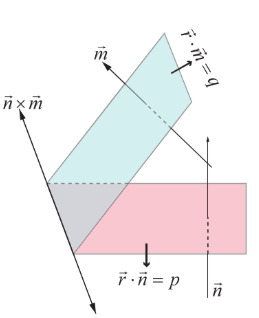
Consider the equations of two planes $a_{1}x + b_{1}y + c_{1}z = p$ and $a_{2}x + b_{2}y + c_{2}z = q$. The line of intersection of the two given planes intersects at least one of the coordinate planes. For simplicity, we assume that the line meets the coordinate plane $z = 0$. Substitute $z = 0$ and obtain the two equations $a_{1}x + b_{1}y - p = 0$ and $a_{2}x + b_{2}y - q = 0$. Then by solving these equations, we get the values of $x$ and $y$ as $x_{1}$ and $y_{1}$ respectively.
6.8.15 Equation of a plane passing through the line of intersection of two given planes#
Theorem 6.22
The vector equation of a plane which passes through the line of intersection of the planes $\vec{r}\cdot \vec{n}_{1} = d_{1}$ and $\vec{r}\cdot \vec{n}_{2} = d_{2}$ is given by $(\vec{r}\cdot \vec{n}_{1} - d_{1}) + \lambda (\vec{r}\cdot \vec{n}_{2} - d_{2}) = 0$, where $\lambda \in \mathbb{R}$.
Proof
Consider the equation
$$ (\vec{r}\cdot \vec{n}_{1} - d_{1}) + \lambda (\vec{r}\cdot \vec{n}_{2} - d_{2}) = 0. \quad (1) $$The above equation can be simplified as
$$ \vec{r}\cdot (\vec{n}_{1} + \lambda \vec{n}_{2}) - (d_{1} + \lambda d_{2}) = 0. \quad (2) $$Put $\vec{n} = \vec{n}_{1} + \lambda \vec{n}_{2}$, $d = d_{1} + \lambda d_{2}$.
Then the equation (2) becomes
$$ \vec{r}\cdot \vec{n} = d. \quad (3) $$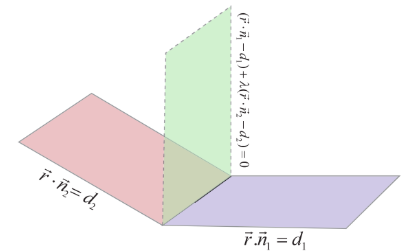
The equation (3) represents a plane. Hence (1) represents a plane.
Let $\vec{r}_{1}$ be the position vector of any point on the line of intersection of the planes. Then $\vec{r}_{1}$ satisfies both the equations $\vec{r}\cdot \vec{n}_{1} = d_{1}$ and $\vec{r}\cdot \vec{n}_{2} = d_{2}$. So, we have
$$ \vec{r}_{1}\cdot \vec{n}_{1} = d_{1} \quad \text{and} \quad \vec{r}_{1}\cdot \vec{n}_{2} = d_{2}. \quad (4) $$By (4), $\vec{r}_{1}$ satisfies (1). So, any point on the line of intersection lies on the plane (1). This proves that the plane (1) passes through the line of intersection.
The Cartesian equation of a plane which passes through the line of intersection of the planes $a_{1}x + b_{1}y + c_{1}z = d_{1}$ and $a_{2}x + b_{2}y + c_{2}z = d_{2}$ is given by
$$ (a_{1}x + b_{1}y + c_{1}z - d_{1}) + \lambda (a_{2}x + b_{2}y + c_{2}z - d_{2}) = 0. $$Example 6.53
Find the equation of the plane passing through the intersection of the planes $\vec{r}\cdot (\vec{i} + \vec{j} + \vec{k}) + 1 = 0$ and $\vec{r}\cdot (2\vec{i} - 3\vec{j} + 5\vec{k}) = 2$ and the point $(-1, 2, 1)$.
Solution
We know that the vector equation of a plane passing through the line of intersection of the planes $\vec{r}\cdot \vec{n}_{1} = d_{1}$ and $\vec{r}\cdot \vec{n}_{2} = d_{2}$ is given by $(\vec{r}\cdot \vec{n}_{1} - d_{1}) + \lambda (\vec{r}\cdot \vec{n}_{2} - d_{2}) = 0$.
Substituting $\vec{r} = x\vec{i} + y\vec{j} + z\vec{k}$, $\vec{n}_{1} = \vec{i} + \vec{j} + \vec{k}$, $\vec{n}_{2} = 2\vec{i} - 3\vec{j} + 5\vec{k}$, $d_{1} = -1$, $d_{2} = 2$ in the above equation, we get
$$ (x + y + z + 1) + \lambda (2x - 3y + 5z - 2) = 0. $$Since this plane passes through the point $(-1, 2, 1)$, we get $(-1 + 2 + 1 + 1) + \lambda (-2 - 6 + 5 - 2) = 0 \Rightarrow 3 + \lambda (-5) = 0 \Rightarrow \lambda = \frac{3}{5}$, and hence the required equation of the plane is $(x + y + z + 1) + \frac{3}{5}(2x - 3y + 5z - 2) = 0 \Rightarrow 5(x + y + z + 1) + 3(2x - 3y + 5z - 2) = 0 \Rightarrow 5x + 5y + 5z + 5 + 6x - 9y + 15z - 6 = 0 \Rightarrow 11x - 4y + 20z - 1 = 0$, or $11x - 4y + 20z = 1$.
Example 6.54
Find the equation of the plane passing through the intersection of the planes $2x + 3y - z + 7 = 0$ and $x + y - 2z + 5 = 0$ and is perpendicular to the plane $x + y - 3z - 5 = 0$.
Solution
The equation of the plane passing through the intersection of the planes $2x + 3y - z + 7 = 0$ and $x + y - 2z + 5 = 0$ is $(2x + 3y - z + 7) + \lambda (x + y - 2z + 5) = 0$ or
$$ (2 + \lambda)x + (3 + \lambda)y + (-1 - 2\lambda)z + (7 + 5\lambda) = 0. $$Since this plane is perpendicular to the given plane $x + y - 3z - 5 = 0$, the normals of these two planes are perpendicular to each other. Therefore, we have
$$ (1)(2 + \lambda) + (1)(3 + \lambda) + (-3)(-1 - 2\lambda) = 0. $$which implies that $2 + \lambda + 3 + \lambda + 3 + 6\lambda = 0 \Rightarrow 8 + 8\lambda = 0 \Rightarrow \lambda = -1$. Thus the required equation of the plane is
$$ (2x + 3y - z + 7) - (x + y - 2z + 5) = 0 \Rightarrow x + 2y + z + 2 = 0.
Example 6.54
Find the equation of the plane passing through the intersection of the planes $2x + 3y - z + 7 = 0$ and $x + y - 2z + 5 = 0$ and is perpendicular to the plane $x + y - 3z - 5 = 0$.
Solution
The equation of the plane passing through the intersection of the planes $2x + 3y - z + 7 = 0$ and $x + y - 2z + 5 = 0$ is $(2x + 3y - z + 7) + \lambda (x + y - 2z + 5) = 0$ or
$$ (2 + \lambda)x + (3 + \lambda)y + (-1 - 2\lambda)z + (7 + 5\lambda) = 0. $$Since this plane is perpendicular to the given plane $x + y - 3z - 5 = 0$, the normals of these two planes are perpendicular to each other. Therefore, we have
$$ (1)(2 + \lambda) + (1)(3 + \lambda) + (-3)(-1 - 2\lambda) = 0. $$which implies that $2 + \lambda + 3 + \lambda + 3 + 6\lambda = 0 \Rightarrow 8 + 8\lambda = 0 \Rightarrow \lambda = -1$. Thus the required equation of the plane is
$$ (2x + 3y - z + 7) - (x + y - 2z + 5) = 0 \Rightarrow x + 2y + z + 2 = 0. $$6.9 Image of a Point in a Plane#
Let $A$ be the given point whose position vector is $\vec{u}$. Let $\vec{r}\cdot \vec{n} = p$ be the equation of the plane. Let $\vec{v}$ be the position vector of the mirror image $A'$ of $A$ in the plane. Then $\overline{AA'}$ is perpendicular to the plane. So it is parallel to $\vec{n}$. Then
$$ \overline{AA'} = \lambda \vec{n} \quad \text{or} \quad \vec{v} - \vec{u} = \lambda \vec{n} \Rightarrow \vec{v} = \vec{u} + \lambda \vec{n}. \quad (1) $$Let $M$ be the middle point of $AA'$. Then the position vector of $M$ is $\frac{\vec{u} + \vec{v}}{2}$. But $M$ lies on the plane.
So, $\left(\frac{\vec{u} + \vec{v}}{2}\right)\cdot \vec{n} = p$. \quad (2)
Substituting (1) in (2), we get
$$ \left(\frac{\vec{u} + \lambda\vec{n} + \vec{u}}{2}\right)\cdot \vec{n} = p \Rightarrow \frac{2\vec{u}\cdot \vec{n} + \lambda |\vec{n}|^{2}}{2} = p \Rightarrow 2\vec{u}\cdot \vec{n} + \lambda |\vec{n}|^{2} = 2p \Rightarrow \lambda = \frac{2(p - \vec{u}\cdot \vec{n})}{|\vec{n}|^{2}}. $$Therefore, the position vector of $A'$ is
$$ \vec{v} = \vec{u} + \frac{2(p - \vec{u}\cdot \vec{n})}{|\vec{n}|^{2}} \vec{n}. $$Note
The mid point $M$ of $AA'$ is the foot of the perpendicular from the point $A$ to the plane $\vec{r}\cdot \vec{n} = p$. So the position vector of the foot $M$ of the perpendicular is given by
$$ \frac{\vec{u} + \vec{v}}{2} = \vec{u} + \frac{p - \vec{u}\cdot \vec{n}}{|\vec{n}|^{2}} \vec{n}. $$
6.9.1 The coordinates of the image of a point in a plane#
Let $(a_{1}, a_{2}, a_{3})$ be the point $\vec{u}$ whose image in the plane is required. Then $\vec{u} = a_{1}\hat{i} + a_{2}\hat{j} + a_{3}\hat{k}$.
Let $ax + by + cz = d$ be the equation of the given plane. Writing the equation in the vector form we get $\vec{r}\cdot \vec{n} = p$ where $\vec{n} = a\hat{i} + b\hat{j} + c\hat{k}$ and $p = d$. Then the position vector of the image is
$$ \vec{v} = \vec{u} + \frac{2(p - \vec{u}\cdot \vec{n})}{|\vec{n}|^{2}} \vec{n}. $$If $\vec{v} = \nu_{1}\hat{i} + \nu_{2}\hat{j} + \nu_{3}\hat{k}$, then
$$ \nu_{1} = a_{1} + 2a\alpha,\quad \nu_{2} = a_{2} + 2b\alpha,\quad \nu_{3} = a_{3} + 2c\alpha, $$where $\alpha = \frac{p - (a a_{1} + b a_{2} + c a_{3})}{a^{2} + b^{2} + c^{2}}$.
Example 6.55
Find the image of the point whose position vector is $\hat{i} + 2\hat{j} + 3\hat{k}$ in the plane $\vec{r}\cdot (\hat{i} + 2\hat{j} + 4\hat{k}) = 38$.
Solution
Here, $\vec{u} = \hat{i} + 2\hat{j} + 3\hat{k}$, $\vec{n} = \hat{i} + 2\hat{j} + 4\hat{k}$, $p = 38$. Then the position vector of the image $\vec{v}$ of $\vec{u} = \hat{i} + 2\hat{j} + 3\hat{k}$ is given by
$$ \vec{v} = \vec{u} + \frac{2[p - (\vec{u}\cdot \vec{n})]}{|\vec{n}|^{2}} \vec{n}. $$Now, $\vec{u}\cdot \vec{n} = (1)(1) + (2)(2) + (3)(4) = 1 + 4 + 12 = 17$.
$|\vec{n}|^{2} = 1^{2} + 2^{2} + 4^{2} = 1 + 4 + 16 = 21$.
Thus, $\vec{v} = (\hat{i} + 2\hat{j} + 3\hat{k}) + \frac{2(38 - 17)}{21}(\hat{i} + 2\hat{j} + 4\hat{k}) = (\hat{i} + 2\hat{j} + 3\hat{k}) + \frac{2 \times 21}{21}(\hat{i} + 2\hat{j} + 4\hat{k}) = (\hat{i} + 2\hat{j} + 3\hat{k}) + 2(\hat{i} + 2\hat{j} + 4\hat{k}) = 3\hat{i} + 6\hat{j} + 11\hat{k}$.
Therefore, the image of the point with position vector $\hat{i} + 2\hat{j} + 3\hat{k}$ is $3\hat{i} + 6\hat{j} + 11\hat{k}$.
Note
The foot of the perpendicular from the point with position vector $\hat{i} + 2\hat{j} + 3\hat{k}$ in the given plane is
$$ > \frac{(\hat{i} + 2\hat{j} + 3\hat{k}) + (3\hat{i} + 6\hat{j} + 11\hat{k})}{2} = 2\hat{i} + 4\hat{j} + 7\hat{k}. > $$
6.10 Meeting Point of a Line and a Plane#
Theorem 6.23
The position vector of the point of intersection of the straight line $\vec{r} = \vec{a} + t\vec{b}$ and the plane $\vec{r}\cdot \vec{n} = p$ is $\vec{a} + \left(\frac{p - (\vec{a}\cdot \vec{n})}{\vec{b}\cdot \vec{n}}\right)\vec{b}$, provided $\vec{b}\cdot \vec{n} \neq 0$.
Proof
Let $\vec{r} = \vec{a} + t\vec{b}$ be the equation of the given line which is not parallel to the given plane whose equation is $\vec{r}\cdot \vec{n} = p$. So, $\vec{b}\cdot \vec{n} \neq 0$.
Let $\vec{r}_{1}$ be the position vector of the point of intersection of the line and the plane. Then $\vec{r}_{1} = \vec{a} + t_{1}\vec{b}$ for some $t_{1} \in \mathbb{R}$, and $\vec{r}_{1}\cdot \vec{n} = p$.
Substituting $\vec{r}_{1}$ in the equation of the plane, we get $(\vec{a} + t_{1}\vec{b})\cdot \vec{n} = p \Rightarrow \vec{a}\cdot \vec{n} + t_{1}(\vec{b}\cdot \vec{n}) = p \Rightarrow t_{1} = \frac{p - \vec{a}\cdot \vec{n}}{\vec{b}\cdot \vec{n}}$.
Hence, the position vector of the point of intersection is $\vec{a} + \left(\frac{p - \vec{a}\cdot \vec{n}}{\vec{b}\cdot \vec{n}}\right)\vec{b}$.
Exercise 6.9
Find the equation of the plane passing through the line of intersection of the planes $\vec{r}\cdot (2\hat{i} - 7\hat{j} + 4\hat{k}) = 3$ and $3x - 5y + 4z + 11 = 0$, and the point $(-2, 1, 3)$.
Find the equation of the plane passing through the line of intersection of the planes $x + 2y + 3z = 2$ and $x - y + z = 3$, and at a distance $\frac{2}{\sqrt{3}}$ from the point $(3, 1, -1)$.
Find the angle between the line $\vec{r} = (2\hat{i} - \hat{j} + \hat{k}) + t(\hat{i} + 2\hat{j} - 2\hat{k})$ and the plane $\vec{r}\cdot (6\hat{i} + 3\hat{j} + 2\hat{k}) = 8$.
Find the angle between the planes $\vec{r}\cdot (\hat{i} + \hat{j} - 2\hat{k}) = 3$ and $2x - 2y + z = 2$.
Find the equation of the plane which passes through the point $(3, 4, -1)$ and is parallel to the plane $2x - 3y + 5z + 7 = 0$. Also, find the distance between the two planes.
Find the length of the perpendicular from the point $(1, -2, 3)$ to the plane $x - y + z = 5$.
Find the point of intersection of the line $x - 1 = \frac{y}{2} = z + 1$ with the plane $2x - y + 2z = 2$. Also, find the angle between the line and the plane.
Find the coordinates of the foot of the perpendicular and length of the perpendicular from the point $(4, 3, 2)$ to the plane $x + 2y + 3z = 2$.