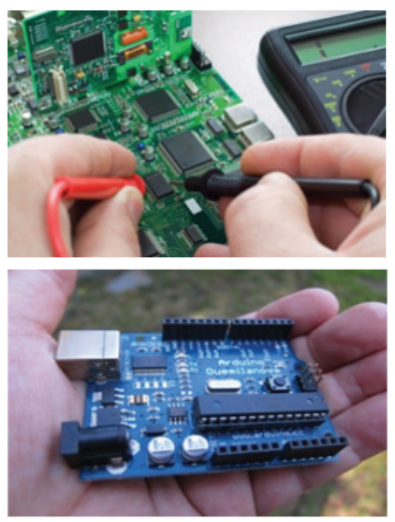
Electronics has become a part of our daily life. All gadgets like mobile phones, computers, televisions, music systems etc work on the electronic principles. Electronic circuits are used to perform various operations in devices like air conditioners, microwave oven, dish washers and washing machines. Besides this, its applications are widespread in all fields like communication systems, medical diagnosis and treatments and even handling money through ATMs.
Evolution of Electronics:
The history of electronics began with the invention of vacuum diode by J.A. Fleming in 1897. This was followed by a vacuum triode implemented by Lee De Forest to control electrical signals. This led to the introduction of tetrode and pentode tubes.
Subsequently, the transistor era began with the invention of bipolar junction transistor by Bardeen, Brattain and Shockley in 1948 for which they received Nobel prize in 1956. The emergence of germanium and silicon semiconductor materials made this transistor gain popularity, in turn its application in different electronic circuits.
The following years witnessed the invention of the integrated circuits (ICs) that helped to integrate the entire electronic circuit on a single chip which is small in size and cost- effective. Since 1958 ICs capable of holding several thousand electronic components on a single chip such as smallscale, medium- scale, large- scale, and verylarge scale integration started coming into existence. Digital integrated circuits became another robust IC development that enhanced the architecture of computers. All these radical changes led to the introduction of microprocessor in 1969 by Intel.
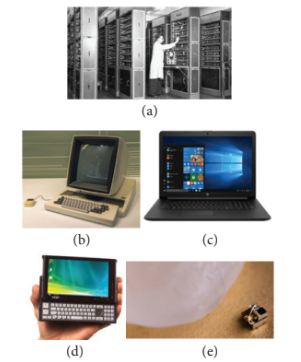
The electronics revolution, in due course of time, accelerated the computer revolution. Now the world is on its way towards small particles of nano- size, far too small to see. This helps in the miniaturization to an unimaginable size. A room- size computer during its invention has now emerged as a laptop, palmtop, iPad, etc. In the recent past, IBM has released the smallest computer whose size is comparable to the tip of the rice grain, measuring just \(0.33\mathrm{mm}\) on each side.
Electronics is the branch of physics which incorporates technology to design electrical circuits using transistors and microchips. It depicts the behaviour and movement of electrons and holes in a semiconductor, electrons and ions in vacuum or gas. Electronics deals with electrical circuits that involve active components such as transistors, diodes, integrated circuits and sensors, associated with the passive components like resistors, inductors, capacitors and transformers.
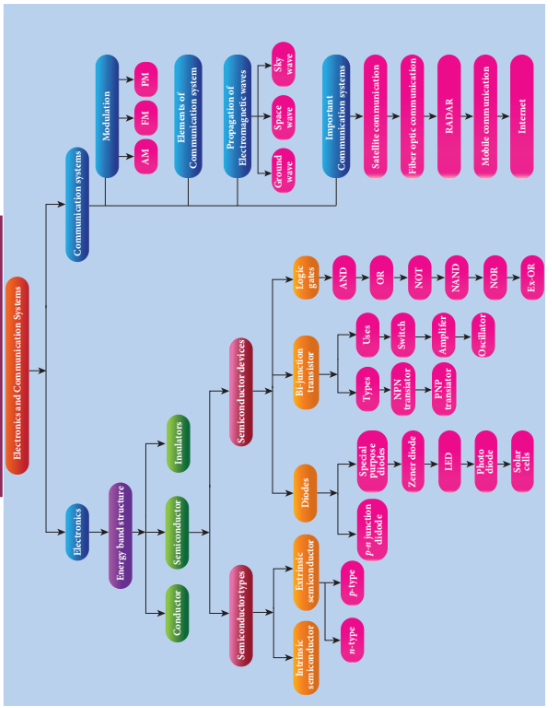
This chapter deals with semiconductor devices like \(p - n\) junction diodes, bipolar junction transistors and logic circuits.
Note
Passive components: components that cannot generate power in a circuit. Active components: components that can generate power in a circuit.
Figure 10.1 Evolution of computers (a) One of the world’s first computers (b) Desktop computer (c) Laptop computer (d) Palmtop computer(e) Smallest computer by IBM kept near the tip of the rice grain
DO YOU KNOW
The world’s first computer ENIAC’ was invented by J.Presper Eckert and John Mauchly at the University of Pennsylvania. The construction work started in 1943 and got over in 1946. It occupied an area of around 1800 square feet. It had 18,000 vacuum tubes and it weighed around 50 tons.
In an isolated atom, the electronic energy levels are widely separated and are far apart and the energy of the electron is decided by the orbit in which it revolves around the nucleus. However, in the case of a solid, the atoms are closely spaced and hence the electrons in the outermost energy levels of nearby atoms influence each other. This changes the nature of the electron motion in a solid from that in an isolated atom to a large extent.
The valence electrons in an atom are responsible for the bonding nature. Let us consider an atom with one electron in the outermost orbit. It means that the number of valence electrons is one. When two such atoms are brought close to each other, the valence orbitals are split up into two. Similarly the unoccupied orbitals of each atom will also split up into two. The electrons have the choice of choosing any one of the orbitals as the energy of both the orbitals is the same. When the third atom of the same element is brought to this system, the valence orbitals of all the three atoms are split into three. The unoccupied orbitals also will split into three.
In reality, a solid is made up of millions of atoms. When millions of atoms are brought close to each other, the valence orbitals and the unoccupied orbitals are split according to the number of atoms. In this case, the
energy levels will be closely spaced and will be difficult to differentiate the orbitals of one atom from the other and they look like a band as shown in Figure 10.2. This band of very large number of closely spaced energy levels in a very small energy range is known as energy band.
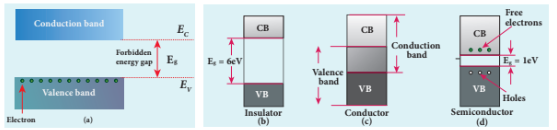
The energy band formed due to the valence orbitals is called valence band (VB) and that formed due to the unoccupied orbitals to which electrons can jump when energised is called the conduction band (CB). The energy gap between the valence band and the conduction band is called forbidden energy gap \((E_{g})\) .Electrons cannot exist in the forbidden energy gap.
A simple pictorial representation of the valence band and conduction band is shown in Figure 10.2(a). \(E_{V}\) represents the maximum energy of the valence band and \(E_{c}\) represents minimum energy of the conduction band. The forbidden energy gap, \(E_{g} = E_{c} - E_{V}\) . We know that the Coulomb force of attraction between the orbiting electron and the nucleus is inversely proportional to the distance between them. Therefore, the electrons in the orbitals closer to the nucleus are strongly bound to it. Hence, the electrons closer to nucleus require a lot of energy to be excited. The electrons in the valence band are loosely bound to the nucleus and can be easily excited to become free electrons.
Figure 10.2 (a) Schematic representation of valence band, conduction band and forbidden energy gap. Energy band structure of (b) Insulator (c) Conductor (d) Semiconductor
The classification of solids into insulators, metals, and semiconductors can be explained with the help of the energy band diagram.
i) Insulators
The energy band structure of insulators is shown in Figure 10.2(b). The valence band and the conduction band are separated by a large energy gap. The forbidden energy gap is approximately \(6\mathrm{eV}\) in insulators. The gap is very large that electrons from valence band cannot move into conduction band even on the application of strong external electric field or the increase in temperature. Therefore, the electrical conduction is not possible as the free electrons are not available for conduction and hence these materials are called insulators. Its resistivity is in the range of \(10^{11} - 10^{19}\Omega \mathrm{m}\) .
ii) Conductors
In conductors, the valence band and conduction band overlap as shown in Figure 10.2(c). Hence, electrons can move freely into the conduction band which results in a large number of free electrons available in the conduction band. Therefore, conduction becomes possible even at low temperatures. The application of electric field provides sufficient energy to the electrons to drift in a particular direction to constitute a current. For conductors, the resistivity value lies between \(10^{- 2}\Omega \mathrm{m}\) and \(10^{- 8}\Omega \mathrm{m}\) .
iii) Semiconductors
In semiconductors, there exists a narrow forbidden energy gap \(\left(E_{g}< 3eV\right)\) between the valence band and the conduction band(Figure 10.2(d)). At a finite temperature, thermal agitations in the solid can break the covalent bond between the atoms (covalent bond is formed due to the sharing of electrons to attain stable electronic configuration). This releases some electrons from valence band to conduction band. Since free electrons are small in number, the conductivity of the semiconductors is not as high as that of the conductors. The resistivity value of semiconductors is from \(10^{- 5}\Omega \mathrm{m}\) to \(10^{6}\Omega \mathrm{m}\) .
Note
In semiconductors, electrons in the valence band are bound electrons which cannot move. Hence, they cannot contribute for conduction.
When the temperature is increased further, more number of electrons are promoted to the conduction band and they increase the conduction. Thus, we can say that the electrical conduction increases with the increase in temperature. In other words, resistance decreases with increase in temperature. Hence, semiconductors are said to have negative temperature coefficient of resistance. The most important commonly used elemental semiconducting materials are silicon (Si) and germanium (Ge). The values of forbidden energy gap for Si and Ge at room temperature are \(1.1\mathrm{eV}\) and \(0.7\mathrm{eV}\) respectively.
A semiconductor in its pure form without any impurity is called an intrinsic semiconductor. Here, impurity means
10.4 (a) The presence of free electron, hole and broken covalent bond in the intrinsic silicon crystal (b) Presence of electrons in the conduction band and holes in the valence band at room temperature
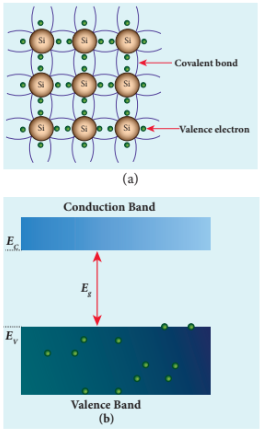
Figure 10.3 (a) Two dimensional crystal lattice of silicon (b) Valence band and conduction band of intrinsic semiconductor
presence of any other foreign atom in the crystal lattice. The silicon lattice is shown in Figure 10.3(a). Each silicon atom has four electrons in the outermost orbit and is covalently bonded with four neighbouring atoms to form the lattice. The band diagram for this case is shown in Figure 10.3(b).
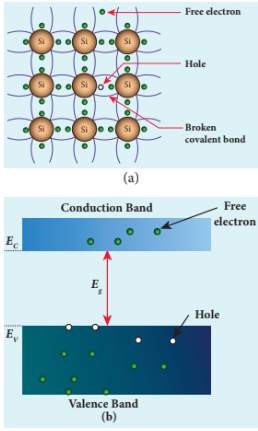
A small increase in temperature is sufficient enough to break some of the covalent bonds and release the electrons free from the lattice (10.4(a)). As a result, some states in the valence band become empty and the same number of states in the conduction band will be occupied by
Figure 10.4 (a) The presence of free electron, hole and broken covalent bond in the intrinsic silicon crystal (b) Presence of electrons in the conduction band and holes in the valence band at room temperature
electrons as shown in Figure 10.4(b). The vacancies produced in the valence band are called holes. As the holes are deficiency of electrons, they are treated to possess positive charges. Hence, electrons and holes are the two charge carriers in semiconductors.
In intrinsic semiconductors, the number of electrons in the conduction band is equal to the number of holes in the valence band. The electrical conduction is due to the electrons in the conduction band and holes in the valence band. The corresponding currents are represented as \(I_{e}\) and \(I_{h}\) respectively.
Note
Definition of a hole: When an electron is excited, covalent bond is broken. Now octet rule will not be satisfied. Thus each excited electron leaves a vacancy to complete bonding. This ‘deficiency’ of electron is termed as a ‘hole’
The total current \(I\) is always the sum of the electron current and the hole current. That is, \(I = I_{e} + I_{h}\) .
An intrinsic semiconductor behaves like an insulator at \(0\mathrm{K}\) . The increase in temperature increases the number of charge carriers (electrons and holes). The schematic diagram of the intrinsic semiconductor in band diagram is shown in Figure 10.4(b). The intrinsic carrier concentration is the number of electrons in the conduction band or the number of holes in the valence band in an intrinsic semiconductor.
The carrier concentration in an intrinsic semiconductor is not sufficient enough to develop efficient electronic devices. Another way of increasing the carrier concentration in an intrinsic semiconductor is by adding impurity atoms.
The process of adding impurities to the intrinsic semiconductor is called doping. It increases the concentration of charge carriers (electrons and holes) in the semiconductor and in turn, its electrical conductivity. The impurity atoms are called dopants and its order is approximately 100 ppm (parts per million).
On the basis of the type of impurity added, extrinsic semiconductors are classified into:
i) n-type semiconductor
ii) p-type semiconductor
i) n-type semiconductor
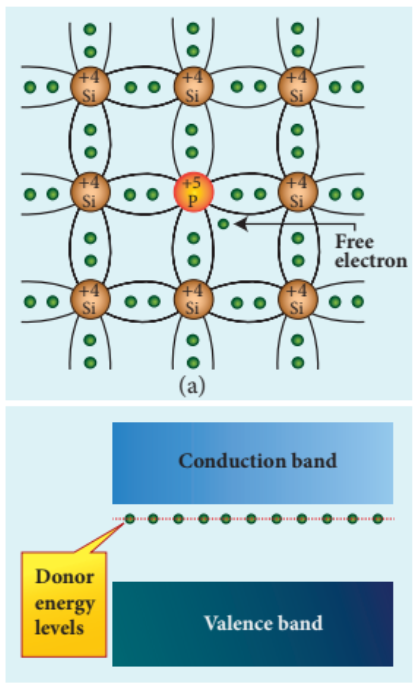
A n- type semiconductor is obtained by doping a pure silicon (or germanium) crystal with pentavalent impurity atoms (from V group of periodic table) such as phosphorus, arsenic and antimony as shown in Figure 10.5(a). The dopant has five valence electrons while the silicon atom has four valence electrons. During the process of doping, a few of the silicon atoms are replaced by pentavalent
Figure 10.5 n-type extrinsic semiconductor: (a) Free electron which is loosely attached to the lattice (b) Representation of donor energy level
dopants. Four of the five valence electrons of the impurity atom form covalent bonds with four silicon atoms. The fifth valence electron of the impurity atom is loosely attached with the nucleus as it is not used in the formation of the covalent bond.
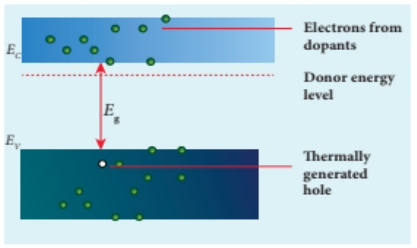
The energy level of the loosely attached fifth electron from the dopant is found just below the conduction band edge and is called the donor energy level as shown in Figure 10.5(b). At room temperature, these electrons can easily move to the conduction band with the absorption of thermal energy. It is shown in the Figure 10.6. Besides, an external electric field also can set free the loosely bound electrons and lead to conduction.
Figure 10.6 Thermally generated holes in the valence band and the free electrons generated by the dopants in the conduction band (n-type semiconductor)
It is important to note that the energy required for an electron to jump from the valence band to the conduction band in an intrinsic semiconductor is \(0.7\mathrm{eV}\) for Ge and \(1.1\mathrm{eV}\) for Si, while the energy required to set free a donor electron is only \(0.01\mathrm{eV}\) for Ge and \(0.05\mathrm{eV}\) for Si.
The V group pentavalent impurity atoms donate electrons to the conduction band and are called donor impurities. Therefore, each impurity atom provides one extra electron to the conduction band in addition to the thermally generated electrons. These thermally generated electrons leave holes in valence band. Hence, the majority carriers of current in an \(n\) - type semiconductor are electrons and the minority carriers are holes. Such a semiconductor doped with a pentavalent impurity is called an \(n\) - type semiconductor.
ii) \(p\) -type semiconductor
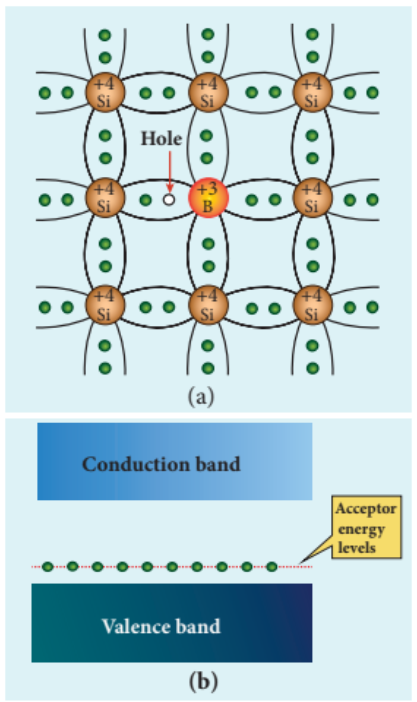
In \(p\) - type semiconductor, trivalent impurity atoms (from III group of periodic table) such as boron, aluminium, gallium and indium are added to the silicon (or germanium) crystal. The dopant with three valence electrons can form three covalent bonds with three silicon atoms. Of the four covalent bonds, three bonds are complete and the remaining one bond is incomplete with one electron. This electron vacancy present in the fourth covalent bond is represented as a hole.
To make complete covalent bonding with all four neighbouring atoms, the dopant is in need of one more electron. These dopants can accept electrons from the neighbouring atoms. Therefore, this impurity is called an acceptor impurity. The energy level of the hole created by each impurity atom is just above the valence band and is called the acceptor energy level, as shown in Figure 10.7(b).
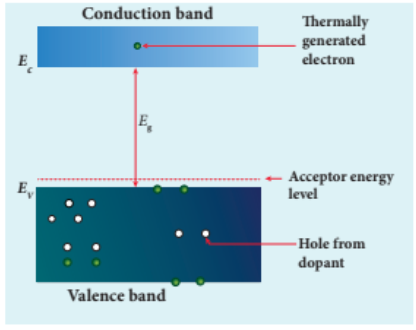
For each acceptor atom, there will be a hole in the valence band; this is in addition to the holes left by the thermally generated electrons. In such an extrinsic semiconductor, holes are the majority carriers and thermally generated electrons are minority carriers as shown in Figure 10.8. The extrinsic semiconductor thus formed is called a \(p\) - type semiconductor.
Figure 10.7 p-type extrinsic semiconductor (a) Hole generated by the dopant (b) Representation of acceptor energy level
Figure 10.8 Thermally generated electron in the conduction band and the holes generated by the dopants in the valence band (p-type semiconductor)
Note
The \(n\) - type and \(p\) - type semiconductors are neutral because only neutral atoms are doped to the intrinsic semiconductors.
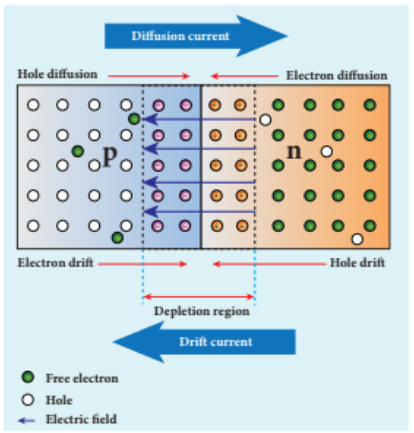
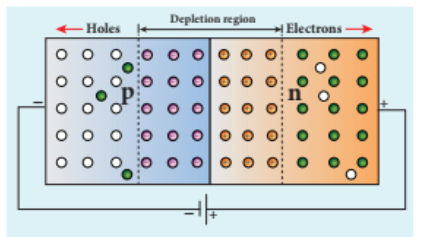
A single piece of semiconductor crystal is suitably doped such that its one side is \(p\) - type semiconductor and the other side is \(n\) - type semiconductor. The contact surface between the two sides is called \(p\) - \(n\) junction. Whenever \(p\) - \(n\) junction is formed, some of the free electrons diffuse from the \(n\) - side to the \(p\) - side while the holes from the \(p\) - side to the \(n\) - side. The diffusion of charge carriers happens due to the fact that the \(n\) - side has higher electron concentration and the \(p\) - side has higher hole concentration. The diffusion of the majority charge carriers across the junction gives rise to an electric current, called diffusion current.
When an electron leaves the \(n\) - side, a pentavalent atom in the \(n\) - side becomes a positive ion. The free electron migrating into \(p\) - side recombines with a hole present in a trivalent atom near the junction and the trivalent atom becomes a negative ion. Since such ions are bonded to the neighbouring atoms in the crystal lattice, they are unable to move. As the diffusion process continues, a layer of positive ions and a layer of negative ions are created on either side of the junction accordingly. The thin region near
Figure 10.9 Formation of p–n junction
the junction which is free from charge carriers (free electrons and holes) is called depletion region (Figure 10.9).
An electric field is set up between the positively charged layer in the \(n\) - side and the negatively charged layer in the \(p\) - side in the depletion region as shown in the Figure 10.9. This electric field makes electrons in the \(p\) - side drift into the \(n\) - side and the holes in the \(n\) - side into the \(p\) - side. The electric current produced due to the motion of the minority charge carriers by the electric field is known as drift current. The diffusion current and drift current flow in opposite directions.
Though drift current is less than diffusion current initially, equilibrium is reached between them at a particular time. With each electron (or hole) diffusing across the junction, the strength of the electric field increases thereby increasing the drift current till the two currents become equal. Hence at equilibrium, there is no net electric current across the junction. Thus, a \(p - n\) junction is formed.
there is no net electric current across the junction. Thus, a \(p - n\) junction is formed.
ii) Junction potential or barrier potential
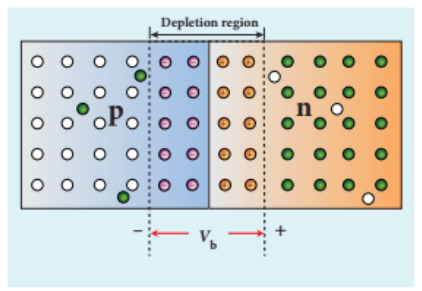
The movement of charge carriers across the junction takes place only to a certain point beyond which the depletion layer acts like a barrier to further diffusion of free charges across the junction. This is due to the fact that the immobile ions on both sides establish an electric potential difference across the junction.
Figure 10.10 Barrier potential formed across the junction
This difference in potential across the depletion layer is called the barrier potential \((V_{\mathrm{b}})\) as shown in Figure 10.10. At \(25^{\circ}\mathrm{C}\) , this barrier potential is approximately 0.7 V for silicon and 0.3 V for germanium.
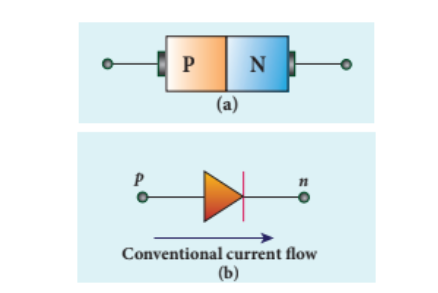
A \(p - n\) junction diode is formed when a \(p\) - type semiconductor is fused with an \(n\) - type semiconductor. It is a device with single \(p - n\) junction as shown in Figure 10.11(a) and its circuit symbol is shown in Figure 10.11(b).
Biasing a diodeBiasing means providing external energy to charge carriers to overcome the barrier potential and make them move in a particular direction. The charge carriers can either move towards the junction or away from the junction. The external voltage applied to the \(p\) - \(n\) junction is called bias voltage. Depending on the polarity of the external source to the \(p\) - \(n\) junction, we have two types of biasing:
i) Forward bias
ii) Reverse bias
i) Forward bias
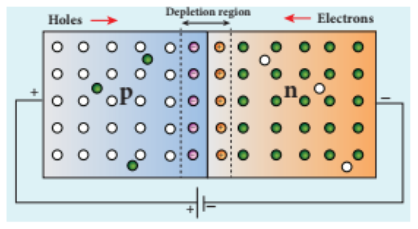
If the positive terminal of the external voltage source is connected to the \(p\) - side and the negative terminal to the \(n\) - side, it is called forward bias as shown in Figure 10.12. The application of a forward bias potential pushes electrons in the \(n\) - side and the holes in the \(p\) - side towards the junction. This initiates the recombination with the ions near the junction which in turn reduces the width of the depletion region and hence the barrier potential.
The electron from the \(n\) - side is now accelerated towards the \(p\) - side as it experiences a reduced barrier potential at the junction. In addition, the accelerated electrons experience a strong attraction by the positive potential applied to the \(p\) - side. This results in the movement of electrons in the \(n\) - side towards the \(p\) - side and similarly, holes in the \(p\) - side towards the \(n\) - side. When the applied voltage is increased, the width of the depletion region and hence the barrier potential are further reduced. This results in a large number of electrons passing through the junction resulting in an exponential rise in current through the junction.
Figure 10.12 Schematic representation of a p-n junction diode under forward bias
ii) Reverse bias
If the positive terminal of the battery is connected to the \(n\) - side and the negative terminal to the \(p\) - side, the junction is said to be reverse biased as shown in Figure 10.13.
Figure 10.13 Schematic representation of a p-n junction diode under reverse bias
As the positive terminal is connected to the \(n\) - type material, the electrons in the \(n\) - side are attracted towards the positive terminal and the holes in the \(p\) - side are attracted by the negative terminal. This increases the immobile ion concentration at the junction. The net effect is the widening of the depletion region leading to an increase in the barrier potential. Consequently, the majority charge carriers from both sides experience a great potential barrier to cross the junction. This reduces the diffusion current across the junction drastically.
Yet, a small current flows across the junction due to the minority charge carriers in both regions. The reverse bias for majority charge carriers serves as the forward bias for minority charge carriers. The current that flows under a reverse bias is called the reverse saturation current. It is represented as \(I_{s}\) .
The reverse saturation current is independent of the applied voltage and it depends only on the concentration of the thermally generated minority charge carriers. Even a small voltage is sufficient enough to drive the minority charge carriers across the junction.
Note
The reverse saturation current of a silicon diode doubles for every 10°C rise in temperature.
It is the study of the variation in current through the diode with respect to the applied voltage across the diode when it is forward biased.
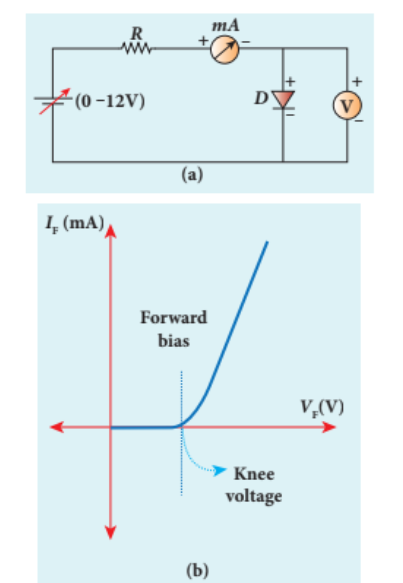
The \(p\) - \(n\) junction diode is forward biased as shown in Figure 10.14(a). An external resistance \((R)\) is used to limit the flow of
current through the diode. The voltage across the diode is varied by varying the biasing voltage across the DC power supply. The forward bias voltage and the corresponding forward bias current are noted. A graph is plotted by taking the forward bias voltage \((V_{p})\) along the x- axis and the current \((I_{p})\) through the diode along the y- axis. This graph is called the forward V- I characteristics of the \(p\) - \(n\) junction diode and is shown in Figure 10.14(b). Four inferences can be brought out from the graph:
(i) At room temperature, a potential difference equal to the barrier potential is required before a reasonable forward current starts flowing across the diode. This voltage is known as threshold voltage or cut-in voltage or knee voltage \((V_{knee})\) . It is approximately \(0.3\mathrm{V}\) for germanium and \(0.7\mathrm{V}\) for silicon. The current flow is negligible when the applied voltage is less than the threshold voltage. Beyond the threshold voltage, increase in current is significant even for a small increase in voltage.
(ii) The graph clearly infers that the current flow is not linear and is exponential. Hence it does not obey Ohm’s law.
(iii) The forward resistance \((r_{\mathrm{p}})\) of the diode is the ratio of the small change in voltage \(\left(\Delta V_{\mathrm{F}}\right)\) to the small change in current \(\left(\Delta I_{\mathrm{F}}\right)\) . That is, \(r_{\mathrm{F}} = \frac{\Delta V_{\mathrm{F}}}{\Delta I_{\mathrm{F}}}\) .
(iv) Thus the diode behaves as a conductor when it is forward biased.
However, if the applied voltage is increased beyond a rated value, it will produce an extremely large current which may destroy the junction due to overheating. This is called as the breakdown of the diode and the voltage at which the diode breaks down is called the breakdown voltage. Thus, it is safe to operate a diode between the threshold voltage and the breakdown voltage.
ii) Reverse characteristics
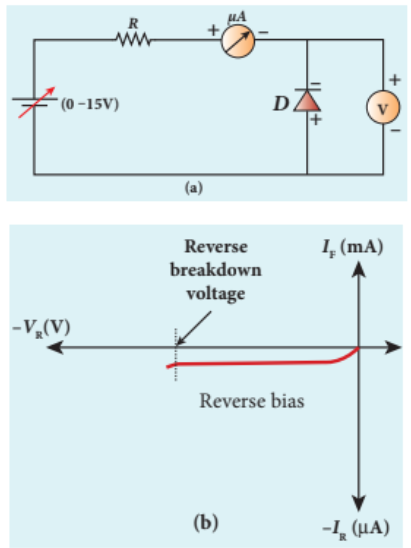
The circuit to study the reverse characteristics is shown in Figure 10.15(a). In the reverse bias, the \(p\) - side of the diode is connected to the negative terminal and \(n\) - side to the positive terminal of the dc power supply.
A graph drawn between the reverse bias voltage and the current across the junction is called the reverse characteristics of a \(p\) - \(n\) junction diode. It is shown in Figure 10.15(b). Under this bias, a very small
current in \(\mu \mathrm{A}\) flows across the junction. This is due to the flow of the minority charge carriers and is called the leakage current or reverse saturation current. This reverse current is independent of the voltage up to a certain voltage, known as breakdown voltage.
Note
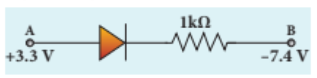
Ideal diode: It acts like a conductor when it is forward biased. When it is reverse biased, it acts like an insulator. For ideal diodes, the forward resistance is zero and barrier potential is considered negligible.
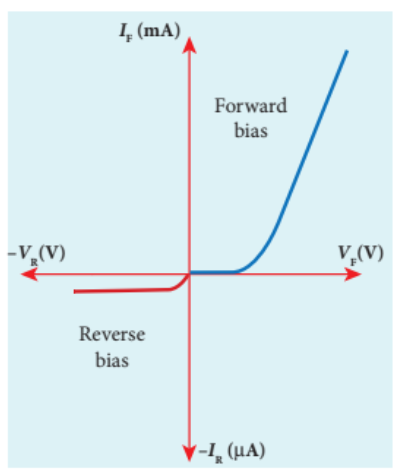
The forward and reverse characteristics are given in one graph as shown in Figure 10.16.
Figure 10.16 Forward and reverse charactristics of a diode
EXAMPLE 10.1
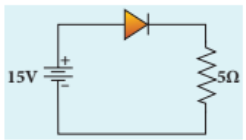
An ideal diode and a \(5\Omega\) resistor are connected in series with a \(15\mathrm{V}\) power supply as shown in figure below. Calculate the current that flows through the diode.
Solution
The diode is forward biased and it is an ideal one. Hence, it acts like a closed switch with no barrier voltage. Therefore, current that flows through the diode can be calculated using Ohm’s law.
The process in which alternating voltage or alternating current is converted into direct voltage or direct current is known as rectification. The device used for this process is called as rectifier. In this section, we will discuss two types of rectifiers namely, half wave rectifier and full wave rectifier
i) Half wave rectifier circuit
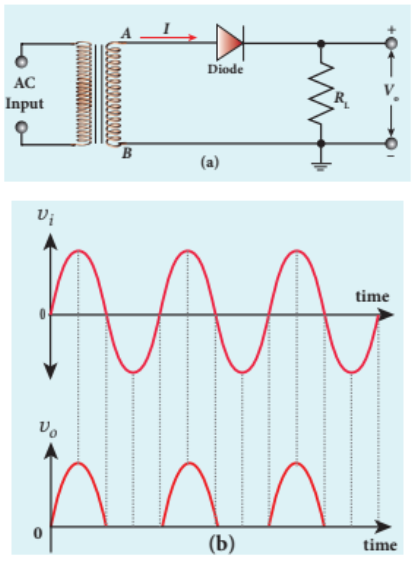
The half wave rectifier circuit consists of a transformer, a \(p - n\) junction diode and a resistor (Figure 10.17(a)). In a half wave rectifier circuit, either a positive half or the negative half of the AC input is passed through by the diode while the other half is blocked. Only one half of the input wave is rectified. Therefore, it is called half wave rectifier. Here, a \(p - n\) junction diode acts as a rectifier diode.
During the positive half cycle
When the positive half cycle of the AC input signal passes through the circuit, terminal A becomes positive with respect to terminal B. The diode is forward biased and hence it conducts. The current flows through the load resistor \(R_{\mathrm{L}}\) and the AC voltage developed across \(R_{\mathrm{L}}\) constitutes the output voltage \(V_{0}\) and the waveform of the output voltage is shown in Figure 10.17(b).
During the negative half cycle
When the negative half cycle of the AC input signal passes through the circuit, terminal A is negative with respect to terminal B. Now the diode is reverse biased and does not conduct. Hence no current passes through \(R_{\mathrm{L}}\) . The reverse saturation current in a diode is negligible. Since there is no voltage drop across \(R_{\mathrm{L}}\) , the negative half cycle of AC supply is suppressed at the output.
The output of the half wave rectifier is not a steady DC voltage but a pulsating wave. This pulsating voltage cannot be used for electronic equipments. A constant or a steady voltage is required which can be obtained with the help of filter circuits and voltage regulator circuits.
Efficiency \((\eta)\) is the ratio of the output DC power to the AC input power supplied to the circuit. Its value for half wave rectifier is \(40.6\%\) .
Note
If the direction of the diode is reversed, the negative half of the AC signal is passed through and the positive half is blocked.
ii) Full wave rectifier
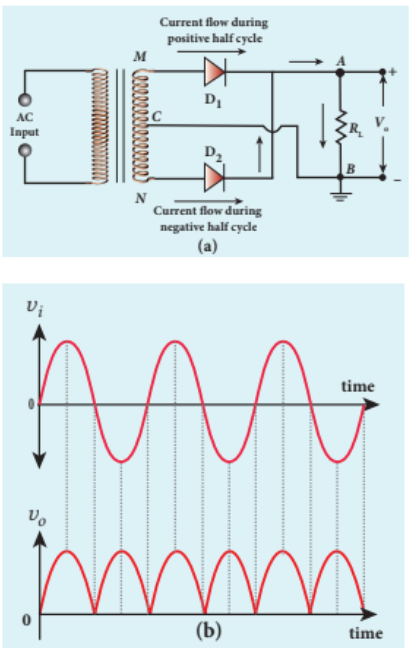
The positive and negative half cycles of the AC input signal are rectified in this circuit and hence it is called the full wave rectifier. The circuit is shown in Figure 10.18(a). It consists of two \(p - n\) junction diodes, a centre tap transformer and a load resistor \(R_{\mathrm{L}}\) . The centre is usually taken as the ground or zero voltage reference point. With the help of the centre tap transformer, each diode rectifies one half of the total secondary voltage.
During positive half cycle
When the positive half cycle of the AC input signal passes through the circuit, terminal M is positive, C is at zero potential and N is at negative potential. This forward biases diode $D_1$ and reverse biases diode $D_2$. Hence, being forward biased, diode $D_1$ conducts and current flows along the path $MD_1ABC$.
During negative half cycle
When the negative half cycle of the AC input signal passes through the circuit, terminal N becomes positive, C is at zero potential and terminal M is at negative potential. This forward biases diode $D_2$ and reverse biases diode $D_1$. Hence, being forward biased, diode $D_2$ conducts and current flows along the path $ND_2ABC$.
Figure 10.18 (a) Full wave rectifier circuit (b) Input and output waveforms
During both postive and negative half cycles of the input signal, the current flows through the load in the same direction. The output signal corresponding to the input signal is shown in Figure 10.18(b). Though both half cycles of AC input are rectified, the output is still pulsating in nature.
The efficiency \((\eta)\) of full wave rectifier is twice that of a half wave rectifier and is found to be \(81.2\%\) . It is because of power losses in the winding, the diode and the load resistance.
Note
Centre tap transformer:
There is a facility to tap at halfway point in thesecondary windings. This helps to measure the induced voltage from one end of the secondary to the centre point. If the centre tap point is grounded, then the voltage across the secondary will be divided into two halves. For example, if the voltage across the secondary is 240 V, then the voltage across one end and the centre tap point is +120 V and at the other end it is –120 V.
The reverse current or the reverse saturation current due to the minority charge carriers is small. If the reverse bias applied to a \(p - n\) junction is increased beyond a point, the junction breaks down and the reverse current rises sharply. The voltage at which breakdown happens is called the breakdown voltage and it depends on the width of the depletion region, which in turn depends on the doping level.
A normal \(p - n\) junction diode gets damaged at this point. Specially designed diodes like Zener diode can be operated at this region and can be used for the purpose of voltage regulation in circuits. There are two mechanisms that are responsible for breakdown under increasing reverse voltage.
i) Avalanche breakdown
Avalanche breakdown occurs in a lightly doped junctions which have wide depletion region. When reverse bias voltage exceeds a certain value, the minority charge carriers are accelerated by reverse voltage and their kinetic energy increases. These charge carriers collide
with semiconductor atoms while passing through the depletion region. This leads to the breaking up of covalent bonds and this results in the generation of electron - hole pairs.
The newly generated charge carriers are also accelerated by the reverse voltage resulting in more collisions and further production of charge carriers. This cumulative process leads to an avalanche (uncontrollably large number) of charge carriers across the junction. This causes diode current to rise abruptly and breakdown takes place. This breakdown is called avalanche breakdown.
ii) Zener breakdown
Heavily doped \(p - n\) junctions have narrow depletion layers whose width is of the order of \(< 10^{- 6}\) m. When reverse voltage across this junction is increased to the breakdown limit, a very strong electric field of strength \(3\times 10^{7}\mathrm{Vm^{- 1}}\) is set up across the narrow layer. This electric field is strong enough to break or rupture the covalent bonds in the lattice and thereby generating electron- hole pairs. This effect is called Zener effect.
Even a small further increase in reverse voltage produces a large number of charge carriers which move across the junction through the thin depletion region. This process gives rise to a large amount reverse current or breakdown current and this breakdown is called Zener breakdown.
Note
In Avalanche breakdown, the minority charge carriers gain sufficient energy from excessive reverse bias voltage to break covalent bond in order to produce new charge carriers. But Zener breakdown occurs due to the direct rupture of covalent bonds because of the existence of the strong electric field. Since depletion region is thin, Zener breakdown occurs usually at lesser reverse bias voltage compared to Avalanche breakdown voltage.
Zener diode is a heavily doped silicon diode used in reverse biased condition and is named after its inventor Clarence Melvin Zener. It is specially designed to be operated in the breakdown region. The doping level of the silicon diode can be varied to have a wide range of breakdown voltages from 2 V to over 1000 V.
As explained in the previous section, Zener breakdown occurs due to the breaking up of covalent bonds by the strong electric field set up in the depletion region by the reverse voltage. It produces an extremely large number of electrons and holes which constitute the reverse saturation current. The current is limited by both external resistance and power dissipation of the diode. A Zener diode is shown in Figure 10.19(a) and its circuit symbol is given in Figure 10.19(b).
It looks like an ordinary \(p - n\) junction diode except that \(n\) - side lead resembles the shape of the letter ‘z’. The arrow head points the direction of conventional current. In Figure 10.19(a), black ring indicates the \(n\) - side lead.
Figure 10.19 Zener diode (a) Commercial picture (b) Circuit symbol
V-I Characteristics of Zener diode
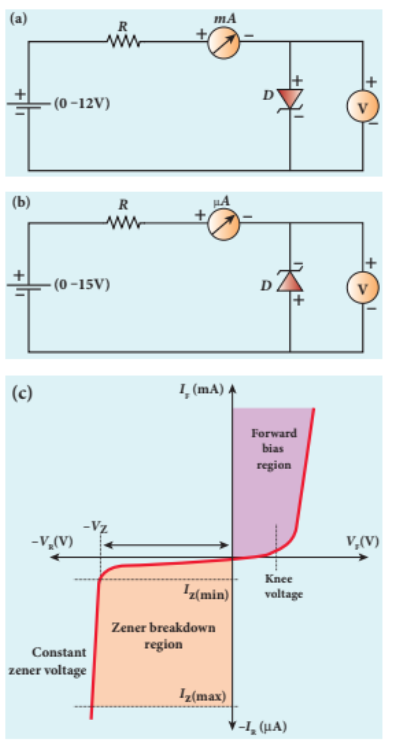
The circuit to study the forward and reverse characteristics of a Zener diode is shown in Figure 10.20(a) and Figure 10.20 (b). The V- I characteristics of a Zener diode is shown in Figure 10.20(c). The forward characteristic of a Zener diode is similar to that of an ordinary \(p - n\) junction diode. It starts conducting approximately around 0.7 V. However, the reverse characteristics is highly significant in Zener diode. The increase in reverse voltage normally generates very small reverse current. While in Zener diode, when the reverse voltage is increased to the breakdown voltage \((V_{z})\) , the increase in current is very sharp. The voltage remains almost constant throughout the breakdown region. In Figure 10.20(c), \(I_{Z(\mathrm{max})}\) represents the maximum reverse current. If the reverse current is increased further, the diode will be damaged. The important parameters of the reverse characteristics are
Zener breakdown voltage, \(V_{z}\)
Minimum current to sustain breakdown, \(I_{Z(\mathrm{min})}\)
Maximum current limited by maximum power dissipation, \(I_{Z(\mathrm{max})}\)
The Zener diode is operated in the reverse bias condition with the voltage greater than \(V_{z}\) and current less than \(I_{Z(\mathrm{max})}\) . The reverse characteristic is not exactly vertical which means that the diode possesses some small resistance called Zener dynamic impedance. Zener resistance is the inverse of the slope of the curve in the breakdown region. It means an increase in the Zener current produces only a very small increase in the reverse voltage. However this can be neglected. The voltage of an ideal Zener diode does not change once it goes into breakdown. In other words, \(V_{z}\) remains almost constant even when \(I_{z}\) increases considerably.
Note
The maximum reverse bias that can be applied before entering into the Zener region is called the peak inverse voltage, commercially referred as PIV rating.
Applications
The zener diode can be used
as voltage regulator
for calibrating voltages to provide fixed reference voltage in a network for biasing
to protect of any gadget against damage from accidental application of excessive voltage.
Zener diode as a voltage regulator
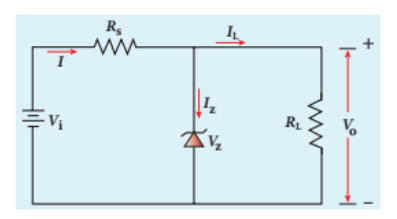
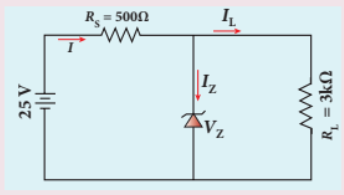
Zener diode as a voltage regulatorZener diode working in the breakdown region can serve as a voltage regulator whose circuit diagram is given in Figure 10.21. A series resistance \(R_{s}\) of suitable value is used to limit the Zener current to avoid any damage to the diode. This resistance also plays a role in voltage regulation. The fluctuating DC input voltage is applied to the circuit and constant output voltage \(V_{0}\) is taken across the load resistance \(R_{\mathrm{L}}\) which is connected in parallel with Zener diode. The output voltage is maintained constant as long as the input voltage is greater than \(V_{Z}\) .
Figure 10.21 Circuit to study voltage regulation by Zener diode
If the input DC voltage is increased, the Zener current increases thereby increasing current through \(R_{\mathrm{s}}\) and the voltage drop across \(R_{\mathrm{s}}\) is also increased. The increased current flows through the diode without affecting the \(I_{\mathrm{L}}\) . Since Zener diode is operated in the breakdown region, the Zener breakdown voltage across the diode is nearly constant even though the reverse bias current through the diode increases considerably. The increase in input voltage is dropped across \(R_{\mathrm{s}}\) and hence it is also called dropping resistance. Because of the parallel connection, the voltage across \(R_{\mathrm{L}}\) is also equal to Zener breakdown voltage which is taken as constant output voltage \(V_{0}\) .
If the input DC voltage is decreased, the diode takes a smaller current and the voltage drop across \(R_{\mathrm{s}}\) is reduced. Thus, the output voltage \(V_{0}\) remains constant. To sum up, if there is any change in input voltage, the voltage drop across \(R_{\mathrm{s}}\) changes accordingly. But the voltage across Zener diode or voltage across \(R_{\mathrm{L}}\) remains constant. Thus the Zener diode acts as a voltage regulator.
EXAMPLE 10.3
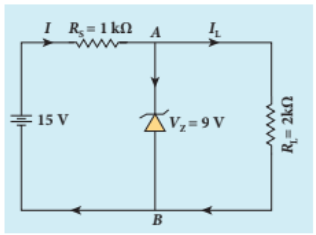
Find the current through the Zener diode when the load resistance is \(2\mathrm{k}\Omega\) . Use diode approximation.
Solution
Voltage across AB, \(V_{Z} = 9\mathrm{V}\) Voltage drop across \(R_{\mathrm{s}} = 15 - 9 = 6\mathrm{V}\) Therefore current through the resistor \(R_{\mathrm{s}}\)
\[I = \frac{6}{1\times 10^3} = 6\mathrm{mA}\]
Voltage across the load resistor, \(V_{\mathrm{AB}} = 9\mathrm{V}\)
Optoelectronics deals with devices which convert electrical energy into light and light into electrical energy using semiconductors. Optoelectronic device is an electronic device which utilizes light for useful applications. We will discuss some important optoelectronic devices namely, light emitting diodes, photo diodes and solar cells.
i) Light Emitting Diode (LED)
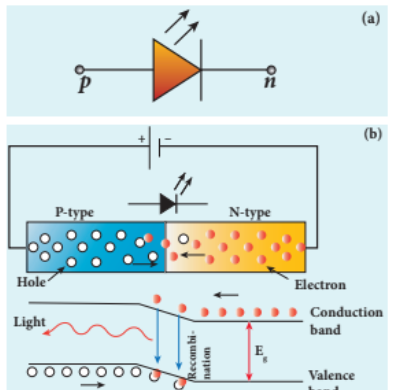
LED is a \(p - n\) junction diode which emits visible or invisible light when it is forward biased. Since electrical energy is converted into light energy, this process is also called electroluminescence. The circuit symbol of LED is shown in Figure 10.22(a). The direction of arrows indicates that light is emitted from the diode.
Figure 10.22 (a) Circuit symbol of LED (b) Schematic diagram to explain recombination process
When the \(p - n\) junction is forward biased, the conduction band electrons on \(n\) - side and valence band holes on \(p\) - side diffuse across the junction. When they cross the junction, they become excess minority carriers (electrons in \(p\) - side and holes in \(n\) - side). These excess minority carriers recombine with oppositely charged majority carriers in the respective regions, i.e. the electrons in the conduction band recombine with holes in the valence band as shown in the Figure 10.22(b).
During recombination process, energy is released in the form of light (radiative) or heat (non- radiative). For radiative recombination, a photon of energy \(hv\) is emitted. For non- radiative recombination, energy is liberated in the form of heat.
The colour of the light is determined by the energy band gap of the material. Therefore, LEDs are available in a wide range of colours such as blue (SiC), green (AlGaP) and red (GaAsP). Now a days, LED which emits white light (GaInN) is also available.
Applications
The light emitting diodes are used in
· indicator lamps on the front panel of the
scientific and laboratory equipments.
· seven-segment displays.
· traffic signals, emergency vehicle lighting
etc.
·remote control of television, air-
conditioner etc.
EXAMPLE 10.4
Determine the wavelength of light emitted from LED which is made up of GaAsP semiconductor whose forbidden energy gap is 1.875 eV. Mention the colour of the light emitted (Take \(h = 6.6\times 10^{- 34}\mathrm{Js}\) ).
Mention the colour of the light emitted (Take \(h = 6.6\times 10^{- 34}\mathrm{Js}\) ).
The wavelength \(660~\mathrm{nm}\) corresponds to red colour light.
ii) Photodiodes
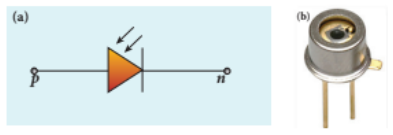
A \(p\) - \(n\) junction diode which converts an optical signal into electric signal is known as photodiode. Thus, the operation
of photodiode is exactly inverse to that of an LED. Photodiode works in reverse bias condition. Its circuit symbol is shown in Figure 10.23(a). The direction of arrows indicates that the light is incident on the photodiode.
The device consists of a \(p\) - \(n\) junction semiconductor made of photosensitive material kept safely inside a plastic case as shown in Figure 10.23(b). It has a small transparent window that allows light to be incident on the \(p\) - \(n\) junction. Photodiodes can generate current when the \(p\) - \(n\) junction is exposed to light and hence are called as light sensors.
Figure 10.23 (a) Circuit symbol (b) Schematic view of photodiode
When a photon of sufficient energy \((hv)\) strikes the depletion region of the diode, some of the valence band electrons are elevated into conduction band, in turn holes are developed in the valence band. This creates electron- hole pairs. The amount of electron- hole pairs generated depends on the intensity of light incident on the \(p\) - \(n\) junction.
These electrons and holes are swept across the \(p\) - \(n\) junction by the electric field created by reverse voltage before recombination takes place. Thus, holes move towards the \(p\) - side and electrons towards the \(n\) - side. When the external circuit is made, the electrons flow through the external circuit and constitute the photocurrent.
When there is no incident light, there exists a reverse current which is negligible.
This reverse current in the absence of any incident light is called dark current and is due to the thermally generated minority carriers.
Applications
The photodiodes are used in
alarm system
count items on a conveyor belt
photoconductors
compact disc players, smoke detectors
medical applications such as detectors for
computed tomography etc.
iii) Solar cell
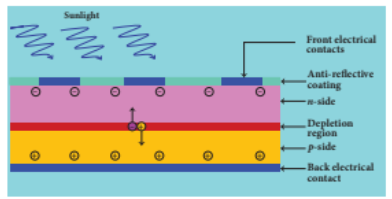
A solar cell, also known as photovoltaic cell, works on the principle of photovoltaic effect. Accordingly, the \(p\) - \(n\) junction of the solar cell generates emf when solar radiation falls on it. The construction details and cross- sectional view are shown in Figure 10.24.
In a solar cell, electron- hole pairs are generated due to the absorption of light photons near the junction. Then the charge carriers are separated due to the electric field of the depletion region. Electrons move towards \(n\) - type silicon layer and holes move towards \(p\) - type silicon layer. The electrons reaching the \(n\) - side are collected by the front contact (metal finger contact) and holes reaching \(p\) - side are collected by the back
Figure 10.24 Cross-sectional view of a solar cell
electrical contact. Thus a potential difference is developed across solar cell.When an external load is connected to the solar cell, photocurrent flows through the load.
Many solar cells are connected together either in series or in parallel combination to form a solar panel. Many solar panels are connected with each other to form solar arrays. For high power applications, solar panels and solar arrays are used.
Applications:
i) Solar cells are widely used in
calculators, watches, toys, portable power
supplies, etc.
ii) Solar cells are used in satellites and
space applications.
iii) Solar panels are used for commercial
production of electricity.
Introduction
In 1951, William Schockley invented the modern version of transistor. It is a semiconductor device that led to a technological revolution in the twentieth century. The heat loss in transistor is very less. This has laid the foundation for integrated chips which contain thousands of miniaturized transistors. The emergence of the integrated chips led to increasing applications in the fast developing electronics industry.
Bipolar Junction Transistor (BJT)
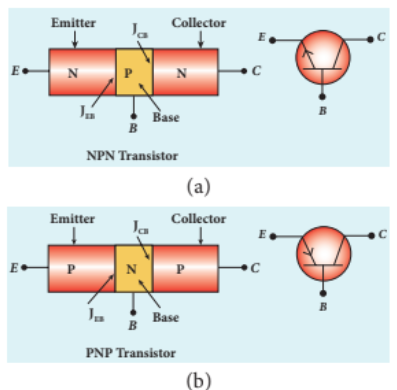
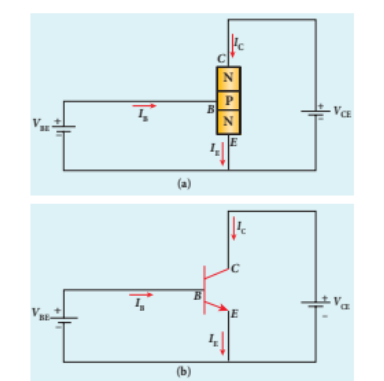
The BJT consists of a semiconductor (silicon or germanium) crystal in which an \(n\) - type material is sandwiched between two \(p\) - type materials (PNP transistor) or
a \(p\) - type material sandwiched between two \(n\) - type materials (NPN transistor). To protect it against moisture, it is sealed inside a metal or a plastic case. The two types of transistors with their circuit symbols are shown in Figure 10.25.
Figure 10.25 Schematic Diagram of (a) NPN transistor and circuit symbol (b) PNP transistor and circuit symbol
The three regions formed are called as emitter, base and collector which are provided with terminals or ohmic contacts labeled as \(E\) , \(B\) , and \(C\) . As BJT has two \(p\) - \(n\) junctions, two depletion layers are formed across the emitter- base junction \((I_{\mathrm{EB}})\) and collector- base junction \((I_{\mathrm{CB}})\) respectively. The circuit symbol carries an arrowhead at the emitter lead pointing from \(p\) to \(n\) indicating the direction of conventional current.
Emitter:
The main function of the emitter is to supply majority charge carriers to the collector region through the base region. Hence, emitter is more heavily doped than the other two regions.
Base:
Base is very thin \((10^{- 6}\mathrm{m})\) and very lightly doped region when compared to the other two regions.
Collector:
The main function of collector is to collect the majority charge carriers supplied by the emitter through the base. Hence, collector is made physically larger than the other two as it has to dissipate more power. It is moderately doped.
Note
Because of the differing size and the amount of doping, the emitter and collector cannot be interchanged.
Transistor Biasing
The application of suitable DC voltages across the transistor terminals is called biasing. The transistor biasing is done differently for different uses. The different modes of transistor biasing are given below.
Forward Active:
In this bias, the emitter- base junction is forward biased and the collector- base junction is reverse biased. The transistor is in the active mode of operation. In this mode, the transistor functions as an amplifier.
Saturation:
Here, the emitter- base junction and collector- base junction are forward biased. The transistor has a very large flow of currents across the junctions. In this mode, transistor is used as a closed switch.
Cut-off:
In this bias, the emitter- base junction and collector- base junction are reverse biased. Transistor in this mode acts an open switch.
Note
In a PNP transistor, base and collector will be negative with respect to emitter indicated by the middle letter N whereas base and collector will be positive in an NPN transistor indicated by the middle letter P.
There are three types of circuit connections for operating a transistor based on the terminal that is used in common to both input and output circuits.
i) Common-Base (CB) configuration
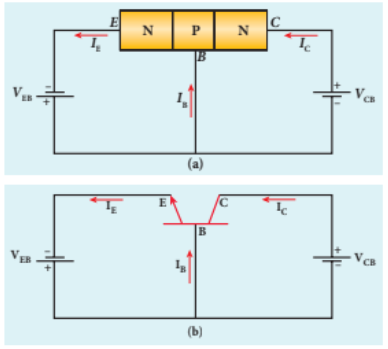
The base is common to both the input and output circuits. The schematic and circuit symbol are shown in Figure 10.26(a) and 10.26(b). The input current is the emitter current \(I_{\mathrm{E}}\) and the output current is the collector current \(I_{\mathrm{C}}\) . The input signal is applied between emitter and base while the output is measured between collector and base.
Figure 10.26 NPN transistor in common base configuration (a) Schematic circuit diagram (b) Circuit symbol
Common-Emitter (CE) configurationIn this configuration, the emitter is common to both the input and output circuits as shown in Figure 10.27. The base current \(I_{\mathrm{B}}\) is the input current and the collector current \(I_{\mathrm{c}}\) is the output current. The input signal is applied between emitter and base while the output is measured between collector and emitter.
Figure 10.27 NPN transistor in common emitter configuration (a) Schematic circuit diagram (b) Circuit symbol
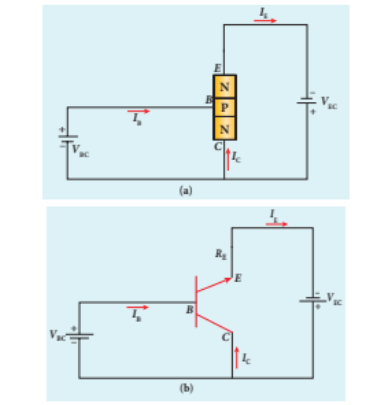
iii) Common-Collector (CC) configuration
Here, the collector is common to both the input and output circuits as shown in Figure 10.28. The base current \(I_{\mathrm{B}}\) is the input current and the emitter current \(I_{\mathrm{E}}\) is the output current. The input signal is applied between base and collector while the output is measured between emitter and collector.
Note
As the output is taken from the emitter in common collector configuration, it is called an emitter follower.
Figure 10.28 NPN transistor in common collector configuration (a) Schematic circuit diagram (b) Circuit symbol
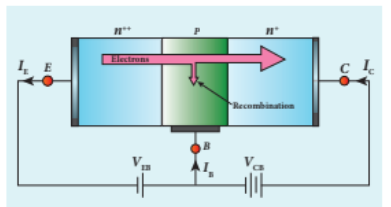
The operation of an NPN transistor in the common base mode is explained below. The current flow in a common base NPN transistor in the forward active mode is shown in Figure 10.29.
Figure 10.29 Flow of current in a NPN transistor
Basically, a BJT can be considered as two \(p\) - \(n\) junction diodes connected back- to- back. In the forward active bias of the transistor, the emitter-base junction is forward biased by a DC power supply $V_{EB}$ and the collector-base junction is reverse biased by the bias power supply $V_{CB}$. The forward bias decreases the depletion region across the emitter-base junction and the reverse bias increases the depletion region across the collector-base junction. Hence, the barrier potential across the emitter-base junction is decreased and that across the collector-base junction is increased. The voltage across the emitter-base junction is represented as $V_{EB}$ and that across the collector-base junction as $V_{CB}$.
In an NPN transistor, the majority charge carriers in the emitter are electrons. As it is heavily doped, it has a large number of electrons. The forward bias across the emitter-base junction causes the electrons in the emitter region to flow towards the base region and constitutes the emitter current ($I_E$). The electrons after reaching the base region recombine with the holes in the base region. Since the base region is very narrow and lightly doped, the number of holes in it is not sufficient to recombine with electrons from emitter. Hence most of the electrons reach the collector region.
Eventually, the electrons that reach the collector region will be attracted by the collector terminal as it has positive potential and flow through the external circuit. This constitutes the collector current ($I_C$). The holes that are lost due to recombination in the base region are replaced by the positive potential of the bias voltage $V_{BE}$ and constitute the base current ($I_B$). The magnitude of the base current will be in microamperes as against milliamperes for emitter and collector currents.
It is to be noted that if the emitter current is zero, then the collector current is almost zero. It is therefore imperative that a BJT is called a current controlled device. Applying Kirchoff’s law, we can write the emitter current as the sum of the collector current and the base current.
$$I_E = I_B + I_C \quad (10.1)$$
Since the base current is very small, we can write $I_E \approx I_C$. There is another component of collector current due to the thermally generated electrons called reverse saturation current, denoted as $I_{CO}$. This factor is temperature sensitive. Therefore, care must be taken towards the stability of the system at high temperatures.
The ratio of the collector current to the emitter current is called the forward current gain ($\alpha$) of a transistor.
$$\alpha = \frac{I_C}{I_E} \quad (10.2)$$
The $\alpha$ of a transistor is a measure of the quality of a transistor. Higher the value of $\alpha$, better is the quality of the transistor. It means that the collector current is closer to the emitter current. The value of $\alpha$ is less than unity and it ranges from 0.95 to 0.99. This indicates that the collector current is 95% to 99% of the emitter current.
Working of a PNP transistor
The working of a PNP transistor is similar to that of the NPN transistor except for the
fact that the emitter current \(I_{E}\) is due to holes and the base current \(I_{B}\) is due to electrons. However, the current through the external circuit is due to the flow of electrons.
EXAMPLE 10.5
In a transistor connected in the common base configuration, \(\alpha = 0.95\) , \(I_{E} = 1 \text{mA}\) . Calculate the values of \(I_{C}\) and \(I_{B}\) .
10.4.3 Static Characteristics of Transistor in Common Emitter Mode#
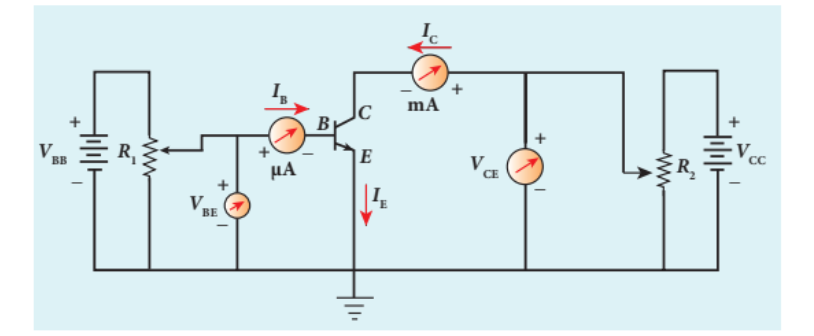
The know- how of certain parameters like the input resistance, output resistance, and current gain of a transistor are very important for the effective use of transistors in circuits. The circuit to study the static characteristics of an NPN transistor in the common emitter mode is given in Figure 10.30. The bias supply voltages \(V_{\mathrm{BB}}\) and \(V_{\mathrm{CC}}\) bias the base- emitter junction and collector- emitter junction respectively. The junction potential at the base- emitter is represented as \(V_{\mathrm{BE}}\) and that at the collector- emitter as \(V_{\mathrm{CE}}\) . The rheostats \(R_{1}\) and \(R_{2}\) are used to vary the base current and collector current respectively.
The static characteristics of the BJT are
i) Input characteristics
ii) Output characteristics
iii) Transfer characteristics
i) Input characteristics
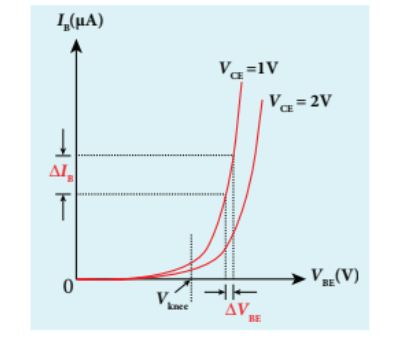
Input characteristic curves give the relationship between the base current \((I_{\mathrm{B}})\) and base to emitter voltage \((V_{\mathrm{BE}})\) at constant collector to emitter voltage \((V_{\mathrm{CE}})\) and are shown in Figure 10.31.
Initially, the collector to emitter voltage is set to a particular value (above \(0.7 \text{V}\) to reverse bias the junction). Then the base- emitter voltage is increased in suitable steps and the corresponding base- current is recorded. A graph is plotted with \(V_{\mathrm{BE}}\) along the x- axis and \(I_{\mathrm{B}}\) along the y- axis. The procedure is repeated for different values of \(V_{\mathrm{CE}}\) .
Figure 10.30 NPN transistor in common emitter configuration
Figure 10.31 Input characteristics
The following observations are made from the graph.
The curve looks like the forward characteristics of an ordinary \(p - n\) junction diode.
There exists a threshold voltage or knee voltage \((V_{\mathrm{knee}})\) below which the base current is very small. This value is 0.7 V for silicon and \(0.3\mathrm{V}\) for germanium transistors. Beyond the knee voltage, the base current increases with the increase in base- emitter voltage.
It is also noted that the increase in the collector- emitter voltage decreases the base current. This shifts the curve outward. This is because the increase in collector- emitter voltage increases the width of the depletion region which in turn, reduces the effective base width and thereby the base current.
Input impedance
The ratio of the change in base- emitter voltage \(\left(\Delta V_{BE}\right)\) to the corresponding change in base current \(\left(\Delta I_B\right)\) at a constant collector- emitter voltage \(\left(V_{CE}\right)\) is called the input impedance \((r_i)\) . The input impedance is not constant in the lower region of the curve.
The input impedance is high for a transistor in common emitter configuration.
ii) Output characteristics
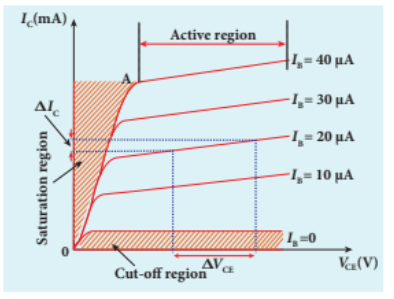
The output characteristics give the relationship between the collector current \((I_{C})\) and the collector to emitter voltage \((V_{CE})\) at constant input current \((I_{B})\) and are shown in Figure 10.32.
Initially, the base current is set to a particular value. Then collector- emitter voltage is increased in suitable steps and the corresponding collector current is recorded. A graph is plotted with \(V_{CE}\) along the \(\mathbf{x}\) - axis and \(I_{C}\) along the y- axis. This procedure is repeated for different values of \(I_{B}\) . The four important regions in the output characteristics are:
Figure 10.32 Output characteristics
i) Saturation region
When \(V_{CE}\) is increased above 0 V, the \(I_{C}\) increases rapidly and reaches a saturation value at a particular value of \(V_{CE}\) , called knee voltage. The initial part of the curve OA (the ohmic region) between the origin 0 and the knee point A is called saturation region. Transistors are always operated above this knee voltage.
ii) Cut-off region
A small collector current exists even after the base current is reduced to zero. This region below the curve for \(I_{\mathrm{B}} = 0\) is called cut- off region because the main collector current is cut- off.
iii) Active region
The central region of the curves is called active region. In this region, the base- emitter junction remains in the forward biased condition and the collector- emitter junction remains in the reverse biased condition. The transistor in this region can be used for voltage, current and power amplification.
iv) Breakdown region
If the collector- emitter voltage is increased beyond the rated value given by the manufacturer, the collector current increases enormously leading to the junction breakdown of the transistor. This avalanche breakdown can damage the transistor.
Output impedance
The ratio of the change in the collector- emitter voltage \(\left(\Delta V_{CE}\right)\) to the corresponding change in the collector current \(\left(\Delta I_{C}\right)\) at constant base current \((I_{\mathrm{B}})\) is called output impedance \((r_0)\)
The output impedance for transistor in common emitter configuration is very low.
iii) Current transfer characteristics
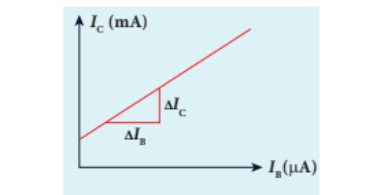
This gives the relationship between the collector current \((I_{C})\) and the base current \((I_{\mathrm{B}})\) at constant collector- emitter voltage \((V_{CE})\) and is shown in Figure 10.33. It is seen that a small \(I_{\mathrm{C}}\) flows even when \(I_{\mathrm{B}}\) is zero. This current is called the common emitter leakage current \((I_{CE0})\) , which is due to the flow of minority charge carriers.
Forward current gain
The ratio of the change in collector current \(\left(\Delta I_{C}\right)\) to the corresponding change in base current \(\left(\Delta I_{B}\right)\) at constant collector- emitter voltage \((V_{CE})\) is called forward current gain \((\beta)\)
There is a relation between current gain in the common base configuration \(\alpha\) and current gain in the common emitter configuration \(\beta\) which is given below.
The collector current is independent of the collector- emitter voltage in the active region.
EXAMPLE 10.6
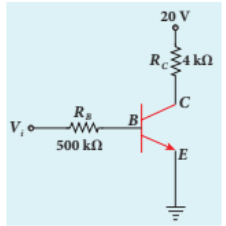
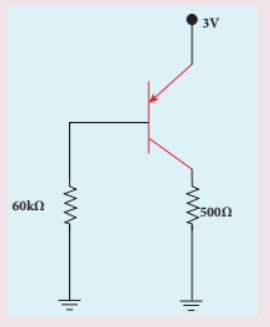
In the circuit shown in the figure, the input voltage \(V_{i}\) is 20 V, \(V_{BE} = 0\) V and \(V_{CE} = 0\) V. What are the values of \(I_{B}, I_{C}, \beta\) ?
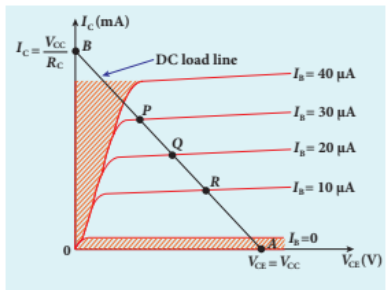
The operating point is a point where the transistor can be operated efficiently. A straight line drawn by joining the points \(A(V_{CC},0)\) and \(B(0,V_{CC} / R_{C})\) is called the DC load line. The DC load line superimposed on the output characteristics of a transistor is used to learn the concept of operating point of the transistor as shown in Figure 10.34.
Figure 10.34 Output characteristics of a transistor in common emitter mode with the DC load line
In Figure 10.34, the points P, Q, R are called Q points or quiescent points
which determine the operating point or the working point of a transistor. If the operating point is chosen at the middle of the DC load line (point Q), the transistor can effectively work as an amplifier. The operating point determines the maximum signal that can be obtained without being distorted.
For a transistor to work as a open switch, the Q point can be chosen at the cut- off region and to work as a closed switch, the Q point can be chosen in the saturation region.
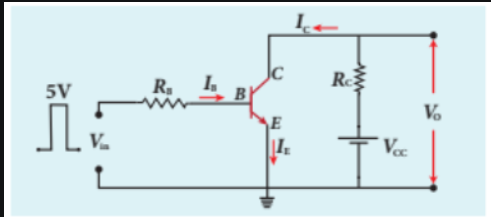
A transistor in saturation region acts as a closed switch while in cut- off region; it acts as an open switch. It functions like an electronic switch that helps to turn ON or OFF a given circuit by a small control signal which keeps the transistor either in saturation region or in cut- off region. The circuit is shown in Figure 10.35.
Figure 10.35 Transistor as a switch
When the input is low:
When the input is low (say 0V), the base current is zero and transistor is not properly forward biased. It is in cut off region. As a result, the collector current is zero and correspondingly the voltage drop across \(R_{C}\) also becomes nearly zero. The output voltage is high and is equal to \(V_{CC}\) . It means that the no current flows through the transistor and it is said to be switched off. The transistor acts as an open switch.
When the input is high:
When the input voltage is increased to a certain high value (say \(+5\mathrm{V}\) ), the base current \((I_{B})\) increases and in turn increases the collector current to its maximum. The transistor will move into the saturation region. The increase in collector current \((I_{C})\) increases the voltage drop across \(R_{C}\) , thereby lowering the output voltage, close to zero (since \(V_{o} = V_{CC} - I_{C}R_{C}\) ). It means that maximum current flows through the transistor and it is said to be switched on. The transistor acts as a closed switch.
It is manifested that a high input to the transistor gives a low output and a low input gives a high output. In addition, we can say that the output voltage is opposite to the applied input voltage. Therefore, a transistor can be used as an inverter (NOT gate) in computer logic circuitry.
EXAMPLE 10.7
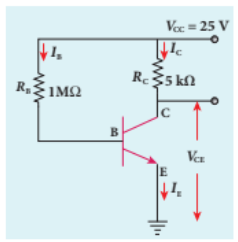
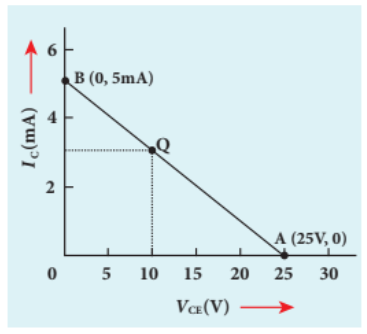
The current gain of a common emitter transistor circuit shown in figure is 120. Draw the DC load line and mark the \(Q\) point on it. \((V_{BE}\) to be ignored).
A transistor operating in the active region has the capability to amplify weak signals. Amplification is the process of increasing the signal strength (increase in the amplitude). If a large amplification is required, the transistors are cascaded with coupling elements like resistors, capacitors, and transformers and they are called multistage amplifiers.
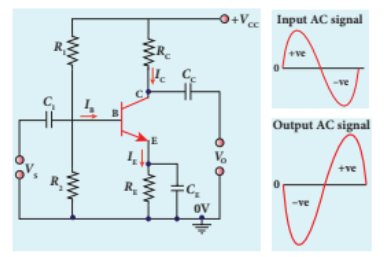
Here, the amplification of an electrical signal is explained with a single stage transistor amplifier which is shown in Figure 10.36(a). Single stage indicates that the circuit consists of one transistor with the allied components. An NPN transistor is connected in the common emitter configuration.
Figure 10.36 (a) Transistor as an amplifier (b) Input and output waveforms showing 180 phase reversal.
To start with, the \(Q\) point or the operating point of the transistor is fixed so as to get the maximum signal swing at the output (neither towards saturation point nor towards cut- off).
A load resistance \(R_{\mathrm{c}}\) is connected in series with the collector circuit to measure the output voltage. The resistance \(R_{1},R_{2}\) and \(R_{\mathrm{E}}\) form the biasing and stabilization circuit. The capacitor \(C_{1}\) allows only the AC signal to pass through. The emitter bypass capacitor \(C_{\mathrm{E}}\) provides a low reactance path to the amplified AC signal. The coupling capacitor \(C_{\mathrm{c}}\) is used to couple one stage of the amplifier with the next stage while constructing multistage amplifiers.
\(V_{\mathrm{s}}\) is the sinusoidal input signal source applied across the base- emitter. The output is taken across the collector- emitter.
Applying Kirchhoff’s voltage law to the output loop, the collector- emitter voltage is given by
Working of the amplifier
During the positive half cycle
Input signal \((V_{s})\) increases the forward voltage across the emitter- base. As a result, the base current \((I_{\mathrm{B}}\) in \(\mu \mathrm{A}\) ) increases. Consequently, the collector current \((I_{\mathrm{c}}\) in mA) increases \(\beta\) times. This increases the voltage drop across \(R_{\mathrm{c}}(I_{c}R_{c})\) which in turn decreases the collector- emitter voltage \((V_{\mathrm{CE}})\) Therefore, the input signal during the positive half cycle produces negative half cycle of the amplified signal at the output. Hence, the output signal is reversed by \(180^{\circ}\) as shown in Figure 10.36(b).
During the negative half cycle
Input signal \((V_{s})\) decreases the forward voltage across the emitter- base. As a result, base current \((I_{\mathrm{B}}\) in \(\mu \mathrm{A}\) ) decreases and in turn decreases the collector current \((I_{\mathrm{c}}\) in mA). The decrease in collector current \((I_{c})\) decreases the potential drop across \(R_{\mathrm{c}}\) which in turn increases the collector- emitter voltage \((V_{\mathrm{CE}})\) . Thus, the input signal during the negative half cycle produces positive half cycle of the amplified signal at the output. Therefore, \(180^{\circ}\) phase reversal is observed during the negative half cycle of the input signal also as shown in Figure 10.36(b).
An electronic oscillator basically converts DC energy into AC energy of frequency ranging from a few Hz to several MHz. Hence, it is a source of alternating current or voltage. Unlike an amplifier, oscillator does not require any external signal source.
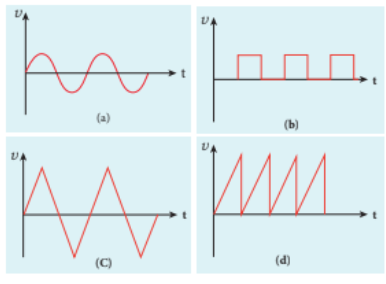
Basically, there are two types of oscillators: Sinusoidal and non- sinusoidal. Sinusoidal oscillators generate oscillations in the form of sine waves at constant amplitude and
frequency as shown in Figure 10.37(a). Nonsinusoidal oscillators generate complex, non- sinusoidal waveforms like squarewave, triangular- wave and sawtooth- wave as shown in Figure 10.36 (b), (c), (d).
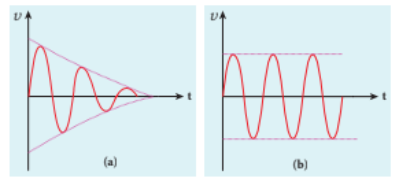
Sinusoidal oscillations are of two types: Damped and undamped. If the amplitude of the electrical oscillations decreases with time due to energy loss, it is called damped oscillations as shown in Figure 10.38(a). On the other hand, the amplitude of the electrical oscillations remains constant with time in undamped oscillations as shown in Figure 10.38(b).
Transistor oscillator
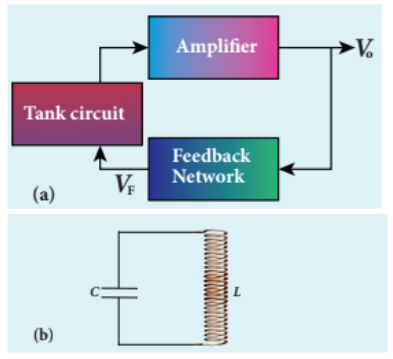
An oscillator circuit consists of three components. They are i) tank circuit ii) amplifier and iii) feedback network. The block diagram is shown in Figure 10.39(a).
i) Tank circuit
The \(LC\) tank circuit consists of an inductance \(L\) and a capacitor \(C\) connected in parallel as shown in Figure 10.39(b). Whenever energy is supplied to the tank circuit from a DC source, the energy is stored in inductor and capacitor alternatively. This produces electrical oscillations of definite frequency.
ii) Amplifier
This is a single stage amplifier which amplifies the weak signal produced by the tank circuit. The required output is supplied by this amplifier.
Figure 10.39 (a) Block diagram of an oscillator (b) Tank circuit
iii) Feedback network
The circuit used to feed a portion of the output back to the input is called the feedback network. If the portion of the output fed to the input is in phase with the input, then the magnitude of the input signal increases. This process is called positive feedback which is necessary for sustained oscillations.
Working
The tank circuit generates electrical oscillations and acts as the AC input source to the transistor amplifier. Amplifier amplifies
the input AC signal. In practical oscillator circuits, there is loss of some energy in inductor coils and capacitors due to electrical resistance. A small amount of energy is used up in overcoming these losses during every cycle of charging and discharging of the capacitor. Due to this, the amplitude of the oscillations decreases gradually. Hence, the tank circuit produces damped electrical oscillations.
In order to produce undamped oscillations, a positive feedback is provided from output to input by feedback network. This compensates energy loss in tank circuit. The frequency of oscillations is determined by the values of L and C and is given by
\[f = \frac{1}{2\pi\sqrt{LC}} \quad (10.8)\]
Barkhausen conditions for sustained oscillations
The following conditions called Barkhausen conditions should be satisfied for sustained oscillations in the oscillator.
There should be positive feedback.
The loop phase shift must be \(0^{\circ}\) or integral multiples of \(2\pi\)
The loop gain must be unity. That is, \(\left|AB\right| = 1\)
Here, \(A\) is the voltage gain of the amplifier, \(\beta\) is the feedback ratio (the fraction of the output that is fed back to the input).
There are different types of oscillator circuits based on the different types of tank circuits. Examples: Hartley oscillator, Colpitts oscillator, Phase shift oscillator and Crystal oscillator.
Applications of oscillators
Transistor oscillators are used
to generate periodic sinusoidal or non
sinusoidal wave forms
to generate RF carriers
to generate clock signal in digital circuits as sweep circuits in TV sets and CRO
EXAMPLE 10.8
Calculate the range of the variable capacitor that is to be used in a tuned- collector oscillator which has a fixed inductance of \(150~\mu \mathrm{H}\) . The frequency band is from \(500~\mathrm{kHz}\) to \(1500~\mathrm{kHz}\) .
Digital Electronics is the branch of electronics which deals with digital signals. It is increasingly used in numerous applications ranging from high end processor circuits to miniature circuits for signal processing, communication etc. Digital signals are preferred over analog signals due to their better performance, accuracy, speed, flexibility and immunity to noise.
There are 2 different types of signals used in Electronics. They are (i) Analog signals and (ii) Digital signals. An analog signal is a continuously varying voltage or current with respect to time. Such signals are employed in rectifying circuits and transistor amplifier circuits.
Digital signals are signals which contain only discrete values of voltages. Digital signals need two states: switch ON and OFF. ON is considered as one state and OFF is considered as the other state. It can also be defined as high ON or low OFF) state, closed ON) or open OFF).These high and low states are defined using binary numbers 1 or 0 in Boolean Algebra. The state 1 represents the terms: circuit on, high voltage, a closed switch. Similarly a 0 state represents circuit off, low voltage or an open switch.
Positive and Negative Logic
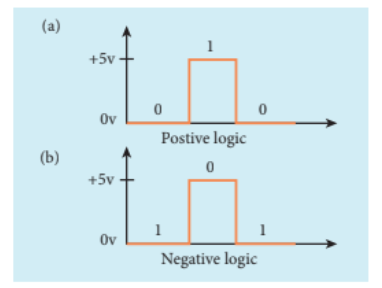
In digital systems, there exists two voltage levels: 5V (high) and 0V (low). In a positive logic system; a binary 1 stands for 5V and 0 stands for 0V while in negative logic system, 1 stands for 0V and 0 stands for 5V as shown in Figure 10.40.
A logic gate is an electronic circuit whose function is based on digital signals. They are binary in nature. The logic gates are considered as the basic building blocks of most of the digital systems. They have one output with one or more inputs. There are three types of basic logic gates: AND, OR, and NOT. The other logic gates are Ex- OR, NAND, and NOR. They can be constructed from the basic logic gates.
Digital electronics deals with logical operations. The variables are called logical variables. The operators like logical addition \((+)\) and logical multiplication \((\cdot)\) are called logical operators. When the logical operators \((+,\ldots)\) operate on logical variables (A,B), they give logical constant (Y). The equation that represents this operation is called logical statement.
For example,
Logical operator: \(^+\) Logical variable: \(A,B\) Logical constant: Y Logical statement: \(Y = A + B\)
The possible combinations of inputs and the corresponding output are given in the form of a table called truth table. The circuits which perform the basic logical operations such as logical addition, multiplication and inversion are discussed below.
AND gate
Circuit symbol
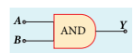
The circuit symbol of a two input AND gate is shown in Figure 10.41(a). \(A\) and \(B\) are inputs and \(Y\) is the output. It is a logic gate and hence \(A,B\) and \(Y\) can have the value of either 1 or 0.
Figure 10.41 (a) Two input AND gate
Inputs
Output
A
B
Y = A . B
0
0
0
0
1
0
1
0
0
1
1
1
(b) Truth table
Boolean Equation*
\[ Y = A.B \]
This performs logical multiplication and is different from arithmetic multiplication.
Logic Operation
The output of AND gate is high (1) only when all inputs are high (1). In other cases, the output is low (0). This is shown in the truth table (Figure 10.41 (b)).
OR Gate
Circuit Symbol
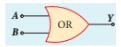
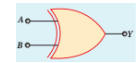
The circuit symbol of a two-input OR gate is shown in Figure 10.42 (a). A and B are inputs and Y is the output.Figure 10.42 (a) Two-input OR Gate
Inputs
Output
A
B
Y = A + B
0
0
0
0
1
1
1
0
1
1
1
1
(b) Truth Table
Boolean Equation
\[ Y = A + B \]
This performs logical addition and is different from arithmetic addition.
Logic Operation
The output of OR gate is high (logic level 1) when any one or both of the inputs are high. The truth table of OR gate is shown in Figure 10.42 (b).
NOT Gate
Circuit Symbol
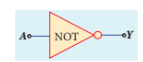
The circuit symbol of NOT gate is shown in Figure 10.43 (a). A is the input and Y is the output.
Figure 10.43 (a) NOT Gate
Input
Output
A
Y = \(\overline{A}\)
0
1
1
0
(b) Truth Table
Boolean Equation
\[ Y = \overline{A} \]
Logic Operation
The output is the complement of the input. This is denoted by an overline. It is also called an inverter. When input A is 0, output Y is 1, i.e., it is inverted. This is shown in the truth table of NOT gate in Figure 10.43 (b).
NAND Gate
Circuit Symbol
The circuit symbol of NAND gate is shown in Figure 10.44 (a). A and B are inputs and Y is the output.
Figure 10.44 (a) Two-input NAND Gate
Inputs
Output (AND)
Output (NAND)
A
B
Z = A.B
Y =\( \overline{A.B}\)
0
0
0
1
0
1
0
1
1
0
0
1
1
1
1
0
(b) Truth Table
Boolean Equation
\[ Y = \overline{A.B} \]
Logic Operation
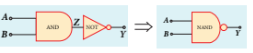
Output Y is the complement of AND operation. The circuit consists of an AND gate followed by a NOT gate. Hence it is referred to as NAND. Only when all inputs are high, the output is at logic level 0. For other cases, the output is high (logic level 1). The truth table of NAND gate is shown in Figure 10.44 (b).
NOR Gate
Circuit Symbol
Figure 10.45 (a) NOR Gate
Inputs
Output (OR)
Output (NOR)
A
B
Z = A+B
Y = \(\overline{A+B}\)
0
0
0
1
0
1
1
0
1
0
1
0
1
1
1
0
(b) Truth Table
Boolean Equation
\[ Y = \overline{A+B} \]
Logic Operation
Output Y is the complement of OR operation (A OR B). The circuit consists of an OR gate followed by a NOT gate. This is referred to as NOR. When all inputs are low, the output is high. For other combinations of inputs, the output is low. The truth table of NOR gate is shown in Figure 10.45 (b).
EX-OR Gate
Circuit Symbol
The circuit symbol of EX-OR gate is shown in Figure 10.46 (a). A and B are inputs and Y is the output. EX-OR operation is denoted by \( \oplus \).
Figure 10.46 (a) EX-OR Gate
(a)
Inputs
Output (EX-OR)
A
B
Y = A \(\oplus B\)
0
0
0
0
1
1
1
0
1
1
1
0
(b) Truth Table
Boolean Equation
\[ Y = A \oplus B = A.\overline{B} + \overline{A}.B \]
Logic Operation
If any one of the two inputs is high, the output is high. For more than two inputs in an EX-OR gate, the output is high when an odd number of inputs are high. The truth table of EX-OR gate is shown in Figure 10.46 (b).
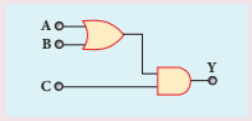
Example 10.9
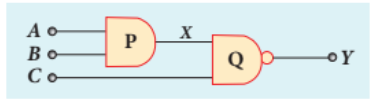
In the following circuit, if all three inputs A, B and C are initially 0 and then 1, what is the output Y?
Solution
A
B
C
X = A.B
Y = X.C
0
0
0
0
0
1
1
1
1
1
Example 10.10
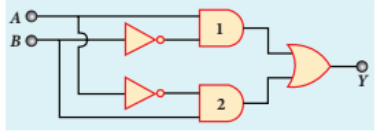
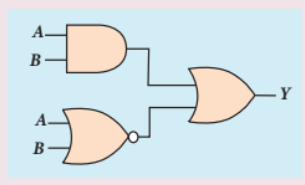
Write the Boolean equation for output Y for the combination of logic gates given below with inputs A and B.
Solution
1st AND gate output: \( A.B \)
2nd AND gate output: \( \overline{A}.\overline{B} \)
OR gate output: \( Y = A.B + \overline{A}.\overline{B} \)
Boolean algebra is basically a choice between two states: (i) true or false (ii) high or low. In Boolean algebra, these two states are represented by binary numbers 0 or 1. This is an ancient concept developed by George Bool in 1854 that connects logic and mathematics. Later, the importance of Boolean algebra was realized in designing computer circuits. Today we are in a digital world and most of the facilities we enjoy are based on Boolean algebra.
Laws of Boolean Algebra
The NOT, OR and AND operations discussed in section 10.5.2 are Boolean operations. The results of these operations can be summarized as follows.
Complement Law
A
Y = \(\overline{A} \)
0
Y = \(\overline{0}\) = 1
1
Y = \(\overline{1} \)= 0
The complement law can also be stated as: \( \overline{\overline{A}} = A \).
OR Laws
A
B
Y = A+B
0
0
Y = 0+0 = 0
0
1
Y = 0+1 = 1
1
0
Y = 1+0 = 1
1
1
Y = 1+1 = 1
The OR laws can be stated as:
First law
\( A + 0 = A \)
Second law
\( A + 1 = 1 \)
Third law
\( A + A = A \)
Fourth law
\( A + \overline{A} = 1 \)
AND Laws
A
B
Y = A.B
0
0
Y = 0.0 = 0
0
1
Y = 0.1 = 0
1
0
Y = 1.0 = 0
1
1
Y = 1.1 = 1
The AND laws can be stated as:
First law
\( A.0 = 0 \)
Second law
\( A.1 = A \)
Third law
\( A.A = A \)
Fourth law
\( A.\overline{A} = 0 \)
Boolean operations follow the following laws.
Commutative Laws
\[ A + B = B + A \]\[ A.B = B.A \]
Associative Laws
\[ A + (B + C) = (A + B) + C \]\[ A.(B.C) = (A.B).C \]
Distributive Laws
\[ A(B + C) = AB + AC \]\[ A + BC = (A + B)(A + C) \]
The above laws are used to simplify complex equations and simplify logic circuits.
The statement of the second theorem is: The complement of the product of two inputs is equal to the sum of their complements.
Proof
The Boolean equation for NAND gate is:
\[ Y = \overline{A.B} \]
The Boolean equation for bubbled OR gate is:
\[ Y = \overline{A} + \overline{B} \]
A and B are inputs and Y is the output. For equivalent inputs, both equations produce the same output. This can be verified using the following truth table.
An integrated circuit is also referred to as IC or chip or microchip (Figure 10.49). It consists of several thousand to millions of transistors, resistors, capacitors integrated on a small piece of semiconductor like silicon.
Integrated circuits (ICs) are a milestone in modern electronics. Due to technological advancement and the advent of VLSI (Very Large Scale Integration) era, it is possible to create a very large number of transistors on a single integrated chip.
Compared to ordinary circuits, integrated circuits have two main advantages: cost and performance. Due to technological advancement, the size, speed and capacity of chips have been greatly improved. Nowadays, computers, mobile phones and other household digital devices have become smaller and cheaper due to integrated circuits. Integrated circuits can function as amplifiers, oscillators, timing circuits, microprocessors and computer memory.Figure 10.49 Circuits with integratedchips
These tiny integrated circuits perform calculations and store data using digital or analog technology. Digital ICs use logic gates that operate with values of one and zero. A low signal to a digital IC produces value 0, and a high signal produces value 1.
Digital ICs are used in computers, networking equipment and most consumer electronic devices.
Analog ICs or linear ICs operate with continuous values. This means that a component of an analog IC can take any value and produce an output of another value. Linear ICs are used especially in audio and radio frequency amplification.
Communication is a process of exchanging information by speaking, writing or through any other medium.
Communication has existed since the beginning of life on this world. Scientific and technological development has effectively eliminated geographical limitations. Information can be exchanged from anyone anywhere on this planet to another. Due to research conducted in communication by eminent scientists like J.C. Bose, G. Marconi and Alexander Graham Bell, communication has seen unprecedented growth. The communication industry is vast and also very old as communication started centuries ago through telegram (1844), telephone (1876), and radio (1887).
Intensive research conducted in the mid and late nineteenth century led to the development of short-distance transmission in a short period. However, the twentieth century saw rapid growth in communication to meet the need for speed and secure data transfer. In this section, we will learn the basic concepts of electronic communication, some important communication systems and their applications.
For short distances, no complex techniques are required to transmit information. The energy of the information signal is sufficient to transmit directly. However, if information in the audio frequency range (20 to 20,000 Hz) is to be transmitted over long distances around the world, some techniques are required to transmit the information without any loss. For long-distance transmission, the low-frequency baseband signal (input signal) is superimposed on a high-frequency radio signal through a process called modulation.
Therefore, in the modulation process, a high-frequency carrier signal (radio signal) is used to carry the baseband signal. Since the frequency of the carrier signal is very high, it can be transmitted over long distances with less attenuation. Typically, the carrier signal is a sine wave signal.
A sinusoidal carrier wave can be represented as \( e_c = E_c \sin (2\pi \nu_c t + \phi) \), where \( E_c \) is the amplitude, \( \nu_c \) is the frequency, and \( \phi \) is the initial phase of the carrier wave at time t.
The three characteristics of the carrier signal can be modified by the baseband signal during the modulation process: amplitude, frequency, and phase of the carrier signal. Accordingly, we get:
If the amplitude of the carrier signal is varied according to the instantaneous amplitude of the baseband signal, it is called amplitude modulation. Here, the frequency and phase of the carrier signal remain unchanged. Amplitude modulation is used in radio and television broadcasting.
Figure 10.50(a) shows the baseband signal carrying information. Figure 10.50(b) shows the high-frequency carrier signal, and Figure 10.50(c) shows the amplitude modulated signal.
We can see that the amplitude of the carrier wave changes according to the voltage of the baseband signal.
Figure 10.50 Amplitude Modulation (a) Baseband signal (b) Carrier signal (c) Modulated signal
In frequency modulation, the frequency of the carrier signal changes according to the instantaneous amplitude of the baseband signal. Here, the amplitude and phase of the carrier signal remain unchanged.
The increase in voltage of the baseband signal increases the frequency of the carrier signal and vice versa. As shown in Figure 10.51, this causes compressions and rarefactions in the frequency spectrum of the modulated wave. Loud signals create compressions and weak signals create rarefactions.
When the voltage of the baseband signal is zero (when there is no input signal), there is no change in the frequency of the carrier wave. It is at its normal frequency. This is called the centre or resting frequency. In practice, this is the frequency allocated for FM broadcasting.
Figure 10.51 Frequency Modulation (a) Baseband signal (b) Carrier signal (c) Frequency modulated signal
Advantages of Frequency Modulation
i) In FM, noise is very low, which increases the signal-to-noise ratio.
ii) Efficiency and range are very high.
iii) Since the entire transmitted power is useful, the transmission efficiency is very high.
iv) FM bandwidth covers the entire audible frequency range. Therefore, FM radio has better quality compared to AM radio.
Limitations of Frequency Modulation
i) Frequency modulation requires very wide bandwidth.
ii) FM transmitters and receivers are very complex and expensive.
iii) Compared to AM, the reception range is less in FM.
In phase modulation, the instantaneous amplitude of the baseband signal changes the phase of the carrier signal, while the amplitude and frequency of the carrier wave do not change. This modulation is used to generate frequency modulated signals. It is similar to frequency modulation, but instead of changing the frequency of the carrier wave, the phase of the carrier wave is changed.
10.10 Elements of Electronic Communication System#
Electronics plays a major role in communication. Electronic communication is the transmission of audio, text, images or data through a medium. Long-distance transmission uses space as the medium.
The elements of a basic communication system are explained through the block diagram shown in Figure 10.52.
i) Information (Baseband or Input Signal)
Information can be in the form of speech, music, images or computer data. This information is given as input to the input transducer.
ii) Input Transducer
In a communication system, the transducer converts information in the form of sound, music, images or computer data into corresponding electrical signals. The electrical equivalent of the original information is called the baseband signal. A microphone that converts sound energy into electrical energy is a good example of a transducer.
iii) Transmitter
The transmitter delivers the electrical signal from the transducer to the communication channel. It consists of circuits such as amplifiers, oscillators, modulators and power amplifiers. The transmitter is located at the broadcasting station.
Amplifier: Since the output of the transducer is very weak, it is amplified by an amplifier.
Figure 10.52 Block diagram of transmission and reception of voice signals
Oscillator: For long-distance transmission in space, it generates high-frequency carrier waves (sine waves). Since the energy of a wave is directly proportional to its frequency, the carrier wave has very high energy.
Modulator: It superimposes the baseband signal on the carrier signal to create the modulated signal.
Power Amplifier: It increases the power level of the electrical signal to travel over long distances.
iv) Transmitting Antenna
It transmits radio signals in all directions in space. It travels at the speed of light in the form of electromagnetic waves.
v) Communication Channel
The communication channel helps to transmit electrical signals from the transmitter to the receiver with less noise or loss. Wired communication uses media such as wires, cables and optical fibres. Wireless communication uses space as the communication medium.
vi) Receiver
The signals transmitted through the communication channel are received by a receiving antenna, which converts the electromagnetic waves into radio frequency signals and delivers them to the receiver.
The receiver consists of electronic circuits such as demodulator and amplifier. The demodulator extracts the baseband signal from the modulated wave. The baseband signal is separated and amplified using amplifiers. Finally, it is delivered to the output transducer.
vii) Repeaters
Repeaters are used to increase the range or distance over which signals are transmitted. This is a combination of transmitter and receiver. Signals are received, amplified and retransmitted to the destination using a carrier signal of a different frequency. A communication satellite in space is a good example.
viii) Output Transducer
It converts the electrical signal back into its original form: sound, music, images or data. Speakers, picture tubes, and computer monitors are examples of output transducers.
10.10.1 Basic Definitions in Electronic Communication System#
To understand electronic communication systems well, it is necessary to understand the following basic definitions.
i) Range
This is the maximum distance between the transmitting end and the place where the signal arrives with sufficient strength.
ii) Noise
This is an unwanted electrical signal that interferes with the transmitted signal. Noise reduces the quality of the transmitted signal. It can be man-made (automobiles, combustion engines, electric motors) or natural phenomena (lightning, radiation from the sun and stars, and environmental effects). Noise cannot be completely eliminated. However, it can be reduced using various techniques.
iii) Attenuation
Attenuation is the loss of signal strength when it is transmitted through a medium.
iv) Bandwidth
The frequency range of baseband signals or information signals such as voice, music, image is called bandwidth. If \( \nu_1 \) and \( \nu_2 \) are the lower and upper frequency limits of a signal, then bandwidth = \( \nu_2 - \nu_1 \).
v) Bandwidth of transmission system
The range of frequencies required to transmit a specific information portion in a given circuit is called the channel bandwidth or the bandwidth of the transmission system.
When electromagnetic waves transmitted by the transmitter travel along the earth’s surface to reach the receiver, this propagation is called ground wave propagation. The corresponding waves are called ground waves or surface waves. Its illustration is shown in Figure 10.53 (a). Here, both the transmitting and receiving antennas must be close to the earth.
This is mainly used in local broadcasting, radio-assisted maritime navigation, ship-to-ship and ship-to-shore communication, and mobile phone communication.
Electromagnetic waves transmitted from an antenna at a high angle upwards are reflected back to the earth by the ionosphere. This type of propagation is called sky wave propagation or ionospheric propagation. The corresponding waves are called sky waves (Figure 10.53 (b)).
The ionosphere acts as a reflecting surface. It starts approximately at 50 km and extends up to 400 km above the earth’s surface. Due to the absorption of high-energy radiation such as ultraviolet rays from the sun, cosmic rays and \( \alpha, \beta \) rays, the air molecules in the ionosphere are ionized. This creates charged ions, and those ions create a medium that reflects radio waves or communication waves (in the permitted frequency range) back to the earth. The phenomenon of radio waves returning to the earth is total internal reflection.
Figure 10.53 Propagation of EM waves (a) Ground wave (b) Sky wave (c) Space wave
As the angle of incidence in the ionosphere increases, the sky wave reaches the ground area far from the transmitter. As this angle of incidence decreases, the sky wave begins to approach the ground area near the transmitter. As the angle of incidence decreases further, the radio waves penetrate the ionosphere and escape. For a specific angle of incidence, the receiving point (B) is found at a minimum distance from the transmitter. The minimum distance between the transmitter and the point where the sky wave reaches the ground is called the skip distance.
As we move away from the transmitter, the reception of the ground wave begins to decrease. At a certain point (A), there is no reception of the ground wave. A specific zone (between points A and B) where neither ground wave nor sky wave electromagnetic waves are received is called the skip zone or skip region. This is shown in Figure 10.53 (b).
iii) Space wave propagation
The process of transmitting and receiving information signals through space is called space wave propagation (Figure 10.53 (c)). Electromagnetic waves with very high frequencies above 30 MHz are called space waves. These waves travel in a straight line from the transmitter to the receiver. Hence, this is used for line-of-sight (LOS) communication.
Television broadcasting, satellite communication and radar communication systems are based on space wave propagation.
The range or distance of propagation (d) depends on the height of the antenna (h). The equation is:
\[ d = \sqrt{2Rh} \qquad (10.9) \]
where R is the radius of the earth. The propagation distance is illustrated in Figure 10.54.Figure 10.54 Distance of coverage
Example 10.12
The height of a transmitting antenna is 40 m and the height of a receiving antenna is 30 m. What is the maximum line-of-sight communication distance between them? The radius of the earth is \( 6.4 \times 10^6 \ \mathrm{m} \).
Solution:
The total distance d between the transmitting and receiving antennas is equal to the sum of the individual propagation distances.
Various types of communication systems exist in practice according to requirements. Here, some important communication systems are introduced and their applications are briefly discussed.
The satellite communication is a mode
of transmission of the signal between
transmitter and receiver via satellite. The
message signal from the Earth station
is transmitted to the satellite on board
via an uplink (frequency band 6 GHz),
amplified by a transponder and then
retransmitted to another Earth station
via a downlink (frequency band 4 GHz)
(Figure 10.55).
Applications
Satellites are classified into different
types based on their applications.Figure 10.55 Satellite communication system
i) Weather satellite: These are used to monitor the earth’s weather and surface temperature. By measuring the mass of clouds, these satellites help us predict rain, dangerous cyclones and storms.
ii) Communication satellite: These are used to broadcast television, radio, and internet signals. Several satellites are used to broadcast worldwide television.
iii) Navigation satellite: These engage in locating the geographic position of ships, aircraft or any other object.
Fibre optic communication is the method of transmitting information through optical fibres from one place to another using light pulses. It operates on the principle of total internal reflection.
Figure 10.56 optical fibers
Applications
Optical fibre system has various applications: international communication, intercity communication, data links, factory and traffic control, and military applications.
Advantages
i) Optical fibres are very cheap. They are lighter than copper wires.
ii) This system has very high bandwidth, meaning it has high information-carrying capacity.
iii) Optical fibre system is not affected by electrical interference.
iv) Optical fibre is cheaper than copper wires.
Disadvantages
i) Optical fibre wires are more fragile compared to copper wires.
RADAR is an acronym for RAdio Detection And Ranging. It is one of the important applications of communication systems. It is used to detect distant objects such as vehicles, ships, spacecraft and to know their location. Radar helps us detect the angle, distance and direction of objects that are not visible to our eyes.
Radar uses electromagnetic waves for communication. First, the electromagnetic signal is transmitted in all directions in space through an antenna. The signal that hits a specific target is reflected and retransmitted in all directions. This reflected signal (echo) is received by the radar antenna and delivered to the receiver.
Then it is processed and amplified to determine the geographic statistics of the object. The distance of the targets is determined from the time taken for the signal to go from the radar to the target and return.
Applications
Radars are used in many fields:
i) In the military, they are used to locate and detect targets.
ii) They are used in navigation systems such as sea search, air search and missile guidance systems by ship.
iii) Radar is used in weather monitoring to measure rainfall rate and wind speed.
iv) In emergency situations, it helps locate and rescue people.
Mobile communication is used to communicate with others in different locations without the use of any physical connection like wires or cables. It allows the transmission over a wide range of area without the use of the physical link. It enables the people to communicate with each other regardless of a particular location like office, house etc. It also provides communication access to remote areas.
Figure 10.57 Mobile communication
It provides the facility of roaming – that is, the user may move from one place to another without the need of compromising on the communication. The maintenance and cost of installation of this communication network are also cheap.
Applications
i) It is used for personal communication and cellular phones offer voice and data connectivity with high speed.
ii) Transmission of news across the globe is done within a few seconds.
iii) Through the Internet of Things (IoT), it is possible to control various devices through one device. Example: Using a mobile phone, all household appliances can be operated.
iv) It enables smart classrooms, online availability of notes, monitoring student activities etc. in the field of education.
Internet is a fast growing technology in the field of communication system with multifaceted tools. It provides new ways and means to interact and connect with people. Internet is the largest computer network recognized globally that connects millions of people through computers. It finds extensive applications in all walks of life.
i) Search engine: The search engine
is basically a web-based service tool used
to search for information on World Wide
Web.
ii) Communication: It helps millions
of people to connect with the use of social
networking: emails, instant messaging
services and social networking tools.
iii) E-commerce: Buying and selling
of goods and services, transfer of funds
are done over an electronic network..
Based on energy bands in solids, they are classified as conductors, insulators and semiconductors.
In n-type semiconductor, electrons are majority carriers and holes are minority carriers.
In p-type semiconductor, holes are majority carriers and electrons are minority carriers.
The thin region near the junction devoid of charges (free electrons and holes) is called the depletion region.
When a PN junction diode is forward biased, the width of the depletion region decreases and it conducts current.
When a PN junction diode is reverse biased, it acts as an open switch and does not conduct current. The width of the depletion region increases.
A forward biased PN junction diode acts as a rectifier. The process of converting alternating voltage or alternating current into direct voltage or direct current is called rectification.
Half wave rectifier rectifies only the half cycle of the input signal and produces pulsating DC output.
Full wave rectifier rectifies both half cycles of the input.
When a very strong electric field is applied, Zener breakdown occurs in a highly doped PN junction diode.
Avalanche breakdown occurs in a lightly doped and very wide depletion region. This occurs when the covalent bond is broken by thermally generated minority carriers.
Zener diode is a highly doped pn junction diode that operates in reverse bias.
Light Emitting Diode is a forward biased semiconductor device that emits visible or invisible light. When majority carriers recombine with minority carriers entering their region, energy is emitted in the form of photons.
A PN junction diode that converts light signals into electrical signals is called a photodiode.
When a sufficiently energetic photon strikes the diode, it creates an electron-hole pair. Before these electrons and holes recombine, they are moved across the junction by the electric field created by the reverse bias, thereby producing photocurrent.
Solar cell is a device that directly converts light energy into electrical energy. It operates on the principle of photovoltaic effect.
Bipolar Junction Transistor (BJT) is a semiconductor device. There are two types: NPN and PNP.
A BJT has three configurations: common base, common emitter and common collector.
In common base configuration, current gain \( \alpha \) is the ratio of collector current to emitter current.
In common emitter configuration, current gain \( \beta \) is the ratio of collector current to base current.
A transistor in common emitter configuration acts as a switch.
A transistor in common emitter configuration acts as an amplifier. Moreover, there is a \( 180^\circ \) phase difference between the amplified output signal and the input signal.
A transistor amplifier with voltage divider and feedback network acts as an oscillator.
Logic gates are logic circuits that provide output according to combinations of inputs.
According to De Morgan’s first theorem, the complement of the sum of logic inputs is equal to the product of their complements.
According to De Morgan’s second theorem, the complement of the product of inputs is equal to the sum of their complements.
The basic elements required to transmit and receive a signal using electromagnetic waves over long distance are: transducer, amplifier, carrier signal, modulator, power amplifier, transmission medium, transmitting and receiving antenna, demodulator, separator.
For long distance transmission, the baseband signal is modulated with the carrier wave.
If the amplitude of the carrier signal is varied according to the instantaneous amplitude of the baseband signal, it is called amplitude modulation.
In frequency modulation, the frequency of the carrier signal changes according to the instantaneous amplitude of the baseband signal.
In phase modulation, the instantaneous amplitude of the baseband signal changes the phase of the carrier signal, while the amplitude and frequency of the carrier wave do not change.
When electromagnetic waves transmitted by the transmitter travel along the earth’s surface to reach the receiver, this propagation is called ground wave propagation.
Electromagnetic waves transmitted from an antenna at a high angle upwards are reflected back to the earth by the ionosphere. This type of propagation is called sky wave propagation.
The process of transmitting and receiving information signals through space is called space wave propagation.
Satellite communication is a type of communication that exchanges signals between transmitter and receiver via satellite.
Fibre optic communication is the method of transmitting information through optical fibres from one place to another using light pulses.
RADAR is an acronym for RAdio Detection And Ranging. It is one of the important applications of communication systems.
Mobile communication helps people in different places to communicate without any connections like wires or cables.
The voltage barrier of a silicon diode is (approximately)
a) 0.7 V
b) 0.3V
c) 2.0 V
d) 2.2V
When a small amount of antimony (Sb) is added to germanium crystal (AIPMT 2011)
a) it becomes p-type semiconductor
b) antimony becomes an acceptor atom
c) there will be more free electrons than holes in the semiconductor
d) its resistance increases
In an unbiased p-n junction, the majority charge carriers (i.e., holes) in the p-region diffuse to the n-region because
a) of the voltage difference across the p-n junction
b) of higher hole concentration in p-region than in n-region
c) of attraction of free electrons in n-region
d) all of the above
In a half wave rectifier, the rectified voltage is applied to a load resistor, during which part of the input signal variation does the load current flow?
a) \( 0^\circ-90^\circ \)
b) \( 90^\circ-180^\circ \)
c) \( 0^\circ-180^\circ \)
d) \( 0^\circ-360^\circ \)
What is the main application of Zener diode?
a) Rectifier
b) Amplifier
c) Oscillator
d) Voltage regulator
Solar cell operates on the principle of
a) diffusion
b) recombination
c) photovoltaic effect
d) carrier flow
Light is emitted in Light Emitting Diode due to
a) recombination of charge carriers
b) light reflection due to operation of lenses
c) amplification of light on the junction
d) very high current conductivity
The voltage barrier in a p-n junction depends on
i) type of semiconductor material
ii) amount of doping
iii) temperature
Which of the following is correct? (NEET)
a) (i) and (ii)
b) (ii) only
c) (ii) and (iii)
d) (i), (ii) and (iii)
For continuous oscillations in an oscillator
a) positive feedback must be present
b) feedback gain must be unity
c) phase shift must be zero or \( 2\pi \)
d) all of the above
If the input of a NOT gate is A = 1011, then its output is
a) 0100 b) 1000 c) 1100 d) 0011
Which of the following represents a forward biased diode? (NEET)
The given electrical network is
equivalent to
a) AND gate
b) OR gate
c) NOR gate
d) NOT gate
The output of the following circuit is 1
when the input ABC is
a) 101
b) 100
c) 110
d) 010
The variation of frequency of carrier
wave with respect to the amplitude of
the modulating signal is called
a) Amplitude modulation
b) Frequency modulation
c) Phase modulation
d) Pulse width modulation
The frequency range of 3 MHz to
30 MHz is used for
Elucidate the formation of n-type extrinsic semiconductors.
Explain the formation of depletion region and voltage barrier in a PN junction diode.
Draw the circuit diagram of a half wave rectifier and explain its operation.
Explain the construction and working of a full wave rectifier.
What is Light Emitting Diode? Explain its working principle with a diagram.
Write a note on photodiode.
Explain the working principle of a solar
cell. Mention its applications.
Sketch the static characteristics of a common emitter transistor and bring out the essential features of input and output characteristics.
Transistor functions as a switch. Explain.
Describe the function of a transistor as an amplifier with the neat circuit diagram. Sketch the input and output wave forms.
Give circuit symbol, logical operation, truth table, and Boolean expression of i) AND gate ii) OR gate iii) NOT gate iv) NAND gate v) NOR gate and vi) EX-OR gate.
State and prove De Morgan’s first and second theorem.
Explain the ampitude modulation with necessary diagrams.
Explain the basic elements of communication system with the necessary block diagram.
Explain the ground wave propagation and space wave propagation of electromagnetic waves through space.
List out the advantages and limitations of frequency modulation.
What is meant by satellite communi-
cation? Give its applications.
Calculate the current flowing through the resistor \( R_1 \) in the given circuit with two ideal diodes connected as shown in the figure. [Answer: 2.5 A]
In the following figure, four silicon diodes and a 10 \( \Omega \) resistor are connected. If each diode has a resistance of 1 \( \Omega \), calculate the current flowing through the 10 \( \Omega \) resistor. [Answer: 0.13 A]
If \( V_{CEsat} = 0.2 \ \mathrm{V} \) and \( \beta = 50 \), calculate the minimum base current (\( I_B \)) required to drive the transistor in the figure to saturation. [Answer: 56 \( \mu A \)]
For the BJT in the circuit shown in the figure, current gain \( \beta = 50 \). For an emitter-base voltage difference of \( V_{EB} = 600 \ \mathrm{mV} \), calculate the emitter-collector voltage difference \( V_{EC} \) in volts. [Answer: 2 V]
Find the currents flowing through the 3 \( \Omega \) and 4 \( \Omega \) resistors in the following circuit. Assume \( D_1 \) and \( D_2 \) are ideal diodes. [Answer: 0 and 2A]
Prove the following Boolean equations using laws and theorems of Boolean algebra.
i) \( (A+B)(A+B) = A \)
ii) \( A(A+B) = AB \)
iii) \( (A+B)(A+C) = A+BC \)
Verify the given Boolean equation using truth table: \( A + AB = A + B \).
In the following voltage regulator circuit, a Zener diode with breakdown voltage 15 V is used. Find the current through the load resistor, total current, and current through the diode. Assume ideal diode. [Answer: 5mA; 20 mA; 15 mA]
9. For the given circuit, give the Boolean equation for output Y and its truth table. [Answer: \( Y = (AB)+(A+B) \)]
Objective: Through this activity, students will (i) create logic gates (ii) verify the truth tables of AND, OR, NOT, EX-OR, NAND and NOR gates.
Title: Logic Gates
Procedure:
Open the browser and type “circuitverse.org/simulator” in the address bar.
From circuit elements, click the ‘Gates’ tab. Select the gate you want to verify and drag it to the workspace using the mouse.
Create the necessary connecting wires for the circuit by dragging the nodes of the logic gate using the mouse.
Click the ‘input’ tab and drag the ‘input tool’ from there and place it on the two inputs.
Click the ‘output’ tab and drag the ‘output tool’ or ‘digital LED’ from there and place it on the output terminal.
Change the inputs by clicking the ‘input tool’. Verify the truth tables of AND, OR, NOT, EX-OR, NAND and NOR gates. You can also verify De Morgan’s two laws if you wish.
Note:
If you wish to save the circuits you create online, login using your email address.