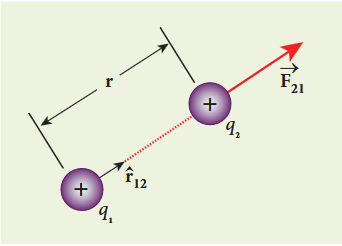
In the year 1786, Coulomb deduced the expression for the force between two stationary point charges in vacuum or free space. Consider two point charges \(q_{1}\) and \(q_{2}\) at rest in vacuum, and separated by a distance of \(r\) as shown in Figure 1.2. According to Coulomb, the force on the point charge \(q_{2}\) exerted by another point charge \(q_{1}\) is
$$ \bar{F}_{21} = k\frac{q_1q_2}{r^2}\hat{r}_{12} \quad (1.2) $$where \(\hat{r}_{12}\) is the unit vector directed from charge \(q_{1}\) to charge \(q_{2}\) and \(k\) is the proportionality constant.
Important aspects of Coulomb’s law#
(i) Coulomb’s law states that the electrostatic force is directly proportional to the product of the magnitude of the two point charges and is inversely proportional to the square of the distance between the two point charges.
(ii) The force on the charge \(q_{2}\) exerted by the charge \(q_{1}\) always lies along the line joining the two charges. \(\hat{r}_{12}\) is the unit vector pointing from charge \(q_{1}\) to \(q_{2}\). Likewise, the force on the charge \(q_{1}\) exerted by \(q_{2}\) is along \(-\hat{r}_{12}\) (i.e., in the direction opposite to \(\hat{r}_{12}\)).
(iii) In SI units, \(k = \frac{1}{4\pi\epsilon_{0}}\) and its value is \(9\times 10^{9}\mathrm{Nm}^{2}\mathrm{C}^{-2}\). Here \(\epsilon_{0}\) is the permittivity of free space or vacuum and its value is
$$ \epsilon_{o} = \frac{1}{4\pi k} = 8.85\times 10^{-12}\mathrm{C}^{2}\mathrm{N}^{-1}\mathrm{m}^{-2}. $$(iv) The magnitude of the electrostatic force between two charges each of one coulomb and separated by a distance of \(1\mathrm{m}\) is calculated as follows:
$$ \left|F\right| = \frac{9\times 10^{9}\times 1\times 1}{1^{2}} = 9\times 10^{9}\mathrm{N}. $$This is a huge quantity, almost equivalent to the weight of one million ton. We never come across 1 coulomb of charge in practice. Most of the electrical phenomena in day-to-day life involve electrical charges of the order of \(\mu \mathrm{C}\) (micro coulomb) or nC (nano coulomb).
(v) In SI units, Coulomb’s law in vacuum takes the form \(\bar{F}_{21} = \frac{1}{4\pi\epsilon_{0}}\frac{q_{1}q_{2}}{r^{2}}\hat{r}_{12}\). In a medium of permittivity \(\epsilon\), the force between two point charges is given by \(\bar{F}_{21} = \frac{1}{4\pi\epsilon}\frac{q_{1}q_{2}}{r^{2}}\hat{r}_{12}\). Since \(\epsilon \gg \epsilon_{0}\), the force between two point charges in a medium other than vacuum is always less than that in vacuum. We define the relative permittivity for a given medium as \(\epsilon_{r} = \frac{\epsilon}{\epsilon_{0}}\). For vacuum or air, \(\epsilon_{r} = 1\) and for all other media \(\epsilon_{r} > 1\).
(vi) Coulomb’s law has same structure as Newton’s law of gravitation. Both are inversely proportional to the square of the distance between the particles. The electrostatic force is directly proportional to the product of the magnitude of two point charges and gravitational force is directly proportional to the product of two masses. But there are some important differences between these two laws.
The gravitational force between two masses is always attractive but Coulomb force between two charges can be attractive or repulsive, depending on the nature of charges.
The value of the gravitational constant \(G = 6.67\times 10^{-11}\mathrm{Nm}^2\mathrm{kg}^{-2}\). The value of the constant \(k\) in Coulomb law is \(k = 9\times 10^{9}\mathrm{Nm}^{2}\mathrm{C}^{-2}\). Since \(k\) is much more greater than \(G\), the electrostatic force is always greater in magnitude than gravitational force for smaller size objects.
The gravitational force between two masses is independent of the medium. For example, if \(1\mathrm{kg}\) of two masses are kept in air or inside water, the gravitational force between two masses remains the same. But the electrostatic force between the two charges depends on nature of the medium in which the two charges are kept at rest.
(vii) The force on a charge \(q_{1}\) exerted by a point charge \(q_{2}\) is given by
$$ \bar{F}_{12} = \frac{1}{4\pi\epsilon_{0}}\frac{q_{1}q_{2}}{r^{2}}\hat{r}_{21} $$Here \(\hat{r}_{21}\) is the unit vector from charge \(q_{2}\) to \(q_{1}\).
But \(\hat{r}_{21} = -\hat{r}_{12}\)
(viii) The expression for Coulomb force is true only for point charges. But the point charge is an ideal concept. However we can apply Coulomb’s law for two charged objects whose sizes are very much smaller than the distance between them. In fact, Coulomb discovered his law by considering the charged spheres in the torsion balance as point charges. The distance between the two charged spheres is much greater than the radii of the spheres.
EXAMPLE 1.2
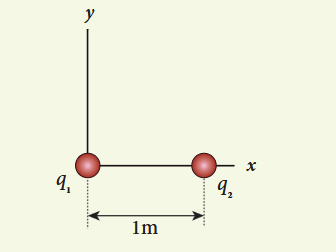
Consider two point charges \(q_{1} = +2\mu \mathrm{C}\) and \(q_{2} = +3\mu \mathrm{C}\) placed at a distance of \(1\mathrm{m}\) from each other in vacuum. (a) Calculate the force experienced by the charge \(q_{2}\) due to the charge \(q_{1}\). (b) What is the force experienced by \(q_{1}\) due to \(q_{2}\)? (c) If these two charges are placed inside the water, how does the force change? (Take \(\epsilon_{r} = 80\) for water)
Solution
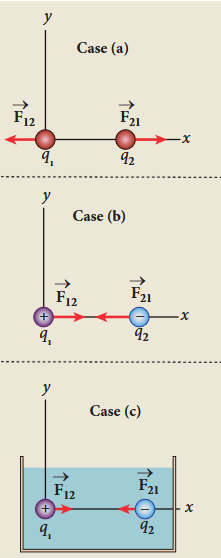
(a) Both the charges are like charges. So the force will be repulsive. The force experienced by the charge \(q_{2}\) due to \(q_{1}\) is given by
$$ \bar{F}_{21} = \frac{1}{4\pi\epsilon_{0}}\frac{q_1q_2}{r^2}\hat{r}_{12} $$Since \(\hat{r}_{12} = \hat{i}\) (unit vector along \(x\) axis)
$$ \bar{F}_{21} = \frac{9\times 10^{9}\times (2\times 10^{-6})\times (3\times 10^{-6})}{1^{2}}\hat{i} $$$$ = 54\times 10^{-3}\hat{i} \mathrm{~N} $$The charge \(q_{2}\) will experience a repulsive force away from \(q_{1}\) along the positive \(x\) direction.
According to Newton’s third law, the force experienced by the charge \(q_{1}\) due to \(q_{2}\) is \(\bar{F}_{12} = -\bar{F}_{21}\). Therefore,
$$ \bar{F}_{12} = -54\times 10^{-3}\hat{i} \mathrm{~N}. $$(b) \(q_{1} = +2\mu \mathrm{C}\), \(q_{2} = -3\mu \mathrm{C}\), and \(r = 1\mathrm{m}\). They are unlike charges. So the force will be attractive.
Force experienced by the charge \(q_{2}\) due to \(q_{1}\) is given by
$$ \bar{F}_{21} = \frac{9\times 10^{9}\times\left(2\times 10^{-6}\right)\times\left(-3\times 10^{-6}\right)}{1^{2}}\hat{r}_{12} $$$$ = -54\times 10^{-3}\mathrm{N}\hat{i} \quad (\text{Using }\hat{r}_{12} = \hat{i}) $$The charge \(q_{2}\) will experience an attractive force towards \(q_{1}\) which is in the negative \(x\) direction.
According to Newton’s third law, the force experienced by the charge \(q_{1}\) due to \(q_{2}\) is \(\bar{F}_{12} = -\bar{F}_{21}\). Therefore,
$$ \bar{F}_{12} = 54\times 10^{-3}\hat{i} \mathrm{~N} $$(c) If these two charges are kept inside the water, then the force experienced by \(q_{2}\) due to \(q_{1}\)
$$ \bar{F}_{21}^{\mathrm{W}} = \frac{1}{4\pi\epsilon}\frac{q_1q_2}{r^2}\hat{r}_{12} $$since \(\epsilon = \epsilon_{\mathrm{r}}\epsilon_{\mathrm{o}}\)
we have \(\bar{F}_{21}^{\mathrm{W}} = \frac{1}{4\pi\epsilon_{\mathrm{r}}\epsilon_{\mathrm{o}}}\frac{q_{1}q_{2}}{r^{2}}\hat{r}_{12} = \frac{\bar{F}_{21}}{\epsilon_{\mathrm{r}}}\)
Therefore,
$$ \bar{F}_{21}^{\mathrm{W}} = -\frac{54\times 10^{-3}\mathrm{N}}{80}\hat{i} = -0.675\times 10^{-3}\mathrm{N}\hat{i} $$Note that the strength of the force between the two charges in water is reduced by 80 times compared to the force between the same two charges in vacuum.
When common salt (NaCl) is taken in water, the electrostatic force between Na and Cl ions is reduced due to the high relative permittivity of water \((\epsilon_{\mathrm{r}} = 80)\). This is the reason water acts as a good solvent.
EXAMPLE 1.3
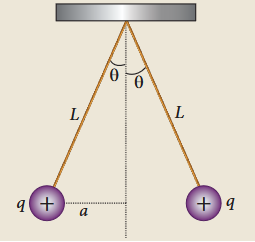
Two small-sized identical equally charged spheres, each having mass 1 g are hanging in equilibrium as shown in the figure. The length of each string is \(10\mathrm{cm}\) and the angle \(\theta\) is \(30^{\circ}\) with the vertical. Calculate the magnitude of the charge in each sphere. (Take \(g = 10\mathrm{ms}^{-2}\))
Solution
If the two spheres are neutral, the angle between them will be \(0^{\circ}\) when hanged vertically. Since they are positively charged spheres, there will be a repulsive force between them and they will be at equilibrium with each other at an angle of \(30^{\circ}\) with the vertical. At equilibrium, each charge experiences zero net force in each direction. We can draw a free body diagram for one of the charged spheres and apply Newton’s second law for both vertical and horizontal directions.
The free body diagram is shown below.
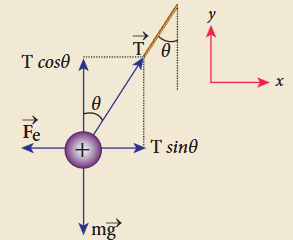
In the \(x\)-direction, the acceleration of the charged sphere is zero.
Using Newton’s second law \(\left(\bar{F}_{tot} = m\bar{a}\right)\) we have
$$ T\sin \theta \hat{i} - F_{e}\hat{i} = 0 $$$$ T\sin \theta = F_{e} $$Here \(T\) is the tension acting on the charge due to the string and \(F_{e}\) is the electrostatic force between the two charges.
In the \(y\)-direction also, the net acceleration experienced by the charge is zero.
$$ T\cos \theta \hat{j} - mg\hat{j} = 0 $$$$ T\cos \theta = mg. $$By dividing equation (1) by equation (2),
$$ \tan \theta = \frac{F_e}{mg} \quad (3) $$Since they are equally charged, the magnitude of the electrostatic force is
$$ F_{e} = k\frac{q^{2}}{r^{2}} \quad \text{where } k = \frac{1}{4\pi\epsilon_{0}} $$Here \(r = 2a = 2L\sin \theta\). By substituting these values in equation (3),
$$ \tan \theta = k\frac{q^{2}}{mg(2L\sin\theta)^{2}} \quad (4) $$Rearranging the equation (4) to get \(q\)
$$ q = 2L\sin \theta \sqrt{\frac{mg\tan\theta}{k}} $$$$ = 2\times 0.1\times \sin 30^{\circ}\times \sqrt{\frac{10^{-3}\times 10\times\tan 30^{\circ}}{9\times 10^{9}}} $$$$ q = 8.01\times 10^{-8}\mathrm{C} = 80.1\mathrm{nC} $$EXAMPLE 1.4
Calculate the electrostatic force and gravitational force between the proton and the electron in a hydrogen atom. They are separated by a distance of \(5.3\times 10^{-11}\mathrm{m}\). The magnitude of charges on the electron and proton are \(1.6\times 10^{-19}\mathrm{C}\). Mass of the electron is \(m_{e} = 9.1\times 10^{-31}\mathrm{kg}\) and mass of proton is \(m_{p} = 1.6\times 10^{-27}\mathrm{kg}\).
Solution
The proton and the electron attract each other. The magnitude of the electrostatic force between these two particles is given by
$$ F_{e} = \frac{ke^{2}}{r^{2}} = \frac{9\times 10^{9}\times\left(1.6\times 10^{-19}\right)^{2}}{\left(5.3\times 10^{-11}\right)^{2}} $$$$ = \frac{9\times 2.56}{28.09}\times 10^{-7} = 8.2\times 10^{-8}\mathrm{N} $$The gravitational force between the proton and the electron is attractive. The magnitude of the gravitational force between these particles is
$$ F_{G} = \frac{Gm_{e}m_{p}}{r^{2}} $$$$ = \frac{6.67\times 10^{-11}\times 9.1\times 10^{-31}\times 1.6\times 10^{-27}}{\left(5.3\times 10^{-11}\right)^{2}} $$$$ = \frac{97.11}{28.09}\times 10^{-47} = 3.4\times 10^{-47}\mathrm{N} $$The ratio of the two forces
$$ \frac{F_{e}}{F_{G}} = \frac{8.2\times 10^{-8}}{3.4\times 10^{-47}} = 2.41\times 10^{39} $$Note that \(F_{e}\approx 10^{39}F_{G}\)
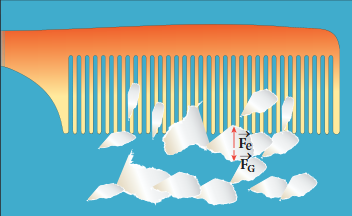
The electrostatic force between a proton and an electron is enormously greater than the gravitational force between them. Thus the gravitational force is negligible when compared with the electrostatic force in many situations such as for small size objects and in the atomic domain. This is the reason why a charged comb attracts an uncharged piece of paper with greater force even though the piece of paper is attracted downward by the Earth.
Superposition principle#
Coulomb’s law explains the interaction between two point charges. If there are more than two charges, the force on one charge due to all the other charges needs to be calculated. Coulomb’s law alone does not give the answer. The superposition principle explains the interaction between multiple charges.
According to this superposition principle, the total force acting on a given charge is equal to the vector sum of forces exerted on it by all the other charges.
Consider a system of \(n\) charges, namely \(q_{1},q_{2},q_{3}\ldots q_{n}\). The force on \(q_{1}\) exerted by the charge \(q_{2}\)
$$ \bar{F}_{12} = k\frac{q_{1}q_{2}}{r_{21}^{2}}\hat{r}_{21} $$where \(\hat{r}_{21}\) is the unit vector from \(q_{2}\) to \(q_{1}\) along the line joining the two charges and \(r_{21}\) is the distance between the charges \(q_{1}\) and \(q_{2}\). The electrostatic force between two charges is not affected by the presence of other charges in the neighbourhood.
The force on \(q_{1}\) exerted by the charge \(q_{3}\) is
$$ \bar{F}_{13} = k\frac{q_{1}q_{3}}{r_{31}^{2}}\hat{r}_{31} $$By continuing this, the total force acting on the charge \(q_{1}\) due to all other charges is given by
$$ \bar{F}_{1}^{tot} = \bar{F}_{12} + \bar{F}_{13} + \bar{F}_{14} + \dots + \bar{F}_{1n} $$$$ \bar{F}_{1}^{tot} = k\left\{\frac{q_{1}q_{2}}{r_{21}^{2}}\hat{r}_{21} + \frac{q_{1}q_{3}}{r_{31}^{2}}\hat{r}_{31} + \frac{q_{1}q_{4}}{r_{41}^{2}}\hat{r}_{41} + \dots + \frac{q_{1}q_{n}}{r_{n1}^{2}}\hat{r}_{n1}\right\} \quad (1.3) $$Both the superposition principle and Coulomb’s law form fundamental principles of electrostatics and explain all the phenomena in electrostatics. But they are not derivable from each other.
EXAMPLE 1.5
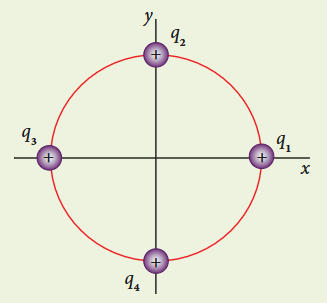
Consider four equal charges \(q_{1}, q_{2}, q_{3}\) and \(q_{4} = q = +1 \mu \mathrm{C}\) located at four different points on a circle of radius \(1 \mathrm{~m}\), as shown in the figure. Calculate the total force acting on the charge \(q_{1}\) due to all the other charges.
Solution
According to the superposition principle, the total electrostatic force on charge \(q_{1}\) is the vector sum of the forces due to the other charges,
$$ \bar{F}_{1}^{\mathrm{tot}} = \bar{F}_{12} + \bar{F}_{13} + \bar{F}_{14} $$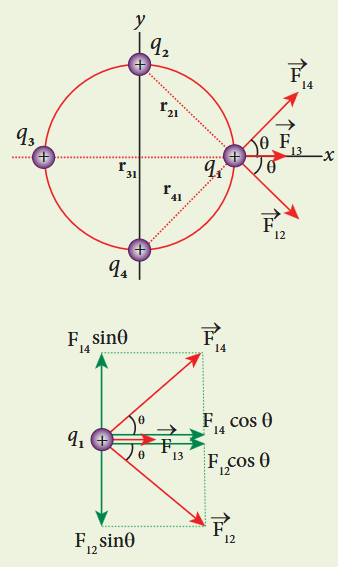
The charges \(q_{2}\) and \(q_{4}\) are equidistant from \(q_{1}\). As a result the strengths (magnitude) of the forces \(\bar{F}_{12}\) and \(\bar{F}_{14}\) are the same even though their directions are different. Therefore the vectors representing these two forces are drawn with equal lengths. But the charge \(q_{3}\) is located farther compared to \(q_{2}\) and \(q_{4}\). Since the strength of the electrostatic force decreases as distance increases, the strength of the force \(\bar{F}_{13}\) is lesser than that of forces \(\bar{F}_{12}\) and \(\bar{F}_{14}\). Hence the vector representing the force \(\bar{F}_{13}\) is drawn with smaller length compared to that for forces \(\bar{F}_{12}\) and \(\bar{F}_{14}\).
From the figure, \(r_{21} = \sqrt{2} \mathrm{~m} = r_{41}\) and \(r_{31} = 2 \mathrm{~m}\)
The magnitudes of the forces are given by
$$ F_{13} = \frac{kq^2}{r_{31}^2} = \frac{9\times 10^9\times 10^{-12}}{4} $$$$ F_{13} = 2.25\times 10^{-3}\mathrm{N} $$$$ F_{12} = \frac{kq^2}{r_{21}^2} = F_{14} = \frac{9\times 10^9\times 10^{-12}}{2} $$$$ = 4.5\times 10^{-3}\mathrm{N} $$From the figure, the angle \(\theta = 45^{\circ}\). In terms of the components, we have
$$ \bar{F}_{12} = F_{12}\cos \theta \hat{i} - F_{12}\sin \theta \hat{j} $$$$ = 4.5\times 10^{-3}\times \frac{1}{\sqrt{2}}\hat{i} - 4.5\times 10^{-3}\times \frac{1}{\sqrt{2}}\hat{j} $$$$ \bar{F}_{13} = F_{13}\hat{i} = 2.25\times 10^{-3}\mathrm{N}\hat{i} $$$$ \bar{F}_{14} = F_{14}\cos \theta \hat{i} + F_{14}\sin \theta \hat{j} $$$$ = 4.5\times 10^{-3}\times \frac{1}{\sqrt{2}}\hat{i} + 4.5\times 10^{-3}\times \frac{1}{\sqrt{2}}\hat{j} $$Then the total force on \(q_{1}\) is
$$ \bar{F}_{1}^{tot} = \left(F_{12}\cos \theta \hat{i} - F_{12}\sin \theta \hat{j}\right) + F_{13}\hat{i} + \left(F_{14}\cos \theta \hat{i} + F_{14}\sin \theta \hat{j}\right) $$$$ \bar{F}_{1}^{tot} = \left(F_{12}\cos \theta + F_{13} + F_{14}\cos \theta\right)\hat{i} + \left(-F_{12}\sin \theta + F_{14}\sin \theta\right)\hat{j} $$Since \(F_{12} = F_{14}\), the \(j^{\mathrm{th}}\) component is zero. Hence we have
$$ \bar{F}_{1}^{tot} = \left(F_{12}\cos \theta + F_{13} + F_{14}\cos \theta\right)\hat{i} $$substituting the values in the above equation,
$$ = \left(\frac{4.5}{\sqrt{2}} + 2.25 + \frac{4.5}{\sqrt{2}}\right)\times 10^{-3}\hat{i} $$$$ = \left(4.5\sqrt{2} + 2.25\right)\times 10^{-3}\hat{i} $$$$ \bar{F}_{1}^{tot} = 8.61\times 10^{-3}\hat{i}\mathrm{~N} $$The resultant force is along the positive \(x\) axis.